
Germany Career Roadmap From Qualification to Employment
“I have a degree or diploma from India. How can I turn it into a successful, long-term career in Germany?” Every day at Europe Careers, we meet qualified Indian professionals — dedicated nurses, talented software developers, experienced civil and electrical engineers, healthcare technicians, and ambitious skilled trades workers — asking this exact question.
Building a professional career in Germany from India is entirely achievable, but it is not an overnight flight or a casual application process. Germany possesses Europe’s largest economy and operates one of the most organized, qualification-driven, and legally structured employment markets in the world. Moving from an Indian graduation hall or hospital ward to a permanent German employment contract involves a defined sequence of practical stages: credential evaluation, intensive German language learning, official document legalization, professional qualification recognition (Anerkennung), targeted employer matching, consular visa approval, and post-arrival settlement.
The most successful candidates are not those who search for shortcuts or believe in exaggerated promises. They are the professionals who understand the complete roadmap, prepare methodically, respect German regulatory standards, and complete each stage with patience and precision. In this comprehensive 2026 guide, written from the direct experience of Europe Careers counsellors and international recruitment specialists, we walk you step by step through the complete Germany career roadmap — explaining what happens at each stage, what you can control, what takes time, and how you can turn your Indian qualification into a fulfilling professional life in Germany.
What Is the Germany Career Roadmap? The 14 Key Stages
The Germany career journey is best understood as a structured progression where each step forms the essential foundation for the next. Attempting to skip steps — such as applying for jobs before learning German or applying for a visa without credential verification — inevitably leads to wasted time and rejected applications.
Here is an executive overview of the complete 14-stage pathway:
| Stage | Core Action | Primary Objective | Key Outcome |
|---|---|---|---|
| Stage 1 | Qualification Check | Verify institutional accreditation and degree type. | Confirmation of German comparability eligibility. |
| Stage 2 | Profile Assessment | Evaluate experience, language baseline, and goals. | Clear, customized career migration plan. |
| Stage 3 | German Language Training | Achieve certified language milestones (A1 to B2). | Official Goethe / telc / ÖSD certificate. |
| Stage 4 | Document Legalization | Apostille degree, transcripts, and syllabus. | Legalized, certified German translations. |
| Stage 5 | Professional Recognition | Submit dossier to German state licensing body. | Official Anerkennungsbescheid or Defizitbescheid. |
| Stage 6 | German Application Profile | Format CV and portfolio to German standards. | Professional Tabellarischer Lebenslauf. |
| Stage 7 | Employer Matching | Target suitable hospitals, firms, or Mittelstand. | Confirmed job interview invitations. |
| Stage 8 | Job Interview | Complete technical and communicative interviews. | Formal hiring selection by German employer. |
| Stage 9 | Contract Review | Examine salary, tariff terms, hours, and probation. | Signed binding German employment contract. |
| Stage 10 | Visa & Immigration | Apply for national employment visa in India. | German National Visa (§§ 18a, 18b, 18g, 16d). |
| Stage 11 | Pre-Departure Prep | Book travel, arrange stay, secure insurance. | Smooth departure readiness from India. |
| Stage 12 | Arrival Administration | Complete city registration, tax ID, and banking. | Official Meldebestätigung and health card. |
| Stage 13 | Workplace Joining | Complete workplace orientation and probation. | Successful integration into German team. |
| Stage 14 | Career Development | Pursue specializations and permanent settlement. | Long-term career growth & Niederlassungserlaubnis. |
Step 1: Check Your Indian Qualification
Every career journey begins with an honest audit of your educational credentials. Germany values formal vocational and academic qualifications highly, but the path depends on whether your field is legally regulated or non-regulated:
- Institutional Accreditation: Your Indian university or college must be recognized by statutory bodies such as UGC, AICTE, or the Indian Nursing Council (INC). For academic degrees, you can verify whether your institution holds an H+ status on the official German Anabin database.
- Degree Comparability: Bachelor’s and Master’s degrees from accredited Indian universities are generally comparable to German higher education degrees. In non-regulated fields like computer science or business administration, formal equivalence is verified through Anabin or an individual Statement of Comparability from the Central Office for Foreign Education (ZAB).
- Regulated Professional Training: In regulated fields — including nursing (B.Sc. Nursing, GNM), medicine (MBBS), physiotherapy, and school teaching — you cannot practice without state authorization. Your Indian syllabus, practical clinical hours, and state nursing council registration will undergo detailed scrutiny by the responsible German state licensing authority.
Step 2: Complete a Realistic Profile Assessment
Before spending money on translations or visa forms, you need a holistic assessment of your profile. A strong profile for Germany is not just about marks on a degree certificate; it combines academic rigor, hands-on experience, language aptitude, and personal readiness.
At Europe Careers, our counsellors assess candidate readiness across six essential criteria:
- Years of Documented Experience: How many years of verified, post-qualification practical experience do you possess in your field?
- Current Language Baseline: Have you already studied German, or are you starting from zero? What is your realistic weekly study commitment?
- Shortage Alignment: Does your specialization fall under Germany’s official bottleneck occupations (Engpassberufe)? Learn more in our detailed analysis of Fachkräftemangel in Germany.
- Document Completeness: Do you have original grade cards, degree certificates, internship logs, and clinical hours breakdowns?
- Financial and Relocation Mindset: Are you prepared for European winter climates, independent living, progressive tax deductions, and German workplace culture?
Step 3: Master the German Language (A1 to B2)
There is no factor more decisive for your career success in Germany than the German language. While English may be spoken in some Berlin tech startups, over 90% of German employers — including public hospitals, municipal clinics, and medium-sized industrial manufacturers (the Mittelstand) — conduct daily operations exclusively in German.
Language learning follows the standardized CEFR progression:
- A1 (Beginner): Basic greetings, numbers, introducing yourself, and understanding simple directions. (Typically 6 to 8 weeks of intensive study).
- A2 (Elementary): Routine workplace schedules, basic tool requests, and simple small talk with colleagues. (Typically 8 to 10 weeks).
- B1 (Intermediate): Operational independence. Explaining equipment issues, handling phone calls, writing routine emails, and following team meetings. For a detailed breakdown, read our guide on What B1 German Actually Means at Work. (Typically 10 to 14 weeks).
- B2 (Upper Intermediate): Full professional autonomy. Complex technical discussions, shift handovers, patient care, and incident documentation. Essential for registered nurses and healthcare licensing. For a full comparison, explore German Language Levels Explained Through Real Workplace Situations. (Typically 12 to 16 weeks).
Step 4: Prepare and Legalize Your Document Dossier
German administrative authorities and employers require complete, verified, and certified documentation. Preparing your dossier early prevents multi-month processing delays later in your journey.
A standard document dossier for Germany includes:
- Valid Indian Passport (with at least 18 months validity remaining).
- Degree or Diploma Certificates (Originals).
- Consolidated and Semester-Wise Mark Sheets.
- Transcript of Records and Detailed Curriculum / Syllabus Breakdown (vital for healthcare and engineering recognition).
- Professional Registration Certificates (e.g., State Nursing Council, Medical Council of India / NMC).
- Detailed Work Experience Certificates on official company/hospital letterhead, specifying hours worked, clinical rotations, and technical responsibilities.
- Apostille Legalization by the Ministry of External Affairs (MEA), Government of India.
- Certified German Translations prepared by sworn court translators (Beeidigte Übersetzer).
Step 5: Professional Recognition (Anerkennung)
Anerkennung is the official assessment of your foreign professional qualification against a corresponding German reference profession (Deutscher Referenzberuf). In Germany, recognition is governed by the Federal Recognition Act (Anerkennungsgesetz) and state-specific laws.
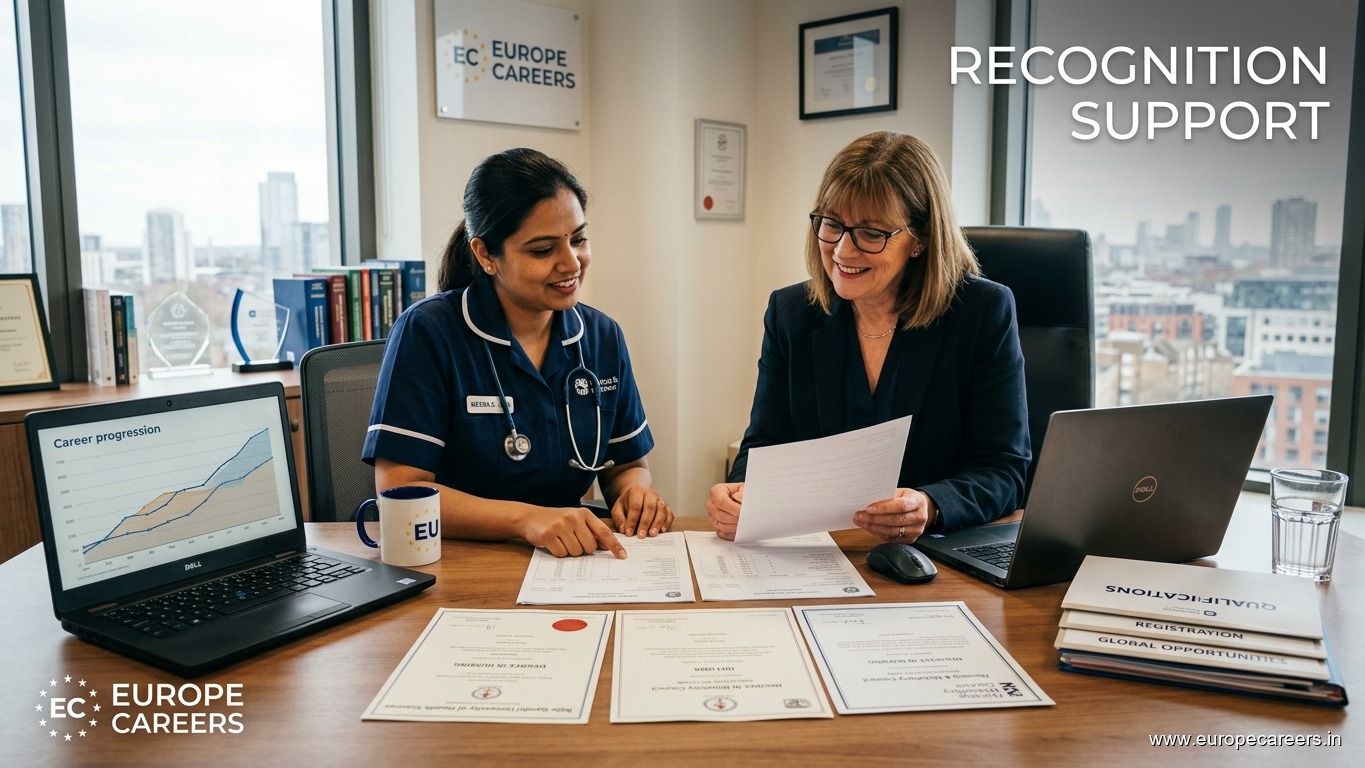
When your dossier is evaluated by the competent authority (Zuständige Stelle), the process yields one of three possible outcomes:
- Full Equivalence (Volle Anerkennung): The authority issues an Anerkennungsbescheid confirming that your Indian qualification is completely equivalent to the German reference qualification.
- Partial Recognition with Deficits (Teilweise Anerkennung): The authority identifies curriculum gaps between Indian and German training (such as specific geriatric, pediatric, or theoretical hours) and issues an official Defizitbescheid. This is not a rejection — it is an official roadmap specifying the compensation measures required (an adaptation course / Anpassungslehrgang or knowledge test / Kenntnisprüfung) to achieve full recognition.
- No Equivalence: The qualification is not recognized. (Rare for accredited university degrees, but can occur if an institution is unaccredited).
Step 6: Build Your German Application Profile
A standard Indian resume will not work in Germany. German human resources managers expect applications formatted strictly according to European and German conventions:
- The Tabular Resume (Tabellarischer Lebenslauf): A clean, reverse-chronological CV (typically 1 to 2 pages). It features precise dates, educational qualifications, clinical or technical duties, certified language levels, IT skills, and personal contact details without biographical fluff.
- The Cover Letter (Anschreiben): A structured one-page letter explaining why you are applying to this specific company or hospital, how your professional background matches their requirements, and why you wish to relocate to their region.
- The Application Dossier (Bewerbungsmappe): A compiled, high-resolution PDF containing your cover letter, CV, degree certificates, recognition decision, language certificates, and verified reference letters.
Step 7: Search for Suitable Employers Across Germany
Many international candidates make the mistake of applying only to famous companies in massive metropolitan centers like Berlin, Munich, or Frankfurt. Because thousands of global applicants target these cities, competition is fierce, and rental housing is notoriously difficult to secure.
A much more effective strategy is targeting the backbone of the German economy: the German Mittelstand and regional hospital networks. Medium-sized industrial manufacturers, municipal clinics, and care groups across Bavaria, Baden-Württemberg, Lower Saxony, and North Rhine-Westphalia face intense labor shortages. These employers often offer superior long-term job security, dedicated onboarding support, assistance with initial housing, and welcoming community environments. For deeper insights, see our analysis on Why German Employers Recruit Skilled Professionals from Abroad.
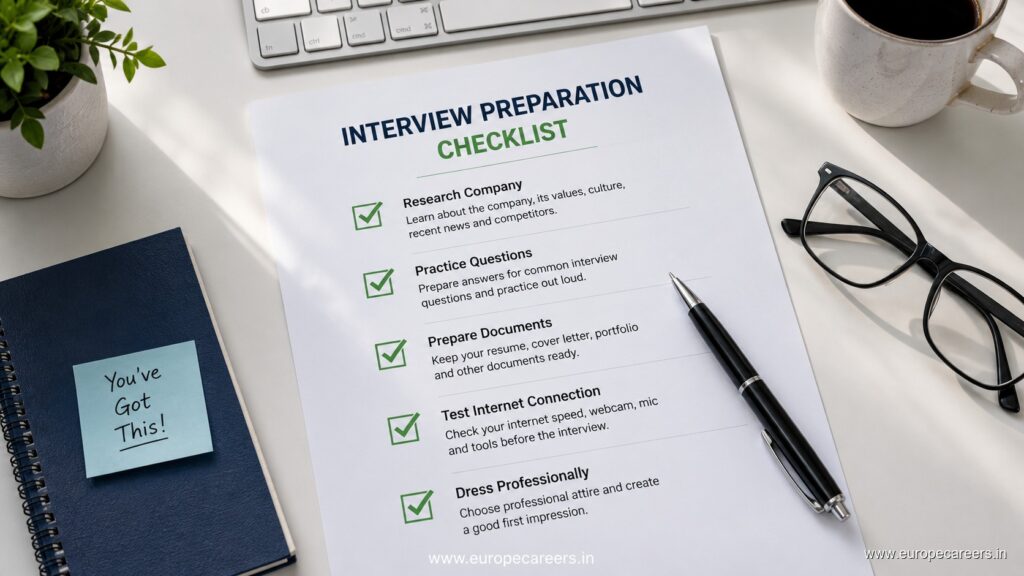
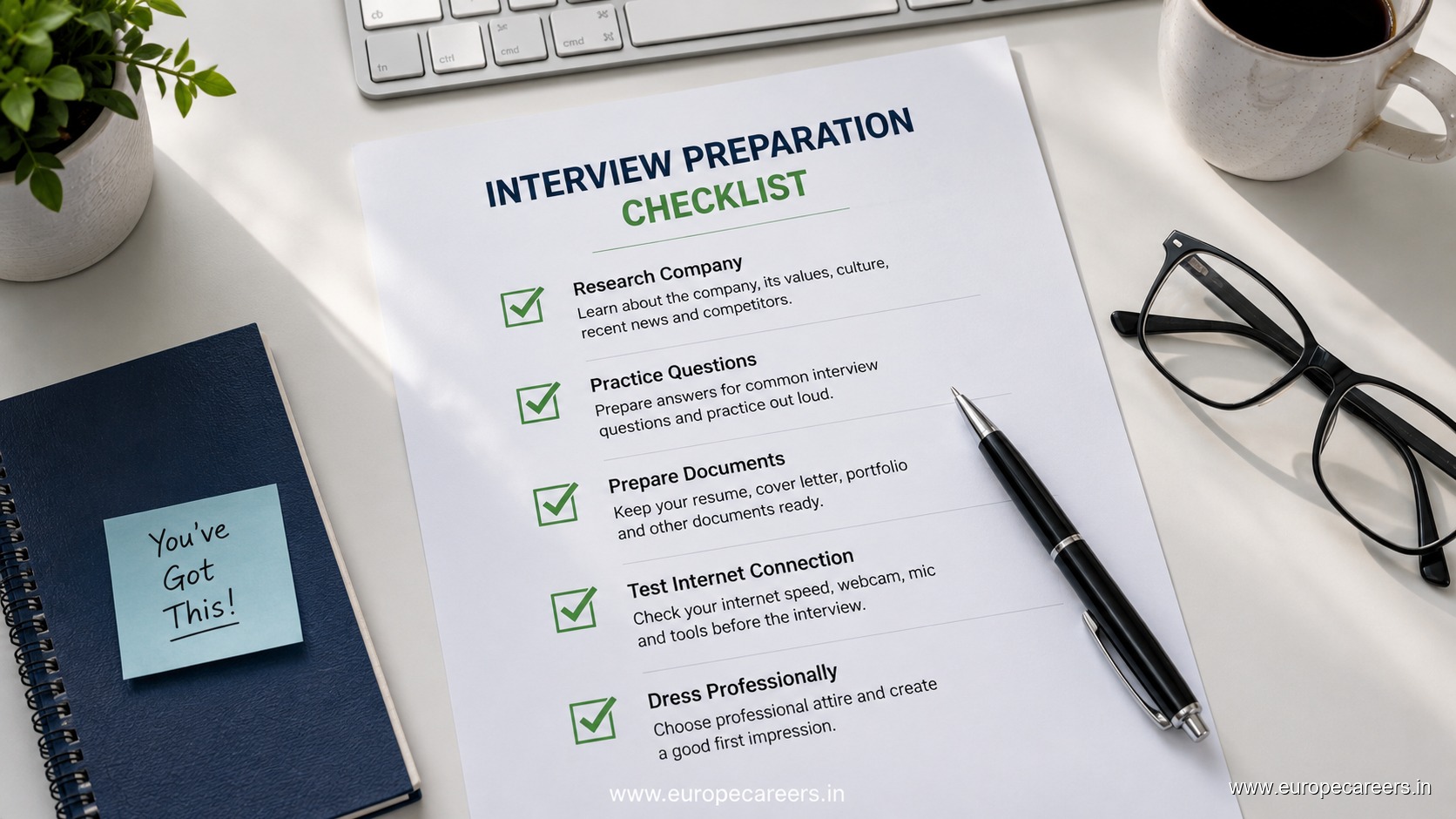
Step 8: Prepare for the Professional Interview
Interviews with German employers (usually conducted via video conference on Microsoft Teams or Zoom) follow a structured, professional format. German managers value honesty, precision, punctuality, and factual clarity (Sachlichkeit):
- Punctuality (Pünktlichkeit): Log into the interview link 3 to 5 minutes early. In Germany, being five minutes late without prior notice leaves an immediate negative impression.
- Professional Self-Introduction: Be ready to summarize your career journey, technical skills, and clinical background in clear German or English (depending on the agreed interview language).
- Scenario-Based Questions: Expect practical questions such as: “How would you handle a patient experiencing sudden shortness of breath?” or “How do you troubleshoot an unexpected voltage fault on a circuit board?”
- Cultural Motivation: Employers want to know why you chose Germany, how you are preparing for language learning, and whether you are emotionally ready for long-term relocation.
Step 9: Understand Your German Employment Contract
Receiving an employment offer is a major triumph. Before signing, examine the contract terms carefully to ensure they meet German labor law standards and visa criteria:
- Gross Salary (Bruttogehalt): German contracts state gross annual or monthly salary. In public healthcare, salaries follow collective bargaining tariffs (such as TVöD Pflege). Learn how taxes and social security deductions affect your take-home pay in our Germany Salary Slip Explained Guide.
- Working Hours: Standard full-time employment is typically 38.5 to 40 hours per week. Shift allowances (night shifts, weekend work, public holidays) should be clearly defined.
- Probation Period (Probezeit): Standard German contracts include a statutory probation period of up to 6 months. During Probezeit, either party can terminate the contract with two weeks’ notice.
- Annual Paid Vacation (Urlaub): German law mandates a minimum of 20 days vacation for a 5-day work week, though most professional contracts provide 28 to 30 paid days off per year.
Step 10: Complete the Immigration and Visa Process
With a signed employment contract and your recognition notice, you are ready to apply for your national long-term employment visa (Category D) through the German Embassy or Consulates in India (via VFS Global). Common visa pathways under the updated Skilled Immigration Act include:
- EU Blue Card (§ 18g AufenthG): For academics and specialists with recognized university degrees and job offers meeting statutory gross annual salary thresholds (€45,300 gross in 2026 for bottleneck professions).
- Skilled Worker with Academic Degree (§ 18b AufenthG) / Vocational Training (§ 18a AufenthG): For professionals with fully recognized degrees or dual vocational qualifications.
- Recognition Visa (§ 16d AufenthG): For nurses and healthcare workers holding a Defizitbescheid who enter Germany to complete adaptation training while employed.
- Fast-Track Procedure for Skilled Workers (§ 81a AufenthG): Your German employer applies directly to the local Foreigners’ Authority (Ausländerbehörde) for preliminary approval (Vorabzustimmung), significantly shortening consular waiting times in India.
Step 11: Prepare for Germany Before Departure
Once your visa is stamped in your passport, pre-departure preparation begins in earnest:
- Flight and Travel Arrangements: Book your flights to arrive 5 to 7 days before your contract start date to allow initial orientation.
- Temporary Accommodation: Secure verified initial housing (employer staff apartments, boarding houses, or temporary rentals) where address registration (Anmeldung) is explicitly permitted.
- Health Insurance: Transition from incoming travel insurance to statutory German health insurance (Gesetzliche Krankenversicherung — GKV). Learn how this works in our German Health Insurance Beginner’s Guide.
- Personal Budget: Prepare sufficient funds in Euros (via a forex card and cash) to cover your initial security deposit (Kaution), food, and transport until your first salary arrives.
Step 12: Arrive in Germany and Complete Initial Administrative Steps
Your first two weeks in Germany involve essential civic and administrative registrations. For a detailed checklist, read our comprehensive guide on the First 30 Days in Germany for New International Workers.
- City Address Registration (Anmeldung): Visit the local citizens’ office (Bürgeramt / Einwohnermeldeamt) within 14 days of arrival with your passport and landlord confirmation (Wohnungsgeberbestätigung). This generates your official registration certificate (Meldebestätigung).
- Tax Identification Number (Steuer-ID): Automatically generated and posted to your registered address by the Federal Central Tax Office (BZSt).
- German Bank Account (Girokonto): Open a standard checking account (Girokonto) with a local Sparkasse, VR-Bank, or licensed online bank to receive your monthly salary.
- Social Security Number (Sozialversicherungsnummer): Issued through your statutory health insurance provider and forwarded to your employer’s payroll department.
Step 13: Start Your New Job and Navigate Workplace Onboarding
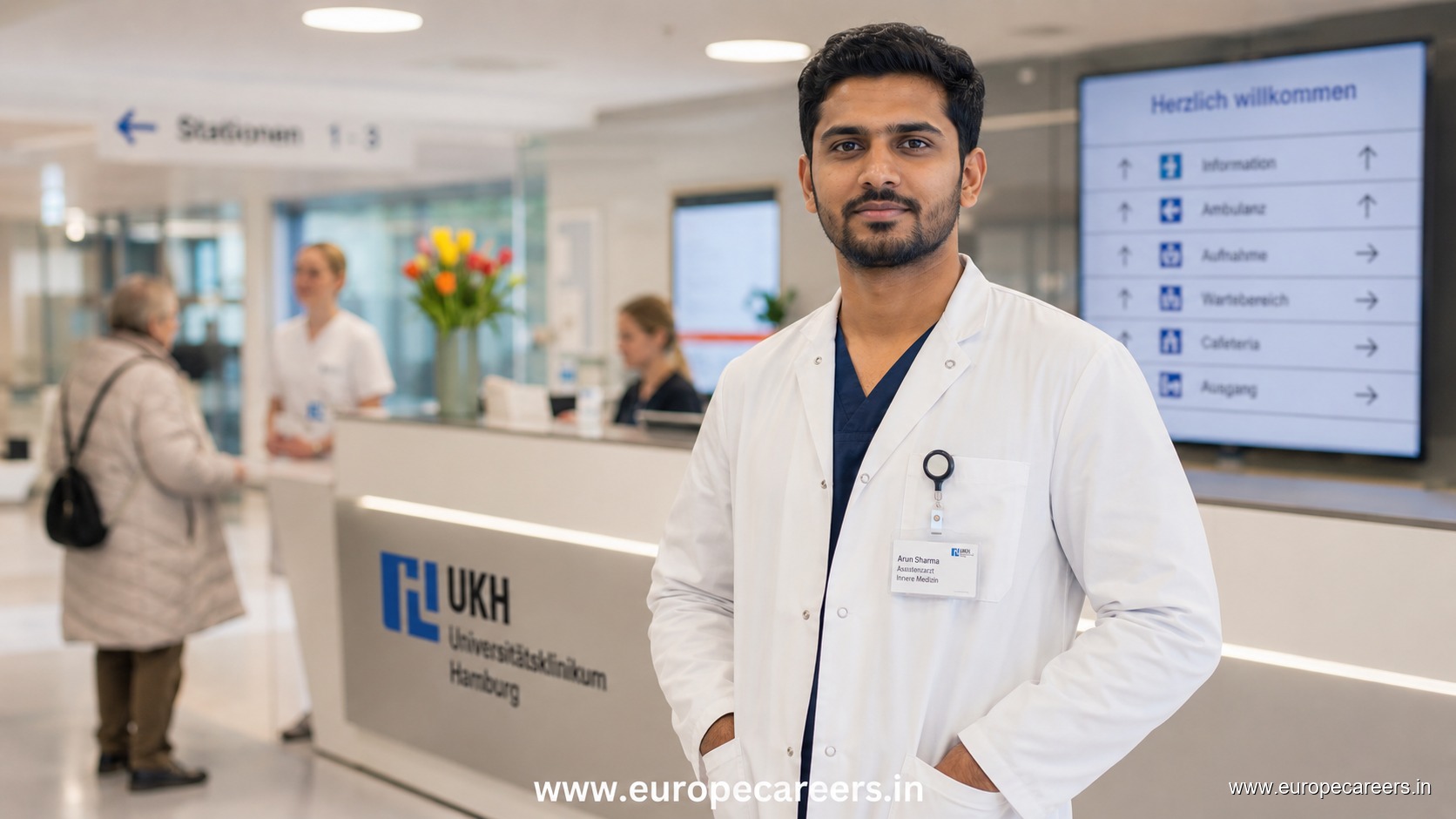
Stepping onto the hospital ward or factory floor is a proud milestone. German workplace culture is founded on transparency, structure, and respect:
- Workplace Mentor (Paten-System): Many German employers assign a dedicated senior colleague (Pate / Mentor) to guide international recruits through internal workflows, IT systems, and daily routines during their first months.
- Workplace Communication: German communication is direct, polite, and fact-focused (Sachlichkeit). Direct feedback is intended to improve processes, not as a personal insult. Learn more in our guide on German Workplace Culture for Indian Professionals.
- Safety and Quality Standards: Strict adherence to workplace safety regulations (Arbeitsschutz) and accurate documentation is mandatory in every German organization.
- Work-Life Balance (Feierabend): When your shift ends, work ceases. German culture respects personal rest, family time, and weekend recovery.
Step 14: Build Your Long-Term Career and Settlement
Securing your first job is just the beginning of your European journey. Germany offers extraordinary pathways for lifelong personal and professional growth:
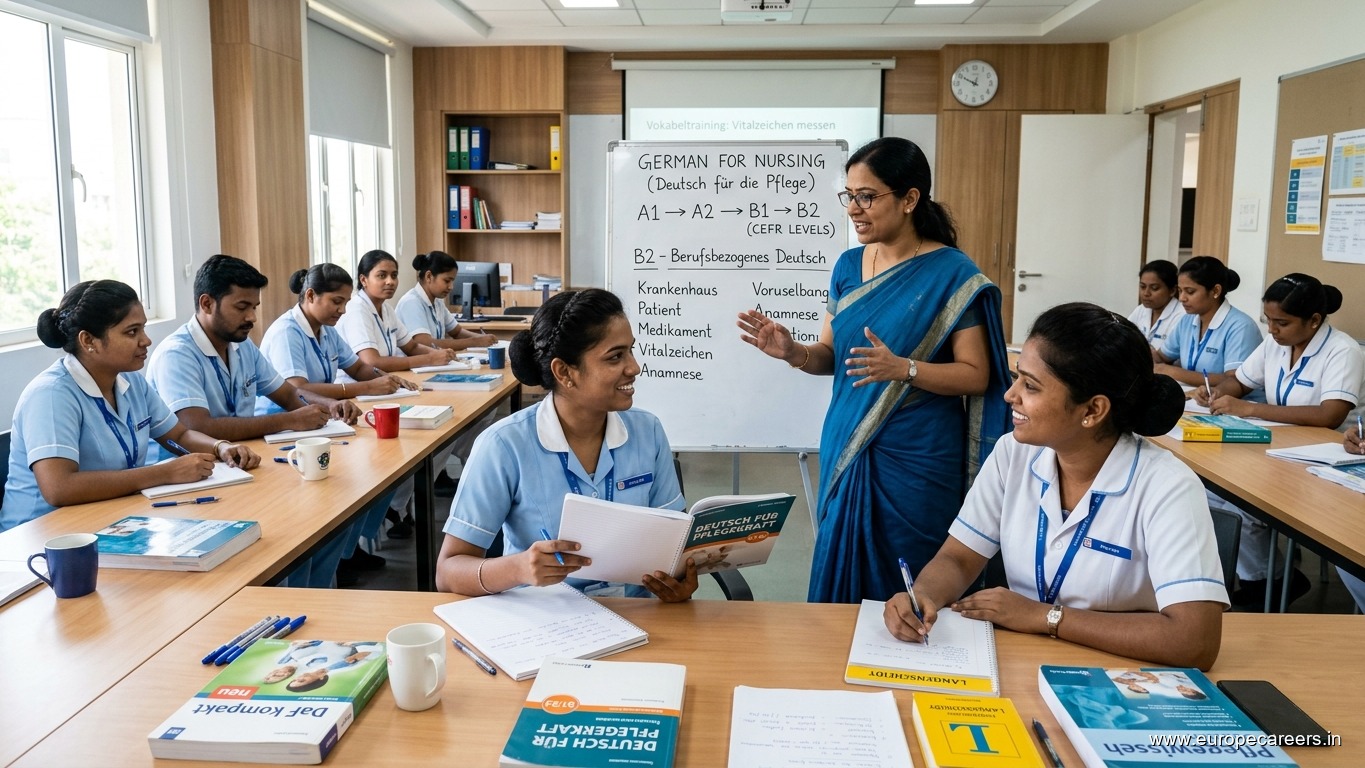
- Specialized Continuing Education (Weiterbildung): In healthcare, nurses can specialize in intensive care (Anästhesie- und Intensivpflege), surgical theater (OTA), or ward management (Stationsleitung), significantly increasing salary bands. Engineers and IT specialists can earn project management and architecture certifications.
- Permanent Settlement (Niederlassungserlaubnis): Qualified workers can apply for permanent residency after 3 years of employment (or just 21 to 27 months for EU Blue Card holders with German language skills).
- Family Reunification (Familienzusammenführung): You have the legal right to bring your spouse and minor children to live with you in Germany. Learn the complete rules in our Family Reunification Guide.
- German Citizenship (Einbürgerung): Under modernized naturalization laws, qualified international workers can apply for German citizenship and hold dual nationality after 5 years (or 3 years with exceptional integration and C1 German).
Profession-Specific Roadmaps: Nurses, Doctors, Engineers, and Trades
Because German law treats different professions differently, here are specific roadmap highlights for key fields:
1. Germany Career Roadmap for Indian Nurses
Indian nurses (holding B.Sc. Nursing or GNM) follow a structured recognition path: B1 German in India → Document dossier → Defizitbescheid → Employer matching with hospital → Visa § 16d → Arrival in Germany as assistant nurse → Adaptation training → B2 exam clearance → Permanent state license (Berufserlaubnis) → Full Registered Nurse salary (TVöD P7/P8). Compare qualifications in our GNM vs. B.Sc. Nursing in Germany Guide.
2. Germany Career Roadmap for Indian Doctors
Indian doctors (MBBS) require: B2 General German → Credential dossier submission to State Medical Chamber → Clearing the Medical Language Exam (Fachsprachenprüfung — FSP at C1) → Temporary practice permit (Berufserlaubnis) → Knowledge test (Kenntnisprüfung) for permanent Approbation → Residency training as Assistenzarzt leading to specialist status (Facharzt).
3. Germany Career Roadmap for Engineers and IT Specialists
Non-regulated university fields follow a market-driven path: Degree comparability check on Anabin/ZAB → B1/B2 German training → German-format CV → Direct technical interviews → Employment contract → EU Blue Card (§ 18g AufenthG) visa application → Direct employment start in German enterprise.
4. Germany Career Roadmap for Skilled Trades (Handwerk)
Electricians, industrial mechanics, and HVAC technicians follow: Vocational training equivalence (IHK FOSA / Chamber of Crafts HWK) → B1 certified German → Technical interview → Skilled Worker Visa (§ 18a AufenthG) → On-site team integration under a Master Craftsman (Handwerksmeister).
How Long Does the Journey Take? What You Can and Cannot Control
A realistic timeline for the Germany career journey from India is typically 8 to 14 months. Candidates who promise themselves a 60-day migration inevitably experience disappointment because international relocation involves independent government authorities.
To maintain psychological resilience, distinguish clearly between what you control and what you do not:
| What You Can Control (Focus Your Energy Here) | What You Cannot Control (Exercise Patience) |
|---|---|
| Daily German language study hours and consistency. | German state authority recognition processing backlogs. |
| Gathering complete, authentic academic transcripts. | VFS consular visa appointment calendar availability. |
| Accuracy and quality of certified document translations. | Employer interview scheduling and internal hiring boards. |
| Interview preparation, technical research, and punctuality. | Federal Employment Agency (ZAV) labor market review times. |
| Personal financial budgeting and emotional readiness. | German rental market tightness in major cities. |
How Europe Careers Supports Your Germany Journey
Navigating dozens of state authorities, language examinations, legal verification requirements, and employment contracts can be overwhelming when attempted alone. At Europe Careers, we serve as an experienced, ethical bridge connecting Indian professionals with reputable German employers.
Depending on the programme and service agreement, Europe Careers supports candidates through:
- Transparent Profile Evaluations: Honest feasibility checks of your qualification, degree status, and career viability before you invest time and resources.
- Structured German Language Coaching: Result-oriented A1 to B2 German courses delivered by experienced instructors, featuring clinical nursing modules and technical terminology.
- Dossier Management: Guidance on apostilles, syllabus documentation, and sworn German translations.
- State Recognition Support: Submitting dossiers to the responsible German recognition bodies and guiding you through Defizitbescheid roadmaps.
- Direct Employer Matching: Connecting you with vetted German hospital networks, municipal healthcare providers, and industrial Mittelstand firms offering fair tariff wages.
- Interview & Contract Coaching: Conducting mock video interviews and helping you understand your contract terms.
- Fast-Track Visa Coordination: Working with German employers to file preliminary fast-track applications (§ 81a AufenthG) with local immigration authorities.
- Pre-Departure & Arrival Guidance: Briefing you on initial housing, health insurance, city registration, and cultural onboarding in Germany.
Important Note: Europe Careers provides professional guidance, training, and recruitment coordination. Official recognition decisions are made exclusively by German state authorities, and visa decisions remain the sovereign authority of the German Embassy and Consulates in India.
The Complete Germany Career Candidate Checklist
Use this 14-point checklist to track your milestone progression from India to Germany:
- ☑ 1. Qualification Verified: Degree or diploma confirmed from an accredited Indian institution with H+ status on Anabin.
- ☑ 2. Passport Ready: Indian passport valid for at least 18 months with blank visa pages.
- ☑ 3. Transcripts Gathered: Consolidated mark sheets, degree certificates, and detailed syllabus breakdown collected.
- ☑ 4. Experience Documented: Experience certificates on official letterhead with clear task breakdowns.
- ☑ 5. German Language Enrolled: Active daily study progressing through A1, A2, B1, and B2.
- ☑ 6. MEA Apostille Completed: Original educational certificates legalized by the Ministry of External Affairs.
- ☑ 7. Certified Translations Done: Dossier translated into German by a certified/sworn translator.
- ☑ 8. Recognition Dossier Submitted: Application filed with the responsible German state licensing authority.
- ☑ 9. German Resume Formatted: Professional Tabellarischer Lebenslauf and portfolio compiled.
- ☑ 10. Employer Interviews Completed: Technical and communicative video interviews cleared.
- ☑ 11. Contract Reviewed & Signed: Fair tariff wages, working hours, and probation terms confirmed.
- ☑ 12. National Visa Approved: Category D employment or recognition visa stamped in passport.
- ☑ 13. Pre-Departure Finalized: Flight booked, initial stay confirmed, statutory health insurance selected.
- ☑ 14. Arrival Registrations Done: City registration (Anmeldung), bank account, and tax ID secured.
Common Mistakes Indian Professionals Should Avoid
Avoid these common missteps to ensure a smooth, successful journey:
- Postponing German Language Study: Waiting until you get a job offer before starting German. In healthcare and skilled trades, employers will not interview candidates without verified language certificates.
- Submitting Incomplete Transcripts: Sending degree certificates without semester mark sheets or clinical hour breakdowns, resulting in multi-month evaluation freezes by German authorities.
- Trusting Unverified Agents: Paying money to agents who promise “guaranteed visas” or “jobs without German language.” Legitimate recruitment requires real qualifications and transparent legal procedures.
- Targeting Only Major Metros: Applying exclusively in Berlin or Munich and ignoring the wealthy, high-demand industrial Mittelstand and regional hospital networks where housing and career progression are far superior.
- Leaving Housing Planning to the Last Minute: Arriving in Germany without confirmed accommodation where address registration (Anmeldung) is permitted.
Frequently Asked Questions (FAQs): Germany Career Roadmap
1. What is the Germany Career Roadmap?
The Germany Career Roadmap is the step-by-step pathway that an international professional follows — from verifying their Indian qualification, learning German, legalizing documents, and obtaining professional recognition to securing an employment contract, obtaining a visa, and relocating to Germany.
2. Can Indian professionals work in Germany?
Yes. Germany’s updated Skilled Immigration Act (Fachkräfteeinwanderungsgesetz) provides clear legal immigration pathways for qualified Indian nurses, doctors, engineers, IT specialists, and vocational trades professionals holding recognized qualifications.
3. Do all Indian degrees need formal recognition (Anerkennung)?
No. Regulated professions (nursing, medicine, teaching, structural engineering) legally require formal state recognition. Non-regulated fields (IT, software development, business administration) usually require only proof that their university degree is comparable to a German degree via the Anabin database or ZAB Statement of Comparability.
4. Is German language mandatory to work in Germany?
For healthcare (nursing, doctors) and skilled trades, certified German is mandatory by law and workplace safety. In international IT companies, English is often the primary working language, but learning German remains vital for long-term integration, career growth, and permanent residency.
5. Which German language level should I target?
Nurses must target B1 to enter and B2 for full registered licensing. Doctors require B2 General plus C1 Medical German (FSP). Engineers and skilled trades workers should target B1 minimum, progressing to B2 on the job.
6. What is a Defizitbescheid?
A Defizitbescheid is an official assessment notice from a German state recognition authority identifying specific curriculum gaps between your foreign training and the German reference profession. It outlines the adaptation course or knowledge test required to gain full recognition.
7. What is an adaptation course (Anpassungslehrgang)?
An adaptation course is a period of supervised practical work and theoretical training at a German hospital or training facility designed to bridge the deficits identified in your Defizitbescheid, leading directly to full professional recognition.
8. How do Indian candidates find German employers?
Candidates can apply directly through German job boards (StepStone, LinkedIn, BA Jobbörse) or partner with reputable, specialized recruitment agencies like Europe Careers, which coordinates directly with vetted German hospital groups and engineering firms.
9. What is the fast-track procedure for skilled workers (§ 81a AufenthG)?
Under § 81a, a German employer applies to the local Foreigners’ Authority on your behalf. The authority coordinates credential recognition and labor approval, issuing a preliminary approval that shortens consular visa waiting times in India to a few weeks.
10. What is an EU Blue Card?
The EU Blue Card (§ 18g AufenthG) is a premium residence permit for highly qualified university graduates holding an employment contract meeting statutory gross salary thresholds. It offers simplified family reunification and fast-track permanent residency in 21 to 27 months.
11. How long does the entire roadmap take from India?
The typical journey takes between 8 and 14 months, depending on your starting German language level, document apostille timelines, state recognition processing times, and consular visa appointment availability.
12. Can GNM nurses from India work in Germany?
Yes. GNM nurses are eligible for German nursing recognition. They receive a Defizitbescheid specifying required clinical adaptation hours or a knowledge test to achieve full equivalence as a registered nurse (Pflegefachfrau / Pflegefachmann).
13. Can Indian engineers find jobs without knowing German?
Some software developers and niche engineers find positions in English-speaking tech hubs. However, over 80% of engineering jobs are in the German Mittelstand, where B1/B2 German is essential for team communication and job security.
14. Can I bring my family to Germany?
Yes. Skilled workers holding a qualified residence permit or EU Blue Card have the statutory right to bring their spouse and minor children through family reunification, provided they have adequate housing and income.
15. How much salary can I expect in Germany?
Salaries depend strictly on profession, experience, region, and collective bargaining agreements (tariffs). Registered nurses typically earn between €3,000 and €3,800 gross monthly plus shift bonuses. Engineers and IT specialists typically earn between €45,000 and €75,000+ gross annually.
16. Does Europe Careers guarantee a job or visa?
No ethical agency can guarantee a job or visa. Hiring decisions rest solely with German employers, and visa decisions are the sovereign authority of the German Embassy and Consulates. Europe Careers provides structured training, document management, employer matching, and procedural guidance.
17. When can I apply for permanent residency in Germany?
EU Blue Card holders can obtain permanent residency (Niederlassungserlaubnis) in just 21 months with B1 German (or 27 months with basic German). Standard skilled workers can apply after 3 years of statutory employment.
18. How can I start my Germany journey with Europe Careers?
You can begin by submitting your academic and professional profile for evaluation through our website at www.europecareers.in or contacting our advisory team at support@europecareers.in.
Conclusion: Turning Your Germany Career Dream into Reality
The journey from an Indian qualification to professional employment in Germany is a structured, proven pathway. It demands dedication, genuine language commitment, and patience with European administrative standards — but the rewards are extraordinary: world-class working conditions, fair tariff salaries, comprehensive social security, global career mobility, and a secure future for you and your family.
By approaching the Germany career roadmap step by step — completing one milestone thoroughly before advancing to the next — you eliminate uncertainty and place yourself among the most competitive international professionals entering the German workforce.
Planning your career in Germany from India? Partner with the international career specialists at Europe Careers. From transparent profile assessments and structured A1–B2 German language coaching to credential recognition guidance, employer matching, and relocation support, our expert team is here to guide your journey with integrity and care.
Visit our official website at www.europecareers.in or email us directly at support@europecareers.in to begin your personalized career roadmap today.