
Can You Bring Your Family to Germany After Getting a Work Visa
Receiving an employment contract and a work visa for Germany is a life-changing milestone for any Indian professional. Whether you are an experienced software engineer, a registered nurse, a doctor, or a specialized technical craftsman, moving to Europe represents years of dedicated education and career preparation. Yet, alongside the professional excitement, one paramount question almost immediately emerges: “I have secured my job in Germany—can I bring my spouse, children, or parents with me?”
At Europe Careers, our relocation counsellors and visa specialists assist Indian families daily with this deeply personal transition. For most Indian professionals, career success is intimately connected to family well-being. Leaving a spouse or young children behind in India creates emotional strain, while building a life together in Germany provides stability, happiness, and peace of mind.
The encouraging reality is that Germany has one of the most progressive and supportive family reunification frameworks in the European Union, particularly under the updated Skilled Immigration Act (Fachkräfteeinwanderungsgesetz – FEG). In many skilled employment situations, qualified foreign workers have a clear legal right to bring their nuclear family to live with them.
However, family reunification is not automatic or uniform across every visa category. A German work visa does not mean that every family member can enter under identical rules. Entitlement and procedural requirements depend on your specific residence title, your employment status, your salary, living space arrangements, and the age and relationship of your family members. This comprehensive 2026 guide explains exactly how German family reunification (Familienzusammenführung) works for Indian professionals.
Can You Bring Your Family to Germany After Getting a Work Visa?
In many skilled worker situations, the answer is yes. If you hold a valid residence title as a qualified academic or vocational specialist (such as an EU Blue Card or a skilled worker residence permit under Sections 18a, 18b, or 18g of the German Residence Act – Aufenthaltsgesetz / AufenthG), German immigration law actively facilitates bringing your spouse and minor children.
To understand the process clearly, Indian applicants must distinguish between three distinct immigration concepts:
- The Entry Visa (Category D National Visa): The initial entry sticker stamped in your passport by the German Embassy in New Delhi or the German Consulates in Mumbai, Chennai, Bengaluru, or Kolkata, allowing entry into Germany.
- The Residence Permit (Aufenthaltstitel): The biometric electronic card issued by your local German Immigration Office (Ausländerbehörde) after arrival, establishing your long-term legal status in Germany.
- The Family Reunification Visa (Visum zur Familienzusammenführung): The specific national visa category applied for by your family members in India so they can join you lawfully in Germany.
Who Can Usually Join a Worker in Germany?
Under standard German immigration law, family reunification is primarily designed to protect the constitutional core of the nuclear family. Eligible family members generally fall into distinct tiers:
| Family Member Category | Reunification Eligibility | Key Conditions & Requirements |
|---|---|---|
| Spouse (Wife or Husband) | Standard core entitlement for eligible skilled workers. | Valid legal marriage; spouse must be at least 18 years of age. Under updated skilled worker rules, basic German (A1) is generally exempt. |
| Minor Children (Under 18 Years) | Standard core entitlement for eligible skilled workers. | Must be unmarried; parents must possess legal custody. Children under 16 face streamlined requirements. |
| Parents & Parents-in-Law | Special conditional pathway under updated Skilled Immigration Act. | Applicable if the skilled worker received their qualifying residence permit for the first time on or after 1 March 2024, and livelihood is fully secured. |
| Adult Children (18+ Years) & Siblings | Strictly restricted / exceptional hardship only. | Adult children and siblings cannot join under standard family reunification; they require independent work, study, or training visas. |
Can Your Spouse Join You in Germany?
Yes. If you hold a qualifying residence permit as a skilled worker or an EU Blue Card, your legally married spouse can apply for a family reunification visa to join you.
To qualify, the following core criteria must be satisfied:
- Valid, Recognized Marriage: The marriage must be legally valid under Indian law and formally registered. The marriage certificate must be apostilled by the Ministry of External Affairs (MEA) in India and translated into German by a sworn court translator.
- Minimum Age: Both you and your spouse must be at least 18 years of age at the time of the visa application.
- Secured Livelihood: Your household income must be sufficient to support both of you without relying on German public welfare benefits (Bürgergeld).
- Adequate Health Insurance: Your spouse must have comprehensive health insurance coverage in Germany.
Can Your Spouse Work in Germany? Unrestricted Employment Rights
One of the most attractive aspects of German immigration policy is that spouses entering Germany under family reunification have unrestricted access to the German labour market.
Under Section 27 Paragraph 5 of the German Residence Act, once your spouse receives their electronic residence permit for family reunification (Aufenthaltserlaubnis zur Familienzusammenführung), their card will explicitly state: “Erwerbstätigkeit erlaubt” (Gainful employment permitted). This confers full legal rights to:
- Take up full-time or part-time employment with any German employer without needing a separate labour market priority test (Vorrangprüfung).
- Work in professional corporate roles, healthcare, retail, hospitality, or academia.
- Pursue self-employment or launch a freelance business (Freiberufler / Gewerbe).
- Take up vocational training (Ausbildung) or enrol in German university degree programs.
Your spouse does not need to secure a job offer before travelling to Germany; they can search for employment freely after arriving and settling in.
Does My Spouse Need A1 German Language Skills?
This is perhaps the most widely misunderstood topic among Indian applicants. Under traditional German immigration regulations, spouses joining foreign residents historically had to present a Goethe-Zertifikat A1 certificate before entering Germany.
However, under current official regulations and the updated Skilled Immigration Act: spouses joining qualified skilled workers are generally EXEMPT from proving German language proficiency prior to entering Germany.
When Is Your Spouse Exempt from the A1 German Requirement?
- You hold an EU Blue Card (Section 18g AufenthG): Complete statutory exemption from pre-entry language proof.
- You hold a Skilled Worker Residence Permit (Sections 18a or 18b AufenthG): Exemption applies under updated skilled worker provisions.
- You hold a residence permit as a researcher, scientist, or executive: Complete pre-entry exemption.
- Your spouse holds a recognized university degree: Even under standard employment, spouses with higher academic degrees demonstrating “discernibly low integration need” are exempt.
Important Note: While your spouse may not legally need A1 German for visa issuance, Europe Careers strongly advises all spouses to begin learning basic German. Knowing everyday conversational German makes grocery shopping, using public transit, interacting with neighbours, and finding local jobs significantly easier and more enjoyable.
Can Your Children Join You in Germany?
Yes. Minor children (unmarried children under 18 years of age) can join parents who are lawfully residing and working in Germany. The specific rules depend on the child’s age and custody situation:
- Children Under 16 Years: Have an unhindered statutory entitlement to join their parents in Germany, provided parental custody, living space, and livelihood conditions are satisfied. No German language skills are required.
- Children Aged 16 and 17: Can join their parents smoothly if both parents (or the sole custodial parent) move to Germany together. If a 16- or 17-year-old child joins a parent subsequent to the parent’s move, the child may need to demonstrate German language skills (typically C1 level) or prove positive integration prospects, unless the parent holds an EU Blue Card or skilled worker permit where exemptions apply.
- Both Parents vs Single Parent Custody: If both parents share joint legal custody under Indian law, but only one parent is relocating to Germany with the child, the moving parent must submit a formal, notarized consent affidavit from the other parent (or an official Indian court custody decree granting sole legal custody).
Can You Bring Your Parents to Germany? The 2024 Rule Explained
Bringing parents or parents-in-law to Germany has historically been one of the strictest areas of German immigration law, usually restricted to cases of extreme personal hardship (außergewöhnliche Härte).
However, under the Skilled Immigration Act, a dedicated pathway was introduced on 1 March 2024 for qualified international specialists:
The March 2024 Skilled Worker Parent Reunification Rule:
Under Section 36 Paragraph 3 of the German Residence Act, skilled workers can bring their parents (and, if their spouse is also permanently resident, their parents-in-law) if:
- The skilled worker received their qualifying residence permit for gainful employment (e.g., EU Blue Card or Section 18a/18b permit) for the very first time on or after 1 March 2024.
- The livelihood of the parents is completely and permanently secured, including comprehensive, private or statutory health insurance that fully covers nursing care and age-related medical treatments.
- No public funds or social assistance benefits are claimed.
Important Disclaimer: This is not an automatic right for every foreign worker in Germany. It does not apply retrospectively to professionals whose first work residence permits were issued before 1 March 2024. Securing comprehensive health insurance for elderly parents in Germany requires careful financial planning.
Financial Resources and Accommodation: What Must You Prove?
When applying for family reunification, the German state requires assurance that your family will not require state social welfare benefits (Bürgergeld). Evaluators assess two main criteria:
1. Sufficient Household Income (Sicherung des Lebensunterhalts)
There is no single fixed salary threshold that applies to every family across Germany. Instead, the Immigration Office calculates your net monthly household income against standard statutory living allowances, rent obligations, and child maintenance benchmarks. For a family of three (worker, spouse, and one young child), a net monthly salary typically ranging from €2,400 to €3,200 (depending on local rental costs) generally meets the subsistence requirement.
2. Accommodation Requirements (Wohnraumnachweis Facilitation)
Traditionally, applicants had to prove specific minimum square footage (typically 12 square metres per person over age six, and 10 square metres for children under six). However, under the updated Skilled Immigration Act, the formal requirement to prove sufficient living space has been facilitated or waived for qualifying skilled workers bringing spouses and minor children.
Nonetheless, from a practical perspective, having adequate, uncrowded housing remains essential for everyday family life, school registration, and address registration (Anmeldung) with the local citizen office.
Health Insurance for Family Members: The Family Insurance Advantage
One of the greatest benefits of the German healthcare system for international workers is Family Insurance (Familienversicherung) under the statutory health insurance system (Gesetzliche Krankenversicherung – GKV, such as Techniker Krankenkasse, Barmer, or AOK).
If you are insured under the statutory GKV system as an employee, your non-working spouse and all your minor children can be co-insured under your health insurance policy at zero additional monthly cost. They receive their own individual electronic health insurance cards (elektronische Gesundheitskarte) and enjoy identical, full medical, dental, and hospital coverage. If your spouse later takes up employment earning above the statutory mini-job threshold, they simply transition to their own payroll-deducted statutory health insurance.
Step-by-Step Family Reunification Process for Indian Families
Here is the complete, practical roadmap from initial planning in India to settling together in Germany:
- Worker Secures Qualifying Employment: The main applicant secures a qualifying employment contract and receives an entry visa or residence permit as a skilled worker or EU Blue Card holder.
- Apostille Indian Certificates: Have your original Indian Marriage Certificate and children’s Birth Certificates apostilled by the Ministry of External Affairs (MEA) in India.
- Sworn German Translations: Have all apostilled certificates translated into German by a certified, sworn court translator (beeidigter Übersetzer).
- Book Visa Appointments in India: Schedule family reunion visa appointments through the official service provider (VFS Global) under the jurisdiction of the relevant German Embassy or Consulate (New Delhi, Mumbai, Bengaluru, Chennai, or Kolkata).
- Assemble Document Dossiers: Prepare comprehensive dossiers for spouse and children, including application forms, passports, marriage and birth certificates, employment proof, salary statements, and proof of health insurance.
- Attend Visa Interview at VFS / German Mission: Family members attend their scheduled appointment in India, submit biometric data, and present original documents.
- Internal Authority Clearance: The German Embassy in India forwards the file to the local Immigration Office (Ausländerbehörde) in the worker’s German city for administrative clearance.
- Visa Issuance: Upon approval, Category D family reunification visas are stamped into passports, typically valid for 3 to 6 months.
- Travel Together or Sequentially: The family travels to Germany.
- Address Registration (Anmeldung): Within two weeks of arrival, register the spouse and children at the local municipal citizen office (Bürgeramt).
- Activate Health Insurance: Submit registration certificates to your statutory insurer to issue electronic health cards.
- Obtain Long-Term Residence Permits: Attend the scheduled appointment at the Ausländerbehörde to receive multi-year electronic residence cards (eAT).
Complete Document Checklist for Indian Families
Ensure that your application dossier contains both original documents and certified copies:
| Document Category | Main Worker Documents | Spouse & Children Documents |
|---|---|---|
| Identification & Status | Original passport, copy of German entry visa or biometric residence permit (Aufenthaltstitel). | Original Indian passports (valid for at least 12 months) with two photocopies of personal data pages. |
| Relationship Proof | Marriage certificate copy, national identity proofs. | Original MEA-apostilled Marriage Certificate and children’s Birth Certificates with certified German translations. |
| Employment & Income | Signed German employment contract, employer confirmation letter, last 3 monthly payslips (if already working in Germany). | Not required for spouse/children (supported by main applicant’s income). |
| Health Insurance | Proof of statutory or private health insurance coverage. | Incoming travel health insurance covering initial arrival, plus proof of eligibility for statutory family insurance (Familienversicherung). |
| Application Formalities | Not applicable. | Completed Videx national visa application forms, signed declaration forms, and biometric passport photos. |
Can Your Family Apply at the Same Time as You?
Yes, in many skilled worker cases, simultaneous application (applying together at the German Embassy/Consulate in India) is possible. This is particularly common for EU Blue Card holders and experienced IT and engineering professionals whose employment contracts, salaries, and initial accommodation arrangements are fully established before departure.
However, many Indian professionals—particularly healthcare workers and nurses undergoing recognition—choose a sequential approach:
- The main worker travels to Germany first, completes initial onboarding, secures permanent apartment housing with a registration certificate (Anmeldung), and receives their first two or three German payslips.
- The spouse and children then apply for family reunification from India, presenting the worker’s German registration certificate, apartment lease, and payslips. This sequential route often streamlines approval at the local Ausländerbehörde because living arrangements are already verifiable.

What Happens After Your Family Arrives in Germany?
Once your spouse and children touch down in Germany, several essential administrative and practical milestones ensure their comfortable integration:
- Address Registration (Anmeldung): Register all family members at your local Bürgeramt within two weeks. Each person will receive their own registration confirmation (Meldebestätigung) and automatic German Tax ID. Learn more in our guide on the First 30 Days in Germany.
- Child Benefit Allowance (Kindergeld): All parents lawfully residing in Germany with a valid residence permit are entitled to receive Kindergeld from the Federal Employment Agency’s Family Benefits Office (Familienkasse). Currently, Kindergeld is €250 per month per child, paid directly into your bank account regardless of parental income.
- School and Kindergarten (Kita) Enrollment:
- Compulsory Schooling (Schulpflicht): In Germany, school attendance is legally mandatory and completely free for children from age six. Public schools provide specialized German integration classes (Willkommensklassen or Vorbereitungsklassen) to help non-German-speaking children master the language rapidly.
- Early Childcare (Kita): Children from age one have a legal right to a subsidized childcare spot, though spaces in major cities are competitive and should be applied for early through your local youth welfare office (Jugendamt).
- Integration Courses (Integrationskurse): Spouses are eligible to attend government-subsidized Integration Courses funded by the Federal Office for Migration and Refugees (BAMF), combining 600 hours of German language instruction (up to B1) with 100 hours of German civic orientation.
Sector-Specific Family Guidance
For Indian Nurses
If you arrive on a Section 16d visa to complete an adaptation course (Anpassungslehrgang) or knowledge test, your residence title is temporary while completing recognition. While family reunification is legally possible under certain conditions, many hospital employers and migration authorities prefer that nurses complete their adaptation and obtain their full registration (Urkunde) before bringing family. Once you are fully recognized as a Pflegefachkraft with an indefinite contract, bringing your spouse and children is straightforward. Read our guide on Recognition of Indian Nursing Qualifications in Germany.
For Indian Doctors
Indian physicians working under a temporary licence (Berufserlaubnis) or holding full Approbation typically command salaries that easily surpass family livelihood thresholds. Family reunification for doctors is well-established, and spouses frequently relocate either simultaneously or shortly after the physician passes the Medical German C1 exam (FSP) and commences hospital residency.
For IT Engineers and Skilled Technical Workers
Software developers, data scientists, and engineering specialists holding EU Blue Cards enjoy the fastest, most streamlined family reunification pathways. With pre-entry language exemptions for spouses and expedited embassy scheduling, many IT families successfully travel to Germany together on day one.
Common Mistakes Indian Families Should Avoid
To prevent avoidable delays and visa rejections, keep these vital precautions in mind:
- Name Discrepancies Across Documents: Ensure that the spelling of names, middle names, and parental names matches identically across Indian passports, marriage certificates, and birth records. Even a minor spelling variance can trigger lengthy verification inquiries.
- Un-apostilled Certificates: Submitting state-notarized certificates without MEA apostille certification will result in immediate document rejection by German consular missions.
- Uncertified Translations: Using informal or non-sworn English translations instead of official sworn German translations.
- Missing Sole Custody Documentation: If a single parent relocates with a child, failing to provide an official court custody decree or a notarized NOC affidavit from the non-moving parent will stall the visa process.
- Assuming Visa Approvals Are Guaranteed: Family visa issuance is an official sovereign decision made by the Federal Foreign Office and local German immigration authorities. No agency can guarantee approvals or bypass official checks.
How Europe Careers Supports Indian Families
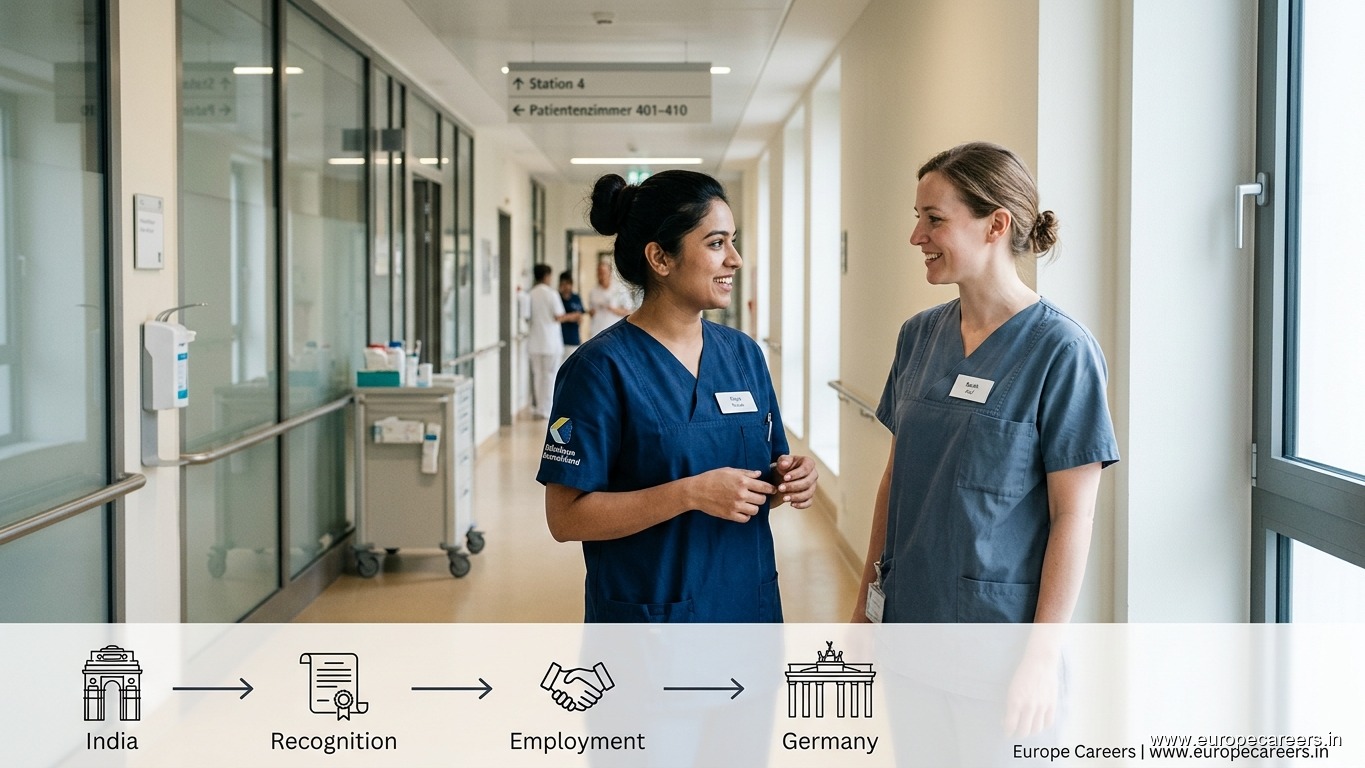
At Europe Careers (www.europecareers.in), our relocation mission is dedicated to supporting both the individual professional and their family. Our comprehensive family relocation services include:
- Eligibility and Residence Title Review: Analyzing your German contract and residence permit category to map out the fastest, most reliable family reunification route.
- Document Dossier Auditing: Reviewing marriage certificates, birth records, and custody papers to identify name discrepancies or missing apostilles before submission.
- Sworn Translation Management: Coordinating certified German translations through authorized court translators.
- Consular Appointment Guidance: Advising families on securing VFS Global appointment slots across German missions in India.
- Health Insurance Coordination: Enrolling spouses and children in statutory Familienversicherung to guarantee seamless, zero-cost family healthcare.
- Settlement and School Orientation: Providing guidance on local Bürgeramt registration, Kindergeld child benefit applications, and neighborhood school admissions.
Frequently Asked Questions: Family Reunification Germany
1. Can I bring my spouse to Germany after getting a work visa?
Yes. If you hold a qualifying residence permit as a skilled worker or an EU Blue Card, your legally married spouse can apply for a family reunification visa to live with you in Germany.
2. Can my spouse work in Germany after moving on a family visa?
Yes. Spouses entering Germany under family reunification have unrestricted access to the German labour market and are permitted to take up any full-time, part-time, or freelance employment.
3. Does my spouse need to learn German (A1 level) before getting the visa?
If you hold an EU Blue Card or a skilled worker residence permit under the Skilled Immigration Act, your spouse is generally exempt from proving German language skills prior to entering Germany.
4. Can I bring my children to Germany?
Yes. Unmarried minor children under 18 years of age can join their parents in Germany under family reunification regulations, provided custody and living conditions are met.
5. Do my children need to know German before moving?
Children under 16 do not need to prove German language skills before moving. Children aged 16 or 17 who move independently of both parents may be subject to integration or language requirements unless exempt under skilled worker provisions.
6. Can I bring my parents to Germany?
Under a special provision effective from 1 March 2024, skilled workers whose qualifying residence permits were issued for the first time on or after that date can bring parents (and parents-in-law) if their livelihood and comprehensive health insurance are fully secured without state assistance.
7. Does an EU Blue Card holder have special family advantages?
Yes. EU Blue Card holders enjoy expedited family reunification processing, full pre-entry language exemptions for spouses, and facilitated housing requirements.
8. How much income do I need to show to bring my family?
There is no fixed universal number. Your net income must cover standard statutory living allowances for all family members plus actual monthly rent, ensuring no reliance on public welfare benefits.
9. Do I need to show a large apartment before applying?
Under updated skilled worker rules, the strict formal requirement to prove living space square footage has been facilitated or waived for eligible skilled workers bringing spouses and minor children.
10. How does health insurance work for my spouse and children?
If you are insured under the statutory health insurance system (GKV), your non-working spouse and children are co-insured completely free of charge under the statutory Familienversicherung scheme.
11. What is Kindergeld and are Indian workers eligible?
Kindergeld is a monthly state child benefit allowance of €250 per child paid by the German government. Indian professionals living legally in Germany with eligible residence permits are fully entitled to receive it.
12. Is school education free for international children in Germany?
Yes. Public school education in Germany is completely free of charge and legally compulsory for all children from age six. Public schools provide intensive German language support classes.
13. Do Indian marriage certificates need to be apostilled?
Yes. The original Indian Marriage Certificate must be apostilled by the Ministry of External Affairs (MEA) in India and accompanied by a sworn German translation.
14. Can my spouse study at a German university?
Yes. A spouse holding a family reunification residence permit has the legal right to enrol in German universities, language institutes, or vocational training courses, subject to standard academic admission criteria.
15. How long does the family reunion visa take to process from India?
Processing typically takes between 8 and 16 weeks, depending on the German consular mission in India, appointment availability, and the processing speed of the local Ausländerbehörde in Germany.
16. Can my family travel with me on day one?
Yes, simultaneous applications are permitted, particularly for EU Blue Card holders and senior engineers whose accommodation and employment contracts are fully finalized before departure.
17. Can Indian nurses bring their families to Germany?
Yes. While nurses completing adaptation training on Section 16d visas often bring their families after completing full recognition, fully licensed nurses holding skilled worker permits can bring spouses and children smoothly.
18. What if my marriage took place after I moved to Germany?
If you marry after moving to Germany, family reunification is still possible, though the authorities may review your residence duration and financial resources closely before granting the visa.
19. Can adult children (above 18) join me under family reunification?
No. Children aged 18 and older cannot join parents under standard family reunification. They must apply independently for their own student, vocational training (Ausbildung), or skilled employment visas.
20. Does Europe Careers guarantee family visa approvals?
No ethical agency can guarantee visa approvals. Sovereign visa decisions rest exclusively with the German Embassy and immigration authorities. Europe Careers provides expert dossier preparation, document auditing, and relocation guidance to maximize your chances of a smooth, successful outcome.
Conclusion: Building a Rewarding Family Life in Germany
Relocating to Germany is not just a professional journey; it is an extraordinary opportunity to build a secure, prosperous, and globally minded future for your entire family. With world-class free schooling, subsidized childcare, universal healthcare coverage, and safe communities, Germany provides an exceptional quality of life for families.
While the administrative steps—apostilles, sworn translations, consular appointments, and income verifications—require attention to detail and patience, thousands of Indian professionals successfully unite with their families in Germany every year. By understanding the regulations early and preparing your documentation methodically, you can welcome your loved ones to Germany with confidence and joy.
Plan Your Family’s Move to Germany with Europe Careers
Are you an Indian skilled worker, nurse, doctor, or engineer planning to bring your spouse and children to Germany? Europe Careers provides comprehensive family relocation support—including document verification, apostille coordination, sworn German translations, consular visa dossier preparation, and post-arrival settlement mentorship.
Europe Careers
Official Website: www.europecareers.in
Direct Email Support: support@europecareers.in