Recognition of Indian Nursing Qualifications in Germany: Step-by-Step Guide for Indian Nurses

Germany has become an important destination for qualified Indian nurses looking to build an international healthcare career. But for an Indian nursing qualification to be used for professional nursing work in Germany, completing the professional recognition process, known as Anerkennung, is an important step.
Unlike some occupations where recognition may not be mandatory, nursing is a regulated profession in Germany. This means that nurses who want to work as qualified nursing professionals generally need their foreign qualification recognised and must meet the requirements for professional authorisation.
For Indian nurses, the process involves more than simply submitting a BSc Nursing or GNM certificate. German authorities look at the qualification, training content, duration of education, professional experience, and other requirements before deciding whether the qualification corresponds to the German nursing profession.
This guide explains the process in simple terms and covers what Indian nurses should know before starting their Germany nursing journey.

What Is Nursing Recognition in Germany?
Nursing recognition is the official process through which a German competent authority checks whether a foreign nursing qualification is comparable with the relevant German nursing qualification.
For internationally trained nurses, the German reference occupation is generally Pflegefachfrau / Pflegefachmann, also referred to as Pflegefachperson.
The authority compares your education and professional background with the requirements of the German reference profession. The assessment may consider:
- Nursing qualification
- Duration of training
- Subjects studied
- Theoretical education
- Clinical training
- Practical experience
- Additional qualifications
- Professional experience
The result is communicated through an official recognition decision, commonly called an Anerkennungsbescheid.
Is Recognition Mandatory for Indian Nurses?
For an Indian nurse who wants to work as a qualified nurse in Germany, recognition is strictly required because nursing is a regulated profession.
The German government’s official information states that nurses from third countries need an individual recognition procedure. The competent authority checks whether the foreign qualification is equivalent to the German nursing reference profession. This means an Indian nurse cannot simply arrive in Germany and start working as a fully qualified nurse using an Indian nursing certificate alone. The professional recognition and licensing requirements must be fulfilled.
Which Indian Nursing Qualifications Can Be Considered?
Indian nurses commonly approach the German recognition process with qualifications such as:
1. BSc Nursing
A Bachelor of Science in Nursing is a common qualification held by Indian nurses seeking international employment. The German authority does not automatically treat every BSc Nursing qualification as equivalent; instead, the individual education and training record is assessed.
2. GNM – General Nursing and Midwifery
GNM-qualified nurses may also apply for professional recognition. The outcome depends on the individual’s qualification, training structure, clinical education, documentation, and professional experience.
3. Post Basic BSc Nursing
Additional qualifications can also form part of the applicant’s professional profile, demonstrating continued formal training and upgraded skills.
4. MSc Nursing
A postgraduate nursing qualification may strengthen the overall academic profile, but the recognition authority still assesses the core professional nursing qualification against the relevant German requirements.
Important Note: Having a particular Indian nursing qualification does not automatically guarantee full recognition. The German competent authority makes the final decision after assessing the individual application.
Step-by-Step Nursing Recognition Process for Indian Nurses
The overall journey follows this pathway:
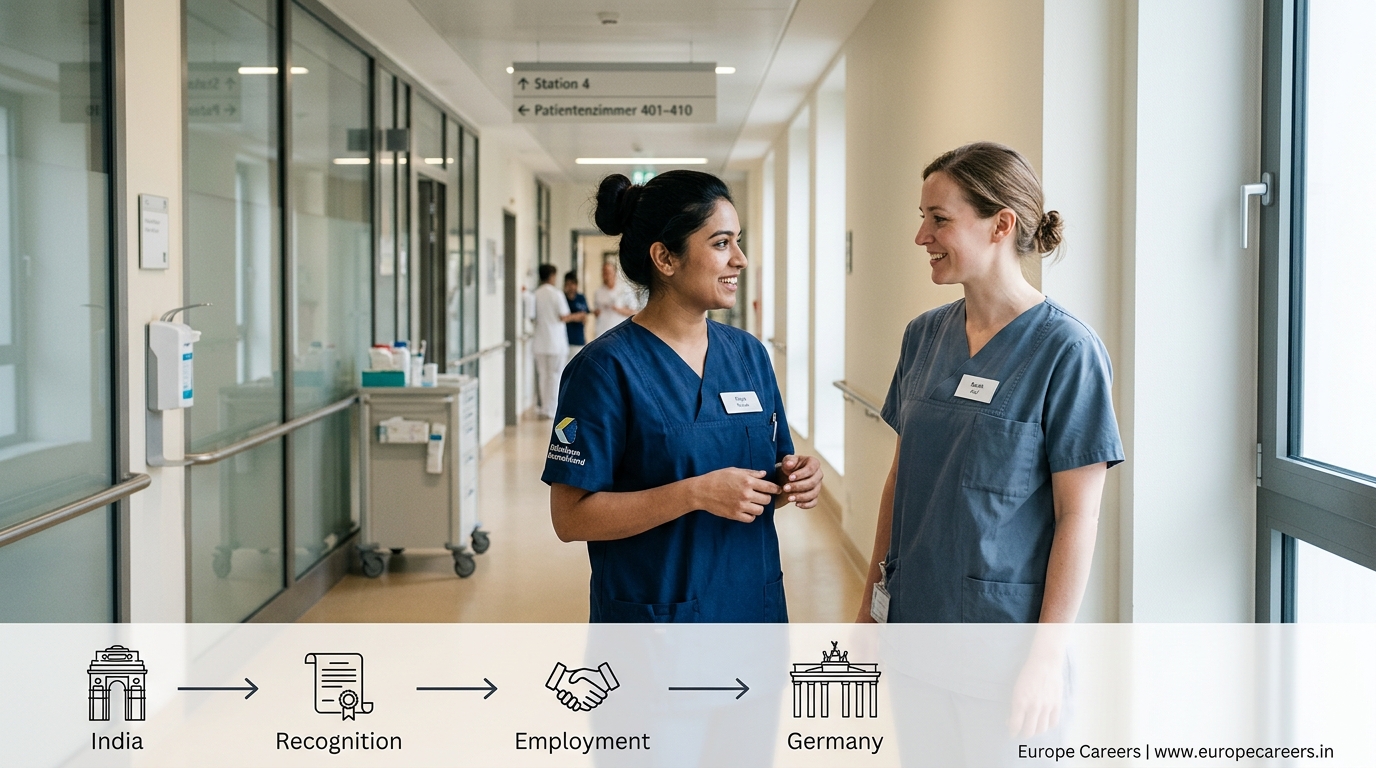
Indian Nursing Qualification → Document Preparation → German Translation → Application → Equivalence Assessment → Recognition Decision → Compensation Measure if Required → B2 German & Other Requirements → Professional Authorisation → Employment
Step 1: Check Your Eligibility
Before starting the process, review your nursing qualification and professional background. Prepare information about your college and university, year of completion, duration of training, clinical training, internship, professional experience, current nursing council registration, and any additional certifications.
Step 2: Identify the Correct German Recognition Authority
Germany has different competent authorities depending on the profession and the federal state (Bundesland) where you intend to work. For nursing, the application is submitted to the competent authority in that specific German federal state. Once granted, the recognition is valid throughout Germany. You can identify the responsible authority via the official Recognition Finder (Anerkennungs-Finder).
Step 3: Prepare Your Nursing Documents
Documentation is one of the most critical parts of the recognition process. Depending on your individual case and the responsible authority, you may need:
- Nursing diploma / degree certificate
- Mark sheets and consolidated mark sheets
- Transcript of records
- Detailed curriculum or syllabus breakdown
- Evidence of training content and exact hours (theory and clinical practice)
- Clinical training and internship logbooks/records
- State Nursing Council registration certificate
- Professional experience certificates and employment references
- Passport / proof of identity
- German language certificate
- Police Clearance Certificate (Certificate of Good Conduct)
- Medical fitness certificate
Why Is the Nursing Transcript Important? A nursing degree certificate alone does not reveal the detailed breakdown of your theoretical vs. clinical hours. German authorities require granular proof of subject areas, practical rotations, and training hours to evaluate comparability.
Step 4: Translate and Certify Your Documents
Indian nursing documents are generally not accepted in their original English or regional language formats without certified translations. Documents normally must be submitted in German, prepared by an authorised or sworn translator (vereidigter Übersetzer). Follow this standard structure: Original Document → Certified Copy (if required) → Sworn German Translation → High-Resolution Digital Scan.
Step 5: Submit the Recognition Application
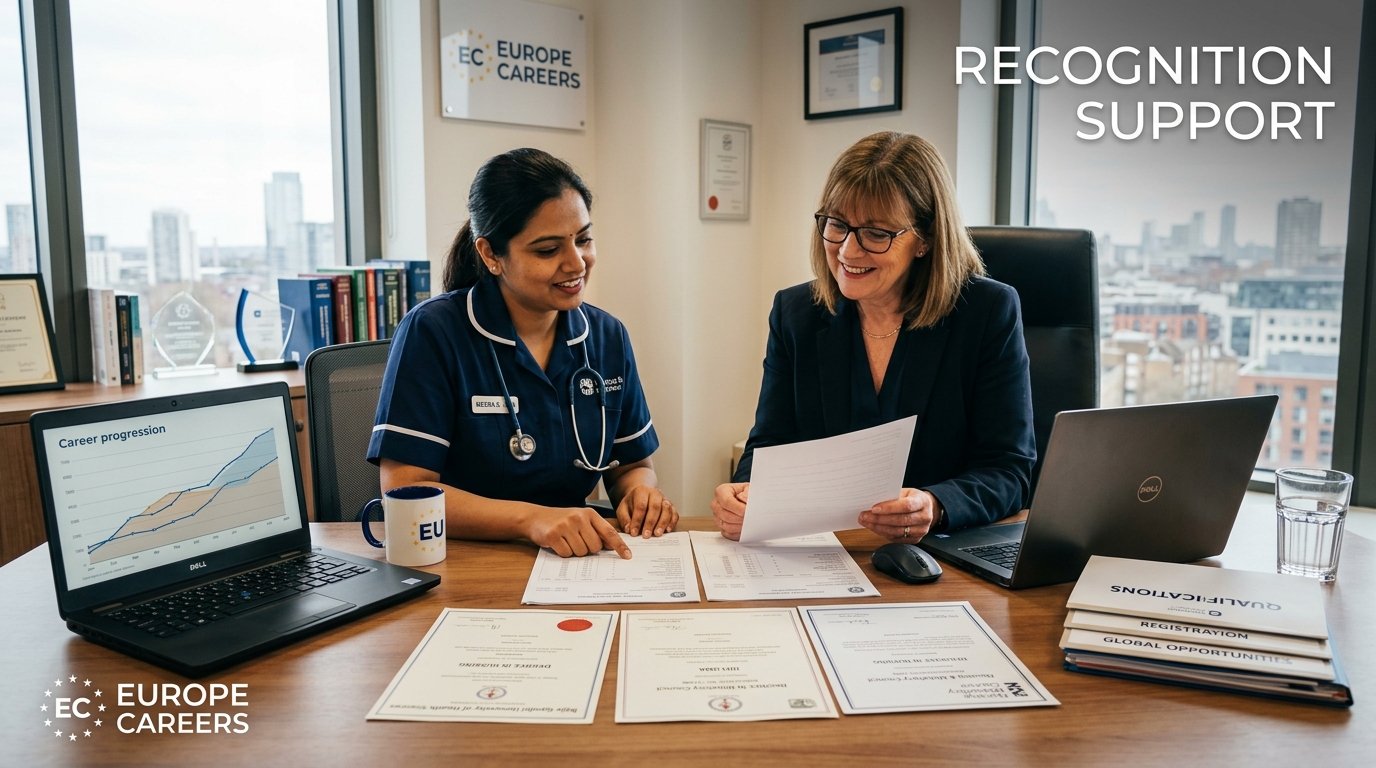
Once your dossier is ready, the application is submitted to the responsible recognition authority. According to Germany’s official information, once all required documents are complete, the recognition procedure generally takes approximately three to four months. Note that missing documents or translation issues can extend this timeframe.
Step 6: The German Authority Compares Your Qualification
The authority compares your Indian nursing education with the German reference curriculum. They assess theoretical nursing education, practical bedside training, clinical placements, training duration, and verified post-qualification work experience to identify whether any “substantial differences” (wesentliche Unterschiede) exist.
Step 7: Receive Your Recognition Decision
There are two primary outcomes:
- Full Recognition (Volle Anerkennung): Your qualification is deemed equivalent. You can proceed directly toward state licensing/authorisation upon fulfilling language and personal suitability requirements.
- Differences Identified (Defizitbescheid): The decision identifies specific theoretical or clinical areas where deficits exist and specifies required compensation measures.
Receiving a Defizitbescheid is common for third-country nurses and simply indicates the bridge programme required. The two standard compensation measures are:
- Adaptation Programme (Anpassungslehrgang): A structured period of practical and theoretical training in a German hospital/care setting addressing specific deficit areas, concluded by a final evaluation interview.
- Knowledge Test (Kenntnisprüfung): An examination covering the contents of the German nursing final state examination. Passing demonstrates professional equivalence.
Step 8: German Language Requirement for Nurses
For professional nursing recognition and license issuance, official German regulations require German at the B2 level under the CEFR. In many states, a specialist medical/nursing language exam (Fachsprachenprüfung) or telc Deutsch B1-B2 Pflege is required to prove competence in clinical handovers, medical records documentation, and direct patient interaction.
Step 9: Medical Fitness and Personal Suitability
In addition to educational equivalence, German law requires proof of personal trustworthiness (a clean criminal record / Certificate of Good Conduct) and physical/mental fitness to practice nursing (medical certificate from an authorized physician).
Step 10: Receive Professional Authorisation (Approbation / Berufserlaubnis)
Once equivalence is established and language, medical, and personal requirements are verified, the authority issues your official professional license (Berufsurkunde), granting legal authorization to practice under the professional title Pflegefachfrau / Pflegefachmann.
Step 11: Move Towards Employment in Germany
With licensing secured or an adaptation plan established with an employer, you can finalize your employment contract and proceed with the visa and relocation process.
Can Indian Nurses Go to Germany Before Full Recognition?
Yes, under specific legal pathways. Under Section 16d of the German Residence Act (AufenthG), qualified nurses who receive a Defizitbescheid can apply for a Recognition Visa (Visum zur Anerkennung ausländischer Berufsqualifikationen) to enter Germany and complete their adaptation course or take the knowledge test while working as a nursing assistant (Pflegehelfer). Additionally, the Recognition Partnership (Anerkennungspartnerschaft) route allows nurses with B1 German and an employer contract to start work while completing the recognition procedure in Germany.
BSc Nursing vs GNM: What Should Indian Nurses Know?
Indian nurses often ask whether BSc Nursing or GNM is preferred. The German authority assesses the concrete hours and syllabus rather than the degree label:
| Evaluation Factor | Why It Matters to German Authorities |
|---|---|
| Nursing Qualification | Establishes your baseline professional foundation (BSc 4-year degree vs. GNM 3-year diploma). |
| Training Duration | Checked against the German standard (minimum 4,600 total training hours: 2,100 theoretical, 2,500 clinical). |
| Curriculum Breakdown | Verifies coverage in geriatric, paediatric, psychiatric, surgical, and internal medicine care. |
| Clinical Training | Hands-on bedside hours demonstrate verified patient care experience. |
| Post-Graduation Work Experience | Demonstrated clinical experience can directly compensate for minor curricular gaps. |
| German Language | B2 level is non-negotiable for receiving the full professional license. |
| Medical Fitness & Conduct | Ensures patient safety and regulatory compliance. |
Timeline and Cost Overview
While official authority processing takes roughly 3 to 4 months once all documents are in order, the total preparation journey (German language up to B2, apostille, translations, employer interviews, and visa) typically spans 9 to 18 months.
Estimated costs include:
- Recognition Authority Fee: €100 – €600 (varies by federal state)
- Sworn Translations: €300 – €800
- Language Courses & Exams (A1 to B2): ₹60,000 – ₹1,50,000
- Visa & Relocation: €75 (visa fee) + flight and initial expenses (often sponsored or reimbursed by German healthcare employers)
Common Mistakes Indian Nurses Should Avoid
- Applying to the Wrong Authority: Submitting papers to an authority in a state where you do not plan to reside or work causes significant delays.
- Submitting Incomplete Syllabi: Sending only the degree certificate without the hourly transcript breakdown is the #1 cause of rejection or delayed assessment.
- Delaying German Language Studies: Waiting for the recognition decision before starting B1/B2 German stalls your journey by months.
- Using Uncertified Translations: German authorities require sworn, certified translations.
- Confusing Recognition with a Job Offer: Anerkennung establishes qualification equivalence; you must still secure an employment contract to get your work visa.
Frequently Asked Questions (FAQ)
Is nursing a regulated profession in Germany?
Yes. Nursing is strictly regulated under the Nursing Professions Act (Pflegeberufegesetz). You cannot legally practice as a registered nurse without official recognition and state authorisation.
Is B2 German required for Indian nurses?
Yes, B2 level (under CEFR) is required for receiving the full professional license (Berufserlaubnis / Approbation). Some migration pathways permit entry at B1 to complete language and adaptation training in Germany.
Can a GNM nurse apply for recognition?
Yes. GNM nurses are eligible to apply. The authority will compare the GNM curriculum and clinical hours against German requirements and may issue a deficit notice specifying an adaptation period or knowledge test.
What is an Anerkennungsbescheid vs. Defizitbescheid?
An Anerkennungsbescheid is the formal recognition decision. If differences are found, it details specific educational deficits — often referred to colloquially as a Defizitbescheid — and outlines required compensatory measures.
Quick Summary: The 12 Stages to Germany
| Stage | Action Item |
|---|---|
| 01 | Check Indian nursing qualification (BSc / GNM) |
| 02 | Identify the responsible German state authority |
| 03 | Collect university transcripts and hourly clinical breakdowns |
| 04 | Translate and certify documents with sworn translators |
| 05 | Submit formal recognition application |
| 06 | German authority assesses equivalence |
| 07 | Receive recognition decision (Bescheid) |
| 08 | Complete adaptation course or knowledge test (if required) |
| 09 | Attain B2 German and submit medical/police clearances |
| 10 | Obtain official professional license (Berufszulassung) |
| 11 | Complete employment contract & visa process |
| 12 | Begin your nursing career in Germany |
Official sources: Make it in Germany – Nursing Professionals · Anerkennung in Deutschland – Recognition Finder