How Europe Careers Helps Indian Nurses Build Their Nursing Career in Germany
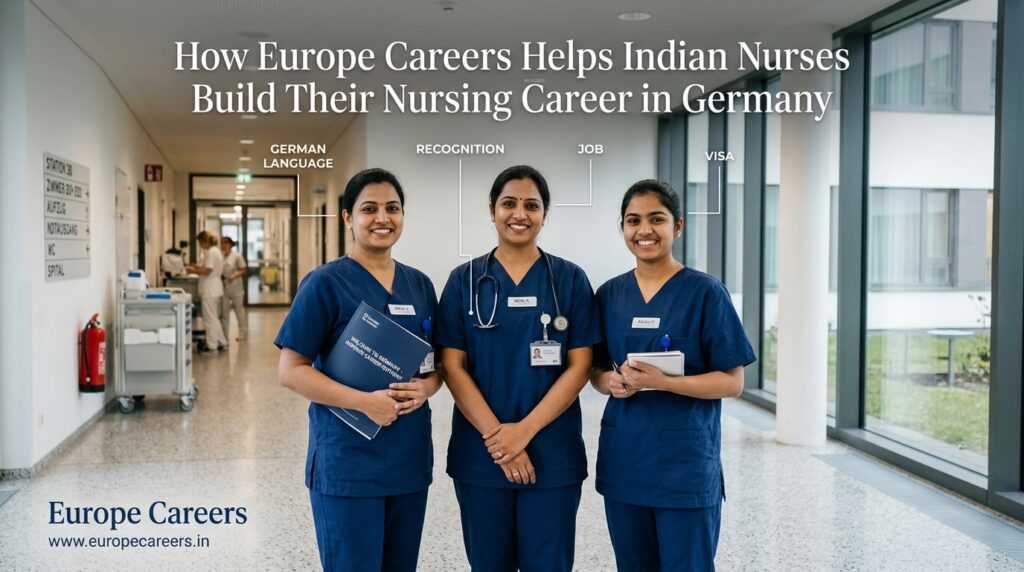
Every year, thousands of qualified Indian nurses dream of taking their clinical skills to Europe. Germany has emerged as one of the most respected destinations for international healthcare professionals. With high workplace standards, modern hospital infrastructure, and a well-regulated healthcare environment, it offers genuine opportunities for long-term professional growth.
Yet for most Indian nurses, the path to Germany feels confusing and overwhelming. Many candidates hold a recognised BSc Nursing or GNM qualification, along with years of bedside experience, but face basic questions: Where do I begin? How do I learn German up to the required B2 level? How does the recognition process (Anerkennung) work? How do I translate my transcripts? Who will connect me with genuine hospital employers? What happens after my visa is approved?
At Europe Careers, our role is to answer these questions with honest advice and structured, end-to-end guidance. We are not a government body, nor do we issue visas or make recognition decisions. Rather, we act as your professional career partner — guiding you through profile evaluation, language preparation, document dossiers, official recognition follow-ups, verified hospital interviews, and relocation support. This comprehensive guide outlines exactly how Europe Careers supports Indian nurses every step of the way.
Why Indian Nurses Choose Germany
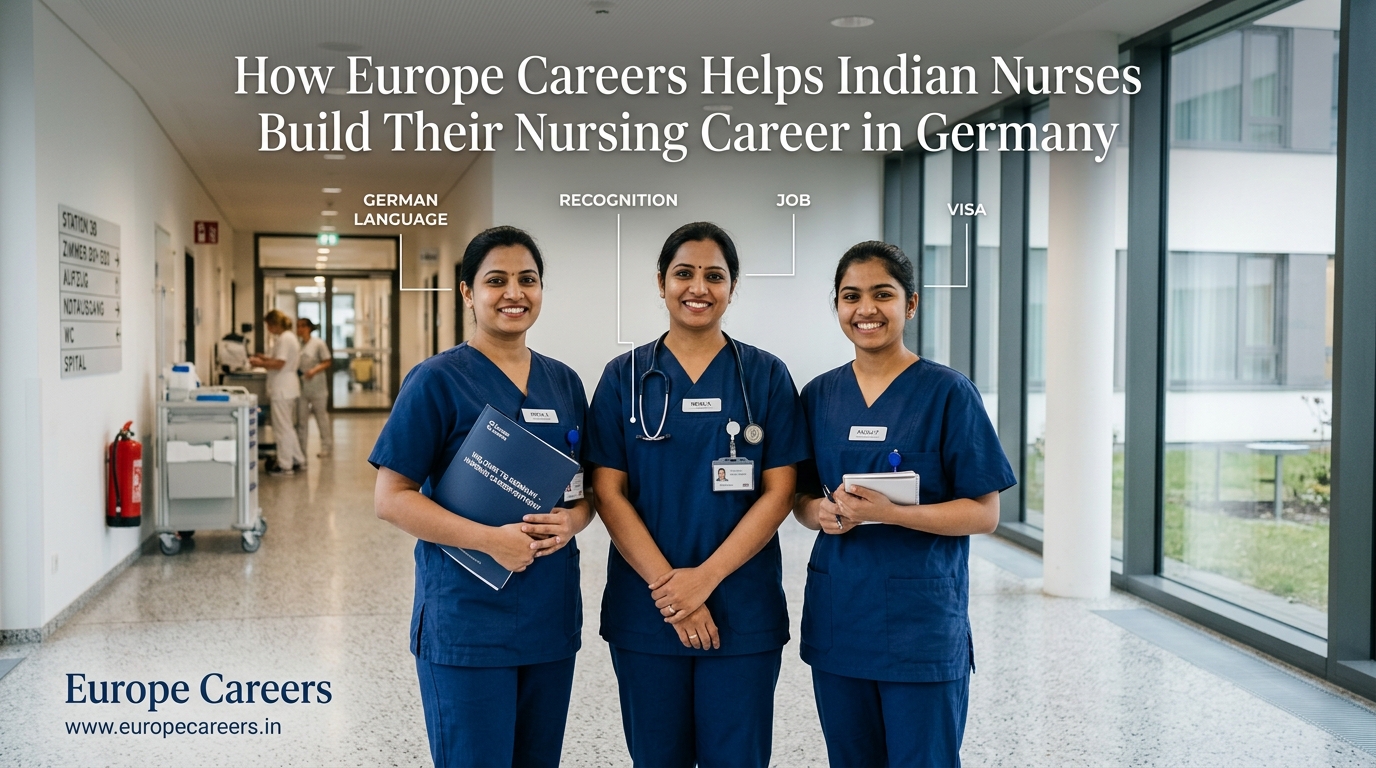
Over the last decade, Germany’s healthcare landscape has opened clear, legal immigration pathways for qualified healthcare workers from non-EU countries. For Indian nurses, Germany offers several distinct advantages:
- High Demand for Healthcare Professionals: Germany has an ageing population and a growing need for skilled bedside nurses across public clinics, university hospitals, and specialised care centres.
- Regulated and Protected Workplace Rights: Nursing in Germany is a legally protected profession. Once recognised, Indian nurses enjoy identical workplace rights, regulated working hours, shift allowances, and statutory benefits as their German colleagues.
- Clear Professional Development: Nurses can pursue advanced clinical specialisations, including intensive care (Intensivpflege), anaesthesia, oncology, geriatric care, or healthcare management.
- Long-Term Career and Residency Pathways: Qualified healthcare workers on standard employment contracts have structured pathways toward permanent residency under the German Residence Act.
- Welcoming International Teams: German medical facilities actively welcome international professionals and provide structured orientation programmes to help candidates integrate comfortably.
How Europe Careers Supports Indian Nurses
Relocating internationally as a regulated professional is not simply a matter of finding a job opening. It requires careful alignment of educational credentials, language qualifications, legal paperwork, and hospital expectations. Europe Careers provides a structured, 10-stage pathway designed to ensure candidates make steady, well-informed progress:
Career Guidance → Profile Assessment → German Language Training → Document Preparation → Recognition Support → Employer Opportunities → Interview Preparation → Visa Support → Pre-Departure Guidance → Relocation Support
01. Career Guidance and Profile Assessment
The journey begins with an honest, comprehensive profile assessment. No two nursing backgrounds are identical. A three-year GNM diploma from a state nursing board represents a different educational structure than a four-year BSc Nursing degree or a Post Basic BSc Nursing programme.
During the assessment stage, Europe Careers reviews:
- Educational Foundation: Your nursing qualification, issuing university or nursing examination board, and curriculum duration.
- Clinical Experience: Your hospital ward history, clinical departments (e.g. ICU, OT, Medical-Surgical, Paediatrics), bed capacity, and years of bedside service.
- Professional Registration: Verification of your active State Nursing Council registration and Good Standing status.
- Language Readiness: Your current exposure to German (whether you are an absolute beginner at A1 or have already completed levels).
- Personal Timelines and Preferences: Preferred hospital settings, family considerations, and readiness for language study.
Please note: Europe Careers cannot guarantee that a qualification will receive full equivalence. Official German authorities evaluate each candidate’s file independently. Our assessment ensures you enter the process with realistic expectations and clear next steps.
02. German Language Training
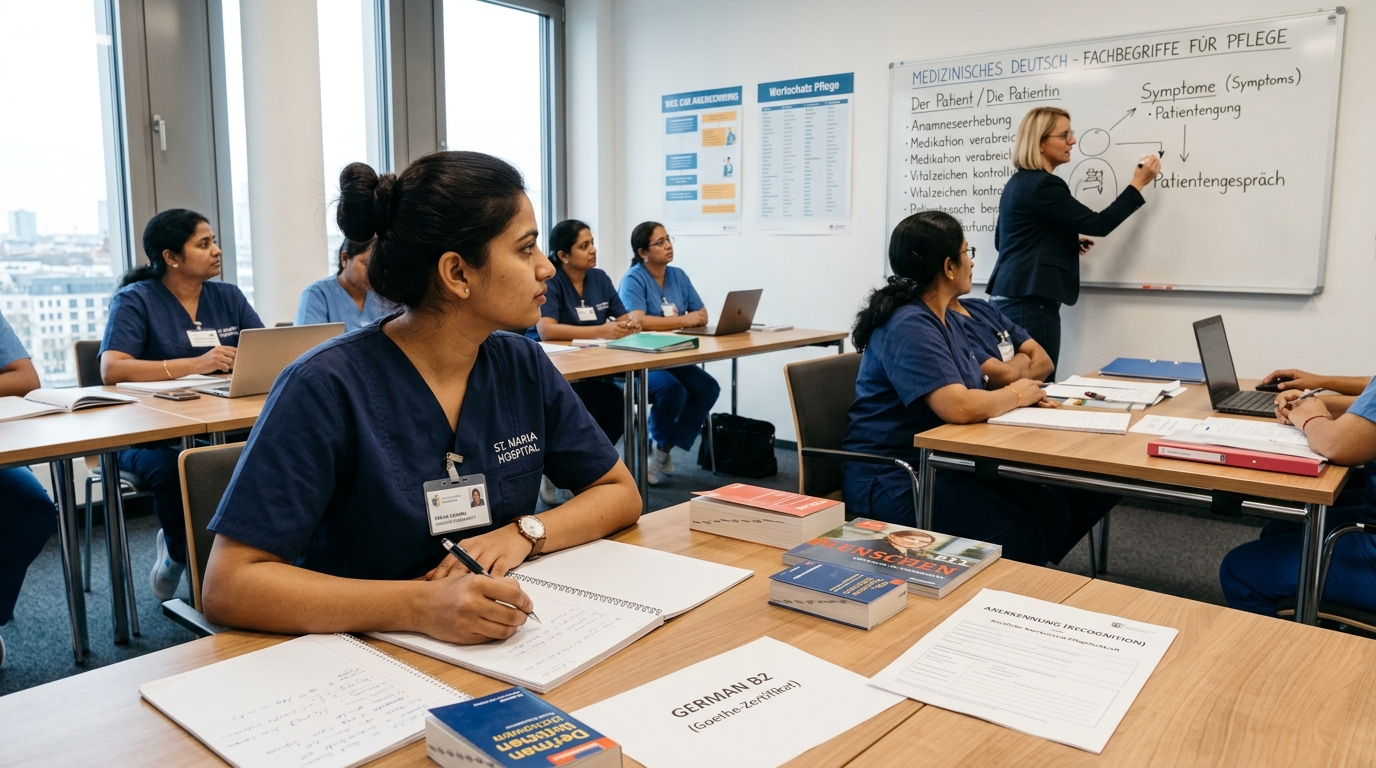
In healthcare, language is a life-safety skill. You must be able to comprehend rapid clinical instructions from physicians, document medication dosages accurately, communicate empathetically with anxious patients, and carry out shift handovers with nursing colleagues. Basic conversational German is not sufficient for professional practice.
The standard language progression under the Common European Framework of Reference for Languages (CEFR) consists of:
- Level A1 & A2 (Foundational German): Everyday expressions, basic clinical greetings, and daily communication.
- Level B1 (Intermediate German): Handling routine workplace interactions, basic medical vocabulary, and meeting the entry visa prerequisite for recognition training in Germany.
- Level B2 (Upper Intermediate / Professional): Fluent communication in healthcare settings, complex medical terminology (Fachsprache), and satisfying the mandatory requirement for full professional licensing (Berufsurkunde).
Europe Careers guides candidates toward structured language courses, accredited examination preparation (such as Goethe-Zertifikat, telc Deutsch B1-B2 Pflege, or ÖSD), and specialized medical vocabulary training. We ensure our candidates understand that language proficiency is the single most valuable investment they make in their German career.
03. Document Preparation
Document errors, missing hourly transcripts, and uncertified translations are the primary causes of bureaucratic delays in the German recognition procedure. German state authorities require extensive evidence showing not just what certificate you hold, but exactly how many hours of theoretical lectures and practical bedside rotations you completed in each subject.
Europe Careers assists candidates in assembling a clean, structured documentation folder including:
- Degree / Diploma Certificates and Consolidated Mark Sheets
- Official Transcripts detailing theoretical and clinical hours breakdown
- Detailed University Syllabus / Curriculum Booklets
- Clinical Logbooks and Internship Completion Certificates
- Active State Nursing Council Registration and Certificate of Good Standing
- Verified Work Experience Certificates detailing department, role, and hospital bed capacity
- Valid Passport and Identity Documentation
- Police Clearance Certificate (PCC) and Medical Fitness Certificate
- Sworn German Translations prepared by authorized translators
Important Clarification: Europe Careers helps candidates organise, verify, and format their documents according to standard administrative expectations, while the final document criteria and acceptance remain solely at the discretion of the responsible German state authority.
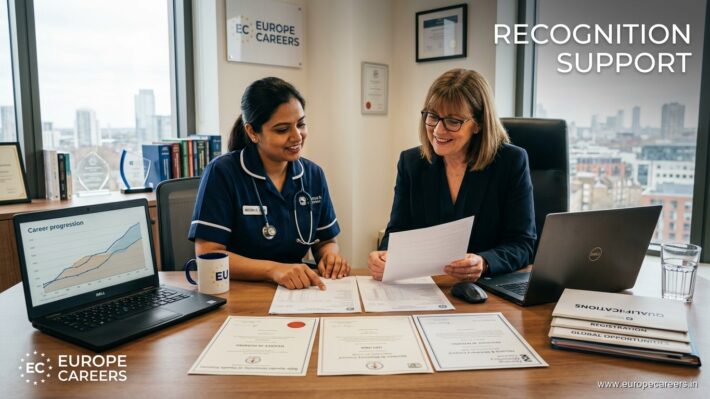
04. Nursing Recognition (Anerkennung)
In Germany, nursing is a legally regulated profession. Foreign-trained nurses cannot practice independently without undergoing professional equivalence assessment, known as Anerkennung. The competent authority in the German federal state (Bundesland) compares your Indian curriculum against the German reference profession, Pflegefachfrau / Pflegefachmann (generalist nurse).
Once the authority completes its assessment, it issues an official decision (Anerkennungsbescheid):
- Full Equivalence (Volle Anerkennung): Your training matches German standards. Upon submitting B2 German and medical/personal clearance, your license is granted.
- Substantial Differences Identified (Defizitbescheid): The authority notes specific gaps between Indian and German training (frequently in elderly care, outpatient care, or specific psychiatric rotations). This is completely standard and does not mean your application has failed.
When differences are identified, the candidate completes an official compensation measure:
- Adaptation Programme (Anpassungslehrgang): Supervised clinical practice and modular theory in a German hospital addressing the deficit areas, concluded by a clinical evaluation.
- Knowledge Test (Kenntnisprüfung): A standardized oral and practical examination covering the core German nursing curriculum.
Europe Careers guides candidates through the application dossier, tracks the submission with state authorities, and explains the contents of the Defizitbescheid so the candidate understands their exact path to full licensing.
05. Employer Search and Nursing Job Opportunities
Once your documents are in order and your language studies are progressing well, Europe Careers coordinates with reputable healthcare institutions across Germany. We work directly with university medical centres, municipal hospitals, private hospital groups, and rehabilitation clinics that offer structured integration programs for international nurses.
Our employer coordination covers:
- Matching your clinical background (e.g. ICU, surgical ward, dialysis) with suitable hospital departments.
- Presenting detailed role descriptions, department structures, and geographical locations.
- Reviewing standard collective bargaining agreements (TVöD or internal hospital contracts), including salary bands, shift premiums, and vacation allowances.
- Scheduling employer video interviews at convenient times.
Europe Careers does not guarantee a job offer to every candidate. The healthcare employer conducts the interview and independently makes all final hiring and contracting decisions.
06. Interview Preparation
Attending a job interview with a German hospital director of nursing (Pflegedirektion) can feel daunting, especially when conducted in German. Europe Careers provides targeted coaching to help candidates present their professional experience with confidence:
- Professional Self-Introduction: Structuring your educational background, clinical postings, and career motivation clearly in professional German.
- Clinical Case Scenarios: Explaining standard bedside procedures, vital sign monitoring, infection control protocols, and medication safety.
- Workplace Culture & Communication: Understanding how German hospital teams operate, including interdisciplinary collaboration, patient autonomy, and handover etiquette.
- Mock Interview Sessions: Practising common questions, clarifying hospital expectations, and refining pronunciation.
07. Visa and Immigration Support
Securing the appropriate visa is a crucial legal step. Immigration to Germany is governed by the German Residence Act (Aufenthaltsgesetz). Depending on whether you enter with a Defizitbescheid or full recognition, different visa categories apply:
- Section 16d AufenthG (Recognition Measures Visa): For nurses travelling to Germany to complete an adaptation course or knowledge test while working as a healthcare assistant (Pflegehelfer).
- Section 16d Para 3 AufenthG (Recognition Partnership): Allowing nurses with an employer contract and B1 German to enter Germany and complete the recognition process while employed.
- Section 18g / 18a AufenthG (Qualified Skilled Worker Visa): For nurses who have already completed recognition and obtained their professional license.
Europe Careers assists candidates with compiling their visa dossier — ensuring employer declarations (Erklärung zum Beschäftigungsverhältnis), recognition decisions, proof of accommodation, and German health insurance documentation are completely and accurately arranged.
Please remember: The German Embassy, consulates, and local Foreigners Authorities (Ausländerbehörde) retain sole authority over all visa decisions. Europe Careers does not issue visas and cannot influence official processing times or visa outcomes.
08. Pre-Departure Support
Before packing your bags and boarding your flight to Germany, practical preparation is essential to prevent arrival anxiety. Europe Careers offers comprehensive pre-departure briefings covering:
- Travel Document Checklist: Ensuring physical originals of all certificates, translations, visa papers, and employment contracts are safely packed.
- Clothing & Climate Guidance: Preparing for European seasons, winters, and hospital dress codes.
- Accommodation Planning: Confirming initial hospital staff dormitory or rental apartment arrangements.
- Cultural Orientation: Basic etiquette, public transportation systems, punctuality norms, and navigating everyday life in German cities.
09. Relocation and Arrival Support
Landing in a new country is the start of your real journey. While services may vary depending on the specific hospital employer and recruitment agreement, Europe Careers collaborates with local hospital integration coordinators to support your arrival:
- Arrival Orientation: Airport pickup coordination or detailed train transit guidance to your new city.
- Check-in to Housing: Settling into your staff residence or arranged apartment.
- Municipal Registration (Anmeldung): Guidance on registering your residence at the local town hall (Bürgeramt), a mandatory step to receive your German Tax ID (Steuer-ID).
- Bank Account & Health Insurance: Setting up a German current account (Girokonto) for salary deposits and registering with a statutory health insurance provider (e.g. TK, AOK, Barmer).
- Hospital Orientation Day: Meeting your ward supervisor, receiving hospital uniforms, and commencing your onboarding training.
The Complete Europe Careers Nursing Journey
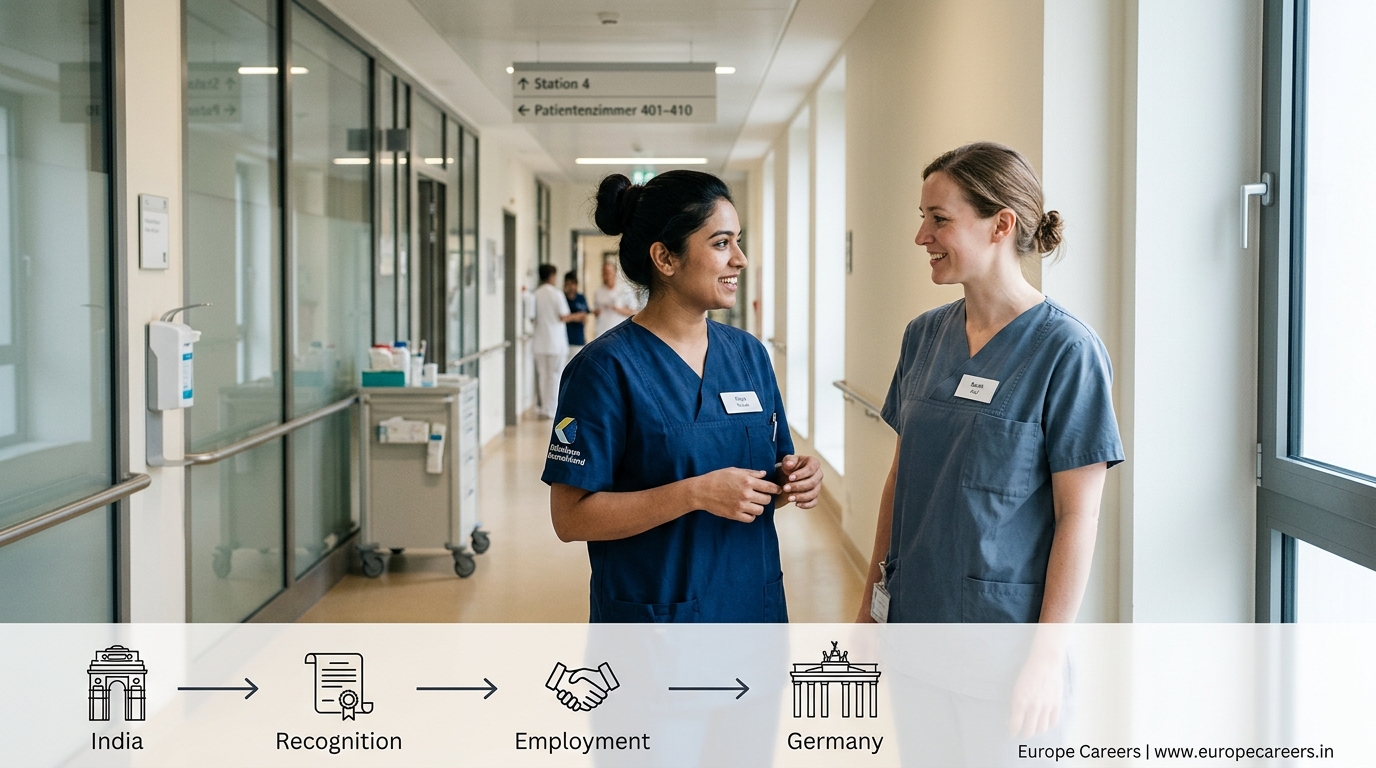
To help you visualise how your pathway unfolds from India to your first clinical shift in Germany, here is our full procedural roadmap:
| Stage | Key Milestones & Responsibilities |
|---|---|
| 1. Initial Contact | Submit your CV, discuss career goals, and undergo an educational profile review. |
| 2. Language Study | Enrol in structured German classes, progressing systematically through A1, A2, B1, and B2. |
| 3. Document Dossier | Gather university transcripts, clinical hours certificates, and arrange sworn German translations. |
| 4. Recognition Filing | Submit the equivalence application to the competent German state authority. |
| 5. Hospital Matching | Profile shared with prospective hospital employers; attend online interview with hospital leadership. |
| 6. Contract Signing | Review and sign the formal employment contract and integration agreement. |
| 7. Bescheid Receipt | Receive the official recognition decision (Defizitbescheid or Vollanerkennung). |
| 8. Visa Application | Submit your completed file to the German consulate or VFS Centre with employer support. |
| 9. Relocation | Attend pre-departure orientation, book flights, and travel to Germany. |
| 10. Registration & Work | Complete local city registration, commence work, and finish adaptation requirements for your permanent nursing license. |
Why Proper Guidance Matters
Navigating the German bureaucratic and healthcare system independently can be daunting. Candidates attempting to handle the process alone often encounter preventable obstacles:
- Applying to the Incorrect Authority: Germany has 16 federal states, each with independent recognition offices. Applying in the wrong state can delay files by several months.
- Submitting Incomplete Transcripts: Certificates without granular hour breakdowns are frequently rejected or returned for clarification.
- Using Unaccredited Translators: Translations that do not meet sworn certification standards are not accepted by German regulatory bodies.
- Unrealistic Language Preparation: Relying on casual apps or stopping at A2 often leads to failed employer interviews or severe difficulties during the clinical adaptation period.
- Unverified Job Offers: Accepting unclear promises or informal job agreements without verified collective contracts can compromise visa applications.
Having structured, transparent guidance from Europe Careers helps eliminate these pitfalls, ensuring your time, energy, and financial investments are protected.
Who Can Contact Europe Careers?
We welcome inquiries from qualified Indian nursing professionals who are dedicated to mastering the German language and building a long-term international healthcare career. Eligible profiles generally include:
- Graduates holding a BSc Nursing degree from an Indian Nursing Council (INC) recognised institution.
- Graduates holding a General Nursing and Midwifery (GNM) diploma with clinical bedside experience.
- Nurses with Post Basic BSc Nursing or MSc Nursing qualifications.
- Registered nurses with an active State Nursing Council registration.
- Working nurses currently in service as well as fresh graduates who are committed to commencing intensive German language training.
What Candidates Should Prepare Before Contacting Us
To help us evaluate your profile efficiently, please have the following basic details ready:
- Your updated, professional Curriculum Vitae (CV)
- Degree or Diploma Certificate copies
- Yearly or consolidated mark sheets
- Current State Nursing Council registration certificate
- Bedside experience certificates (detailing hospital departments and duration)
- Valid Passport (minimum 1 – 2 years validity remaining)
- Current German language proficiency level (if already started)
- Your preferred timeline for relocation
Frequently Asked Questions (FAQ)
1. Can Indian nurses work in Germany?
Yes. Germany has established clear legal frameworks under the Skilled Immigration Act (Fachkräfteeinwanderungsgesetz) allowing Indian nurses with recognised qualifications and language skills to live and work in the country.
2. What nursing qualifications can be considered?
Both BSc Nursing (4-year degree) and GNM (3-year diploma) qualifications are eligible for recognition evaluation by German authorities. Post Basic BSc Nursing and MSc Nursing qualifications are also accepted.
3. Is B2 German mandatory for nurses?
Yes. While you may enter Germany with B1 German under specific recognition visa programmes to complete language and adaptation training, full professional licensing as a registered nurse (Pflegefachkraft) strictly requires certified B2 German.
4. What is Anerkennung?
Anerkennung is the official German recognition procedure. A state authority compares your foreign nursing qualification, hours, and curriculum against German educational standards to determine professional equivalence.
5. Can Europe Careers help with recognition?
Yes. Europe Careers assists you in assembling your paperwork, obtaining sworn translations, formatting curriculum records, submitting files to the correct state authority, and following up on your application.
6. Can Europe Careers guarantee recognition?
No. No agency can guarantee recognition. The evaluation and final decision rest exclusively with the designated competent authority of the respective German federal state.
7. Can Europe Careers guarantee a nursing job?
No. We introduce qualified candidates to reputable German healthcare employers and coordinate interviews, but the hospital’s hiring committee independently makes all selection decisions.
8. What happens if I receive a Defizitbescheid?
A Defizitbescheid is normal for non-EU nurses. It outlines the specific clinical or theoretical areas that differ from German training. You simply bridge these deficits in Germany through a paid adaptation course (Anpassungslehrgang) or by passing a knowledge test (Kenntnisprüfung).
9. Does Europe Careers provide German language training?
Europe Careers guides candidates through structured, accredited German language programmes with experienced instructors, focusing on both general grammar and specialized nursing terminology.
10. Can Europe Careers help with interview preparation?
Yes. We conduct dedicated interview coaching sessions covering professional self-introductions in German, common clinical questions, and German workplace communication norms.
11. Can Europe Careers help with visa documentation?
Yes. We guide you through assembling all necessary visa documents, including employment declarations, health insurance, and recognition notices. However, visa issuance remains solely under the authority of the German Embassy or consulate.
12. Does Europe Careers provide relocation support?
Yes. Depending on your programme and employer agreement, we coordinate pre-departure briefings, accommodation arrangements, travel instructions, and onboarding registration guidance in Germany.
13. How long does the entire journey take?
The total duration usually spans between 9 and 18 months. The majority of this time is dedicated to mastering the German language from A1 to B1/B2, followed by recognition processing and visa clearance.
14. What documents should I prepare first?
Start by securing your official college transcripts, detailed subject-wise hours breakdown, registered nurse certificate, valid passport, and experience letters from current or past employers.
15. Can experienced nurses also apply?
Absolutely. Clinical bedside experience in critical care, operating theatres, emergency rooms, or general wards is highly valued by German hospitals and can help compensate for minor curriculum differences during recognition.
Why Choose a Structured Process?
Building an international healthcare career in Germany is a life-changing step. It requires dedication, serious language study, and respect for administrative regulations. When you partner with a consultancy that prioritizes honest assessments, clear milestones, and realistic timelines over exaggerated promises, your journey becomes transparent and manageable.
At Europe Careers, our commitment is to provide clear direction, verified hospital partnerships, and continuous personal support from your very first consultation in India until you are settled in your new healthcare role in Germany.
Planning to Build Your Nursing Career in Germany?
If you are an Indian nurse ready to explore international career pathways, the team at Europe Careers is here to help you evaluate your eligibility, plan your German language studies, and navigate the recognition process with clarity.
Contact our advisory team today for an initial profile review and personalized guidance:
- Website: www.europecareers.in
- Email: support@europecareers.in
- Explore More Guides: Read our detailed breakdown on How Long Does It Take to Become a Registered Nurse in Germany? and our Step-by-Step Nursing Recognition Guide.