GNM vs B.Sc Nursing: Which Qualification Can Work in Germany?
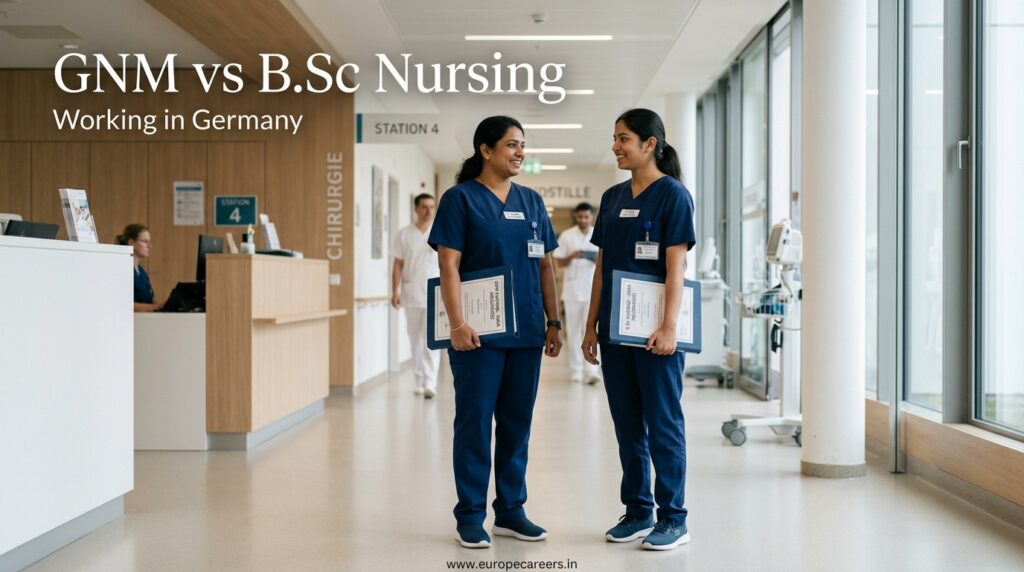
One of the most frequent questions Indian nursing professionals ask our career advisory team at Europe Careers is:
“I have completed my GNM diploma. Am I eligible to work as a registered nurse in Germany?”
Or conversely:
“I hold a 4-year B.Sc Nursing degree. Does that mean my qualification is automatically accepted in Germany without any extra tests?”
There is a widespread misconception that one Indian qualification is an automatic “winner” while the other is rejected. In reality, the German healthcare system does not simply look at certificate titles. Nursing in Germany is a strictly regulated profession under the Nursing Professions Act (Pflegeberufegesetz). Every foreign-trained nurse — regardless of whether they hold a GNM diploma, a B.Sc Nursing degree, or an M.Sc Nursing credential — must undergo an individual qualification assessment known as Anerkennung (professional recognition).
The responsible German state authority compares your specific education, subjects, theoretical hours, clinical bedside rotations, and work experience against the German reference occupation: Pflegefachfrau / Pflegefachmann (generalist nurse). Neither qualification is automatically accepted, and neither is automatically disqualified. This practical guide breaks down how both qualifications are assessed, what differences exist, and what Indian nurses should realistically prepare for.
GNM vs B.Sc Nursing — Basic Difference
In India, General Nursing and Midwifery (GNM) and Bachelor of Science in Nursing (B.Sc Nursing) serve distinct educational tracks, although both qualify graduates to register as Registered Nurses and Registered Midwives (RN/RM) with State Nursing Councils:
| Evaluation Feature | General Nursing & Midwifery (GNM) | Bachelor of Science in Nursing (B.Sc Nursing) |
|---|---|---|
| Academic Level | State Board Diploma | University Bachelor’s Degree |
| Course Duration | Typically 3 to 3.5 years (including internship) | 4 years (including integrated 6-month clinical internship) |
| Curriculum Emphasis | Hands-on bedside patient care, clinical procedures, maternal & child health | Comprehensive theory, clinical science, nursing administration, research & pedagogy |
| Minimum Clinical Hours | Varies by state curriculum and board guidelines | Standardised by Indian Nursing Council (INC) university regulations |
| Indian Career Pathway | Staff Nurse in public or private hospitals; eligible for Post Basic B.Sc Nursing | Clinical Staff Nurse, Nursing Tutor, Ward In-charge, eligible for M.Sc Nursing |
| German Reference Occupation | Evaluated against Pflegefachfrau / Pflegefachmann | Evaluated against Pflegefachfrau / Pflegefachmann |
| German Recognition Mode | Individual equivalence assessment by State Authority | Individual equivalence assessment by State Authority |
| Typical Outcome | Deficit decision (Defizitbescheid) requiring adaptation course or knowledge test | Deficit decision or partial equivalence; compensation measure usually required |
Note: Curricula and practical clinical hours vary across Indian universities and state nursing boards. German authorities do not rely on generalized comparisons; they evaluate your individual mark sheets, transcripts, and verified clinical logbooks.
What Is GNM Nursing?
General Nursing and Midwifery (GNM) is a diploma-level program focused intensely on practical, clinical bedside care. Administered by state nursing examination boards, GNM trains students in foundational nursing arts, medical-surgical nursing, community healthcare, and maternal care.
Key attributes of a GNM qualification:
- Intensive, hospital-based practical training during the diploma.
- Licensing as a Registered Nurse and Midwife (RN/RM) in India.
- Extensive experience in high-volume Indian clinical wards.
When submitted for German recognition, a GNM diploma is reviewed thoroughly. Because German nursing training (a 3-year vocational program) mandates 2,100 hours of theoretical instruction and 2,500 hours of clinical rotations across distinct specialties (including geriatric and outpatient care), GNM applicants often show differences in specific theoretical modules or specialized rotations. These differences are standard and can be compensated through structured adaptation in Germany.
What Is B.Sc Nursing?
Bachelor of Science in Nursing (B.Sc Nursing) is a 4-year undergraduate university degree established under the Indian Nursing Council (INC) framework. It combines academic nursing science, pharmacology, anatomy, and pathology with extensive bedside clinical rotations, alongside introductory research methodology and ward management.
Key attributes of B.Sc Nursing:
- Formal 4-year university degree structure.
- Higher total theoretical lecture hours compared to diploma programs.
- Rotations covering medical, surgical, paediatric, psychiatric, community health, and obstetric nursing.
While B.Sc Nursing provides a robust academic dossier, holding a degree does not guarantee automatic recognition in Germany. German authorities evaluate subject distribution rather than degree level alone. If the German authority identifies that specific outpatient or elderly care hours were missing in your syllabus, compensatory measures will still be prescribed.
Can GNM Nurses Work in Germany?
Yes, GNM nurses can work in Germany. A GNM diploma is fully eligible to be submitted for professional recognition (Anerkennung) across German federal states.
The German state competent authority reviews:
- Total theoretical hours completed across all three years.
- Verified clinical bedside rotations and hospital bed capacities.
- Post-qualification clinical experience in verified hospital settings.
- Active nursing council registration and good standing status.
In almost all cases, GNM nurses receive an official decision identifying specific differences (Defizitbescheid). Under Section 16d of the German Residence Act (AufenthG), GNM nurses can travel to Germany on a recognition visa, work as healthcare assistants (Pflegehelfer) with salary, and complete an adaptation course or knowledge test to attain full registered nurse status (Pflegefachkraft).
Can B.Sc Nursing Nurses Work in Germany?
Yes, B.Sc Nursing graduates can work in Germany. A 4-year B.Sc Nursing degree provides a comprehensive foundation for German equivalence assessments.
Because B.Sc Nursing includes extensive theoretical hours, German authorities find substantial alignment in general nursing science, pharmacology, and acute hospital care. However, because German generalist nursing training covers specialized modules in geriatric long-term care and ambulant home care that are less prominent in standard Indian curricula, even B.Sc graduates frequently receive a partial deficit decision specifying a brief adaptation period.
How Germany Compares Indian Nursing Qualifications
Germany assesses foreign healthcare qualifications against a defined domestic reference occupation. For nursing, this benchmark is:
Pflegefachfrau / Pflegefachmann / Pflegefachperson (Generalist Registered Nurse)
The German vocational nursing education requires a minimum of 4,600 total hours, divided strictly into:
- At least 2,100 hours of theoretical and practical instruction.
- At least 2,500 hours of practical bedside training across acute inpatient hospital care, long-term inpatient elderly care, outpatient care, paediatrics, and psychiatric care.
When the German state authority examines an Indian dossier, it compares your verified transcripts against these benchmarks. If your curriculum matches in hospital bedside hours but lacks sufficient elderly or outpatient care hours, the authority notes these as “substantial differences” (wesentliche Unterschiede).
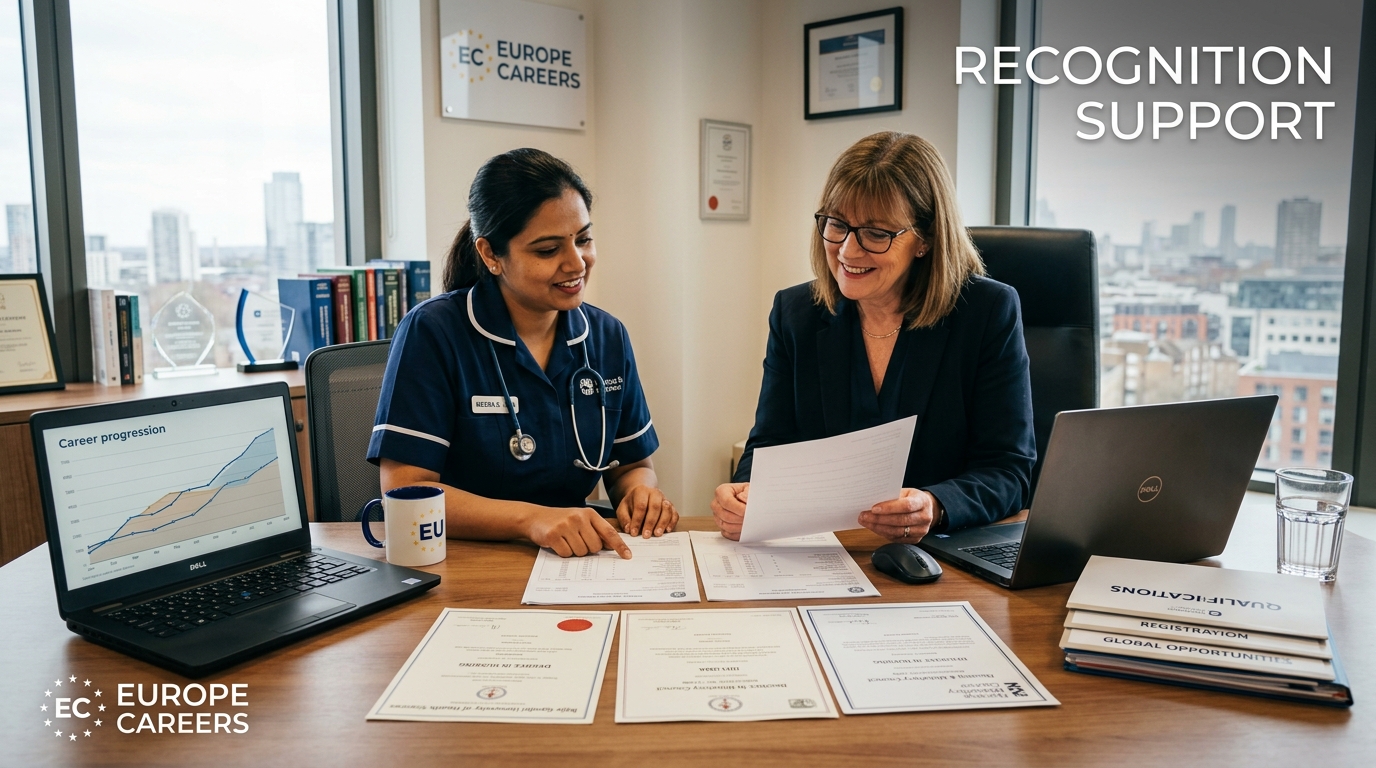
GNM vs B.Sc Nursing: What Documents Matter?
Regardless of whether you hold a GNM diploma or a B.Sc Nursing degree, the success and speed of your recognition application depend on the completeness of your academic and clinical paperwork:
- Official Hourly Transcript: A document issued by your college or university showing the exact hours spent in lectures vs. clinical postings for each subject.
- Syllabus / Curriculum Book: The formal syllabus issued by your university or state examination board detailing subject contents.
- Clinical Posting Logbook: Evidence of rotations completed during training and mandatory internships.
- State Nursing Council Registration & Good Standing: Active certificate proving your unblemished professional standing in India.
- Experience Certificates: Detailed letters from hospital HR specifying your ward postings, role, duties, and hospital bed count.
- Sworn German Translations: Official translations prepared by recognized sworn translators (vereidigte Übersetzer).
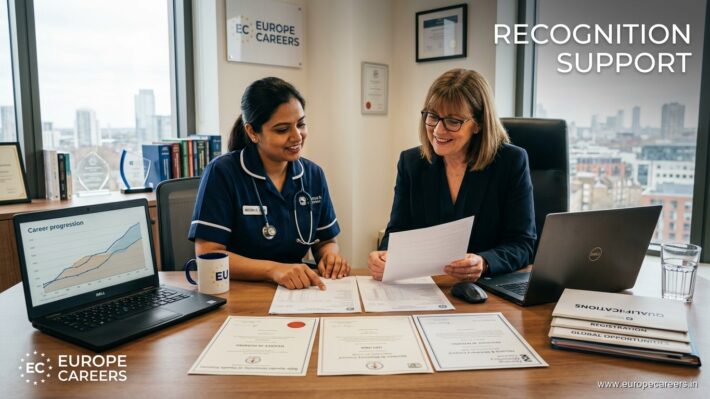
Europe Careers guides candidates through formatting and verifying their document dossier, while the formal document standards remain governed by the responsible German state office.
GNM vs B.Sc Nursing — Does Work Experience Matter?
Under German recognition regulations, verifiable post-qualification work experience can be taken into account to compensate for educational differences. If your original diploma curriculum had minor gaps in certain clinical procedures, but you have 2 – 5 years of documented bedside experience in a multi-specialty hospital, the authority can consider this experience during its assessment.
Key considerations regarding experience:
- Quality over quantity: Experience in intensive care (ICU), operating theatres, emergency departments, or medical-surgical wards is highly regarded by both recognition authorities and hospital employers.
- Official documentation: Experience must be documented through formal employer reference letters detailing hours, departments, and responsibilities.
- Not an automatic guarantee: While valuable, extensive experience does not eliminate mandatory legal requirements such as German language proficiency or personal trustworthiness clearances.
German Language Requirement for GNM and B.Sc Nurses
Language expectations are identical for both GNM and B.Sc Nursing holders. Official German guidance confirms that B2 level German is required for receiving the full professional nursing license (Berufsurkunde / Approbation).
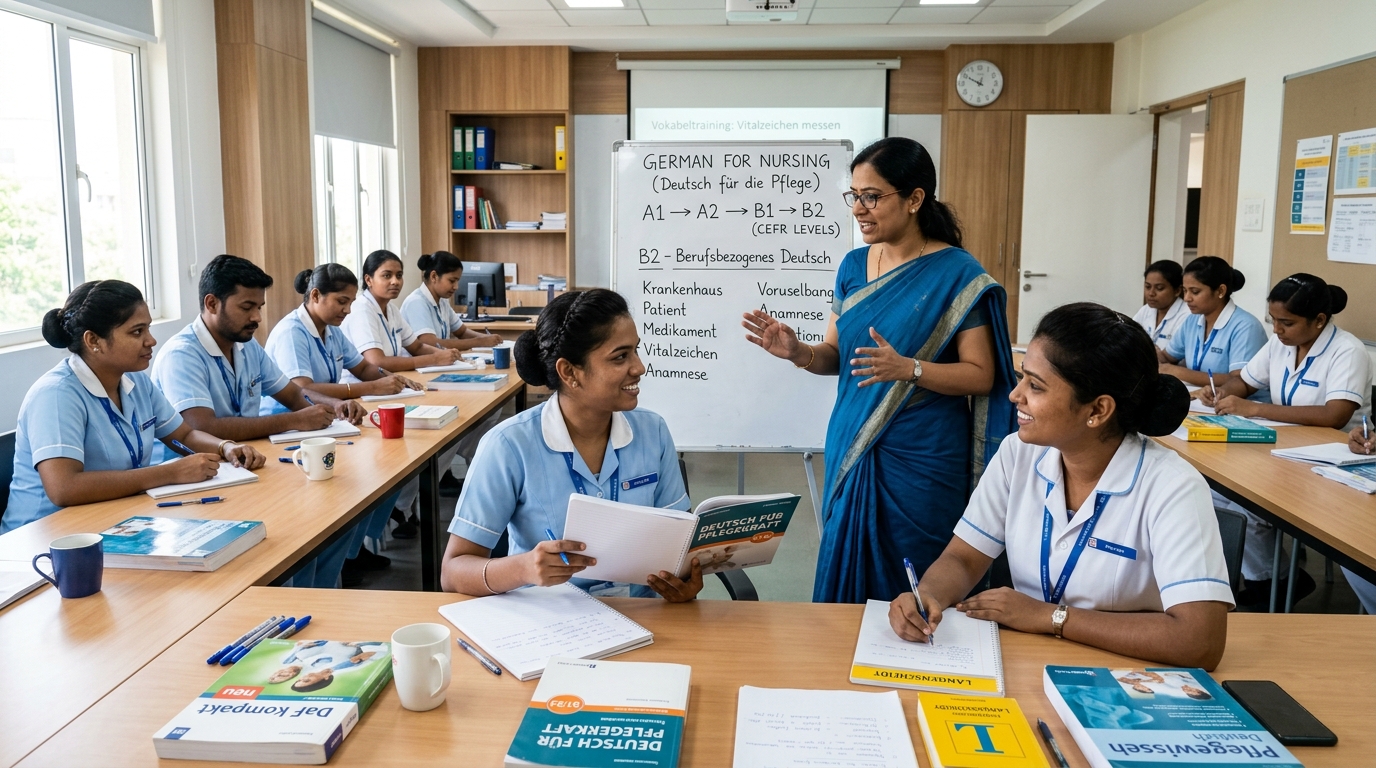
The language progression unfolds across four structured stages:
- A1 (Beginner): Everyday greetings, basic personal information, and simple questions.
- A2 (Elementary): Basic hospital vocabulary, routine daily communication, and simple past-tense exchanges.
- B1 (Intermediate): Clinical handovers, comprehending routine medical documentation, and the prerequisite level for visa entry under recognition pathways.
- B2 (Professional / Clinical): Fluent dialogue with doctors, patients, and relatives; accurate medical record documentation; and passing specialized clinical nursing exams (e.g. telc Deutsch B1-B2 Pflege or state Fachsprachenprüfung).
What Happens During Nursing Recognition?
The recognition journey for Indian nurses follows a systematic administrative sequence:
Indian Nursing Qualification → Document Preparation → Recognition Application → Equivalence Assessment → Recognition Decision → Full Recognition OR Identified Differences → Adaptation / Knowledge Test if Required → Professional Requirements → Employment Pathway
The competent state authority typically takes 3 to 4 months to review a complete application file. Once reviewed, the official notice (Bescheid) outlines the exact legal outcome.
What Is a Defizitbescheid?
A Defizitbescheid is the official legal notice issued when a German state authority determines that substantial differences exist between your Indian education and the German reference profession. It is not a rejection.
The notice clearly defines the deficits and gives the applicant two pathways to achieve full registered nurse equivalence:
- Adaptation Period (Anpassungslehrgang): A period of supervised clinical training in a German hospital (usually 6 to 12 months) addressing the identified areas, concluded by a clinical assessment. Nurses work with a salary during this period.
- Knowledge Test (Kenntnisprüfung): An examination covering the mandatory German state nursing exam content, assessing both theoretical and practical clinical skills.
Is B.Sc Nursing Better Than GNM for Germany?
It is inaccurate to describe one qualification as definitively “better” than the other. Both qualifications lead to the identical professional license (Pflegefachfrau / Pflegefachmann) once recognition is completed. The practical distinctions lie in how the process unfolds:
B.Sc Nursing Advantages: With a 4-year degree curriculum, B.Sc graduates generally have more theoretical hours on paper, which can reduce the number of deficit modules listed in their recognition decision. A degree is also an advantageous foundation if you plan to pursue hospital management or university master’s studies in Germany later.
GNM Advantages: GNM diploma holders often have extensive hands-on bedside experience from high-volume Indian hospital wards. Because German nursing is traditionally a vocational profession with immense respect for bedside skill, hospital directors warmly welcome GNM nurses who demonstrate strong clinical instincts and solid German language skills.
Ultimately, your success in Germany is determined by your German language proficiency, your commitment to completing your adaptation course, and your clinical dedication — not simply your degree title.
GNM vs B.Sc Nursing — Germany Pathway Comparison
| Pathway Stage | GNM Diploma Pathway | B.Sc Nursing Pathway |
|---|---|---|
| Language Prep | A1 to B2 German required | A1 to B2 German required |
| Recognition Type | Individual equivalence assessment | Individual equivalence assessment |
| Document Filing | Diploma, mark sheets, clinical hours, transcript | Degree certificate, mark sheets, detailed transcript |
| Clinical Experience | Considered to balance curriculum differences | Considered during equivalence review |
| Recognition Result | Deficit notice (Anpassungslehrgang required) | Deficit notice (Anpassungslehrgang or exam required) |
| Visa Category | Section 16d AufenthG (Recognition measures) | Section 16d or Section 18g Skilled Worker Visa |
| Final Title | Pflegefachfrau / Pflegefachmann | Pflegefachfrau / Pflegefachmann |
| Hospital Salary | Identical collective wage once fully licensed | Identical collective wage once fully licensed |
How Europe Careers Helps GNM and B.Sc Nurses
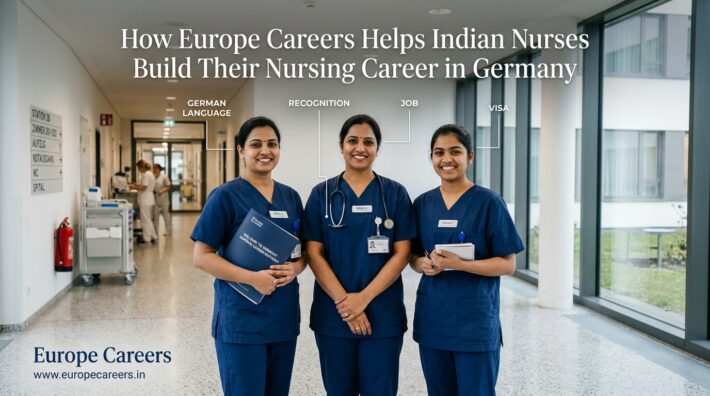
At Europe Careers, we provide honest counselling and step-by-step operational support for both GNM and B.Sc Nursing graduates. Depending on your background and program agreement, our services include:
- Profile Assessment: Thorough review of your transcripts, clinical hours, and work history.
- Career Guidance: Clear orientation regarding realistic timelines, federal state selections, and hospital sectors.
- German Language Training: Structured courses up to B2 level with certified instructors.
- Document Preparation Guidance: Assembling complete dossiers and arranging sworn German translations.
- Recognition Process Tracking: Submitting applications to the competent state authority and tracking decisions.
- Employer Coordination: Introducing qualified profiles to accredited German hospital employers.
- Interview Coaching: Conducting mock clinical interviews in German.
- Visa Documentation Support: Preparing visa appointment paperwork according to German consulate requirements.
- Pre-Departure Briefings: Guidance on travel, luggage, clothing, and cultural orientation.
- Relocation Guidance: On-arrival support including local city registration (Anmeldung), health insurance, and hospital onboarding.
Europe Careers Process for Indian Nurses
Our structured pathway is built around eight transparent milestones:
ASSESS → PREPARE → LEARN → RECOGNISE → CONNECT → PREPARE FOR EMPLOYMENT → VISA → RELOCATE
Each phase is designed to ensure you never invest time or resources into applications without having your prerequisite qualifications and language milestones securely verified first.
What Should a GNM Nurse Do First?
- Obtain your consolidated mark sheets and official college transcript.
- Request an hourly breakdown certificate showing theory vs. clinical hours.
- Confirm that your State Nursing Council registration and Good Standing are active.
- Secure detailed experience letters from past and current hospital employers.
- Start intensive German language training (A1/A2) immediately.
- Select the German federal state where you intend to practice.
- Prepare certified copies and sworn German translations of your records.
- Submit your recognition application to the competent state authority.
- Receive your deficit decision and prepare for your hospital adaptation placement.
- Attend hospital interviews and apply for your Section 16d recognition visa.
What Should a B.Sc Nursing Graduate Do First?
- Collect your official degree certificate, provisional certificate, and yearly mark sheets.
- Request an official university transcript detailing subject-wise lecture and clinical rotation hours.
- Verify your State Nursing Council registration.
- Obtain verified work experience certificates from your hospital employers.
- Dedicate focused effort to German language classes aiming for B1/B2 certification.
- Submit your recognition application to the designated German recognition office.
- Attend hospital interviews arranged with partnering German medical facilities.
- Finalize your employment contract and proceed with your skilled worker or recognition visa application.
Common Mistakes GNM and B.Sc Nurses Should Avoid
- Assuming Degree Equals Automatic Recognition: Assuming a B.Sc Nursing degree bypasses the German equivalence process without document checks.
- Submitting Documents Without Hourly Breakdowns: Sending certificates without transcripts showing exact lecture and bedside hours.
- Neglecting Clinical Logbooks: Omitting verified internship records that prove bedside rotations.
- Delaying German Language Studies: Waiting until the recognition decision arrives before starting German studies.
- Filing in the Wrong State Authority: Submitting files to an arbitrary German state office rather than the state where employment is planned.
- Confusing Recognition with a Job Guarantee: Equivalence is a legal credential check, not an employment contract.
- Relying on Unverified Agents: Trusting unverified recruitment promises that offer “no-German” or “direct flight” nursing jobs.
- Paying Fees Without Formal Agreements: Committing funds without a written, transparent service contract.
- Expecting Identical Timelines for Every Applicant: Every file has unique educational hours and individual state review speeds.
GNM vs B.Sc Nursing — Which Documents Should You Start Collecting?
Use these practical checklists to begin organizing your professional dossier:
GNM Nurse Document Checklist
- [ ] GNM Diploma Certificate
- [ ] 1st, 2nd, and 3rd Year Mark Sheets
- [ ] Official College Transcript with detailed hours
- [ ] Clinical Posting & Internship Logbook details
- [ ] State Nursing Council Registration Certificate (RN/RM)
- [ ] Certificate of Good Standing from Nursing Council
- [ ] Hospital Work Experience Certificates
- [ ] Valid Passport (minimum 2 years validity)
- [ ] Updated Professional Curriculum Vitae (CV)
- [ ] German Language Certificates (as completed)
B.Sc Nursing Document Checklist
- [ ] B.Sc Nursing Degree Certificate / Provisional Degree
- [ ] 1st to 4th Year Individual & Consolidated Mark Sheets
- [ ] Official University Transcript with theory and practical hours
- [ ] University Syllabus Book / Course Curriculum breakdown
- [ ] Clinical Internship Completion Certificate
- [ ] State Nursing Council Registration Certificate
- [ ] Certificate of Good Standing
- [ ] Bedside Clinical Work Experience Certificates
- [ ] Valid Passport
- [ ] Updated Professional CV
- [ ] German Language Certificates
Frequently Asked Questions (FAQ)
1. Can GNM nurses work in Germany?
Yes. GNM nurses are eligible to apply for German qualification recognition. Once their deficit decision is issued, they can enter Germany, complete an adaptation course, and receive their full nursing license.
2. Can B.Sc Nursing graduates work in Germany?
Yes. B.Sc Nursing graduates regularly undergo the German recognition process. Their 4-year curriculum provides a strong academic foundation for equivalence evaluation.
3. Is GNM recognized in Germany?
GNM is assessed individually against the German reference occupation Pflegefachfrau/Pflegefachmann. It typically receives a deficit notice rather than instant full equivalence, allowing candidates to bridge remaining modules in Germany.
4. Is B.Sc Nursing automatically recognized in Germany?
No. No foreign degree receives automatic recognition without individual document verification by the designated state authority.
5. Is B2 German required for Indian nurses?
Yes. Official German regulations require certified B2 German for receiving the full professional license (Berufsurkunde). Entry with B1 is possible under specific recognition visa programs to complete language training in Germany.
6. Does work experience help during recognition?
Yes. Verified post-qualification bedside clinical experience can be formally considered by the recognition authority to compensate for minor curricular hour gaps.
7. What is Anerkennung?
Anerkennung is the German term for the formal professional equivalence procedure where an authority compares foreign training with German standards.
8. What is a Defizitbescheid?
A Defizitbescheid is an official decision outlining specific differences between your training and the German benchmark, detailing required compensatory measures.
9. What is an adaptation programme (Anpassungslehrgang)?
An adaptation course is a period of supervised hospital work and targeted lectures in Germany designed to bridge deficit areas, ending with a final clinical assessment.
10. What is a knowledge test (Kenntnisprüfung)?
A knowledge test is an alternative examination covering the content of the German state nursing final exam. Passing it directly grants professional equivalence.
11. Can I apply for recognition from India?
Yes. The entire recognition application dossier is prepared and submitted to the German state authority while you are still residing in India.
12. Does Europe Careers help with recognition?
Yes. Europe Careers guides you in gathering transcripts, obtaining certified translations, filing with the correct state authority, and interpreting your decision.
13. Does Europe Careers provide German language training?
Yes. We organize structured German language courses from A1 to B2 with qualified language trainers focusing on medical and general German.
14. Can Europe Careers help with employer opportunities?
Yes. We coordinate with accredited German hospitals, clinics, and care centres looking for qualified Indian nurses and schedule formal employer interviews.
15. Does Europe Careers guarantee a job or visa?
No. Europe Careers does not guarantee jobs or visas. Hiring decisions are made solely by hospital employers, and visa decisions remain the exclusive legal jurisdiction of German embassies and immigration authorities.
16. What documents should a GNM nurse prepare first?
Start with your diploma certificate, 3-year mark sheets, nursing council registration, official transcript showing theory/clinical hours, and experience letters.
17. What documents should a B.Sc Nursing graduate prepare first?
Obtain your 4-year mark sheets, degree certificate, official university transcript with hourly breakdowns, nursing registration, and hospital experience letters.
18. Do GNM and B.Sc nurses earn the same salary in Germany?
Once fully licensed as a registered nurse (Pflegefachkraft), both GNM and B.Sc nurses are paid under the same collective wage agreements (e.g. TVöD Pflege) based on role and experience, without salary discrimination based on Indian qualification type.
19. Can Post Basic B.Sc Nursing nurses also apply?
Yes. Post Basic B.Sc Nursing strengthens your profile by adding degree-level academic credits to your foundational GNM diploma.
20. Can fresh nursing graduates apply?
Yes, fresh graduates can commence language studies and initiate recognition filings immediately upon receiving their provisional degree/diploma and nursing registration.
21. How long does the entire journey take?
The overall journey typically takes between 9 and 18 months, with the majority of time dedicated to mastering the German language from A1 to B1/B2.
Final Conclusion: Focus on the Complete Pathway
Whether you hold a GNM diploma or a B.Sc Nursing degree, you have a viable, legally established pathway to practice as a registered nurse in Germany. German authorities do not view one qualification as an outright winner over the other; rather, they evaluate your individual training, curriculum depth, and clinical experience.
Your journey is a balanced equation combining five essential components:
Qualification + German Language Mastery + Official Recognition + Employer Opportunity + Visa Clearance
By preparing complete transcripts, committing wholeheartedly to German language learning, and working with transparent, professional advisors, you can navigate the process with confidence and clarity.
Not Sure How Your Qualification Fits the Germany Pathway?
If you are an Indian nurse holding a GNM diploma, B.Sc Nursing, or Post Basic B.Sc qualification, the advisory team at Europe Careers is here to review your documents, guide your German language preparation, and help you understand your realistic pathway to Germany.
- Website: www.europecareers.in
- Email: support@europecareers.in
- Related Guides: Read our detailed breakdown on Recognition of Indian Nursing Qualifications in Germany and our overview on How Europe Careers Helps Indian Nurses.