
How Long Does It Take to Become a Registered Nurse in Germany? Complete 2026 Guide for Indian Nurses

Introduction: The Question Every Indian Nurse Asks First
 Before making one of the biggest decisions of their professional life, every Indian nurse planning to work in Germany asks the same question.
How long will it actually take?
Not just the training. Not just the language. The whole process — from where you are sitting right now in India to the day you walk into a German hospital as a fully licensed registered nurse.
The good news is this — in 2026, the timeline is shorter than most people think.
Thanks to major changes in Germany’s immigration laws — particularly the Recognition Partnership scheme introduced under the Skilled Immigration Act — Indian nurses can now reach Germany and start working in as little as 8 to 10 months from the day they start preparing. Full Approbation — the German nursing licence — typically follows within 12 to 15 months of starting the process.
This guide by EuropeCareers gives you the complete honest picture — every stage of the journey, how long each one takes, and exactly what you need to do to stay on the fastest possible timeline.
What You Are Working Toward — The Approbation
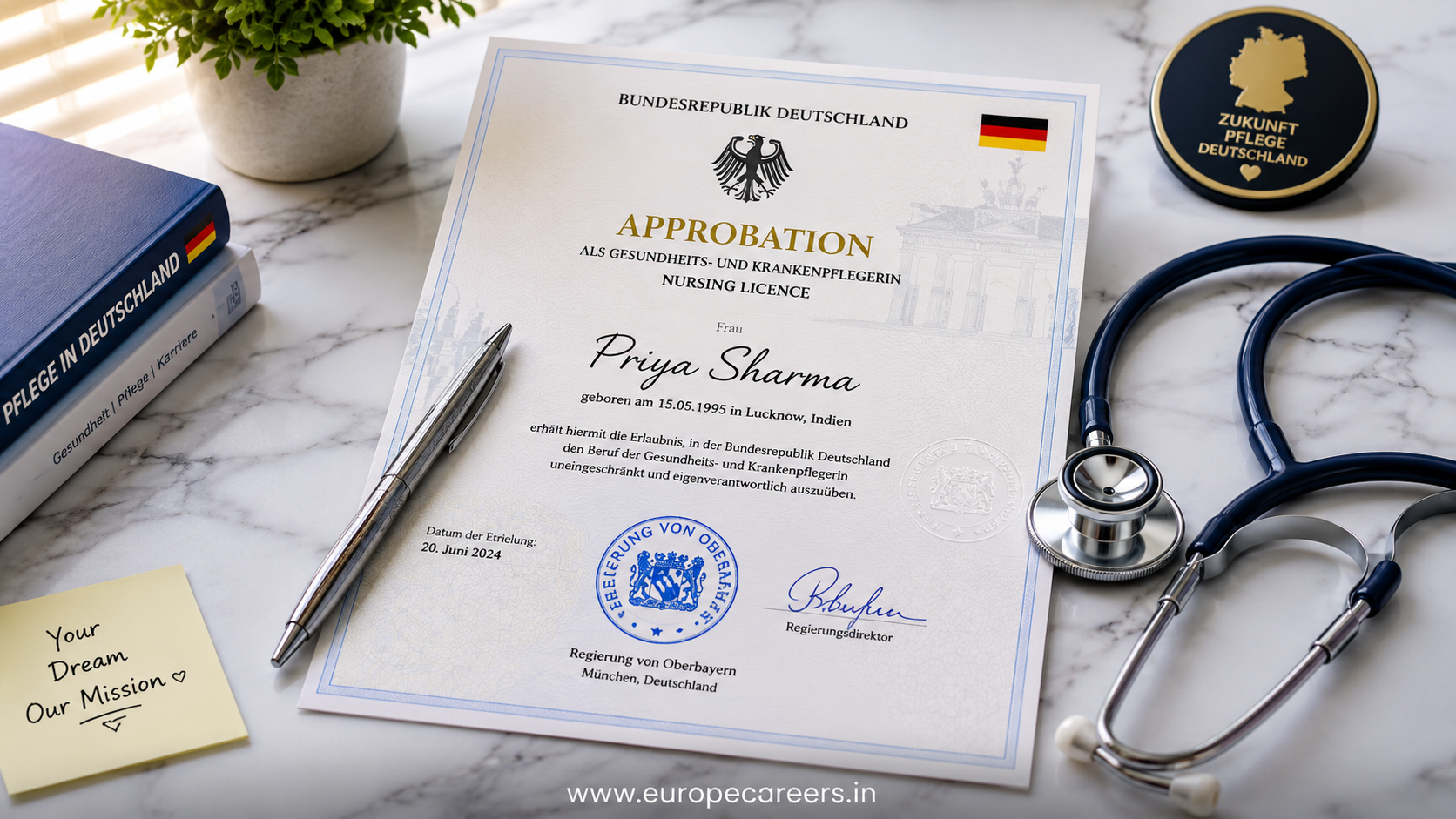 Before diving into the timeline, understand the end goal.
To legally practice as a fully qualified nurse in Germany, you need the Approbation — the official German nursing licence. It is issued by the relevant state government authority — each German state has its own Approbation office.
The Approbation is not a registration like the NMC in the UK or AHPRA in Australia. It is a state-issued licence — and it is permanent once issued. You do not renew it. You do not pay annual fees to maintain it. Once you have it, it is yours for life.
Every step in this guide is working toward that single document.
The Fastest Route in 2026 — Recognition Partnership
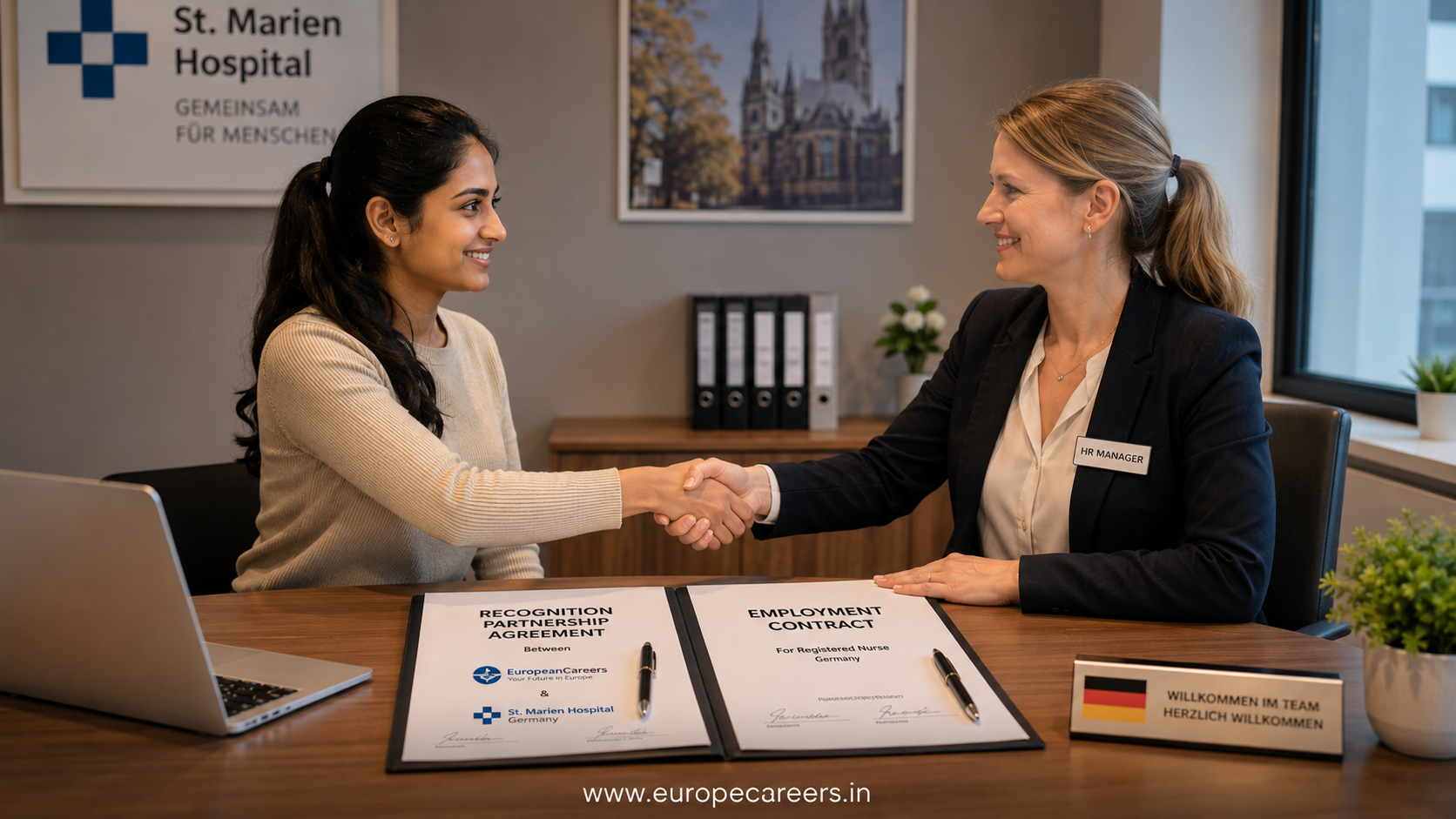 The single biggest change that makes the 12 to 15 month timeline possible is the Recognition Partnership — called Anerkennungspartnerschaft in German.
Before 2024, Indian nurses had to complete the full qualification recognition process from India — waiting months for their documents to be assessed — before they could enter Germany to work. This meant many nurses sat at home for 12 to 18 months with no income before even arriving.
That has completely changed.
Under the Recognition Partnership, you can now:
Enter Germany with just A2 level German and a signed job offer. Start working in a German hospital immediately — earning a full salary — under nursing supervision. Complete the recognition process while already living and working in Germany. Receive your Approbation while employed.
This one change compresses the overall timeline dramatically. Instead of waiting in India for recognition to be completed, you are in Germany earning money while recognition runs in the background.
The Recognition Partnership requires three things — a German employer willing to sign the partnership agreement, A2 level German, and your nursing qualification documents. That is all.
The Complete 12 to 15 Month Timeline — Stage by Stage
Here is the realistic, honest timeline broken into clear stages for Indian nurses in 2026.
Stage 1 — German Language A1 and A2
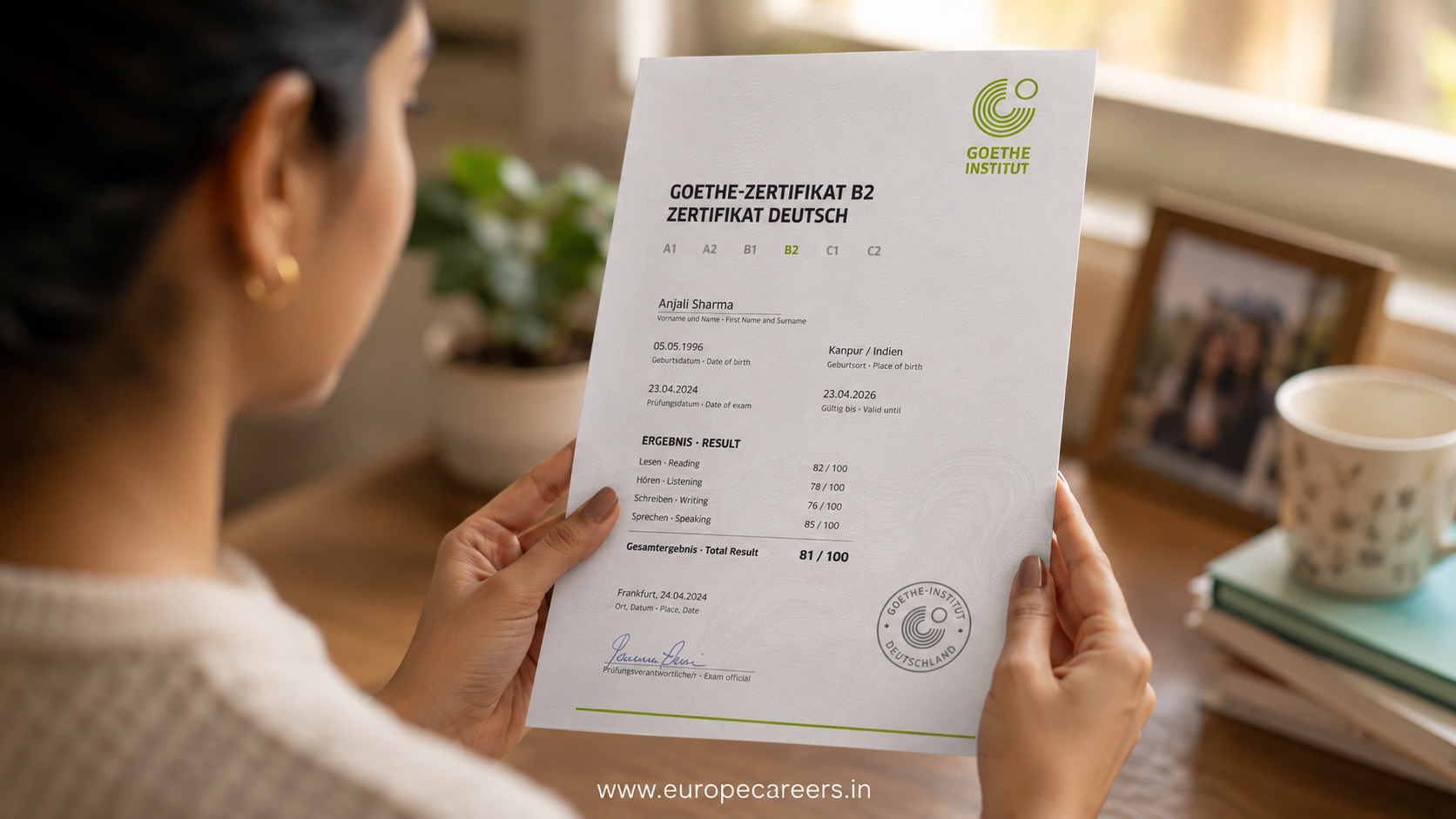 Time required: 3 to 4 months
What you need: A2 certificate from Goethe-Institut or telc
This is where everything starts. Begin your German language course immediately — on the same day you decide to pursue Germany as your career destination.
A1 level covers basic German — greetings, numbers, simple sentences, everyday vocabulary. A2 covers slightly more complex communication — basic medical vocabulary, simple patient interaction phrases, and everyday conversation.
Reaching A2 from zero takes approximately 3 to 4 months for motivated Indian nurses who study 2 to 3 hours daily. Many Indian nurses complete A1 and A2 together in one intensive course at the Goethe-Institut or a private language centre.
The Goethe-Institut has examination centres in Delhi, Mumbai, Kolkata, Pune, Bengaluru, and Chennai. The telc examination network also has centres across India. Both certificates are accepted by German immigration authorities.
At A2, you can apply for the Recognition Partnership visa. You do not need B2 to enter Germany under this route. This is what makes the 12 to 15 month timeline possible — you enter Germany at A2 and continue learning German while working.
Run parallel to this stage: Begin collecting your nursing documents — qualification certificates, marksheets, Council registration, and work experience letters. Getting apostilles and certified translations takes 6 to 8 weeks — start this immediately alongside your A1 course so documents are ready by the time you finish A2.
Stage 2 — Find a German Employer
Time required: 1 to 2 months (runs parallel to language learning)
What you need: Signed employment contract and Recognition Partnership agreement
While you are completing your A1 and A2 German course, begin your job search for a German nursing employer simultaneously.
German hospitals and care homes actively recruit Indian nurses internationally. The shortage of nurses in Germany is so severe — over 200,000 unfilled positions — that most large hospital groups have dedicated international recruitment processes.
Employers to approach include major German hospital groups — Asklepios, Helios, Sana, Vivantes, Charité, and Universitätsklinikum groups across different states. Elderly care home groups — AWO, Caritas, Diakonie, and private care companies — are also active international recruiters.
German nursing recruitment agencies are another important channel. These agencies connect Indian nurses with German employers and often handle much of the paperwork on your behalf.
Once you receive a job offer, the employer provides two key documents — the signed Arbeitsvertrag — employment contract — and the signed Anerkennungspartnerschaft agreement — the Recognition Partnership document confirming they will support your recognition process. Both documents are needed for your visa application.
You do not need your full recognition completed to receive a job offer. You need your qualification documents, your A2 German certificate or proof of enrolment in a German course, and a professional nursing CV in European format.
Stage 3 — Document Preparation and Apostille
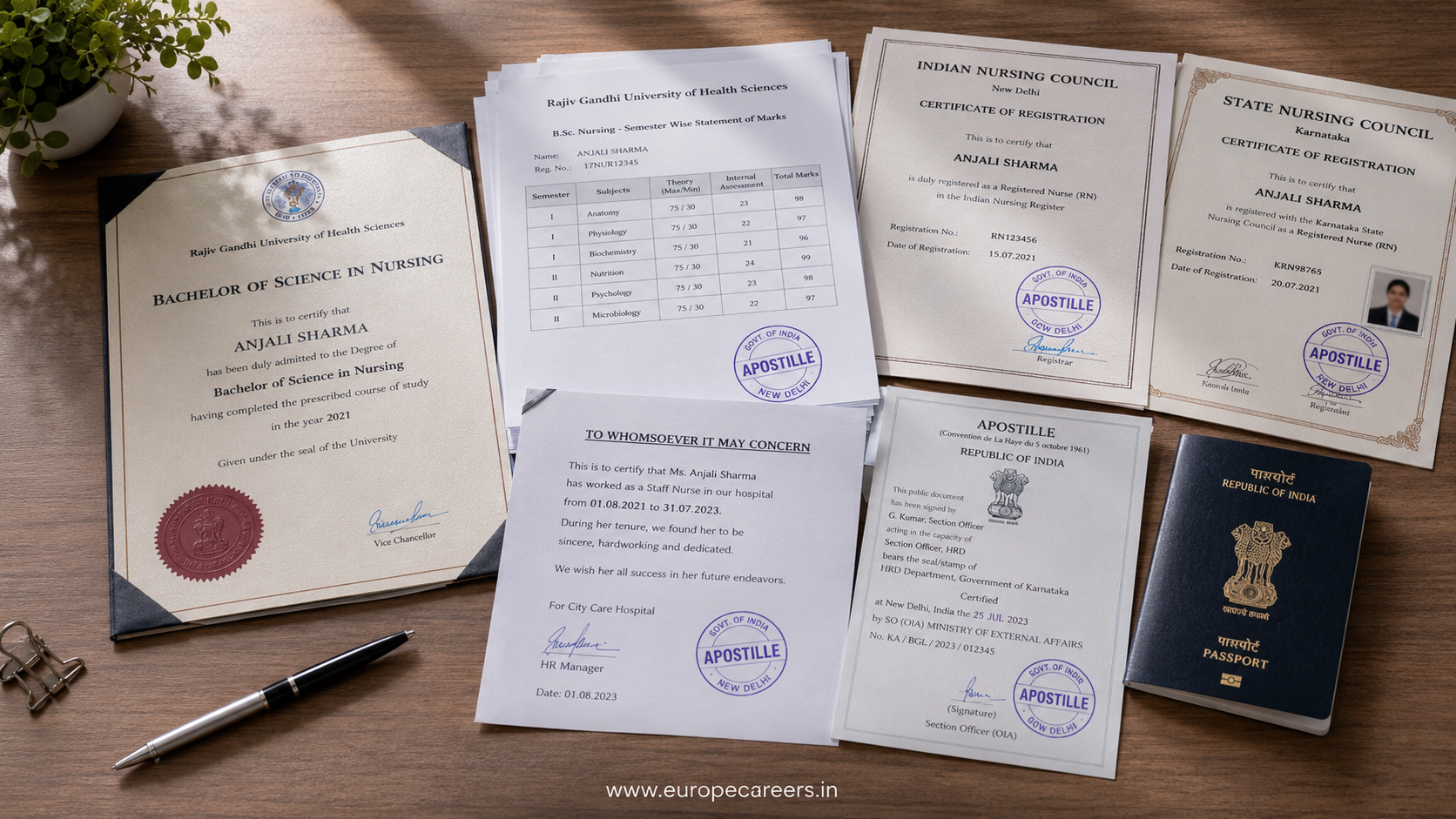 Time required: 6 to 8 weeks (runs fully parallel to Stages 1 and 2)
What you need: Apostilled and translated nursing documents
Start collecting and preparing your documents from Day 1 — do not wait until your language course is finished.
Documents required:
GNM or BSc Nursing certificate. All semester marksheets and transcripts. Practical training hours certificate from your nursing college. State Nursing Council registration certificate. Indian Nursing Council registration certificate. Work experience letters from every hospital where you worked after qualification. Valid passport with at least 3 years remaining validity.
Apostille process: All documents must be apostilled by the Ministry of External Affairs in India. The MEA has apostille facilitation centres in Delhi, Mumbai, Kolkata, Chennai, Bengaluru, and other cities. The process typically takes 3 to 4 weeks if submitted directly or through an authorised agency.
Certified German translation: All documents must be accompanied by certified German translations by a sworn translator. Allow 2 to 3 weeks for professional translation of your full document set. Several translation agencies in India specialise in medical and nursing documents for Germany.
Total document preparation time running parallel to language: 6 to 8 weeks. If you start on Day 1, your documents are ready by the time you finish your A2 language course.
Stage 4 — Visa Application
Time required: 6 to 10 weeks
What you need: Recognition Partnership visa — Type D National Visa
With your A2 German certificate, employment contract, Recognition Partnership agreement, and apostilled translated documents in hand, you apply for the German Recognition Partnership visa.
This is a National Type D long stay visa applied for at the German Embassy or the relevant German Consulate — Delhi, Mumbai, Chennai, or Bengaluru — depending on your home state. Many applications are submitted through VFS Global centres.
Documents for the visa application:
Valid passport. Completed visa application form. Signed employment contract. Signed Recognition Partnership agreement. Nursing qualification certificates with apostille and certified German translations. A2 German language certificate. Police clearance certificate from India. Medical fitness certificate. Biometric passport photographs. Visa fee of €75.
Processing time: German nursing visas under the Recognition Partnership pathway are typically processed in 6 to 10 weeks when the application is complete. Incomplete applications cause significant delays — make sure every document is included before submitting.
Book your visa appointment as early as possible. German Embassy appointments fill up quickly — book your slot as soon as you have your employer contract, even if you are still gathering remaining documents.
Stage 5 — Arrive in Germany and Begin Working
Timeline position: Approximately Month 5 to Month 6 from Day 1
Once your visa is approved, you travel to Germany.
On arrival, you register your address at the Einwohnermeldeamt — the local residents registration office. This is mandatory and must be done within two weeks of arrival. Your employer will guide you through this process.
You then apply for your Temporary Residence Permit — Aufenthaltserlaubnis — at the local Ausländerbehörde — Foreigners Authority. Your employer’s HR team typically assists with this.
You begin working immediately as a supervised nurse — Pflegehilfskraft or supervised Pflegefachkraft — earning your German salary from day one.
Average salary during the recognition period is approximately €2,400 to €2,800 gross per month — roughly 2.1 to 2.5 lakh rupees per month. This is your income while the recognition process runs in the background.
Stage 6 — Anerkennung Application Processing
Time required: 3 to 6 months (runs while you work in Germany)
What you need: Submitted application to state authority
Your employer submits the Anerkennung — recognition — application to the relevant German state authority on your behalf — or assists you in submitting it. This is the formal assessment of whether your Indian nursing qualification meets German standards.
The authority compares your Indian nursing curriculum, practical training hours, and qualifications against German nursing standards under the Pflegeberufegesetz — the German Nursing Professions Act.
Processing times by state:
Bavaria — 3 to 5 months with complete applications
Baden-Württemberg — 3 to 5 months
North Rhine-Westphalia — 4 to 6 months
Other states — 3 to 7 months depending on backlog
Three possible outcomes:
Full equivalence: Your Indian qualification is fully equivalent to German nursing standards. Approbation is issued immediately without additional training. This is more likely for BSc Nursing graduates from recognised universities with 3 or more years of clinical experience.
Partial equivalence with compensation measures: Your qualification has specific gaps compared to German standards. You complete a supervised adaptation period — Anpassungslehrgang — of 3 to 6 months. This is the most common outcome for Indian nurses.
Non-equivalence: Very rare for recognised Indian nursing qualifications. Seek advice from EuropeCareers if you receive this outcome.
Since you are already working in Germany during processing, this stage does not add to the overall time away from earning — it runs concurrently with your employment.
Stage 7 — Compensation Measures If Required
Time required: 3 to 6 months
What you need: Supervised adaptation period at your German employer
If the Anerkennung authority identifies gaps — which is common for Indian nurses — you complete the Anpassungslehrgang — supervised practical adaptation period.
During this period, you continue working at your German hospital under the supervision of a senior registered German nurse. You are assessed on specific clinical competencies identified as gaps in your Indian training — typically areas like documentation standards, German nursing protocols, patient communication techniques, and specific procedural differences.
You are paid your full salary during the Anpassungslehrgang. This is not unpaid training — it is supervised employment.
Duration is typically 3 to 6 months for most Indian nurses. BSc Nursing graduates with significant clinical experience often complete it in 3 months. GNM graduates may need the full 6 months.
At the end of the Anpassungslehrgang, the supervising authority assesses you. If successful, your Approbation application proceeds.
Fachsprachprüfung — Clinical Language Examination:
Several German states — including Bavaria, Baden-Württemberg, and North Rhine-Westphalia — also require a Fachsprachprüfung — a specialist clinical language test in German — before issuing the Approbation. This tests your ability to communicate professionally in nursing situations — patient handovers, documentation, doctor communication, and patient education. It is conducted at C1 German level.
If your state requires it, prepare for the Fachsprachprüfung alongside your Anpassungslehrgang. The preparation takes approximately 6 to 8 weeks of focused study if you are already at B2 German by this point — which you will be after 6 to 8 months of working in Germany.
Stage 8 — Approbation Issued
Timeline position: Month 12 to Month 15 from Day 1
What you need: Nothing — the authority processes and issues it
Once your Anerkennung is complete and compensation measures are passed — or if you received full equivalence — the state authority issues your Approbation.
The Approbation typically takes 2 to 6 weeks to be formally issued and delivered after all requirements are met.
From this point forward, you are a fully licensed registered nurse in Germany — independently practicing, not supervised — with the right to:
Work in any German hospital, clinic, care home, or healthcare setting across all 16 German states. Apply for senior nursing roles, specialist nursing positions, and nursing management roles. Progress toward permanent residency — which is achievable in 21 months with B1 German or 33 months with standard requirements. Bring your family to Germany under family reunification.
The Full 12 to 15 Month Timeline at a Glance

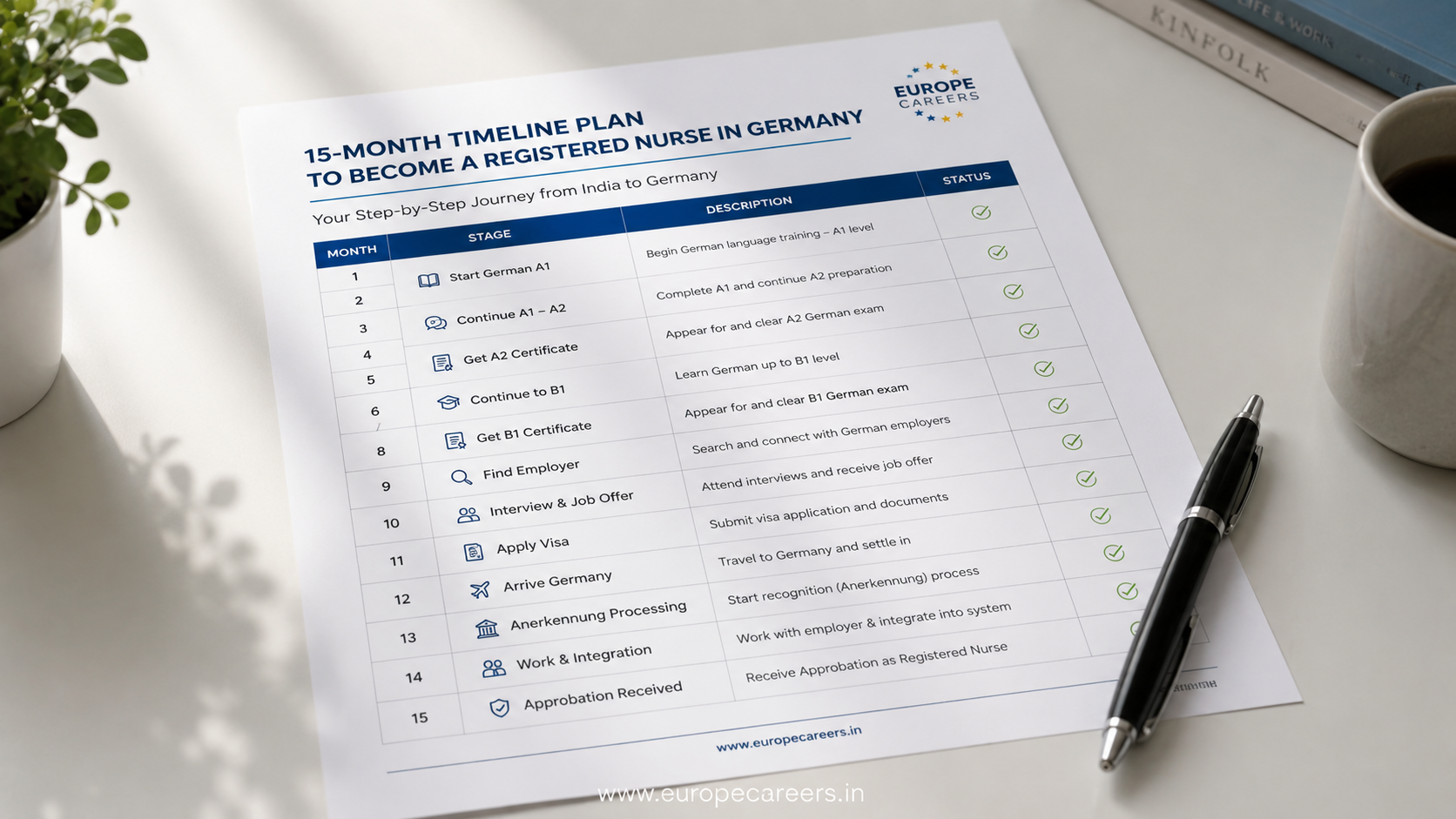
| Month | What Happens |
|---|---|
| Month 1 | Start A1 German course. Begin document collection and apostille process simultaneously. |
| Month 2 | Continue A1 German. Documents being apostilled and translated. Begin job search. |
| Month 3 | Complete A1. Begin A2 German. Documents ready. Actively applying to German employers. |
| Month 4 | Complete A2 and get certificate. Job offer received. Employment contract signed. |
| Month 5 | Visa application submitted with all documents. |
| Month 6 to 7 | Visa approved. Fly to Germany. Register address. Begin working as supervised nurse. Anerkennung application submitted by employer. |
| Month 7 to 12 | Working and earning in Germany. Anerkennung being processed. Continuing German language — B1 and B2. |
| Month 10 to 12 | Anerkennung outcome received. Anpassungslehrgang begins if required. Fachsprachprüfung preparation if required by state. |
| Month 13 to 15 | Anpassungslehrgang completed. Fachsprachprüfung passed if required. |
| Month 14 to 15 | Approbation issued. Full registered nurse status in Germany. |
What Speeds Up the Timeline
Starting German immediately:
Every week you delay starting German is a week added to your overall timeline. Start A1 on the day you decide to pursue Germany.
BSc Nursing qualification:
BSc Nursing graduates are assessed more favourably than GNM in most states — higher likelihood of full equivalence or shorter Anpassungslehrgang. If you have a BSc Nursing, you are in a strong position.
Strong clinical work experience:
3 or more years of post-qualification clinical experience — especially ICU, surgical, emergency, or critical care — significantly improves your Anerkennung outcome. Document every year of experience carefully with detailed work experience letters from your employer.
Choosing a fast-processing state:
Bavaria and Baden-Württemberg consistently process Anerkennung applications faster than many other states. If you have flexibility in choosing your employer location, consider this.
Complete and correct documents first time:
Incomplete applications are the single biggest cause of delays. Submit complete, correctly apostilled, correctly translated documents and your processing time will be at the shorter end of the range.
Using an experienced employer:
German hospitals and care homes that have hired Indian nurses before have established processes and relationships with Anerkennung authorities. They know exactly what documents to submit and how to avoid delays. An experienced employer is worth significantly more than an inexperienced one even if the salary is slightly lower.
GNM vs BSc Nursing — Does It Affect the Timeline
Yes — but it does not stop you.
BSc Nursing (4 years from a recognised university):
Most likely outcome is partial equivalence with a short Anpassungslehrgang of 3 to 4 months. Full equivalence is possible with strong clinical experience. Overall timeline: 12 to 14 months.
GNM (3.5 years):
Anerkennung outcome varies more widely. Many GNM nurses receive partial equivalence with an Anpassungslehrgang of 4 to 6 months. Some states assess GNM as having larger gaps — particularly in nursing theory. Overall timeline: 14 to 16 months. Still within range of 15 months for many candidates.
GNM with Post Basic BSc Nursing:
Very strong position. The combined qualification closes most gaps. Likely outcome is partial equivalence with shorter compensation measures. Timeline similar to or slightly faster than straight BSc Nursing.
Practical advice for GNM nurses: Build strong clinical work experience before applying. 5 or more years of hands-on hospital experience — particularly in specialty areas — compensates significantly for the shorter theoretical training and results in better Anerkennung outcomes.
What You Earn During the Process
This matters enormously for planning and it is one of Germany’s most important advantages over other nursing destinations.
During the Recognition Partnership supervised period — Months 6 to 12:
Salary is typically €2,200 to €2,800 gross per month depending on employer and state. Net take home approximately €1,600 to €2,000 per month — roughly 1.42 to 1.77 lakh rupees per month in hand.
After Approbation — From Month 14 to 15 onward:
Full registered nurse salary. Average €2,800 to €3,800 gross per month. Net take home approximately €1,900 to €2,600 per month — roughly 1.68 to 2.3 lakh rupees per month in hand.
Night shift, weekend, and public holiday allowances add significantly to these figures — nurses who work regular night shifts can earn €200 to €600 extra per month.
The key point is that from Month 6 or 7 onward, you are earning a German salary — not waiting at home in India. By the time you receive your Approbation at Month 14 to 15, you have already earned 8 to 9 months of German nursing income.
Frequently Asked Questions
How long does it take for an Indian nurse to get a job in Germany in 2026?
Under the Recognition Partnership route, Indian nurses can start working in Germany within 5 to 7 months of starting the process — once A2 German is complete, a job offer is received, and the visa is processed. Full Approbation typically follows within 12 to 15 months of starting.
Do I need B2 German before going to Germany as a nurse?
Not under the Recognition Partnership route. You can enter Germany with A2 German and a signed employment contract. However you must reach B2 and ideally C1 while working in Germany — this is required for the Fachsprachprüfung in many states and for full clinical independence.
What is the Recognition Partnership and how does it help Indian nurses?
The Recognition Partnership — Anerkennungspartnerschaft — is a scheme introduced under Germany’s Skilled Immigration Act that allows Indian nurses to enter Germany and begin working under nursing supervision while their qualification recognition is processed. It means you earn money from Month 6 or 7 rather than waiting in India for 12 to 18 months before being allowed to enter.
Is GNM accepted in Germany?
Yes. GNM is accepted and assessed by German Anerkennung authorities. The outcome varies by state and by the specific GNM programme — some receive partial equivalence with shorter compensation measures, others need more extensive bridging. Post Basic BSc Nursing in addition to GNM significantly strengthens the application.
How much does a nurse earn in Germany during the recognition period?
During the supervised recognition period, Indian nurses typically earn €2,200 to €2,800 gross per month — approximately 1.95 to 2.47 lakh rupees per month gross. After receiving the full Approbation, salary increases to €2,800 to €3,800 gross per month or higher depending on specialisation and employer.
Which German states are fastest for nursing Anerkennung?
Bavaria and Baden-Württemberg are generally the fastest — processing complete applications in 3 to 5 months. North Rhine-Westphalia takes 4 to 6 months. Processing times vary and depend heavily on submitting a complete and correct application first time.
Can I bring my family to Germany while working as a nurse?
Yes. Once you have a valid residence permit and employment contract, you can apply for family reunification for your spouse and children. Your spouse can work freely in Germany in any profession once they arrive.
Conclusion: 12 to 15 Months Is Real — If You Start the Right Way
The most important thing this guide should leave you with is clarity.
Becoming a registered nurse in Germany as an Indian professional is not a 3 or 5 year journey anymore. With the Recognition Partnership, proper planning, and the right employer — 12 to 15 months from starting your German A1 course to holding your Approbation is a realistic and achievable timeline.
The language is the foundation. Start German on Day 1. Do not wait until you have sorted everything else. Every week of language learning you complete brings your working date in Germany closer by exactly one week.
The documents run parallel. Get your apostilles and translations moving from the very first month alongside your language course.
The employer matters. Work with German hospitals and recruitment partners who have experience hiring Indian nurses — they know the process, they have the contacts, and they make the Anerkennung run faster.
And the Recognition Partnership changes everything. You are not waiting in India. You are in Germany, earning a European salary, building your life, learning German on the job, and walking toward your Approbation while your bank account grows.
At EuropeCareers, we help Indian nurses navigate every step of this journey — from choosing the right German language course to finding the right employer, preparing your documents, and staying on the fastest possible timeline to your Approbation.
Germany needs nurses. Indian nurses are ready. The pathway has never been more accessible than it is in 2026.