What Does B1 German Actually Mean in Everyday Work Life

You have spent months studying German. You memorized modal verbs, practiced adjective endings, passed your Goethe or telc examination, and now hold a certified B1 certificate. It is a moment of genuine pride. But as your departure for Germany approaches, a very practical question begins to surface: “What will I actually be able to do in a German workplace with B1?”
At Europe Careers, where our language trainers and career advisors guide hundreds of Indian nurses, engineers, IT specialists, and technicians toward successful employment in Germany, we hear this question every week. Many international candidates assume that B1 means they are fully fluent and ready to debate complex topics effortlessly. Others worry that B1 is barely enough to order a coffee at a train station.
The reality sits firmly in the middle. Under the Common European Framework of Reference for Languages (CEFR), B1 represents the threshold of independent language use. In plain language, it means you can manage most everyday workplace situations that follow a predictable routine. You are no longer helpless, and you do not need someone translating every sentence into English. However, B1 is not full professional fluency. When conversations speed up, when specialized technical vocabulary is required, or when an unexpected workplace problem occurs, B1 will reveal its natural boundaries.
In this guide, we break down what B1 German actually feels like during a normal workday. Through realistic workplace dialogues, practical comparisons, and honest assessments across different professions, you will discover what B1 handles comfortably, what remains challenging, and how you can bridge the gap toward full professional confidence.

What Can You Do With B1 German at Work?
When you reach B1, your relationship with the German language undergoes a fundamental transformation. At A1 and A2, you relied heavily on memorized phrases, hand gestures, and visual cues. At B1, you can construct original sentences, connect ideas using conjunctions like weil (because), obwohl (although), and dass (that), and express personal thoughts.
In a German work environment, a solid B1 level enables you to manage seven core activities:
- Understand Routine Instructions: You can follow standard operational procedures, safety briefings, and supervisory directions when spoken in clear, standard German (Hochdeutsch).
- Ask Clarification Questions: When you are unsure about a task sequence or tool location, you can formulate polite, grammatically clear questions without switching to English.
- Converse with Colleagues: You can participate in daily break room small talk — discussing weekend plans, family, commuting routes, weather, and lunch options.
- Explain a Simple Problem: If a machine stops, a software test fails, or an item is missing from inventory, you can describe what happened, when it occurred, and what immediate action you took.
- Discuss Schedules and Deadlines: You can coordinate shift swaps, confirm appointment dates, report task completion, and negotiate realistic delivery times.
- Write Short Professional Messages: You can write clear emails to team members, draft brief handover notes, or fill out routine digital maintenance logs.
- Handle Familiar Phone Conversations: You can answer incoming calls, identify the caller, take down names and phone numbers, and transfer calls to the correct department.
Real Workplace Situation 1: Discussing the Work Schedule
To see how B1 functions in daily life, imagine Suresh, an Indian technician who recently joined an industrial manufacturing company in Bavaria:
The Dialogue:
Suresh: “Hallo Julia, hast du kurz Zeit? Ich habe eine Frage zum Schichtplan für nächste Woche.”
English: “Hello Julia, do you have a moment? I have a question about the shift schedule for next week.”
Julia: “Ja klar, Suresh. Worum geht es genau?”
English: “Yes of course, Suresh. What is it about exactly?”
Suresh: “Ich bin am kommenden Mittwoch für die Spätschicht eingeteilt. Da ich aber am Nachmittag einen wichtigen Behördentermin beim Bürgeramt habe, wollte ich fragen, ob wir die Schicht tauschen könnten. Könntest du am Mittwoch die Spätschicht übernehmen, und ich arbeite dafür am Freitag für dich im Frühdienst?”
English: “I am scheduled for the late shift next Wednesday. But since I have an important official appointment at the citizens’ registration office in the afternoon, I wanted to ask if we could swap shifts. Could you take the late shift on Wednesday, and I work the early shift for you on Friday instead?”
Julia: “Das passt mir eigentlich ganz gut. Wir müssen das nur kurz im System eintragen und Herrn Braun Bescheid geben.”
English: “That actually suits me quite well. We just need to enter it in the system and let Mr. Braun know.”
Suresh: “Super, vielen Dank! Ich gehe gleich zu Herrn Braun und lasse das Formular unterschreiben.”
English: “Great, thank you very much! I will go to Mr. Braun right away and get the form signed.”
Why This Is a Classic B1 Situation: Suresh used common workplace vocabulary (Schichtplan, Spätschicht, Frühdienst, Behördentermin, Schicht tauschen). He linked his thoughts with subordinate clauses (Da ich… habe, wollte ich fragen, ob…), explained his reasoning politely, proposed a fair solution, and agreed on the next administrative step. This is exactly what B1 independence looks like.

Real Workplace Situation 2: Reporting a Problem to a Manager
Now consider Anita, an Indian electrical engineer working at an automation components facility near Nuremberg:
The Dialogue:
Anita: “Guten Morgen, Herr Meier. Ich muss Ihnen kurz ein Problem an Prüfstand zwei melden.”
English: “Good morning, Mr. Meier. I need to briefly report a problem at testing bench two.”
Herr Meier: “Guten Morgen, Frau Patel. Was ist passiert?”
English: “Good morning, Ms. Patel. What happened?”
Anita: “Während des Belastungstests hat das Messgerät falsche Werte angezeigt. Ich habe die Kalibrierung überprüft, aber die Abweichung bleibt bestehen. Ich vermute, dass das Verbindungskabel beschädigt ist.”
English: “During the stress test, the measuring device displayed incorrect values. I checked the calibration, but the discrepancy persists. I suspect that the connecting cable is damaged.”
Herr Meier: “Haben Sie ein Ersatzkabel im Lager gefunden?”
English: “Did you find a replacement cable in the storage room?”
Anita: “Ja, ich habe ein neues Kabel geholt und werde es jetzt anschließen. Wenn der Test danach funktioniert, können wir den Prüfbericht bis 15 Uhr fertigstellen.”
English: “Yes, I got a new cable and will connect it now. If the test works after that, we can complete the test report by 3:00 PM.”
What B1 Can Handle Here: Anita described symptoms clearly (falsche Werte, Abweichung), stated what troubleshooting steps she had already completed (Kalibrierung überprüft), identified the likely cause (Kabel beschädigt), and gave a reliable timeline for completion. Her German was straightforward, professional, and fact-focused.
Real Workplace Situation 3: Joining a Simple Team Discussion
In a team meeting, B1 reveals both its strengths and its limitations:
What You Can Understand: When the team leader speaks clearly and presents slides with bullet points, a B1 speaker follows the main agenda items without difficulty. You understand project milestones, deadlines, assigned tasks, and whether the project is on track or delayed.
Where Difficulties Appear: The moment two German colleagues begin debating passionately, the challenge intensifies. They speak simultaneously, use colloquial shortcuts, reference company policies using acronyms, and make subtle sarcastic remarks. At B1, you will likely lose the thread of rapid cross-talk. When the manager suddenly turns to you and asks: “Frau Patel, wie schätzen Sie die langfristigen Risiken dieser Strategie ein?” (Ms. Patel, how do you assess the long-term risks of this strategy?), formulating a sophisticated, nuanced opinion on the spot requires deep mental effort.
What Can Still Be Difficult at B1?
Understanding what B1 cannot do is just as important as knowing what it can do. Being honest about language limitations prevents workplace misunderstandings and helps you plan your next learning steps:
- Rapid Colloquial Speech: Native German speakers frequently contract words and swallow endings in informal conversation (e.g., saying “Hab’ ich nich’ geseh’n” instead of “Das habe ich nicht gesehen”).
- Regional Accents and Dialects: Depending on whether you work in Munich, Stuttgart, Cologne, or Dresden, local pronunciation and regional terms (such as Semmel vs. Brötchen for bread rolls) can temporarily confuse a textbook B1 learner.
- Dense Technical & Legal Jargon: Reading employment agreements, liability disclaimers, German industrial standards (DIN / VDE), or specialized pharmacological guides remains challenging without regular dictionary use.
- Unscripted Phone Calls: Answering calls from angry clients, suppliers with heavy accents, or administrative authorities is one of the most intimidating hurdles for B1 speakers because visual context is absent.
- Diplomatic Disagreement and Negotiation: Expressing polite skepticism, softening criticism, or negotiating sensitive workplace boundaries requires advanced subjunctive forms (Konjunktiv II) and modal particles (doch, mal, eben, halt) that are fully developed only at B2.
B1 German for Nurses: Where It Helps and Where It Reaches Its Limit
For Indian nurses holding B.Sc. Nursing or GNM diplomas, B1 is an indispensable stepping stone — but it is critical to understand its exact role in the German healthcare system.
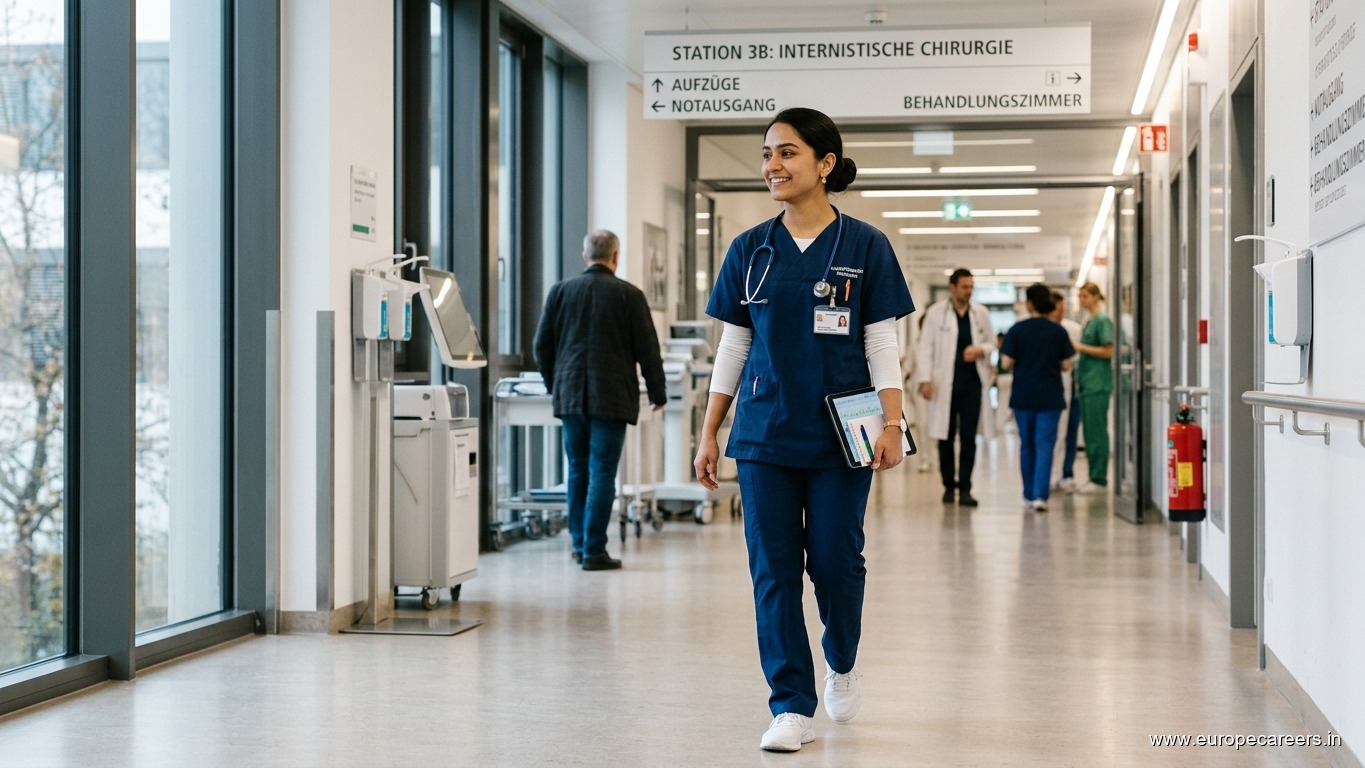
What a Nurse Can Do at B1:
- Greet hospital patients politely and introduce themselves warmly.
- Take routine vital signs and give simple instructions: “Ich messe jetzt Ihren Blutdruck. Bitte halten Sie den Arm ruhig.” (“I am measuring your blood pressure now. Please keep your arm still.”)
- Assist patients with mobility, hygiene, and daily meals while engaging in basic reassuring conversation.
- Understand standard shift instructions from senior nurses regarding bed assignments and routine checks.
The Regulatory Reality: B1 Is Not the Finish Line:
In all 16 German federal states, foreign nursing qualifications cannot receive full state recognition (Berufserlaubnis / Urkunde) with B1 alone. As explained in our guide on the German Defizitbescheid Process, nurses often enter Germany with certified B1 to begin practical adaptation training (Anpassungslehrgang). During this period, you work as an assistant nurse while completing hospital clinical hours and taking specialized B2 nursing language classes. To administer complex intravenous medications independently, lead shift handovers, and document clinical histories without supervision, passing a certified B2 examination is legally mandatory.
B1 German for Engineers, IT Professionals, and Skilled Workers
In technical occupations, the communicative demands of B1 depend heavily on the company environment:
- Skilled Trades (Electricians, Mechatronics, HVAC): B1 is often the primary operational threshold. On an industrial assembly floor or construction site, an electrician who speaks solid B1 can understand wiring plans, follow safety guidelines, report missing components, and coordinate with the master craftsman. Because technical trades are classified as official bottleneck occupations (see our analysis on Fachkräftemangel in Germany), holding B1 makes Indian tradesmen exceptionally attractive to German employers.
- Software Developers and Cloud Engineers: In English-speaking tech startups, B1 is more than enough for daily life. It allows you to order food, speak to the office manager, understand Slack announcements, and build friendships with German teammates. However, if you join a traditional German enterprise or SAP consultancy, progressing to B2 will be essential to lead client meetings and technical workshops.
- Mechanical, Automotive, and Electrical Engineers: B1 allows you to handle shop-floor trials, review technical drawings, and participate in daily scrums. To write formal test protocols, coordinate with external suppliers, and advance into project leadership, B2 remains the recommended career benchmark.
B1 vs. B2 in the Workplace: A Side-by-Side Comparison
The jump from B1 to B2 is often described as the shift from “coping with routines” to “professional autonomy.” Here is how the two levels compare across typical workplace dimensions:
| Workplace Area | At B1 Level (Intermediate) | At B2 Level (Upper Intermediate) |
|---|---|---|
| Daily Communication | Can handle familiar, predictable situations using straightforward sentence patterns. | Can handle complex, varied conversations with greater spontaneous fluency and fewer pauses. |
| Team Meetings | Can follow the main topics and give short, prepared status updates. | Can participate actively, contribute ideas, debate alternatives, and counter arguments. |
| Problem Solving | Can explain what is broken and what immediate action was taken. | Can analyze root causes, evaluate operational risks, and propose detailed solutions. |
| Professional Vocabulary | Moderate general workplace vocabulary; relies on simpler substitute words for technical terms. | Extensive industry-specific vocabulary; uses precise technical, medical, or engineering terms. |
| Written Documentation | Can write short emails, routine handover notes, and simple progress reports. | Can draft detailed incident reports, formal client emails, and comprehensive documentation. |
| Customer & Patient Interaction | Limited to basic questions, courtesy phrases, and standard explanations. | Can handle sensitive conversations, address complaints diplomatically, and reassure anxious clients. |
How Europe Careers Helps Candidates Move From B1 to B2
Transitioning from B1 to B2 is rarely about learning more grammar rules — it is about building listening stamina, spontaneous speaking fluency, and specialized vocabulary. At Europe Careers, our training programs are specifically designed to help Indian professionals bridge this gap effectively.
Depending on the programme and service agreement, Europe Careers supports candidates with:
- Intensive Verbal Speaking Drills: Daily role plays that simulate real German workplace scenarios — including shift handovers, progress reporting, and supplier negotiations.
- Workplace Listening Comprehension: Audio practice featuring authentic German workplace dialogues, background ambient noise, and varied regional speaking rhythms.
- Industry-Specific Vocabulary Modules: Specialized training tracks for clinical nursing German (Pflegefachsprache), automotive engineering terms, and skilled trades safety protocols.
- Job Interview Preparation: Targeted coaching on answering behavioral and technical questions in German, helping you impress German hiring managers during video interviews.
- Examination Strategy Workshops: Comprehensive preparation for certified B2 examinations (Goethe-Zertifikat, telc B2, or telc B1-B2 Pflege) conducted by authorized examination bodies.
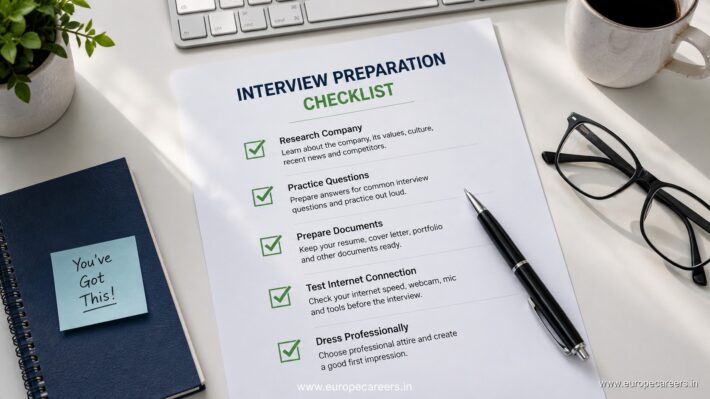
Simple B1 Workplace Checklist: Test Your Real-World Readiness
Before starting your first job in Germany, evaluate your practical communicative ability against this 7-point B1 checklist:
- ☑ Can I introduce myself professionally? (State my name, Indian educational background, professional role, and past experience in clear German.)
- ☑ Can I ask for assistance politely? (Formulate a clear question when I need help with an internal tool, procedure, or document.)
- ☑ Can I explain a simple problem? (Describe what went wrong, when it happened, and what needs immediate attention.)
- ☑ Can I understand routine instructions? (Follow multi-step directions from my supervisor without requiring English translation.)
- ☑ Can I talk about my daily tasks? (Explain what I worked on yesterday, what I am doing today, and when I expect to finish.)
- ☑ Can I write a basic workplace email? (Draft a professional message requesting information, confirming an appointment, or reporting status.)
- ☑ Can I follow familiar team conversations? (Understand the main points of a departmental meeting when spoken in clear standard German.)
If you can check all seven boxes, your B1 German is solid and operational. You are well-prepared to begin your onboarding in Germany and progress toward B2.
Frequently Asked Questions (FAQs): B1 German at Work
1. What is B1 German in simple terms?
B1 is the intermediate level under the CEFR framework. It means you are an “independent language user” who can communicate clearly in familiar everyday and workplace situations, understand main ideas, express opinions simply, and describe past experiences.
2. Is B1 German enough to work in Germany?
It depends on the profession. For skilled trades, machine operators, and many engineering roles, B1 is often sufficient to begin working. In regulated professions like nursing and medicine, B1 allows you to enter for adaptation courses, but B2 or higher is mandatory for full licensing.
3. What can I realistically do with B1 German at work?
You can understand standard supervisory instructions, ask questions, explain simple operational delays, write routine emails, answer familiar phone calls, discuss shift schedules, and engage in daily cafeteria small talk.
4. Is B1 German enough for Indian nurses?
B1 is generally sufficient to secure a job offer, obtain an entry visa under § 16d AufenthG, and start working as an assistant nurse during adaptation training. However, full recognition as a registered nurse (Pflegefachkraft) legally requires passing B2.
5. Is B1 German enough for engineers and IT professionals?
In international software firms where English is the primary language, B1 is more than enough for daily life. In traditional German manufacturing and Mittelstand engineering firms, B1 allows you to handle shop-floor collaboration, but B2 is recommended for long-term career advancement.
6. Can I get a German work visa with B1 German?
Yes. Many visa categories — including the Skilled Worker Visa (§§ 18a, 18b AufenthG), Recognition Partnership (§ 16d AufenthG), and Opportunity Card (§ 20a AufenthG) — formally recognize B1 German for qualification points and consular visa approval.
7. What is the biggest difference between B1 and B2 German?
B1 is functional and handles predictable, familiar situations. B2 is nuanced, allowing you to debate complex technical topics, defend solutions in meetings, write formal documentation, and handle unplanned crises with confidence.
8. How long does it take to move from B1 to B2?
With intensive study (15 to 20 hours per week), advancing from B1 to B2 typically takes 4 to 6 months. While working full-time in Germany and practicing daily with colleagues, it usually takes 6 to 9 months.
9. Does holding a B1 certificate guarantee a job in Germany?
No certificate guarantees a job. Hiring decisions depend on technical qualifications, verified clinical or practical experience, interview performance, and employer demand. However, B1 makes your profile dramatically more competitive.
10. Does B1 German guarantee professional recognition?
No. Professional recognition evaluates your educational curriculum against German standards. For regulated professions (nursing, medicine, teaching), final recognition decisions require meeting the state’s statutory language standard, which is B2 or higher.
11. How does B1 German benefit permanent residency?
Under the EU Blue Card regulations, holding certified B1 German reduces the required employment waiting period for permanent residency (Niederlassungserlaubnis) from 27 months down to just 21 months.
12. How does Europe Careers support my German language journey?
Europe Careers provides structured language coaching from A1 through B2, specialized clinical and technical workplace dialogues, interview preparation, credential evaluation, and fast-track employer matching across Germany.
Conclusion: Making B1 Your Springboard to Professional Success
Reaching B1 German is a tremendous achievement that transforms you from a silent observer into an active, independent participant in everyday German work life. It empowers you to understand your supervisor, support your teammates, ask for help without embarrassment, and manage your daily responsibilities with dignity.
However, B1 should always be viewed as your foundation — your springboard — rather than your final destination. By continuing to practice daily, learning industry-specific vocabulary, and actively engaging with your German colleagues, your communication will naturally mature from basic operational independence into effortless professional confidence.
Planning to improve your German for work in Germany? Partner with the international career specialists at Europe Careers. Whether you need structured German language preparation, profession-specific workplace communication practice, or comprehensive career and relocation guidance, our team is ready to support you.
Visit our official website at www.europecareers.in or email us directly at support@europecareers.in to begin your structured language and career preparation today.