
Anerkennung Exam in Germany 2026 — Complete Guide for Indian Doctors, Nurses and Healthcare Professionals
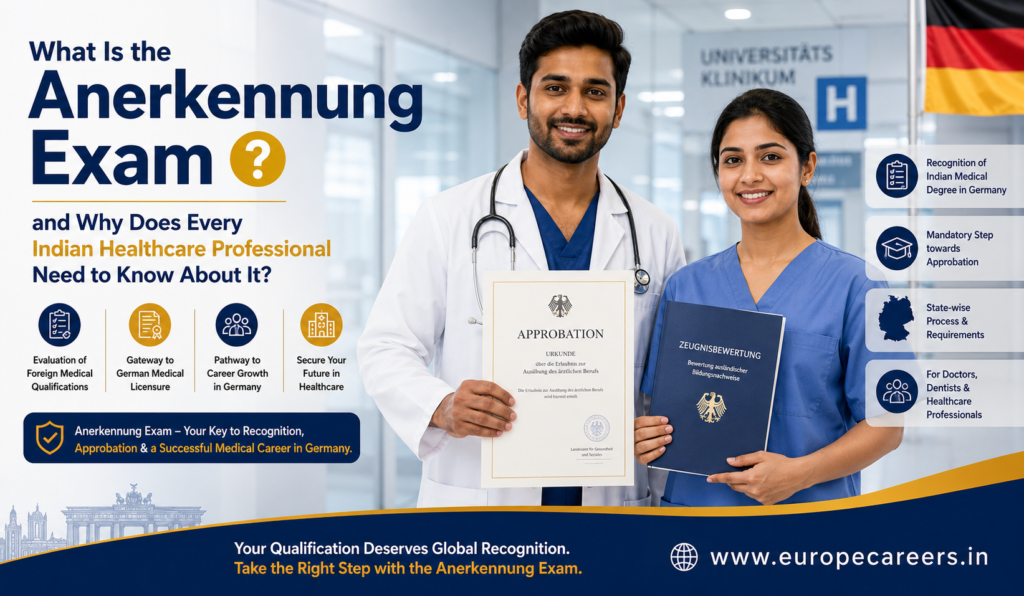
What Is the Anerkennung Exam and Why Does Every Indian Healthcare Professional Need to Know About It?
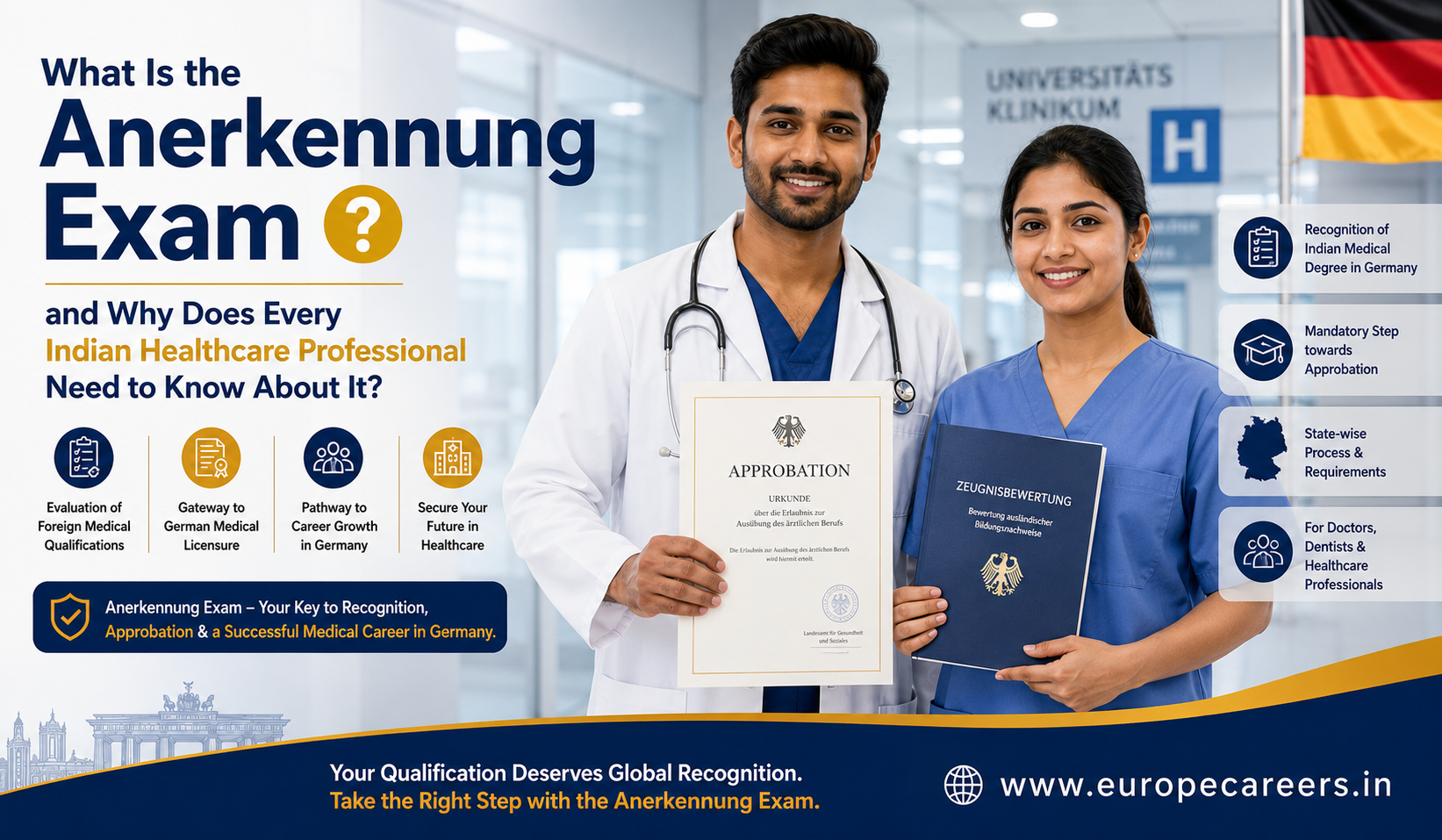 If you are an Indian doctor, nurse, dentist, pharmacist, physiotherapist, or any other healthcare professional planning to work in Germany, there is one word you will hear more than any other throughout your entire journey.
That word is Anerkennung.
In German, Anerkennung simply means recognition. But in the context of your career in Germany, it means something very specific and very important — it is the official process by which Germany evaluates your Indian qualification, compares it to the equivalent German qualification, and decides whether you are allowed to use your professional title and practise your profession in Germany.
Germany does not automatically accept your Indian degree just because you have it. Medicine, nursing, dentistry, pharmacy, physiotherapy, and occupational therapy are all regulated professions in Germany. This means that before you can legally call yourself a doctor, nurse, or any other healthcare professional and practise in a German hospital or clinic, you must go through the Anerkennung process.
At EuropeCareers, we guide Indian healthcare professionals through the entire Anerkennung journey every day. This guide explains exactly what the process involves, which exams you will face, how they work, how to prepare for them, and what happens after you pass.
Anerkennung — The Big Picture
The Anerkennung process is not a single exam. It is a multi-stage procedure that involves document assessment, language examinations, and — for most Indian professionals — one or two knowledge-based examinations. The exact steps depend on your profession.
For the purposes of this article, we will cover the three most important and most commonly searched Anerkennung pathways for Indian professionals:
Doctors (MBBS / MD graduates) — The Anerkennung process for doctors involves the Gleichwertigkeitsprüfung (equivalence assessment), the Fachsprachprüfung (FSP, medical language examination), and in most cases for Indian graduates, the Kenntnisprüfung (KP, medical knowledge examination). The final goal is receiving the Approbation — Germany’s full and permanent medical licence.
Nurses (BSc Nursing / GNM holders) — The Anerkennung process for nurses involves a document-based equivalence assessment and, if differences are found, either an Anpassungslehrgang (adaptation course) or a Kenntnisprüfung (knowledge test). The goal is receiving the state licence to use the professional title Pflegefachperson and practise nursing in Germany.
Other healthcare professionals (physiotherapists, occupational therapists, pharmacists, dentists) — Each profession has its own regulated pathway, but the general structure is the same — document assessment, language examination, and a knowledge or aptitude test if equivalence is not confirmed.
Step One — The Equivalence Assessment (Gleichwertigkeitsprüfung)
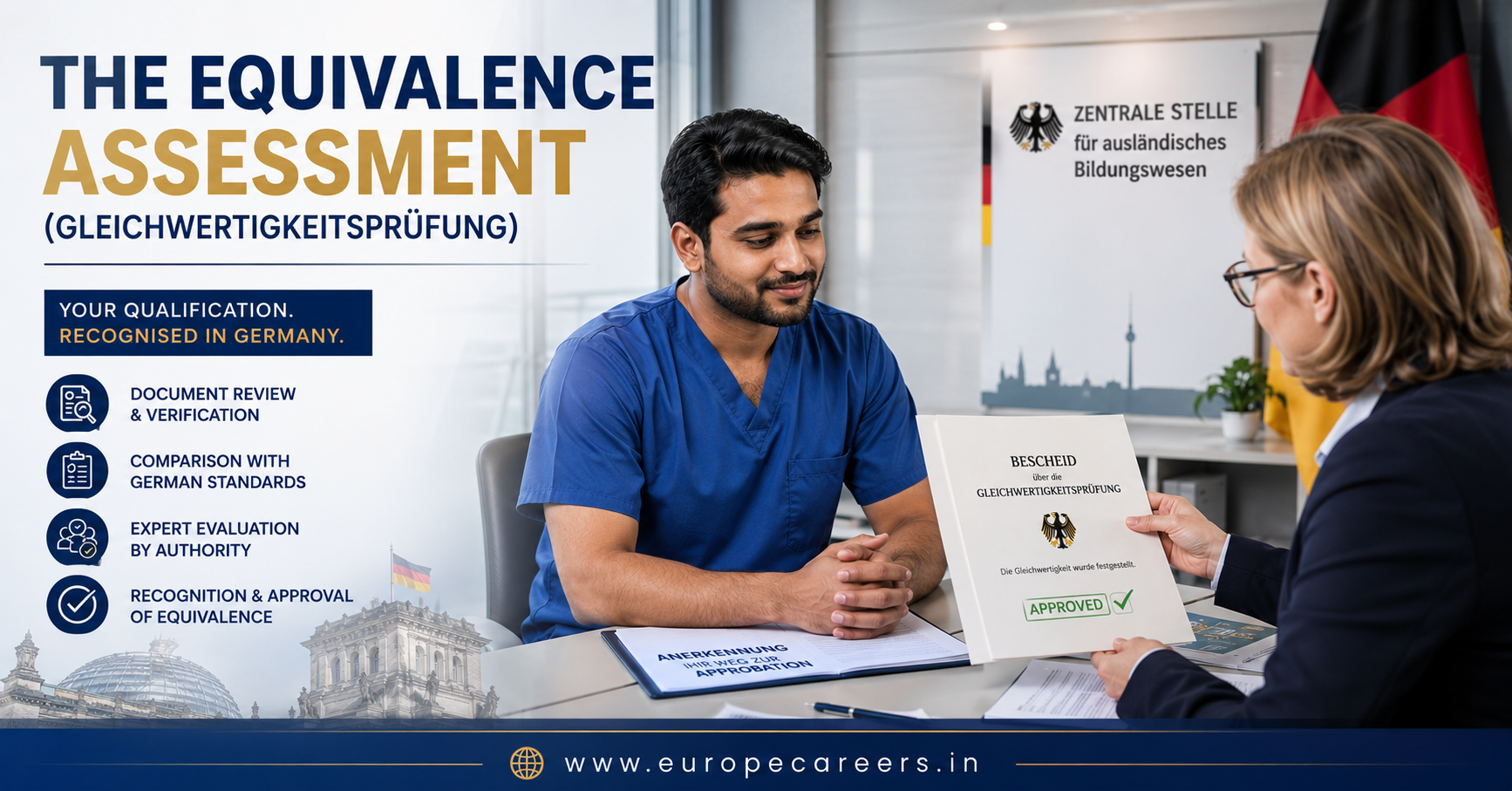 The first step in the Anerkennung process for every Indian healthcare professional is the equivalence assessment — called the Gleichwertigkeitsprüfung in German. This is not an exam you sit in a room. It is a document-based evaluation carried out by the competent authority in the German federal state where you intend to work.
The competent authority takes your Indian qualification — your MBBS certificate, BSc Nursing degree, BDS, BPharm, or whatever your healthcare qualification is — and compares it point by point against the equivalent German qualification. They look at the subjects you studied, the clinical hours you completed, the duration of your training, and the content of your curriculum.
The possible outcomes of the equivalence assessment are as follows.
Full equivalence — Your Indian qualification is assessed as fully equivalent to the German qualification. You do not need to sit any knowledge examination. You proceed directly to language requirements and the licence application. For Indian healthcare professionals, this is rare but possible for certain well-recognised programmes.
Partial equivalence with deficits — The most common outcome for Indian professionals. The authority identifies specific areas where your Indian training differs from German standards. They issue a written notice called a Defizitbescheid, which lists the identified gaps. To compensate for these gaps, you must complete a compensatory measure — either an Anpassungslehrgang (adaptation programme) or a Kenntnisprüfung (knowledge examination). You choose which one you prefer in most cases.
No equivalence — In rare cases where the differences are too substantial to bridge through a single compensatory measure, your qualification may not be recognised. This is uncommon for mainstream Indian healthcare degrees from recognised universities but can occur for certain diploma-level qualifications.
For Indian MBBS doctors specifically, partial equivalence with the requirement to pass the Kenntnisprüfung is almost the universal outcome. Indian medical degrees are generally not considered directly equivalent to German medical degrees because of differences in clinical hour distribution, certain subject content, and the structure of the final state examination.
Step Two — The Fachsprachprüfung (FSP) — Medical Language Examination
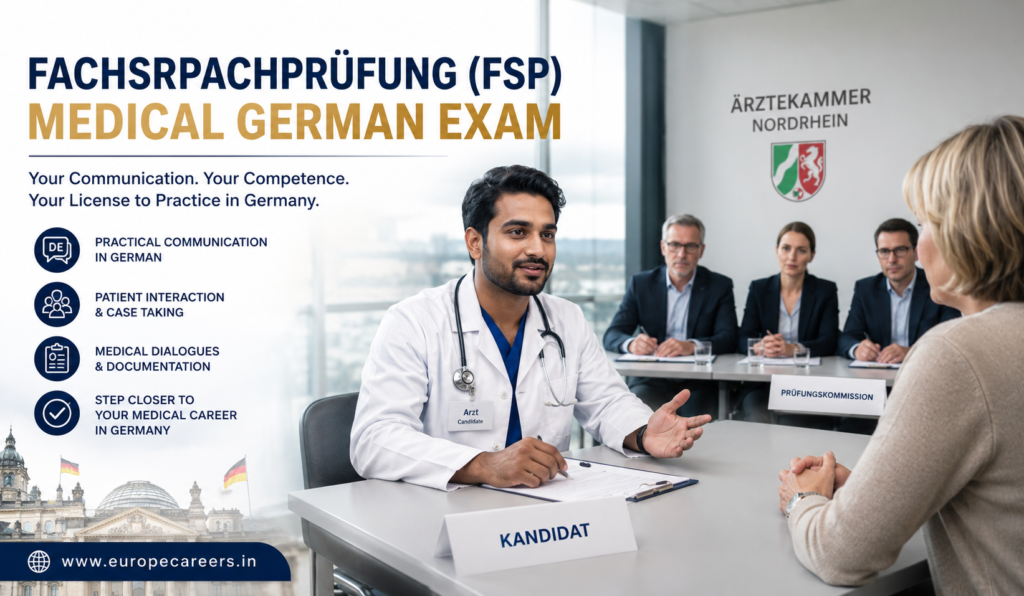 Before sitting the Kenntnisprüfung, and as a standalone requirement for all healthcare professionals seeking the German licence, you must pass the Fachsprachprüfung — abbreviated as FSP. This is the medical German language examination, and it is one of the most important and challenging milestones of the entire Anerkennung process.
The FSP is not a general German language exam like the Goethe-Institut certificates. It is a highly specific, clinical communication examination that tests whether you can function as a healthcare professional in a German-speaking hospital environment. It requires C1 level German with a strong medical vocabulary and the ability to apply that language in realistic clinical situations.
The FSP is organised by the regional medical association or professional chamber of the German state where you are applying — for doctors, this is the Landesärztekammer. For nurses and other healthcare professionals, it may be organised by the Gesundheitsamt or the Landesbehörde depending on the state.
The examination takes approximately 60 minutes and is divided into three parts.
Part One — Doctor-Patient Interview (Anamnese) — An examiner plays the role of a patient. You conduct a full medical history interview in German — asking about their symptoms, medical history, family history, current medications, allergies, and relevant risk factors. You must be professional, empathetic, clear, and accurate in German throughout. The examiner may play an anxious, confused, or difficult patient — your job is to handle this calmly and professionally.
Part Two — Written Documentation — Based on the history you just took, you write a structured medical summary in German. This is the Arztbrief or anamnesis documentation. Your ability to use correct medical terminology, write clearly and concisely, and organise clinical information in German format is assessed here.
Part Three — Doctor-Doctor Handover (Übergabe) — You present the same case to a second examiner who plays the role of a colleague physician or specialist. You communicate the case as if you are handing over a patient — presenting the history, your assessment, and your proposed management plan in professional clinical German.
The entire examination is conducted in German. There are no multiple choice questions. It is entirely oral and written, and entirely based on your ability to communicate as a healthcare professional in German.
To pass the FSP, you need to demonstrate C1 level general German proficiency and strong medical-specific vocabulary. This is the reason why reaching B2 German is just the beginning for Indian healthcare professionals aiming to work in Germany — B2 is the entry point for language preparation, not the finish line.
After passing the FSP, doctors in Germany are typically eligible to apply for the Berufserlaubnis — a temporary supervised work permit — which allows them to begin working in a German hospital under supervision while completing the rest of the Anerkennung process.
Step Three — The Kenntnisprüfung (KP) — Medical Knowledge Examination
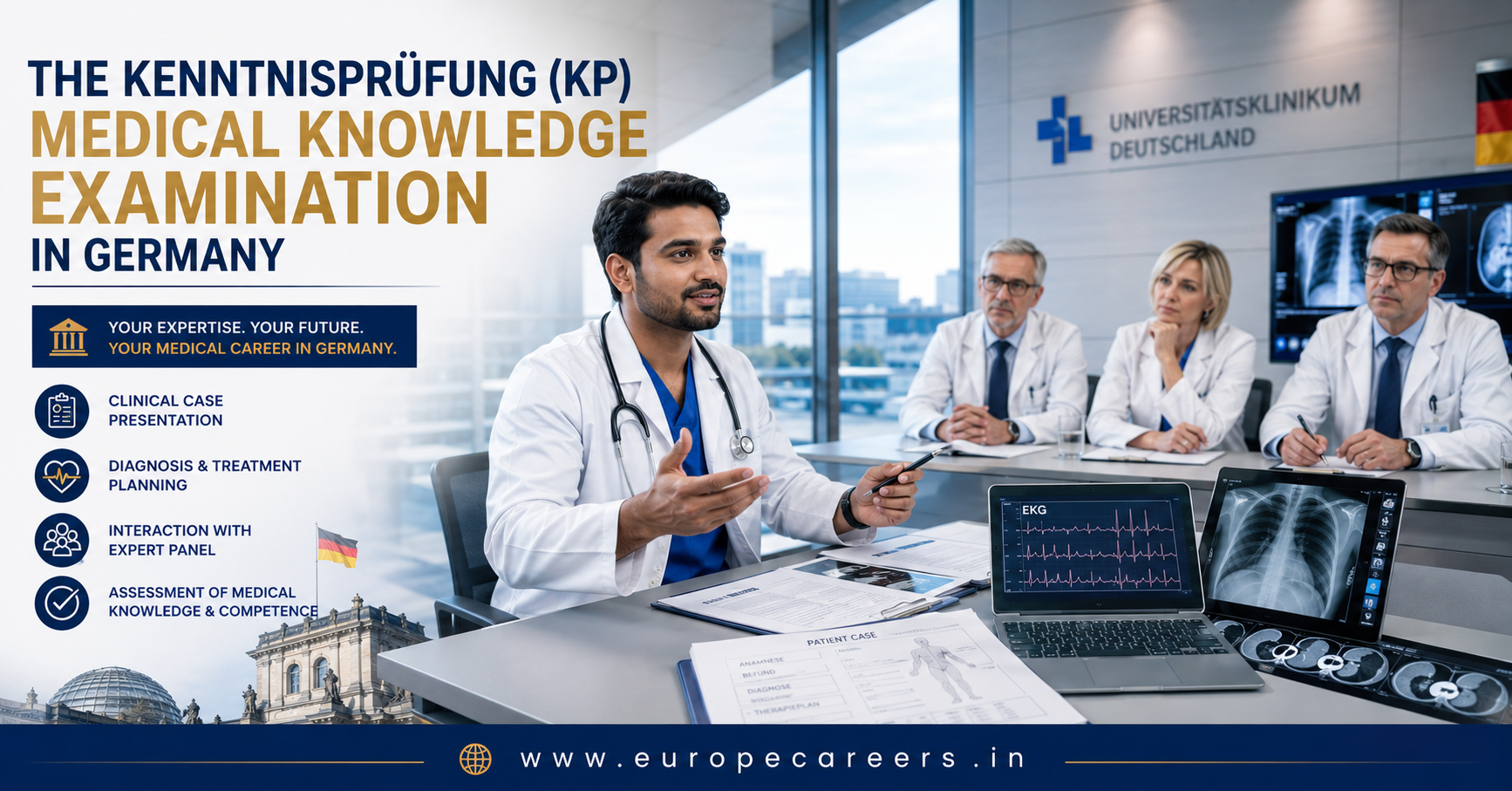 The Kenntnisprüfung — often shortened to KP — is the medical knowledge examination that most Indian doctors and many Indian nurses must pass as part of the Anerkennung process. This is the examination that formally confirms your clinical knowledge meets German professional standards, compensating for any deficits identified in the equivalence assessment.
The Kenntnisprüfung is not a written multiple choice examination like NEET or USMLE. It is an oral and practical clinical examination. There are no MCQs. You are examined face to face by a panel of physicians and medical experts, and you must demonstrate your clinical reasoning, diagnostic thinking, and therapeutic decision-making in German.
Here is exactly what the Kenntnisprüfung covers and how it works.
Subjects covered in the Kenntnisprüfung:
The core focus is on internal medicine and surgery — the two foundational disciplines of German clinical practice. In addition, the examination covers emergency medicine, clinical pharmacology, radiology and imaging interpretation, patient communication ethics, German healthcare law, medical documentation, and professional regulations including patient rights, confidentiality, and informed consent procedures under German law.
Structure of the examination:
The examination is conducted in two interconnected parts. The first is a clinical case presentation and discussion — the examiner presents you with a patient case and you work through the diagnosis, investigations, and management plan out loud, explaining your reasoning in German. The second part is a practical clinical component where you may be asked to take a patient history from a real patient, perform elements of a physical examination, interpret ECG results or laboratory findings, and present the case to the examining panel.
The examination is conducted at a university clinic or major German hospital designated by the competent authority in your state. The whole process typically takes up to 90 minutes per candidate.
Passing criterion:
There is no percentage-based score. The examining panel assesses whether your clinical knowledge, reasoning, and communication meet the standard required to practise the profession safely and independently in Germany. At the end of the examination, the panel tells you verbally whether you have passed or not. A formal written result follows within a few weeks.
Attempts allowed:
The Kenntnisprüfung can be attempted a maximum of three times. If you fail all three attempts, you are generally barred from practising as a doctor in that German state and in most cases across all of Germany. This is the reason why structured, serious preparation for the KP is absolutely essential before sitting the exam. EuropeCareers emphasises this point to every client — do not rush into the Kenntnisprüfung without thorough preparation.
Cost:
The examination fee varies by German federal state. It ranges from approximately €266 in some states to over €1,100 in others. EuropeCareers helps our clients identify which German state offers the best combination of manageable fees, shorter waiting times, and supportive examining environments.
The Kenntnisprüfung for Nurses — How It Differs
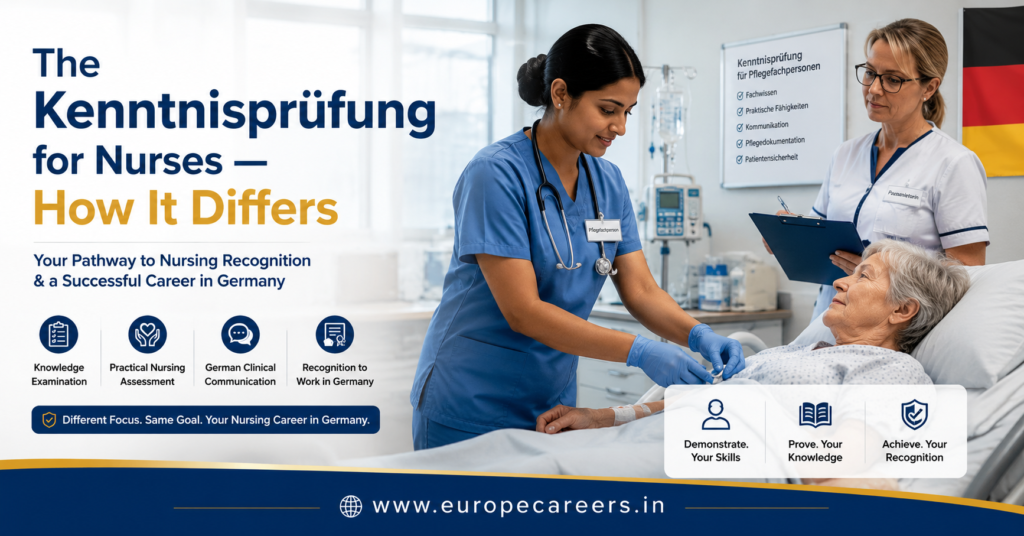 For Indian nurses going through the Anerkennung process, the Kenntnisprüfung is similar in principle but different in content. The nursing knowledge examination focuses on nursing practice rather than medical diagnosis and treatment. It covers patient care procedures, nursing documentation, wound care, medication administration, patient safety protocols, nursing ethics, and communication with patients and the interdisciplinary healthcare team — all in German.
The choice between the Kenntnisprüfung and the Anpassungslehrgang (adaptation course) is important for nursing professionals. The Anpassungslehrgang is a supervised practical training period lasting up to three years in a German hospital or care facility, during which you work alongside qualified German nurses and are assessed on the job rather than through a formal examination. For many Indian nurses, particularly those who prefer learning by doing rather than sitting formal exams, the Anpassungslehrgang is the better route.
However, the Kenntnisprüfung is faster — if you pass it, you receive your full recognition immediately. The Anpassungslehrgang takes longer but allows you to simultaneously earn income, improve your German in a real clinical environment, and build your professional network in Germany.
EuropeCareers discusses both options in detail with every nursing client and helps them decide based on their language level, clinical confidence, and personal timeline.
German Language Requirements — The Foundation of Everything
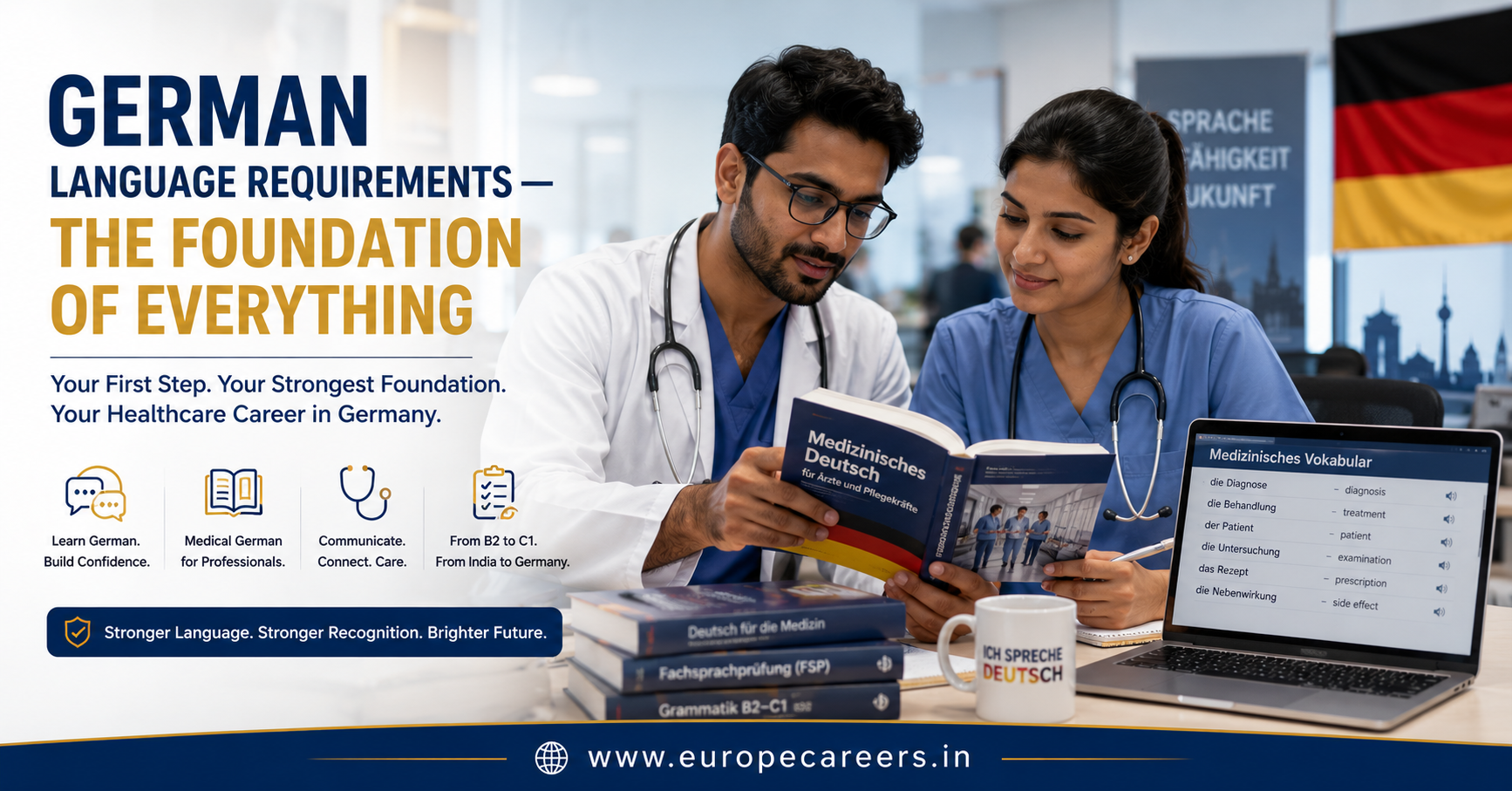 The single most important thing any Indian healthcare professional needs to understand about the Anerkennung process is this: your German language level determines everything.
The minimum language levels for each stage are as follows.
A2 German is the minimum required to enter Germany under a Recognition Partnership arrangement — a special visa route that allows doctors and nurses to enter Germany and work while completing recognition.
B1 German is needed for the basic visa application and to begin working in some supervised capacities.
B2 German is the minimum required to apply for the Fachsprachprüfung and to receive the Berufserlaubnis (temporary work permit) in most German states.
C1 German with medical specialisation is required to pass the Fachsprachprüfung. You cannot pass the FSP on B2 general German alone — the medical vocabulary and clinical communication demands of the FSP require C1 level competence in the medical context.
For the Kenntnisprüfung, C1 medical German is equally essential because the entire examination is conducted in German and your ability to reason out loud clinically in German is itself part of what is being assessed.
For Indian healthcare professionals, the realistic German language preparation timeline looks like this. Starting from zero German, reaching A2 takes approximately 3 to 4 months. Reaching B1 takes 7 to 10 months. Reaching B2 takes 12 to 15 months. Preparing for and passing the Fachsprachprüfung medical German examination adds 3 to 4 months of specialised medical German preparation on top of B2.
Most serious Indian healthcare professionals begin their German language journey 18 to 24 months before their planned move to Germany. This is the realistic and necessary timeline. EuropeCareers builds this preparation schedule with every client from the very first consultation.
The Berufserlaubnis — Working While You Complete Recognition
One of the most practically important aspects of the Anerkennung process for Indian healthcare professionals is the Berufserlaubnis — a temporary professional work permit that allows you to begin working in a German hospital or clinic under supervision before your full Anerkennung is complete.
For doctors, the Berufserlaubnis is typically issued after you pass the Fachsprachprüfung and have a signed employment contract with a German hospital. It allows you to work as a supervised physician — treating patients, writing prescriptions, and participating in ward rounds — under the oversight of a fully licensed German doctor. The Berufserlaubnis is typically valid for one to two years and can be extended, with most states allowing a maximum of four years under Berufserlaubnis status.
This is an enormously practical benefit. Rather than spending the preparation period for your Kenntnisprüfung unemployed and living entirely off your savings, you can work in a German hospital, earn a salary, improve your medical German in a real clinical environment, and prepare for the Kenntnisprüfung simultaneously. German hospitals actively hire Indian doctors on Berufserlaubnis — the labour shortage in German healthcare means hospitals are genuinely motivated to support foreign professionals through the recognition process.
For nurses, a similar temporary permit is available in most states, allowing BSc Nursing and GNM graduates from India to begin working in supervised nursing roles while their full recognition is being processed.
Which German State Should Indian Professionals Choose?
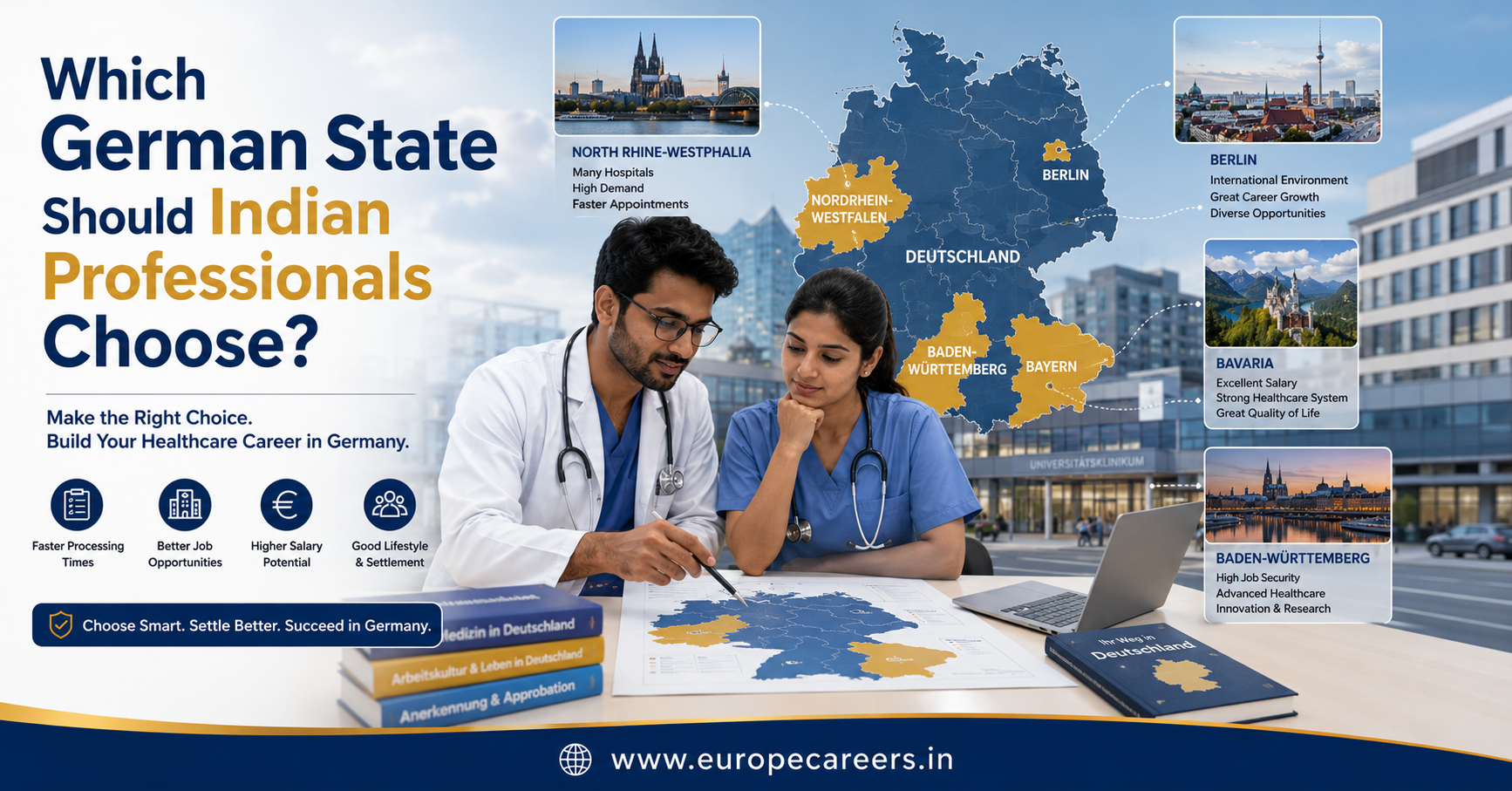 Germany has 16 federal states — called Bundesländer — and each state has its own competent authority, its own processing times, and its own examining standards for the Kenntnisprüfung and FSP. Choosing the right state is one of the most underrated strategic decisions in the entire Anerkennung process.
Some states process applications faster than others. Some states have more experienced examining panels for international candidates. Some states have lower examination fees. And some states have larger concentrations of hospitals actively hiring international doctors and nurses, which makes finding a Berufserlaubnis position easier.
Bavaria, North Rhine-Westphalia, and Baden-Württemberg are the three states with the largest hospital networks and the most established experience in hiring and processing international healthcare professionals. They have higher costs in some cases but also have the most support infrastructure.
Saxony, Thuringia, and Brandenburg in eastern Germany have faster processing times and lower examination fees in many cases, though the hospital networks are smaller and competition for positions from international professionals is lower.
Berlin is popular among international applicants because of its cosmopolitan atmosphere, large Indian community, and well-developed support networks for internationally trained healthcare professionals.
EuropeCareers advises every client on state selection based on their specific situation — medical specialisation, language level, timeline, salary expectations, and personal preferences.
How to Prepare for the Kenntnisprüfung — A Practical Preparation Plan
Preparation for the Kenntnisprüfung requires a structured approach covering three areas simultaneously: clinical knowledge in German, medical German language, and practical clinical skills in a German hospital context.
Clinical Knowledge Preparation
The Kenntnisprüfung focuses primarily on internal medicine and surgery. You need to be confident presenting, diagnosing, and managing the most common clinical presentations in these two disciplines — heart failure, myocardial infarction, pneumonia, sepsis, diabetes and its complications, hypertension, stroke, appendicitis, bowel obstruction, fractures, and post-operative care among many others.
You should be comfortable interpreting ECGs, reading chest X-rays, understanding standard laboratory values, and discussing drug mechanisms and interactions in clinical context. Emergency medicine scenarios — including resuscitation, anaphylaxis, acute coronary syndrome, and respiratory failure — are commonly tested.
Your knowledge of German healthcare law, patient rights, medical documentation requirements, and professional ethical standards in the German system must also be solid.
Medical German Language Preparation
The Kenntnisprüfung requires you to present complex clinical thinking in German under examination pressure. This means your medical German vocabulary must go far beyond everyday conversation. You need to master the specific terminology of each clinical discipline, the formal language of case presentations, the vocabulary of drug names and pharmacology in German, and the professional communication patterns of German clinical medicine.
Specialised medical German courses — specifically designed for internationally trained doctors preparing for the FSP and KP — are the most efficient preparation route. Many are available in online format, making them accessible from India before you even travel to Germany.
Clinical Practice in Germany
The most effective preparation for the Kenntnisprüfung is working in a German hospital as a Berufserlaubnis holder before sitting the exam. Real patient contact, real clinical reasoning in German, real interactions with German doctors and nurses — this practical immersion accelerates both language acquisition and clinical confidence in the German context faster than any course or textbook.
Indian doctors who sit their Kenntnisprüfung after six to twelve months of supervised clinical practice in Germany under Berufserlaubnis consistently perform better than those who attempt the exam before gaining any German clinical experience.
Study Timeline
A realistic preparation timeline from starting German language to sitting the Kenntnisprüfung and receiving Approbation typically looks as follows. Months one to fifteen — German language preparation from zero to B2. Months twelve to eighteen — specialised medical German and FSP preparation. Months eighteen to twenty-two — pass FSP, receive Berufserlaubnis, begin supervised clinical work in Germany. Months twenty-two to thirty — Kenntnisprüfung preparation while working in a German hospital. Month twenty-eight to thirty — sit and pass Kenntnisprüfung. Shortly after — receive full Approbation and begin independent practice.
The total timeline from starting language preparation in India to receiving Approbation in Germany is typically two and a half to three years. This is the honest realistic timeline and EuropeCareers builds every client’s plan around it from day one.
Salary After Approbation — What Indian Doctors Earn in Germany
The financial return on the Anerkennung investment is exceptional. After receiving the Approbation and beginning independent practice as a qualified German doctor, Indian physicians can expect the following salary levels.
An Assistenzarzt — a resident physician in a German hospital — earns approximately €4,500 to €6,500 gross per month. This is the starting level for most Indian MBBS doctors who have completed Anerkennung and are beginning their Facharzt specialist training in Germany.
A Facharzt — a fully trained specialist — earns €6,000 to €8,000 or more gross per month depending on the specialisation. Surgeons, cardiologists, radiologists, and anaesthesiologists are consistently at the higher end of this range. Overtime, night shifts, and weekend shifts add a further 15 to 25 percent to base salaries.
Senior physicians and department heads — Oberarzt and Chefarzt levels — earn €8,000 to €15,000 or more per month gross. These senior positions typically require five to ten years of German specialist training after Approbation.
For nurses, salary after full Anerkennung starts at approximately €3,000 to €3,500 gross per month and increases with experience and specialisation to €4,000 to €5,000 or more per month for senior and specialist nurses.
All employment in Germany comes with comprehensive social security contributions — health insurance, pension, unemployment insurance, and accident insurance — all automatically included in your employment package. The effective value of these benefits in addition to the gross salary makes German healthcare employment exceptionally financially strong compared to almost any alternative for Indian professionals.
What Is the Approbation and Why Is It the Final Goal?
The Approbation is the full, permanent, and unconditional licence to practise medicine in Germany. It is issued by the competent state authority after you have successfully completed all stages of the Anerkennung process — including passing the FSP, passing the Kenntnisprüfung, and meeting all documentation and personal suitability requirements.
The Approbation is not state-specific — once issued in any German state, it is valid throughout Germany. It allows you to practise independently without supervision, to open your own medical practice, to prescribe all medications, and to hold any clinical position up to and including department head level.
For nurses, the equivalent final licence is the state recognition certificate — the Anerkennungsbescheid — which grants you the right to use the protected professional title of Pflegefachperson and practise nursing independently across Germany.
After receiving Approbation and working as a fully recognised healthcare professional in Germany, the path to permanent residency opens clearly. After three years of qualified employment on a Skilled Worker Visa, you can apply for the Niederlassungserlaubnis — permanent settlement permit. After five years of continuous legal residence, you can apply for German citizenship, and since Germany’s 2024 nationality law reform, Indian professionals can hold both Indian and German passports.
Common Mistakes Indian Healthcare Professionals Make in the Anerkennung Process
At EuropeCareers, we have supported Indian healthcare professionals through the Anerkennung process for years. These are the most common and most costly mistakes we see.
Underestimating language preparation time — Many Indian doctors assume that B2 German is enough to start the clinical process in Germany. It is not enough to pass the FSP and certainly not enough to pass the Kenntnisprüfung. C1 medical German is the realistic target and takes longer than most people plan for.
Sitting the Kenntnisprüfung without enough German clinical experience — Attempting the KP before gaining any real German hospital experience is one of the most common reasons for failure. The examination tests your ability to reason clinically in German under pressure — something that only real German hospital work can fully prepare you for.
Choosing the wrong German state — Applying in a state with long processing times, high fees, or limited hospital opportunities can add months to your overall timeline and increase your costs significantly. State selection requires careful research.
Not seeking qualified guidance for document preparation — The Anerkennung document file is complex. Incorrect translations, missing attestations, or wrongly formatted documents are the most common cause of delays in the equivalence assessment. A single document error can push your timeline back by three to four months.
Attempting the KP too quickly after failing — If you fail the Kenntnisprüfung, the temptation is to rebook immediately. However, rushing back without identifying and addressing the specific weaknesses the examination panel flagged is the fastest way to fail again. Structured review and additional clinical preparation between attempts is essential.
How EuropeCareers Supports Indian Healthcare Professionals Through Anerkennung
At EuropeCareers, we provide dedicated, end-to-end Anerkennung support for Indian doctors, nurses, dentists, physiotherapists, and other healthcare professionals targeting Germany.
Our support begins with a comprehensive profile evaluation — we assess your Indian qualification, your clinical experience, your current German language level, and your target specialisation, and give you a clear, honest assessment of your Anerkennung pathway, timeline, and costs.
We assist with the equivalence assessment application — compiling documents, coordinating certified translations, identifying the right competent authority in your target German state, and submitting your recognition file correctly the first time.
We guide your German language preparation — recommending course providers, building your study timeline, and specifically preparing you for the Fachsprachprüfung medical language examination.
We connect you with German hospital employers who hire international healthcare professionals on Berufserlaubnis, giving you the clinical experience in Germany that is the single most important preparation for the Kenntnisprüfung.
We support your visa application — whether the Recognition Visa, the Skilled Worker Visa, or the Opportunity Card — and prepare your complete consulate file.
And we remain available throughout the entire process — because Anerkennung is a journey of two to three years, and having a consistent, knowledgeable support partner throughout that journey makes an enormous difference.
Visit europecareers.in to start with your free profile evaluation today. Tell us your qualification, your current language level, and your career goals in Germany — and we will map out your complete Anerkennung pathway with you.
Frequently Asked Questions — Anerkennung Exam Germany
What is the Anerkennung process in Germany? Anerkennung is the official recognition process through which Germany evaluates whether a foreign professional qualification — such as an Indian MBBS, BSc Nursing, or BDS degree — is equivalent to the German qualification for the same profession. For regulated healthcare professions, Anerkennung is mandatory before you can legally practise in Germany.
Do all Indian doctors need to sit the Kenntnisprüfung? Almost all Indian MBBS graduates need to sit the Kenntnisprüfung because Indian medical degrees are generally assessed as partially equivalent to German medical degrees. Full equivalence without an examination is rare for Indian applicants.
What is the Fachsprachprüfung and is it the same as the Kenntnisprüfung? No, they are two different examinations. The Fachsprachprüfung (FSP) is a medical German language examination testing clinical communication skills. The Kenntnisprüfung (KP) is a medical knowledge examination testing clinical reasoning and competence. Most Indian doctors must pass both. The FSP is taken first, typically before or alongside applying for the Berufserlaubnis.
How many times can I attempt the Kenntnisprüfung? The Kenntnisprüfung can be attempted a maximum of three times. Failing all three attempts generally bars you from practising medicine in Germany. Thorough preparation before each attempt is essential.
What German language level do I need for the FSP? The FSP requires C1 level German with strong medical vocabulary. General B2 German is not sufficient to pass the FSP. Specialised medical German preparation at C1 level is necessary.
How long does the full Anerkennung process take for Indian doctors? From starting German language preparation at zero, the realistic total timeline to receiving Approbation in Germany is two and a half to three years. This covers language preparation, equivalence assessment, FSP, Berufserlaubnis period with clinical work, and Kenntnisprüfung.
Can I work in Germany before Anerkennung is complete? Yes. After passing the FSP and receiving a job offer from a German hospital, you can apply for the Berufserlaubnis — a temporary supervised work permit — that allows you to work as a doctor in Germany while completing the KP and full recognition process.
What salary can Indian doctors expect in Germany after Approbation? Assistenzarzt (resident) level earns €4,500 to €6,500 gross per month. Facharzt (specialist) earns €6,000 to €8,000 or more per month. Senior positions earn significantly more. All employment includes comprehensive social insurance.
What is the Approbation? Approbation is Germany’s full, permanent medical licence. It is the final outcome of the complete Anerkennung process for doctors and allows independent medical practice anywhere in Germany without restrictions or supervision.
Does EuropeCareers help with the Anerkennung process from India? Yes. EuropeCareers provides end-to-end Anerkennung support for Indian healthcare professionals — from profile evaluation and document preparation through language guidance, hospital placement, visa support, and ongoing guidance throughout the two to three year process.