
Germany Opportunity Card 2026 — The Complete Guide for Indian Professionals
What Is This Card and Why Should You Care?
Let us be honest. If you are an Indian professional who wants to work in Germany, you have probably hit the same wall that thousands of Indians hit every year.
German companies say they want a job interview before giving you an offer. But you cannot fly to Germany for every interview. And without a job offer, you cannot get a German work visa. So you are stuck in a loop — no visa without a job, no job without a visa.
Germany has finally broken this loop.
On 1 June 2024, Germany launched something called the Opportunity Card — in German it is called the Chancenkarte. This is a completely new type of visa where you do not need a job offer before coming to Germany. You come first. You search for the job after you arrive. You meet companies in person. You attend face-to-face interviews. And while you are searching, you can even work part-time to earn money.
At EuropeCareers, we genuinely believe this is the biggest opportunity for Indian professionals going to Europe in the last twenty years. This article explains everything — what it is, who can apply, how the points work, what you can do after arriving, how to apply step by step, and what happens once you get a job offer.
Who Is This Card For?
The Opportunity Card is for skilled professionals from non-EU countries — which includes India. It is specifically designed for people like these.
You are an engineer with three to five years of experience and you have been applying to German companies from India but nobody is responding because they want candidates they can meet in person.
You are an IT professional — software developer, data analyst, cloud engineer — and you know Germany needs people like you but you just cannot crack the remote hiring barrier from India.
You are a nurse, physiotherapist, or healthcare professional and you want to explore German hospitals and clinics directly rather than applying blindly from thousands of kilometres away.
You are a finance, accounting, or business professional who wants to work in Frankfurt or Munich but has no direct German employer connections yet.
You are a fresh graduate with a good degree who wants to start a career in Germany and is willing to put in the effort to find a job on the ground.
This card is not for unskilled workers. It is not for students who want to study. And it does not guarantee you a job — it gives you the legal right to be in Germany and search for one properly.
The Big Picture — Why Is Germany Doing This?
 Germany is in a serious problem. The country needs more than 400,000 skilled workers every year just to keep its economy running. Its own population is getting older, people are retiring faster than new workers are entering, and there are simply not enough Germans to fill all the jobs available.
Germany’s engineering companies need engineers. Its hospitals need nurses and doctors. Its IT sector needs software developers. Its logistics companies need supply chain professionals. Its banks need finance graduates.
India produces exactly these kinds of professionals every year in large numbers. The Opportunity Card is Germany’s structured invitation to those professionals — come here, show us what you can do, and let us match you with the employers who need you.
India is currently the single largest source country for Opportunity Card applications in the entire world. Nearly one out of every three Chancenkarte visas issued globally has gone to an Indian applicant. That tells you how seriously Indian professionals are taking this.
Two Ways to Qualify
There are two routes to get the Opportunity Card. You need to understand which one applies to you before doing anything else.
Route One — Direct Route
If your Indian degree or qualification is already officially recognised in Germany — meaning a German authority has looked at your certificate and said it is equal to a German qualification — then you qualify for the Opportunity Card directly. No points needed. No extra scoring required.
This route is also available if you studied or trained inside Germany itself.
For most Indian applicants, this full pre-recognition takes a few months to complete. But if you are in a field where Indian degrees are commonly recognised — like certain engineering or IT disciplines — pursuing recognition before applying makes your visa file much stronger.
Route Two — Points System
If your degree is not yet officially recognised in Germany, do not worry. You can still qualify through the points system. You need to score a minimum of 6 points from different categories. Most Indian professionals with a good degree, some work experience, and basic English or German can reach 6 points quite easily.
We will explain exactly how the points work in the next section.
The Points System — How It Works
 You need at least 6 points to qualify through the points route. Here is exactly how you can earn them.
Your Qualification — Up to 4 points
If your degree or vocational training is from a country that has a mutual recognition agreement with Germany, you get 4 points. If it is a standard university degree or two-plus year vocational qualification from India, you get points based on the assessment. A Master’s degree or PhD gives you stronger standing in this category.
Work Experience — Up to 2 points
If you have at least five years of professional experience in a field related to your qualification, you get 2 points. This is straightforward for most experienced Indian professionals. Five years of documented IT, engineering, healthcare, finance, logistics, or any qualified field experience — 2 points, done.
German Language — Up to 2 points
If you know German above the basic minimum level, you get extra points. A2 level German gives you 1 point. B2 level German gives you 2 points. This is very motivating — learning German not only adds to your points but also makes finding a job in Germany dramatically easier after you arrive.
Age — Up to 2 points
Under 35 years old — 2 points. Between 35 and 40 years old — 1 point. Over 40 — no age points, but your qualification and experience points still count fully.
Previous Connection to Germany — 1 point
If you have previously studied, worked, or lived in Germany legally, you get 1 extra point.
Your Spouse Also Qualifies — 1 point
If your husband or wife also independently qualifies for an Opportunity Card, you get 1 additional point.
In-Demand Profession — 2 points
If your field is on Germany’s official shortage occupation list — which includes IT, engineering, nursing, healthcare, construction, electrical trades, and logistics — you get 2 points.
So to give you a real example: an Indian software engineer aged 28 with a BTech degree, five years of work experience, and B2 English can easily score 6 or more points by combining qualification points, experience points, and age points alone. Most Indian IT and engineering professionals we work with at EuropeCareers score 7 to 9 points without any difficulty.
Basic Requirements Everyone Must Meet
Before calculating your points, you need to meet these basic conditions. These apply to everyone regardless of which route you are using.
You must have a university degree or vocational qualification with at least two years of formal training. Indian bachelor’s degrees, BTech, BSc, BCom, BBA, BSc Nursing, and equivalent programmes all qualify. ITI qualifications with two-plus years of training may also be eligible depending on the field.
You must have a language certificate — either German at A1 level or English at B2 level. You do not need both — just one. For most Indian professionals who are comfortable in English, an IELTS score of 6.0 or a TOEFL or Cambridge B2 certificate is perfectly sufficient. This is one of the most relaxed language requirements in any German immigration programme.
You must show you can financially support yourself for 12 months in Germany. The required amount in 2026 is €1,091 per month — roughly €13,092 for the full year. In Indian rupees that is approximately ₹14.5 lakhs. The standard way to prove this is through a German blocked account, which we explain in detail below.
You must have a clean criminal record. You will need a Police Clearance Certificate from India, officially translated into German.
You must be in good health. Some consulates ask for a medical fitness certificate.
The Blocked Account — What Is It and How Does It Work?
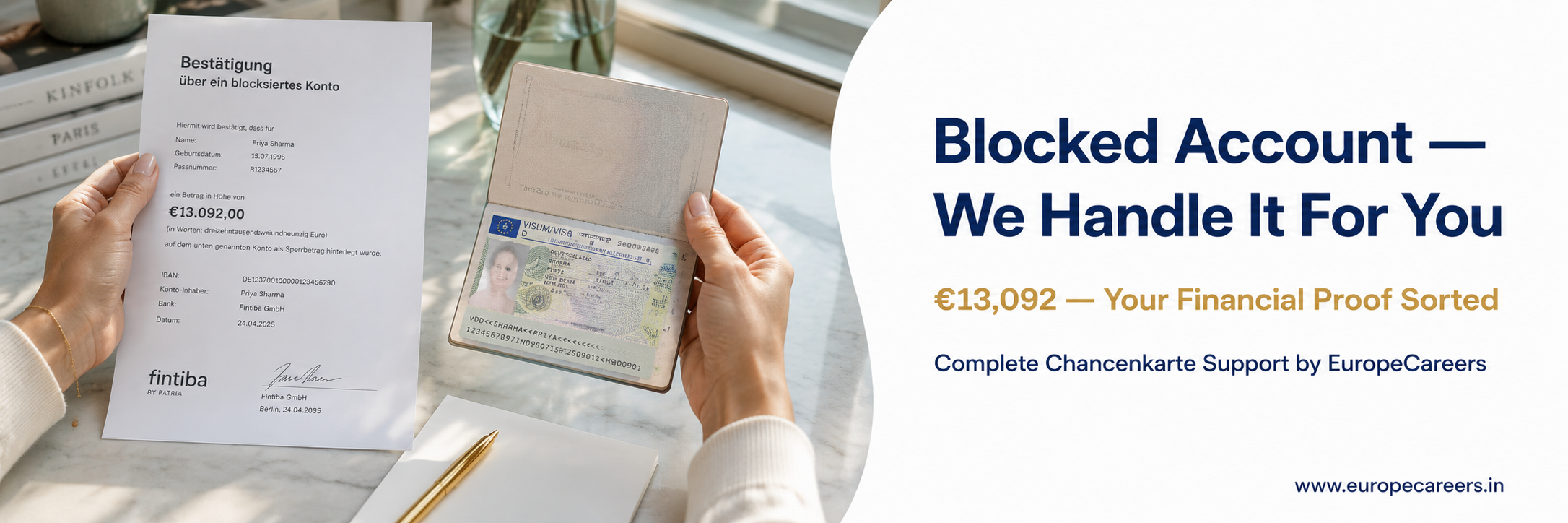 The blocked account — in German called Sperrkonto — is a special German bank account that you open from India before your visa application. You deposit the full required amount — approximately €13,092 — into this account. After you arrive in Germany, the money is released to you in monthly instalments of €1,091. You cannot withdraw the whole amount at once — it comes out monthly, which is exactly what German consulates want to see as proof that you have stable monthly funds.
In Indian rupees, opening the blocked account requires depositing approximately ₹14.5 to ₹15 lakhs upfront. This money is yours — it is not a fee, not a charge, not a donation to any government. It sits in your account and is released back to you every month after you arrive.
EuropeCareers helps every Opportunity Card client choose the right blocked account provider, complete the opening process, and make sure the documentation is in the exact format that German consulates accept. Choosing the wrong provider is one of the most common and easily avoidable mistakes Indian applicants make.
What Can You Do After You Arrive in Germany?
Once you are in Germany on your Opportunity Card, here is exactly what you are allowed to do and not allowed to do. This is important — please read this carefully.
You CAN do all of this:
You can live legally in Germany for 12 months. Full legal residence. No problem.
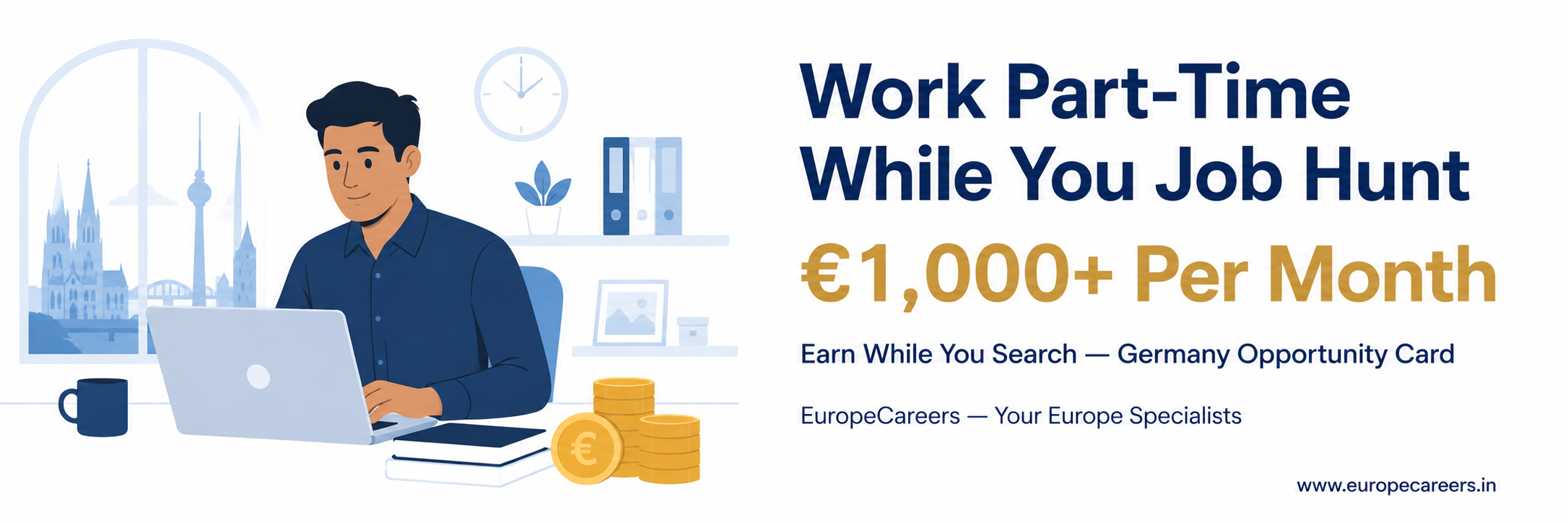
You can work part-time for up to 20 hours per week. At Germany’s minimum wage of €12.41 per hour, 20 hours per week gives you over €1,000 per month. This combined with your blocked account monthly release means most Opportunity Card holders are financially comfortable during their job search.
You can do two-week trial work with any employer. These are short arrangements where a company lets you work with them for up to two weeks before deciding whether to make a formal job offer. This is one of the most effective tools for landing a full-time role — employers can see your actual work quality before committing, and you get a real taste of the company before accepting anything.
You can attend interviews, job fairs, company open days, and networking events across Germany.
You can register with the Federal Employment Agency — Germany’s official job centre — and use their free job placement services.
You can join German language classes to improve your German while you search.
You CANNOT do these things:
You cannot work full-time without first converting your Opportunity Card to a work permit after getting a job offer.
You cannot do freelancing or self-employment on this visa.
You cannot use this card to work in another European country — it is valid only in Germany.
Which Cities Are Best for Indian Opportunity Card Holders?
Where you choose to base yourself during your job search matters a lot. Here is a simple breakdown of the main German cities for Indian professionals.
Berlin is the best city if you are in IT, digital, startups, or creative industries. English is widely spoken in professional environments here — more than any other German city. It is the most international and welcoming city for newcomers. Rent is high but still lower than Munich.
Munich has the highest salaries and the strongest engineering and automotive sector in Germany. BMW, Siemens, MAN, Allianz — all headquartered here or nearby. German language skills matter more in Munich than in Berlin. Cost of living is the highest in Germany but salaries compensate.
Frankfurt is Germany’s financial centre — the European Central Bank, Deutsche Bank, and hundreds of international banks are here. Best city for finance, banking, logistics, and aviation professionals. Very international atmosphere.
Hamburg is strong for logistics, shipping, aviation, and renewable energy. Airbus has a big engineering presence here. Quality of life is excellent and costs are reasonable compared to Munich.
Stuttgart is the home of Mercedes-Benz, Porsche, and Bosch. If you are a mechanical or automotive engineer, Stuttgart is your strongest bet. German language is important here.
Cologne and Düsseldorf together form Germany’s most populated region. Strong in media, chemicals, healthcare, retail, and insurance. Good quality of life and moderate costs.
For Indian IT professionals, Berlin is usually the recommended starting point. For engineers, Munich or Stuttgart. For healthcare professionals, most medium and large German cities have urgent vacancies.
Step-by-Step Application Process from India
Here is exactly how the process works when you apply with EuropeCareers support.
Step 1 — Get Your Profile Evaluated
Start with a free consultation with EuropeCareers. We calculate your exact points score, identify your route, check your qualification recognition status, and give you a clear timeline and cost estimate.
Step 2 — Get Your Language Certificate
If you do not have one already, register for IELTS Academic and aim for 6.0 to 7.0 overall. Or get a Goethe-Institut German certificate if you have been learning German. Both are accepted. This is a non-negotiable document — no certificate, no visa.
Step 3 — Open Your Blocked Account
Open your Sperrkonto with a recognised provider. EuropeCareers guides you through this completely. Deposit approximately €13,092 equivalent in Indian rupees. Receive your blocked account confirmation letter.
Step 4 — Gather Your Documents
The full list you need is as follows. Valid passport with at least 12 months validity remaining. Two completed visa application forms. Two recent passport-size photos with white background. Your degree certificate and transcripts — both originals and certified German translations. Your language certificate. Your blocked account confirmation letter. Your Police Clearance Certificate from India with certified German translation. A medical fitness certificate. A German-format CV called Lebenslauf. A motivation letter in German or English explaining your background and why you want to work in Germany.
Step 5 — Book Your Consulate Appointment
Book your national visa appointment at the German Embassy in New Delhi or German Consulate in Mumbai, Chennai, Kolkata, or Bangalore depending on which one covers your state. Book early — appointments fill up fast.
Step 6 — Attend Your Visa Interview
Carry all original documents and copies. Consular officers will ask about your professional background, your job search plan, your financial situation, and your language skills. EuropeCareers does a full mock interview session with every client before this appointment.
Step 7 — Wait for Approval
Processing typically takes 6 to 12 weeks. Complete files with no missing documents are processed fastest. EuropeCareers reviews every document before submission to eliminate errors.
Step 8 — Fly to Germany
Once your visa is approved, collect it from the consulate, book your flights, and travel to Germany.
Step 9 — Register on Arrival
Within 14 days of arriving and moving into accommodation, go to your local Einwohnermeldeamt — the residents’ registration office — and register your address. This gives you your Anmeldebescheinigung, which is the most important document for everything that follows — bank account, health insurance, job applications.
Step 10 — Start Your Job Search Immediately
Do not wait even one week. Register with the Federal Employment Agency the same week you arrive. Update your LinkedIn for the German market. Use German job portals — Indeed.de, Stepstone.de, Xing.de, and direct company career pages. Start outreach immediately. EuropeCareers provides a detailed week-by-week job search action plan for every client.
What Happens When You Get a Job Offer?
 This is the best part. When a German employer makes you a formal full-time job offer, you apply to convert your Opportunity Card to the appropriate work residence permit. The exact type depends on your salary and qualification level.
If your annual salary is above €45,934 and you have a recognised university degree, you apply for the EU Blue Card — Germany’s premium work permit that leads to permanent residency in as little as 21 months for B1 German speakers.
If your salary is at market rate but below the EU Blue Card threshold, or if your qualification is vocational rather than degree-level, you apply for the Skilled Worker permit under Section 18a of the German Residence Act.
During the conversion process you continue living and working part-time in Germany normally. The conversion takes a few weeks and does not require you to leave Germany and come back on a new visa. Once it is done, you start full-time work.
Your employer pays you at the German market rate. You are covered by German social insurance — health insurance, pension, unemployment insurance, and accident insurance are all automatically included.
What Is the Path to Permanent Residency?
The Opportunity Card is just the starting point. Here is the full journey.
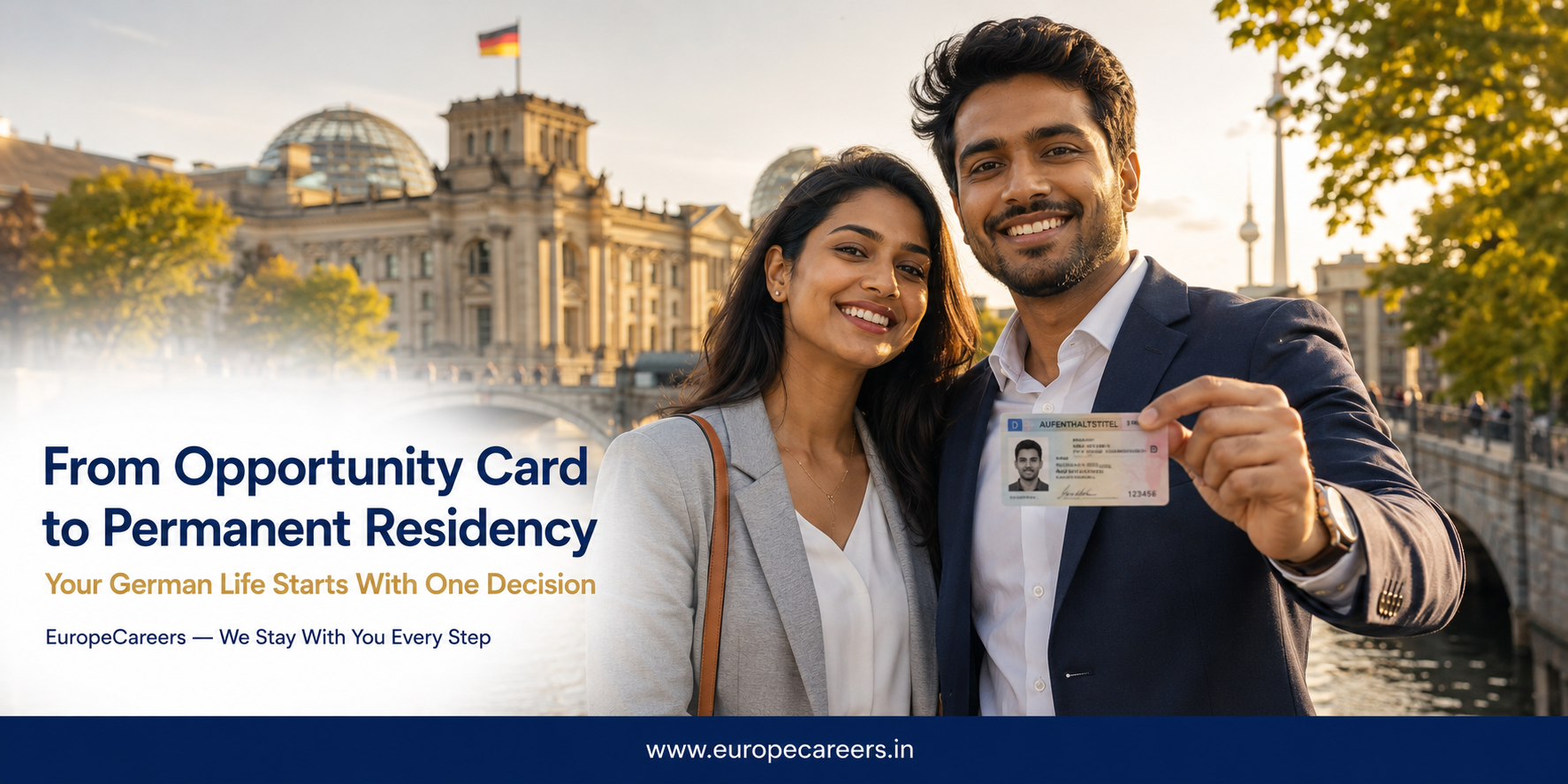
After converting to a Skilled Worker permit and working for three years in your qualified field, you can apply for the Niederlassungserlaubnis — Germany’s permanent settlement permit. This means you can live and work in Germany permanently with no restrictions.
If you get an EU Blue Card and reach B1 German level, you can apply for permanent residency in just 21 months. That is less than two years from starting full-time work.
After five continuous years of legal residence in Germany, you can apply for German citizenship. And since June 2024, India-Germany dual citizenship is officially allowed — you do not have to give up your Indian passport. You can hold both.
Opportunity Card vs EU Blue Card vs Regular Work Visa — Simple Comparison
 Opportunity Card — No job offer needed. Come first, search after. Part-time work allowed. 12 months validity. Minimum 6 points required. Best for: professionals without a German job offer yet.
EU Blue Card — Job offer required before applying. Minimum salary €45,934 per year for shortage occupations. University degree required. Fastest PR route — 21 months. Best for: highly qualified professionals who already have a qualifying job offer.
Skilled Worker Visa — Job offer required before applying. Works for both degree and vocational qualifications. No minimum salary beyond market rate. Full recognition required. Best for: professionals with a confirmed German employer ready to hire them.
The Opportunity Card is clearly the right starting point for the large majority of Indian professionals who do not yet have a German employer lined up.
Most Common Mistakes Indian Applicants Make
At EuropeCareers we see the same mistakes repeatedly. Here is what to avoid.
Incomplete documents — Missing even one certified translation or one document validity date can delay your application by months. Every single item must be present and correct before you submit.
No formal language certificate — Many applicants think their spoken English is enough. Consulates require a formal certificate from IELTS, TOEFL, Cambridge, or PTE. No certificate, no visa — simple.
Wrong blocked account provider — Not every blocked account service is accepted by German consulates. Using an unrecognised provider means your financial proof gets rejected. Always use EuropeCareers recommended providers.
Arriving without a job search plan — 12 months feels like a long time but goes quickly if you do not have a clear strategy. Applicants who arrive without a sector focus, a target city, and an active approach often run out of time before finding a qualified position.
Working full-time before permit conversion — Some people start full-time work immediately after getting a job offer without waiting for the formal permit conversion. This is a visa violation. Always wait for the new permit before starting full-time work.
Not learning any German before arrival — Even if your Chancenkarte used the English B2 route, arriving in Germany with zero German is a serious disadvantage in most sectors outside pure tech. Even A2 German makes a big difference in how employers perceive you and how fast you find a job.
How EuropeCareers Helps You
At EuropeCareers we provide complete end-to-end support for the Germany Opportunity Card. This is exactly what we do for every client.
We start with a detailed free profile evaluation where we calculate your exact points score, identify your strongest route, and give you an honest timeline.
We prepare your complete visa document file — translations, Lebenslauf, Motivationsschreiben, blocked account documentation, and every supporting document formatted exactly as the consulate requires.
We conduct a full mock visa interview where we ask you exactly what German consular officers ask Indian applicants and coach you on how to answer clearly and confidently.
We give you a post-arrival job search action plan — week by week, sector by sector, city by city — so you do not waste a single day of your 12 months.
We connect you with German employers in your sector where possible through our employer network.
We support your permit conversion once you get your job offer.
Visit europecareers.in and reach out to us today for your free profile evaluation. Tell us your background, your qualification, your work experience, and your goals — and we will tell you exactly where you stand and exactly what your path looks like.
Your German career is waiting. The Opportunity Card is the door. EuropeCareers helps you walk through it.
Frequently Asked Questions
Do I need a job offer for the Germany Opportunity Card? No. That is the whole point of this visa. You come to Germany first and search for a job after arriving.
How many points do I need? Minimum 6 points from the official points system. Most Indian professionals with a degree, work experience, and English B2 certificate reach this easily.
Can I work while on the Opportunity Card? Yes — part-time up to 20 hours per week. Full-time work requires converting to a work permit after getting a qualified job offer.
How much money do I need to show? €1,091 per month — roughly €13,092 for 12 months — approximately ₹14.5 lakhs in 2026. Usually shown through a German blocked account.
How long does the visa take to process from India? Typically 6 to 12 weeks from submitting a complete application file.
What happens if I do not find a job in 12 months? You leave Germany when the card expires. You can reapply after improving your profile — typically language skills or qualification recognition.
Does this lead to permanent residency? Yes. After converting to a Skilled Worker permit and working three years, you qualify for permanent residency. On the EU Blue Card with B1 German it is just 21 months.
Can I keep my Indian passport after getting German citizenship? Yes. Since June 2024, dual citizenship between India and Germany is officially permitted. You do not give up your Indian passport.
Which sector has the most jobs for Indians on the Opportunity Card? IT and software development, engineering, healthcare and nursing, finance, and logistics are the strongest sectors for Indian professionals in 2026.
Is EuropeCareers free? We offer a free initial profile evaluation. Our paid services cover complete document preparation, visa filing support, interview coaching, and post-arrival guidance. Contact us at europecareers.in for full details.