
Occupational Therapy Jobs in Germany 2026 — Complete Guide for Indian & Foreign Healthcare Professionals
Introduction — Why Germany Is the Top Destination for Occupational Therapists in 2026
Discover high demand, strong salaries, career growth, and international healthcare opportunities.
If you are a qualified occupational therapist — or an aspiring OT student — and you are thinking about building your career in Europe, Germany deserves to be at the very top of your list. With an ageing population, a rapidly growing demand for rehabilitation and therapeutic services, and a healthcare system that actively recruits trained professionals from India and other non-EU countries, Germany is offering one of the most stable and financially rewarding career environments for occupational therapists anywhere in the world right now.
At EuropeCareers, we have helped hundreds of Indian healthcare professionals navigate the path to working in Germany — from qualification recognition and language preparation to visa applications and finding their first employer. In this complete 2026 guide, we cover everything you need to know about occupational therapy jobs in Germany: what the role looks like, how much you can earn, how to get your qualification recognised, which visa to apply for, and how to land your first OT position from India.
What Is Occupational Therapy Called in Germany?
Before you start your job search, there is one critical piece of terminology to understand. In Germany, occupational therapy is called Ergotherapie, and an occupational therapist is an Ergotherapeut (male) or Ergotherapeutin (female). When you are searching German job portals, always use these German terms — searching for “occupational therapist” in English will return far fewer results than searching for “Ergotherapeut” or “Ergotherapie Stelle.”
The profession in Germany covers everything from paediatric developmental therapy and neurological rehabilitation to geriatric care, psychiatric support, and workplace reintegration. The scope of practice broadly mirrors what occupational therapists do in India, the UK, and Australia, though the German system places particularly strong emphasis on documentation, interdisciplinary team collaboration, and evidence-based practice protocols.
Is There Demand for Occupational Therapists in Germany in 2026?
The short and direct answer is yes — and the demand is growing. Germany’s demographic challenge is well-documented. The country has one of the oldest populations in the world, with nearly 22% of its citizens aged 65 or above. As of early 2026, Germany has over 639,000 job vacancies nationwide, spanning sectors including healthcare, engineering, IT, and finance. Healthcare is consistently among the most acute shortage areas. University Insights
The new Skilled Immigration Act has expanded the list of shortage occupations significantly, with health services professionals now explicitly included among those eligible for easier immigration pathways and lower salary thresholds. For occupational therapists, this means Germany is not just tolerating foreign applicants — the system has been restructurally reformed to actively welcome and fast-track them. Select Your University
LinkedIn currently lists over 1,000 occupational therapist positions in Germany, with new roles added daily across hospitals, rehabilitation centres, paediatric clinics, elderly care facilities, psychiatric institutions, and private practices. Education Vibes
Occupational Therapist Salary in Germany 2026 — Full Breakdown
This is the section most professionals want to get straight to. Germany pays occupational therapists well — and the salary grows significantly with experience.
The average occupational therapist gross salary in Germany is €63,223 per year, or approximately €30 per hour. An entry-level occupational therapist with 1 to 3 years of experience earns an average of €44,894 per year, while a senior-level OT with 8 or more years of experience earns around €71,295 per year. In addition to the base salary, therapists typically earn an average annual bonus of €1,024. Shuraa Education
A person working as an occupational therapist in Germany typically earns around €4,720 per month including housing, transport, and other benefits. Salaries range from €2,170 at the entry level to €7,510 at the highest senior levels. Breaking this down by experience: professionals with less than two years of experience earn approximately €2,470 per month, those with two to five years earn around €3,290 per month — a 34% increase — and those with five to ten years of experience reach approximately €4,870 per month. All India Institute of Medical Sciences
In Indian rupees at current exchange rates, an entry-level OT in Germany earns approximately ₹40,000 to ₹55,000 per month, a mid-career professional earns ₹55,000 to ₹80,000 per month, and a senior therapist can earn ₹90,000 to ₹1.3 lakh per month — all as a salaried employee with full social security, health insurance, and pension contributions included.
These are among the highest occupational therapist salaries available in any country where Indian professionals can realistically obtain a work visa. For context, an OT in India typically earns ₹20,000 to ₹45,000 per month in a private hospital setting.
Where Do Occupational Therapists Work in Germany?
The work settings available to occupational therapists in Germany are diverse and cover the full spectrum of healthcare environments.
Hospitals and rehabilitation centres are the largest employers. Major university hospitals and rehabilitation clinics in cities like Berlin, Munich, Hamburg, Frankfurt, Cologne, and Stuttgart have dedicated occupational therapy departments across neurology, orthopaedics, cardiac rehabilitation, and oncology wards.
Paediatric clinics and child development centres represent a growing segment. Companies such as Joy Center Family in the Stuttgart area specifically recruit internationally qualified occupational therapists for paediatric work with children aged 2 to 15, covering developmental, emotional, sensory, and motor challenges, with English fluency accepted alongside German language skills. Select Your University
Elderly care and nursing homes (Pflegeheime) are in particularly acute need. With Germany’s ageing population, occupational therapists who can work with geriatric patients — supporting daily living skills, cognitive stimulation, and fall prevention — are in very high demand.
Psychiatric facilities and mental health clinics employ OTs as core members of the interdisciplinary treatment team, working with patients experiencing depression, anxiety, schizophrenia, and addiction.
Private Ergotherapie practices offer smaller, more independent working environments and are especially common in suburban and rural areas, where therapists often build long-term caseloads with returning patients.
Schools and special education settings employ occupational therapists to support children with learning disabilities, sensory processing disorders, and physical challenges in educational settings.
Home care and community therapy is a growing area as Germany increasingly moves toward community-based rehabilitation models, with OTs visiting patients in their homes.
Qualification Recognition in Germany — The Most Important Step
This is the part of the process that requires the most attention and planning. Occupational therapy (Ergotherapie) is a regulated profession in Germany, which means you cannot legally practise as an occupational therapist without having your foreign qualification formally recognised by the German authorities.
In Germany, regulated professions require practitioners to obtain recognition of their foreign qualification or a professional licence before they can work. During the recognition procedure, the competent recognition authority assesses whether your foreign qualification is equivalent to the German reference occupation. The assessment generally takes three to four months after all documents have been submitted, and results in a notice indicating full recognition, partial recognition, or no recognition. Shivanshint
For occupational therapists, the competent recognition authority varies by state (Bundesland). You will typically apply to the state health authority (Gesundheitsamt or Landesbehörde) in the German state where you intend to work.
The documents you typically need for the recognition application include your degree certificate and transcripts certified and officially translated into German, a detailed syllabus or course content breakdown of your OT degree programme, proof of clinical hours completed during your training, a valid passport, and your CV. Some states also request a certificate of good standing or a reference from a previous employer.
After the verification procedure, applicants receive a recognition notice indicating whether the foreign qualification is fully equivalent to the German reference occupation. If partial recognition is granted, applicants can complete compensatory measures — such as internships, specialist training courses, or job-related German language courses — to achieve full equivalence. A residence permit for recognition purposes can be granted for up to 24 months, with the option to extend for a further 12 months if needed. mbbs in georgia
The recognition process costs several hundred euros depending on the state and can take between 3 and 6 months. EuropeCareers assists our clients with every aspect of this application — document collection, certified translations, and liaising with the relevant authority.
German Language Requirement for OT Jobs
There is no way around this: German language proficiency is essential for practising occupational therapy in Germany. The language requirement serves both a clinical and a safety function — you will be communicating with patients, families, physicians, nurses, and colleagues in German every day.
For most occupational therapy roles in Germany, employers require a minimum of B2 level German under the Common European Framework of Reference (CEFR). Many hospital and senior care employers require C1 level, particularly in neurological and psychiatric settings where nuanced communication is critical.
For the qualification recognition process itself, the skills analysis visa requires at least A2 German, but for full professional practice in healthcare, B2 is the standard requirement. mbbs in georgia
For Indian students and professionals building toward an OT career in Germany, we recommend the following timeline. Start at A1 as soon as you decide Germany is your goal. Reach A2 within 3 to 4 months. Reach B1 within 8 to 10 months. Complete B2 within 14 to 16 months of starting. If targeting clinical or psychiatric roles, push to C1 within 18 to 22 months. Goethe-Institut centres across India — in Delhi, Mumbai, Pune, Chennai, Kolkata, and Bangalore — offer structured courses and internationally recognised certification examinations at all levels.
The language investment is real and takes time. But the financial return makes it one of the most rewarding preparations a healthcare professional can make.
Visa Pathways for Indian OT Professionals — 2026 Options
Germany offers several visa and residence permit routes for occupational therapists coming from India. The right one depends on whether your qualification has already been recognised.
Skilled Worker Visa (§18a AufenthG) — This is the primary route for occupational therapists with full or partial recognition of their qualification. The German Skilled Worker Visa under Section 18a covers trade professionals and vocational workers without a university degree requirement, including nurses and healthcare assistants, and requires a job offer from a German employer along with evidence of qualification recognition. Atmiaeducation
Recognition Visa (§16d AufenthG) — If your recognition application has been partially approved and you need to complete compensatory measures, this visa allows you to enter Germany and complete those qualification measures. This permit can be granted for up to 24 months and allows part-time work of up to 20 hours per week in a related field while completing the recognition process. mbbs in georgia
EU Blue Card — For occupational therapists with a recognised degree and a qualifying salary offer. In 2026, the EU Blue Card salary threshold for shortage occupations including healthcare is €45,934.20 annually, which is lower than the standard threshold of €50,700 for non-shortage roles. The Blue Card offers faster pathways to permanent residency — potentially within 21 months for B1 German speakers. University Insights
Germany Opportunity Card (Chancenkarte) — If you do not yet have a job offer, the Opportunity Card allows qualified professionals to enter Germany for up to one year to search for a job, with permission to work part-time for up to 20 hours per week during this period. India is currently the single largest source country for Opportunity Card holders, accounting for nearly one-third of all visas issued worldwide. You need a points score of at least 6, which healthcare professionals with OT qualifications and German language skills can typically achieve. PrepLadder
Visa processing times have improved significantly in 2026 following Germany’s rollout of fully digital visa processing. Standard timelines are 8 to 12 weeks from application submission, with employer fast-tracking reducing this to as little as 4 weeks in some cases. University Insights
Step-by-Step Guide: How to Get an Occupational Therapy Job in Germany from India
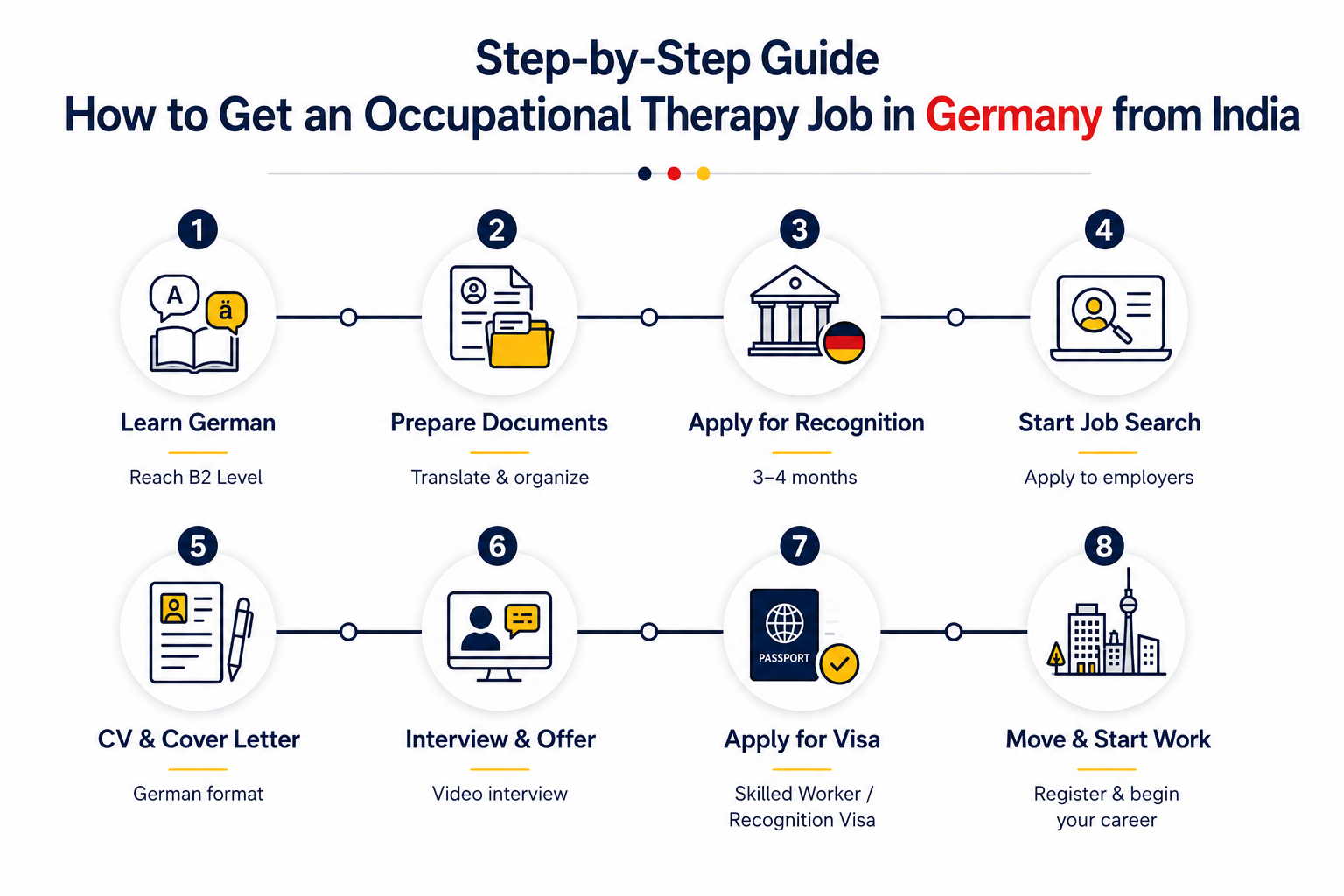
Discover the complete step-by-step process — from German language preparation and qualification recognition to job placement, visa, and relocation support with Europe Careers.
Here is the exact roadmap EuropeCareers takes our clients through.
Step 1 — Start German language preparation. The earlier the better. Commit to reaching B2. Use Goethe-Institut, Lingoda, or DeutschAkademie structured courses. Set a target exam date and work backward.
Step 2 — Get your documents in order. Compile your OT degree certificate, official transcripts, a detailed course content list (module-by-module), clinical placement records, and your CV. Have all non-German documents officially translated by a certified translator (vereidigter Übersetzer).
Step 3 — Apply for qualification recognition. Submit your recognition application to the relevant state health authority in your target German state. EuropeCareers can identify the correct authority and assist with the full application package. The assessment takes 3 to 4 months.
Step 4 — Begin your job search. Do not wait for recognition to be complete before applying to employers. German employers in healthcare are accustomed to hiring OTs whose recognition is in progress. Use portals including Indeed.de, Stepstone.de, Medi-Jobs.de, Karriere.de, and LinkedIn. Search for “Ergotherapeut Stelle” or “Ergotherapeutin gesucht” in your target city.
Step 5 — Prepare your German-format CV and cover letter. German employers expect a Lebenslauf in the DIN 5008 format — a structured, precise document including a professional photo, personal details, education history, and work experience in reverse chronological order. Your cover letter (Anschreiben) should be written in professional German.
Step 6 — Interview and receive a job offer. Most German healthcare employers conduct interviews via video call for international applicants. Prepare to discuss your clinical experience, patient groups you have worked with, your German language level, and your availability date.
Step 7 — Apply for your visa. With your recognition notice (full or partial) and a signed employment contract, apply for the Skilled Worker Visa or Recognition Visa at the German Embassy in New Delhi or the relevant German Consulate in India. The required documents include your passport, recognition notice, employment contract, German language certificate, biometric photo, and proof of accommodation in Germany.
Step 8 — Register and begin work. On arrival in Germany, register at your local Einwohnermeldeamt (residents’ registration office) within 14 days. Open a German bank account, register with your health insurance provider (Krankenkasse), and begin your first day of work.
Career Progression for Occupational Therapists in Germany
Starting as a staff occupational therapist in Germany is just the beginning. The career trajectory is genuinely impressive.
After two to three years of clinical experience, you can move into senior Ergotherapeut roles with significantly higher compensation. With five or more years of experience, team leader and department head positions become accessible — a senior-level occupational therapist with 8 or more years of experience earns an average of €71,295 per year. All India Institute of Medical Sciences
Beyond clinical work, German occupational therapists can pursue a Bachelor’s or Master’s degree in Ergotherapie at a Hochschule (university of applied sciences) — often with employer sponsorship or reduced hours to accommodate study. A Master’s qualification opens the door to university teaching, clinical research, healthcare management, and policy roles. On average, a Master’s Degree represents the highest level of education associated with the top salary band for occupational therapists in Germany. Eklavya Overseas
Running your own private Ergotherapie practice is also a common goal for experienced therapists. Germany’s statutory health insurance system (gesetzliche Krankenversicherung) reimburses OT services, meaning a well-established private practice can generate a very strong independent income.
Path to Permanent Residency — After working in Germany for a qualifying period under a skilled worker visa, you can apply for the Niederlassungserlaubnis (permanent settlement permit). Under the standard route this requires 4 to 5 years; under the EU Blue Card route it can be achieved in as little as 21 months for B1 German speakers. After 5 years of legal residence and B1 German, you become eligible for German citizenship — and since 2024, dual citizenship with India is officially permitted, meaning you do not have to give up your Indian passport.
Top Cities for Occupational Therapy Jobs in Germany
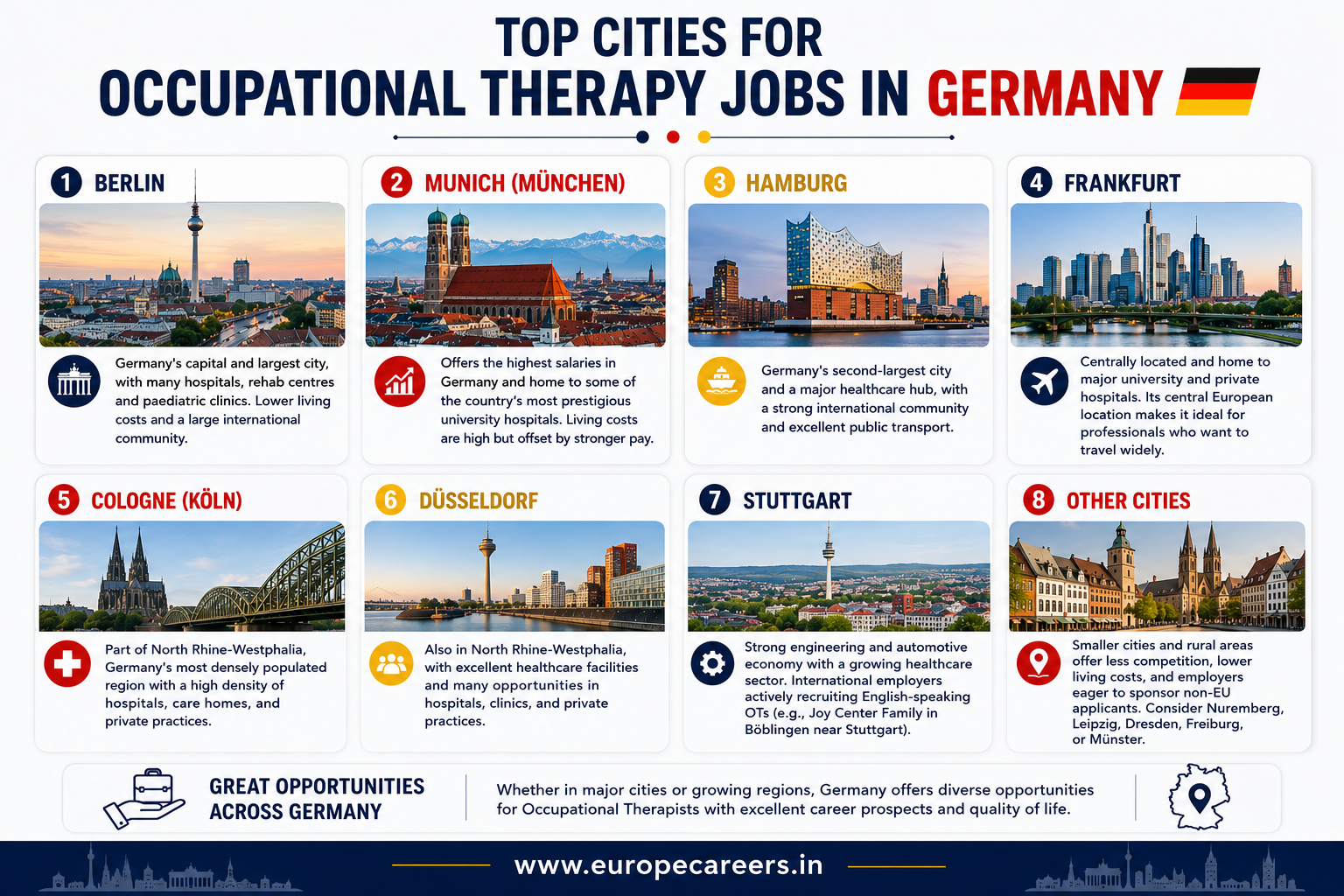
Discover healthcare opportunities, salary potential, and career growth for international professionals.
Berlin is Germany’s capital and largest city, with a vast network of hospitals, rehabilitation centres, and paediatric clinics. Living costs are lower than Munich, and the international community is large and welcoming.
Munich (München) offers the highest salaries in Germany and home to some of the country’s most prestigious university hospitals. Living costs are high but offset by the stronger pay.
Hamburg is Germany’s second-largest city and a major healthcare hub, with a strong international community and excellent public transport.
Frankfurt is centrally located and home to major university and private hospitals. Its central European location makes it ideal for professionals who want to travel widely.
Cologne (Köln) and Düsseldorf in the North Rhine-Westphalia region represent Germany’s most densely populated area with an enormous density of hospitals, care homes, and private practices.
Stuttgart has a strong engineering and automotive economy alongside a growing healthcare sector, and notably has international employers actively recruiting English-speaking OTs, as evidenced by the Joy Center Family clinic in Böblingen near Stuttgart specifically hiring occupational therapists with paediatric expertise and English fluency to serve German and American military families.
Smaller cities and rural areas often have less competition for OT positions, lower living costs, and employers who are particularly motivated to sponsor non-EU applicants. Do not overlook cities like Nuremberg, Leipzig, Dresden, Freiburg, or Münster.
Advantages and Challenges — An Honest Assessment from EuropeCareers
What works strongly in your favour: Germany has a genuine structural shortage of occupational therapists that will worsen over the next decade as the population ages. The Skilled Immigration Act has been specifically reformed to make it easier for non-EU healthcare professionals to enter Germany. Salaries are among the highest for OTs anywhere in the world. The social security system is excellent — your health insurance, pension contributions, and unemployment insurance are all covered. Permanent residency pathways are clear and achievable. Dual citizenship with India is now permitted. The qualification is recognised across the EU.
What requires preparation and patience: German language learning to B2 is a significant time and financial investment — there is no shortcut. The qualification recognition process takes 3 to 6 months and requires a well-organised set of documents. The German job application format is specific and different from what Indian applicants are used to. Initial salary at the entry level, while strong by Indian standards, may feel modest against Germany’s cost of living, particularly in Munich or Frankfurt — though this improves quickly with experience.
How EuropeCareers Can Help You
At EuropeCareers, we have built a dedicated support pathway specifically for Indian occupational therapy professionals targeting Germany. Our support includes a personalised profile assessment to identify your strongest visa pathway, step-by-step guidance through the qualification recognition application, German-format CV and cover letter preparation, connection to German employers actively seeking international OT candidates, end-to-end visa application support, and pre-departure and post-arrival orientation.
We do not believe in sending you to Germany unprepared. Our goal is to make sure that when you land, your paperwork is in order, your employer is waiting, and your career in Europe starts on the strongest possible footing.
If you are an occupational therapist ready to take your career to Germany, reach out to EuropeCareers today for a free consultation. We will assess your profile, map out your timeline, and tell you honestly exactly what it takes — and how long it will take — to make it happen.
Frequently Asked Questions
Can Indian occupational therapists work in Germany? Yes, absolutely. Germany’s Skilled Immigration Act actively supports non-EU healthcare professionals including occupational therapists (Ergotherapeuten). You need your qualification recognised, a B2 German language certificate, and either a job offer or the Opportunity Card.
What is the salary of an occupational therapist in Germany? The average gross salary is approximately €63,223 per year. Entry-level OTs earn around €44,894 per year, while senior therapists with 8 or more years of experience earn around €71,295 per year.
Is occupational therapy in demand in Germany? Yes. Germany faces a significant and growing shortage of occupational therapists due to its ageing population and expanding rehabilitation services. The profession is listed among shortage occupations under Germany’s new Skilled Immigration Act.
How long does qualification recognition take for OTs in Germany? The recognition assessment generally takes 3 to 4 months after all documents are submitted. If compensatory measures are required for partial recognition, the total process can take 6 to 12 months.
What German language level is required for OT jobs in Germany? Most employers require B2 level German. Clinical and psychiatric settings often prefer C1. The recognition visa process requires a minimum of A2 for skills analysis purposes, but B2 is the practical standard for safe and effective patient care.
Can an Indian OT get permanent residency in Germany? Yes. After working on a skilled worker visa for 4 to 5 years (or 21 months on an EU Blue Card with B1 German), you can apply for permanent residency. Since 2024, India-Germany dual citizenship is permitted, so you do not have to give up your Indian passport.
Which city in Germany is best for occupational therapists? Berlin, Munich, Hamburg, Frankfurt, and Stuttgart are the largest markets with the most vacancies. Smaller cities and rural areas offer less competition and employers who are especially motivated to sponsor international applicants.