
Complete Approbation Process for Indian Doctors in Germany (2026 Guide)

If you are an Indian MBBS graduate looking at the current state of medical PG in India, you are probably feeling the heat. The intense pressure of the NEET-PG exams, the fierce competition for a handful of clinical seats, and the astronomical fees of private medical colleges have pushed many brilliant doctors to look beyond borders. This is exactly why Germany has emerged as a top-tier destination for Indian healthcare professionals. But to practice medicine in this European powerhouse, you need to clear the Approbation Process for Indian Doctors in Germany.
Navigating the German medical licensing system can feel like learning a completely new anatomy. There is a lot of paperwork, strict language requirements, and challenging exams. However, unlike the unpredictable entrance exams back home, the German pathway is logical, structured, and entirely based on your clinical competence and communication skills.
In this comprehensive 2026 guide, we will break down everything you need to know about getting your medical license in Germany. Whether you are still in medical college, completing your internship, or already working as a Junior Resident, this guide will serve as your ultimate roadmap.
Why Germany is Becoming the Best Destination for Indian Doctors in 2026
Before we dive into the technicalities of the Approbation process, it is important to understand why thousands of Indian doctors are moving to Germany in 2026.
Germany’s healthcare system is facing a massive demographic shift. A large portion of their senior doctors are reaching retirement age, and there are simply not enough local graduates to fill the void. To address this, the German government has streamlined visa processes (such as the Opportunity Card or Chancenkarte) and made it more accessible for non-EU doctors to integrate into their system.
Here is why Germany stands out for Indian doctors in 2026:
Direct Entry to Medical PG (Residency): In Germany, you don’t write a competitive entrance exam like NEET-PG or USMLE to “win” a seat. Once you get your Approbation, you apply for jobs. Your residency (Weiterbildung) is an actual job where you earn a full salary from day one.
No Tuition Fees for Specialisation: You are not paying crores for a clinical seat. You are a paid employee (Assistenzarzt) in a hospital.
High Salary & Standard of Living: With the latest TV-Ärzte (tariff contracts for doctors) updates in 2026, resident doctors start at around €5,100 to €5,500 per month (approx. ₹4.5 to ₹4.9 Lakhs).
Excellent Work-Life Balance: The 80-hour toxic work weeks common in Indian residencies are illegal in Germany. Strict labour laws ensure you get paid for overtime and have sufficient rest and holiday time.
Permanent Residency: Healthcare professionals are fast-tracked for permanent residency (Niederlassungserlaubnis) and even citizenship under the new German naturalisation laws.
What is Approbation in Germany?
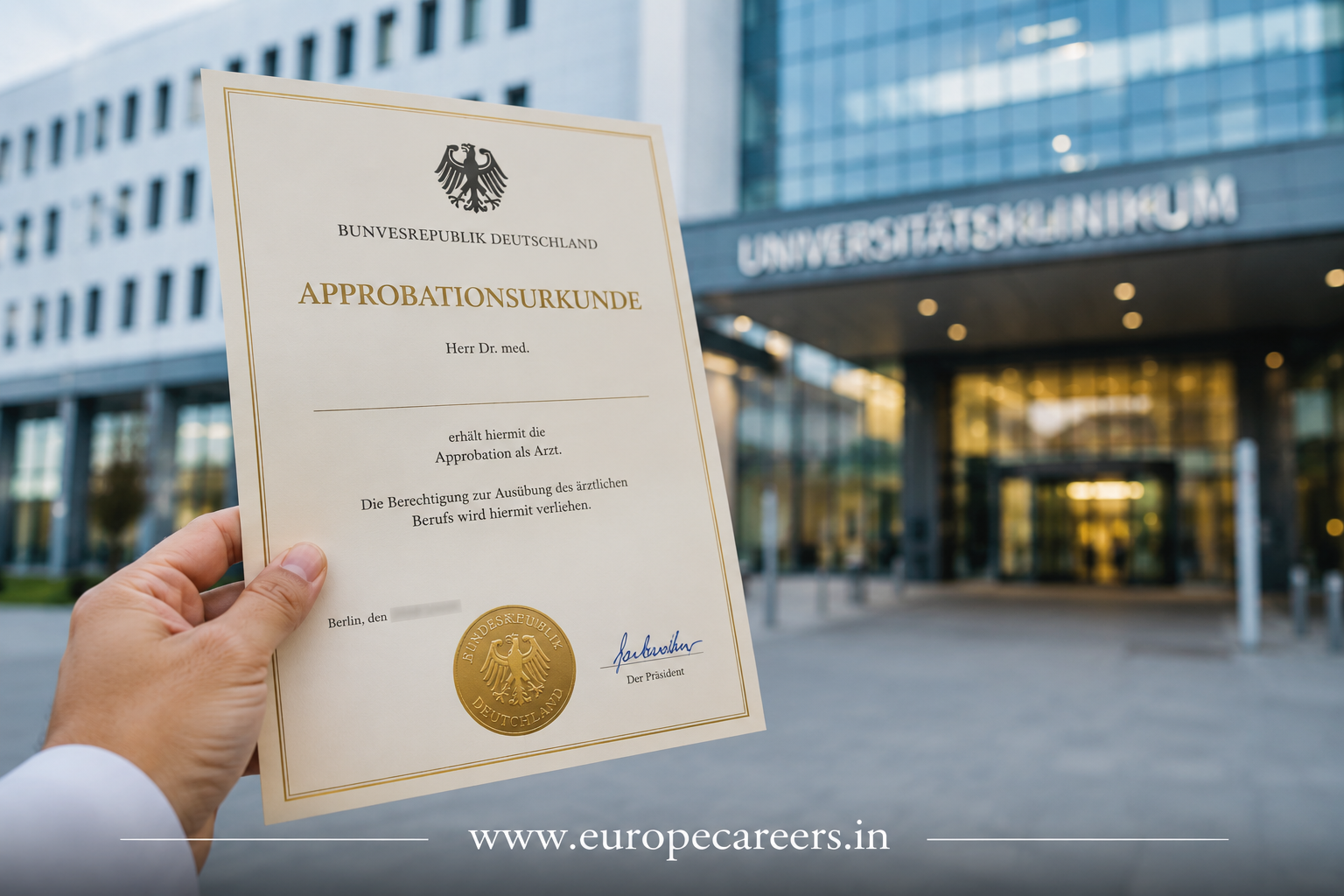 To put it simply, Approbation is your unrestricted, permanent, and full medical license to practice medicine anywhere in Germany.
When you graduate with an MBBS degree from India (which is a non-EU/Third Country), your degree is not automatically recognised as 100% equivalent to a German medical degree. The Approbation is the final certificate issued by the German state medical authorities (Approbationsbehörde) that legally acknowledges your foreign degree is equivalent to local standards, allowing you to work independently, write prescriptions, and start your specialist training (Facharztweiterbildung).
Without Approbation, you cannot become a specialist in Germany. It is the ultimate goal of your entire relocation journey.
Difference Between Approbation and Berufserlaubnis
Many Indian doctors get confused between Approbation and Berufserlaubnis. While both allow you to work as a doctor, they serve very different purposes.
Here is a detailed comparison for 2026:
| Feature | Approbation (Permanent License) | Berufserlaubnis (Temporary License) |
| Validity | Permanent (Lifetime) | Temporary (Usually max 2 years) |
| Geography | Valid across all 16 states in Germany | Valid only in the specific state (often specific hospital) |
| Independence | Can practice independently | Must work under the supervision of an approved doctor |
| Specialisation (PG) | Time counted towards your PG (Weiterbildung) | Usually not counted towards your PG training time |
| Exam Requirement | Requires passing the Kenntnisprüfung (KP) or full equivalency | Only requires passing the Fachsprachprüfung (FSP) |
| Status | Full Doctor (Arzt) | Temporary Assistant Doctor |
Expert Advice: You should always aim for Approbation. While a Berufserlaubnis is a great stepping stone to start earning money and gaining clinical experience in a German hospital while you prepare for your final exams, it is a ticking clock.
Why Indian Doctors Need Approbation
You might wonder, “I already have my permanent registration from the National Medical Commission (NMC) in India. Why do I need to prove myself again?”
The Approbation Process for Indian Doctors in Germany is a legal necessity for patient safety. The medical curriculum in India, while excellent, differs from the European system in terms of legal frameworks, pharmacology guidelines, patient rights, and the healthcare insurance system. Germany needs to ensure that any doctor treating its citizens is fully competent in local medical practices and can communicate flawlessly in German. Furthermore, European Union (EU) law dictates that non-EU degrees must undergo an equivalency check before a permanent license is issued.
Step-by-Step Approbation Process for Indian Doctors in Germany
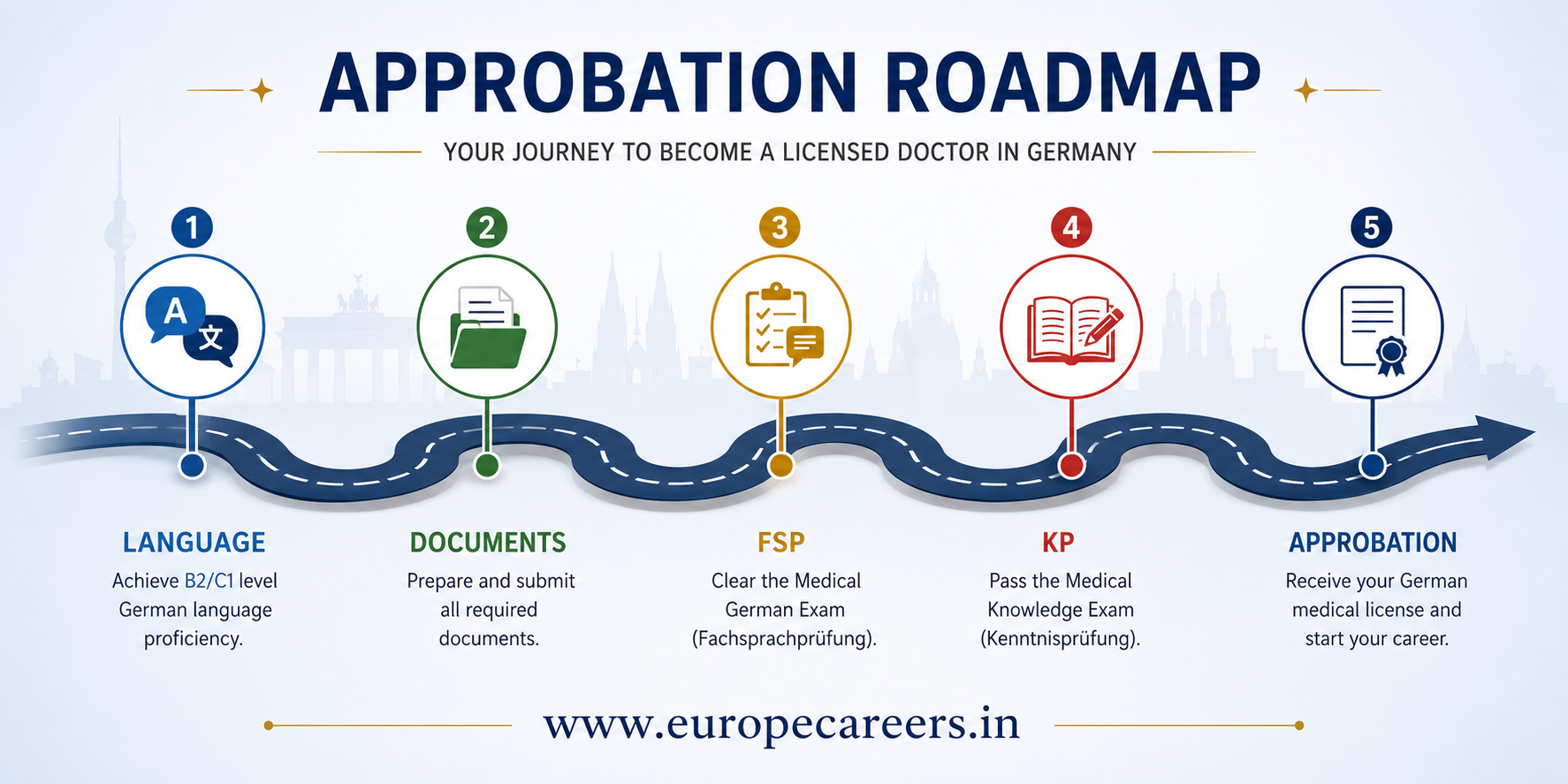 The journey to your German medical license is a marathon, not a sprint. The Approbation Process for Indian Doctors in Germany requires careful planning. Here is the step-by-step roadmap updated for 2026.
1. MBBS Recognition & Anabin Check
Before you spend a single rupee on German classes, verify your university. Germany uses a database called “Anabin” to evaluate foreign universities. Your Indian medical college must be listed as H+ (fully recognised). You must have completed your 4.5 years of academics plus the 1-year mandatory rotatory internship. Your NMC/State Medical Council permanent registration is absolutely mandatory.
2. German Language Requirement (B1 to B2)
You cannot survive in the German healthcare system without the language. Start your German language journey while you are still in India. You need to clear a general German B2 level certification from recognised bodies like Goethe-Institut, TELC, or ÖSD.
A1 to B1: Focuses on everyday grammar and vocabulary.
B2: Focuses on complex texts, spontaneous communication, and understanding native speakers.
3. Document Verification and Translation
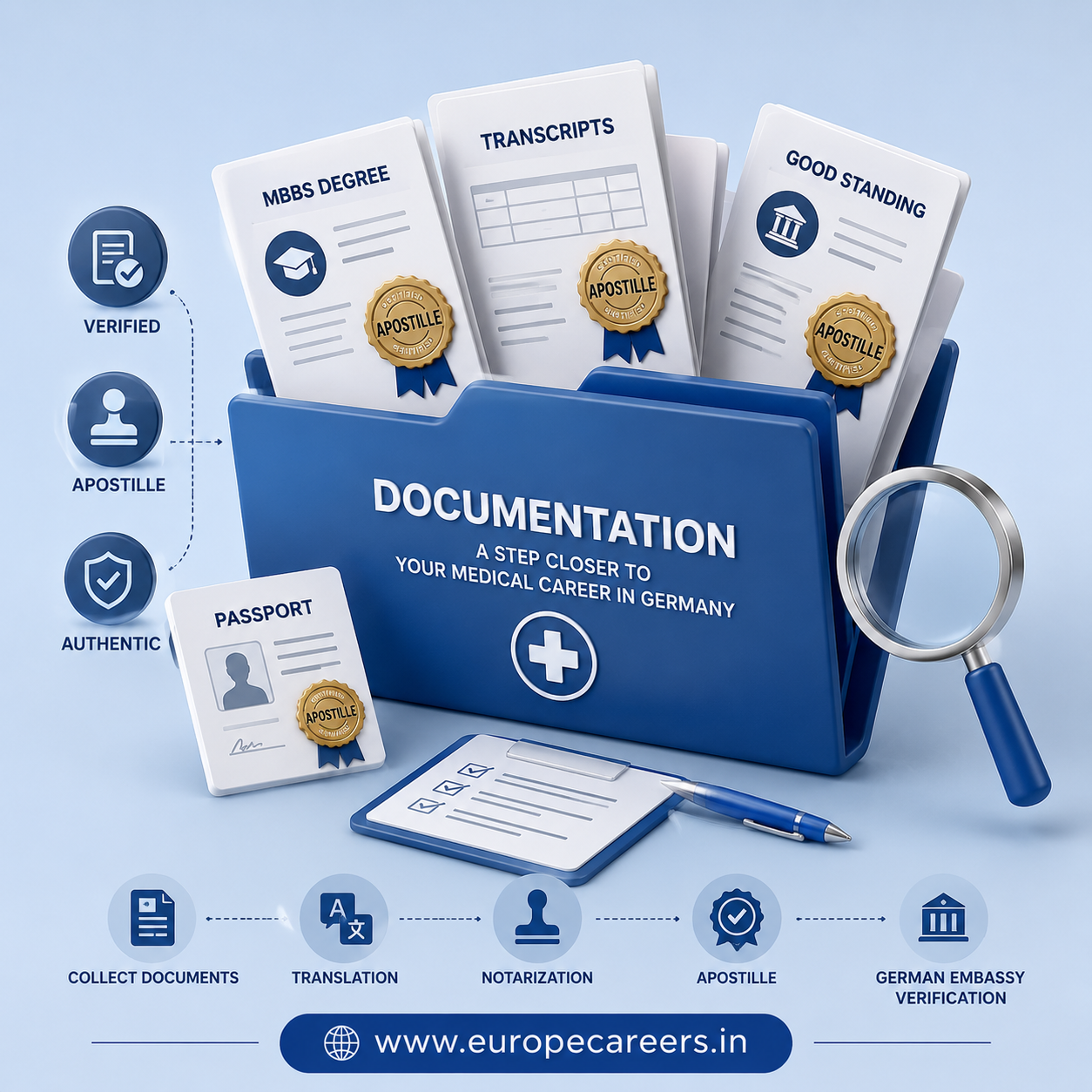
German bureaucracy is famously strict. You will need to gather your degree, transcripts, internship completion certificate, Good Standing Certificate, and police clearances.
All documents must be apostilled by the Ministry of External Affairs (MEA) in India.
They must then be translated into German by a “Sworn Translator” (Vereidigter Übersetzer) recognised by German courts. Doing this through a trusted platform like www.europecareers.in ensures your dossier is perfectly formatted, preventing months of delays.
4. Applying to the State Medical Authority
Germany has 16 federal states (Bundesländer), and each has its own medical licensing authority (Approbationsbehörde). You must choose one state and submit your application (Antrag auf Approbation) there. You cannot apply to multiple states simultaneously. Once they review your documents, they will usually issue a letter stating that your language skills and medical knowledge need to be tested.
5. Fachsprachprüfung (FSP) – Medical German Exam
This is the C1 level Medical German exam. You need to travel to Germany (or use a specialized visa) to take this exam. It tests whether you can take a patient’s history, write a doctor’s letter, and present the case to a senior consultant in flawless Medical German. Once you pass the FSP, you are eligible for the temporary license (Berufserlaubnis).
6. Medical Equivalency Assessment (Gleichwertigkeitsprüfung)
The state authority will compare your Indian MBBS syllabus with the German curriculum. Since Indian and German curriculums have structural differences, Indian doctors almost always receive a Defizitbescheid (deficiency letter), meaning full equivalency is not granted automatically. Do not panic; this is normal for 99% of non-EU graduates. This leads you directly to the next step.
7. Kenntnisprüfung (KP) – Medical Knowledge Exam
Because your degree is not 100% equivalent on paper, you must pass the Kenntnisprüfung to prove your clinical knowledge is up to German standards. It is a practical and oral exam focusing primarily on Internal Medicine, Surgery, and Pharmacology.
8. Visa Process for Doctors
In 2026, Indian doctors generally use the Recognition Visa (Anerkennungsvisa – Section 16d) or the new Opportunity Card (Chancenkarte) to enter Germany. These visas allow you to stay in Germany, take your FSP and KP exams, and even work part-time or do clinical observerships (Hospitation) to sustain yourself.
9. Clinical Observerships (Hospitation)
While preparing for your exams in Germany, doing a Hospitation (shadowing a doctor) for 2 to 4 weeks is highly recommended. It gets you used to the hospital software, the hierarchy, and the daily ward routine, making your exams much easier to crack.
10. Final Licensing Approval
Once you pass the KP, you submit the final clean police records and health certificates. The authority then issues your Approbationsurkunde (Certificate of Approbation). Congratulations, you are officially a fully licensed doctor in Germany!
Required Documents for Approbation
If there is one thing you must take seriously, it is your documentation. A single missing stamp can delay your process by months. Here is a definitive list for 2026:
| Category | Required Document | Remarks / 2026 Rules |
| Identity & Civil | Passport (Authenticated Copy) | Must have valid dates. |
| Birth Certificate | Translated and Apostilled. | |
| Updated CV in German (Lebenslauf) | Must have zero timeline gaps (chronological order). | |
| Academic | MBBS Degree Certificate | Apostilled by MEA and Translated. |
| Marksheets (All years) | Apostilled and Translated. | |
| Syllabus Summary | Some states require a breakdown of clinical hours. | |
| Professional | Internship Completion Certificate | Apostilled and Translated. |
| NMC Permanent License | Apostilled and Translated. | |
| Good Standing Certificate | Issued by NMC/State Council. Must be less than 3 months old when submitted! | |
| Background Checks | Police Clearance Certificate (India) | Must be less than 3 months old. |
| Police Clearance (Germany) | Führungszeugnis (Applied later in Germany). | |
| Medical Fitness Certificate | Signed by a registered doctor, proving you are physically fit to practice. | |
| Language | B2 German Certificate | Goethe, TELC, or ÖSD. |
German Language Requirements for Doctors
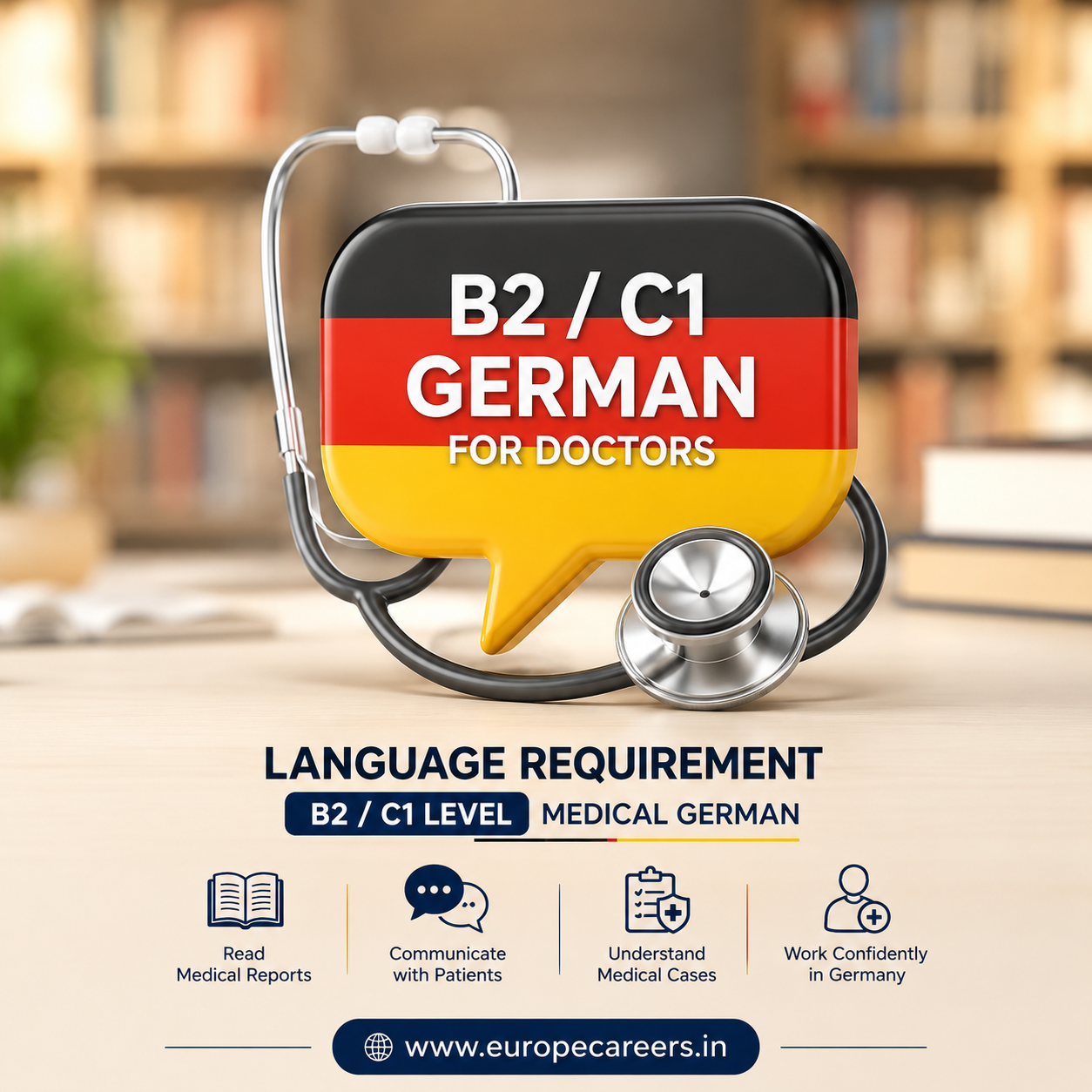 Let us be brutally honest: your medical knowledge is useless in Germany if you cannot communicate it. The language barrier is the biggest hurdle for Indian doctors.
1. General German (B2 Level):
You need to pass a B2 exam. This proves you can understand the main ideas of complex text and interact with a degree of fluency that makes regular interaction with native speakers possible without strain. It usually takes 8 to 10 months of intensive study in India to reach this level.
2. Medical German (C1 Medizin Level):
While your general German is B2, your clinical vocabulary must be at a C1 level. You need to know the difference between the Latin terms doctors use with each other (e.g., Appendizitis) and the German terms you use with patients (e.g., Blinddarmentzündung). This is specifically what the FSP tests.
What is Fachsprachprüfung (FSP)?
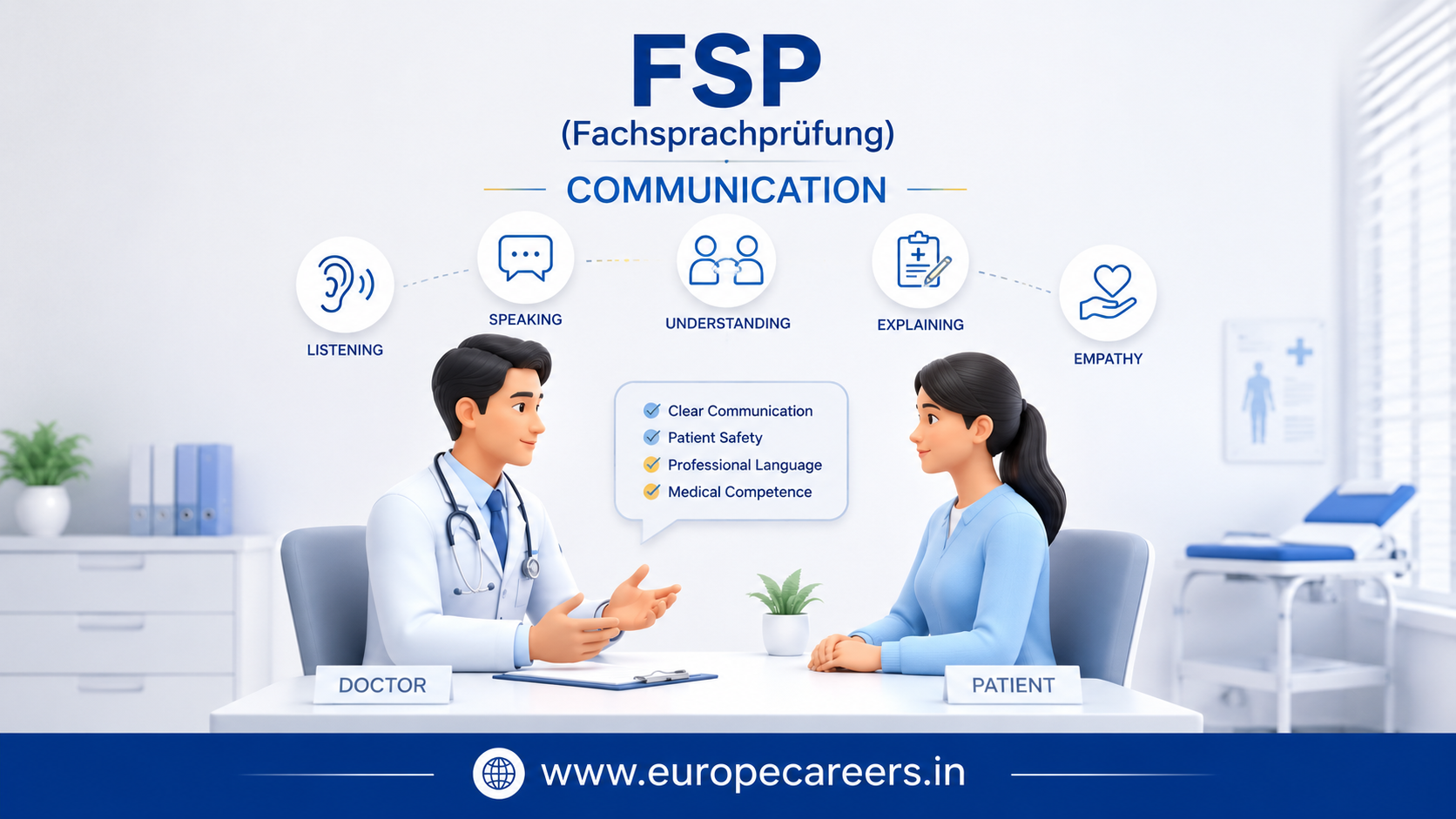 The Fachsprachprüfung (FSP) is not a test of your medical knowledge; it is a test of your clinical communication. It usually lasts 60 minutes and is divided into three 20-minute sections:
Doctor-Patient Simulation (Anamnese): An actor plays the patient. You must take a detailed medical history, ask the right questions empathetically, and explain the suspected diagnosis and planned tests (like taking blood or doing an ECG) in simple, non-medical German.
Medical Documentation (Arztbrief): You sit in a room and write a formal summary of the patient’s history, your suspected diagnosis, and the plan. This must be written in formal medical German, checking your grammar and spelling.
Doctor-Doctor Handover (Patientenvorstellung): You present the case to two senior doctors (the examiners). Here, you must use high-level medical terminology, answer their questions regarding the case smoothly, and justify your communication.
Pro Tip: Indian doctors often fail the FSP not because of poor vocabulary, but because of poor structure and loss of empathy under pressure. Practice with native speakers or specialised tutors is non-negotiable.
What is Kenntnisprüfung (KP)?
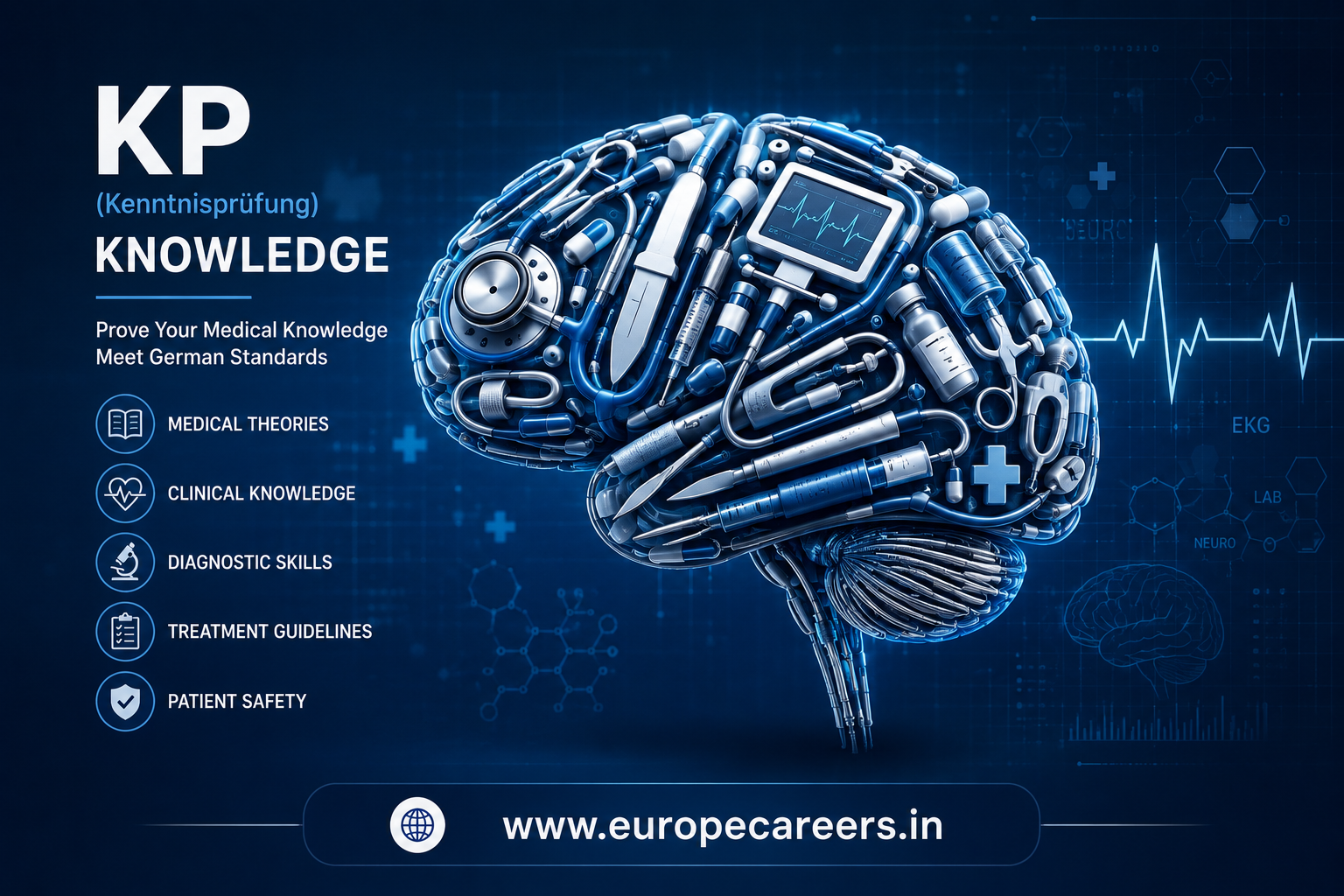 The Kenntnisprüfung (KP) is the final boss of the Approbation Process for Indian Doctors in Germany. It is a rigorous oral and practical examination that tests if your medical knowledge is equivalent to a German medical graduate’s final university exam (the Staatsexamen).
Exam Pattern:
Format: It is not a multiple-choice question (MCQ) exam like NEET-PG. It is a viva-voce (oral) and practical clinical exam.
Duration: Usually lasts between 60 to 90 minutes.
Subjects: The core focus is strictly on Internal Medicine and Surgery. You will also be heavily cross-questioned on Clinical Pharmacology (drug interactions, dosages in Germany), Radiology, and Emergency Medicine. Sometimes, an elective subject (like Neurology or Pediatrics) might be added.
How to Crack the KP:
Understand the German Guidelines: German doctors follow specific guidelines (AWMF Leitlinien) for treatment protocols. A treatment protocol in India for Tuberculosis or Hypertension might differ slightly from the German protocol. You must know the local guidelines.
Practical Application: You might be taken to a real patient’s bedside, asked to examine them, read their X-rays, and propose a treatment plan.
Preparation: Most Indian doctors join an offline or online KP preparation course in Germany (which lasts 3 to 6 months) to get accustomed to the specific questioning style of the examiners.
States in Germany with Better Opportunities for Foreign Doctors
Choosing the right federal state to apply for your Approbation is a strategic decision. Processing times and exam difficulty vary drastically.
North Rhine-Westphalia (NRW): Highly popular because of a massive number of hospitals and job opportunities. However, the wait times for exams can be long due to the sheer volume of applicants.
Bavaria (Bayern) & Baden-Württemberg: Offer some of the highest salaries and excellent university hospitals, but the living costs (Munich, Stuttgart) are high, and the licensing authorities are known to be quite strict.
Saxony (Sachsen) & Thuringia (Thüringen): Eastern states often process applications much faster and have a massive demand for foreign doctors in regional hospitals. They are excellent launchpads for your career.
Hesse (Hessen): Home to Frankfurt, offering a good balance of cosmopolitan life and structured licensing processes.
Expert note: Don’t just follow the crowd to Berlin or Munich. A regional hospital in a smaller town will offer you much better hands-on surgical/clinical exposure early in your career than a crowded university hospital.
Salary of Doctors in Germany (2026 Update)
 One of the biggest motivations for Indian doctors to clear the Approbation process is the financial reward. Doctors in Germany are paid according to fixed union tariffs (TV-Ärzte), meaning you get paid fairly regardless of your nationality.
Here is an estimated breakdown of gross salaries for hospital doctors in 2026:
| Career Level (German Title) | Experience Level | Approx. Monthly Gross Salary (€) | Approx. Monthly in INR |
| Resident Doctor (Assistenzarzt) | Year 1 | € 5,100 – € 5,500 | ₹ 4.5 Lakhs – ₹ 4.9 Lakhs |
| Resident Doctor (Assistenzarzt) | Year 3 | € 5,600 – € 5,900 | ₹ 5.0 Lakhs – ₹ 5.2 Lakhs |
| Specialist (Facharzt) | Fresh Specialist | € 6,800 – € 7,200 | ₹ 6.0 Lakhs – ₹ 6.4 Lakhs |
| Senior Physician (Oberarzt) | Consultant Level | € 8,500 – € 9,800 | ₹ 7.5 Lakhs – ₹ 8.7 Lakhs |
| Chief Physician (Chefarzt) | Department Head | € 15,000+ (Negotiated) | ₹ 13.5 Lakhs+ |
Note: These are base salaries. You earn extra for night shifts (Nachtdienste), weekend shifts, and on-call duties, which can add €800 to €1,500 extra to your monthly paycheck. Taxes in Germany are high (around 35-40% depending on your tax class), but they cover your comprehensive health insurance, unemployment benefits, and pension.
Realistic Timeline of the Entire Process
Patience is key. The Approbation Process for Indian Doctors in Germany is not a fast-food drive-through.
Phase 1: In India (8 to 12 Months)
Learning German from A1 to B2.
Getting documents apostilled and translated.
Sending the application to the German medical authority.
Phase 2: Transition (2 to 4 Months)
Waiting for the Defizitbescheid.
Applying for the visa and travelling to Germany.
Phase 3: In Germany (6 to 12 Months)
Preparing for and clearing the FSP exam.
Working on a temporary license (Berufserlaubnis) or doing Hospitation.
Preparing for and clearing the KP exam.
Total Timeline: From starting German A1 to holding the Approbation certificate, expect a realistic timeline of 1.5 to 2.5 years.
Common Mistakes Indian Doctors Make
As career consultants at www.europecareers.in, we have seen brilliant doctors sabotage their own timelines. Avoid these critical errors:
Taking the German Language Lightly: Memorising grammar to pass the Goethe exam is not enough. If you cannot speak fluently, you will fail the FSP. Treat German as your most important medical subject.
DIY Bureaucracy Errors: Submitting incomplete documents, using unregistered translators, or having unexplained timeline gaps in your CV will lead to authorities putting your file at the bottom of the pile.
Rushing the FSP/KP: Failing the exams means waiting 3 to 6 months for a retest date. Do not attempt the exams until you are taking mock tests and passing them consistently.
Isolating Themselves: Sticking only to Indian peer groups in Germany delays cultural and linguistic integration. Mingle with locals and international doctors.
Applying to the Wrong State: Following a friend to a state with an 18-month backlog for exams instead of a state with a 3-month waiting period.
Can Indian Doctors Do Medical PG in Germany?
 Yes, absolutely! In fact, this is the main reason to go through the Approbation process.
Once you have your Approbation, you apply for a job as an Assistenzarzt (Resident Doctor).
In Germany, Medical PG (called Facharztweiterbildung) is not an academic degree you study for in a university; it is practical, on-the-job training in a hospital.
You find a hospital authorised to provide training (Weiterbildungsermächtigung) in your desired specialty. You sign an employment contract, earn a full salary, and maintain a logbook (Logbuch) of your surgeries, procedures, and ultrasounds. After completing the required years (usually 5 to 6 years) and filling your logbook, you sit for the specialist board exam (Facharztprüfung). Pass it, and you are a Consultant (Facharzt).
Best Specialisations in Germany for Indian Doctors
Unlike India, where getting a seat in Radiology or Dermatology requires a top 1% NEET rank, Germany offers a more level playing field, heavily based on the hospital’s hiring needs and your interview performance.
High Demand (Easier to get into): Internal Medicine, General Surgery, Psychiatry, Neurology, Anaesthesiology, and Family Medicine.
Moderate Demand: Paediatrics, Orthopaedics, Gynaecology & Obstetrics.
Highly Competitive (Requires strong German, excellent networking, and patience): Dermatology, Radiology, Plastic Surgery, and Ophthalmology.
Expert Tip: Many Indian doctors start their residency in Internal Medicine or General Surgery in a smaller regional hospital, build a stellar reputation, and then switch to a competitive specialty in a larger city later.
Challenges Faced by Indian Doctors in Germany
Let us keep it real. Moving to a new country is tough.
The Bureaucratic Grind: The paperwork is relentless. Everything is done via physical mail (Post) or highly regulated digital portals.
The Culture Shock: The German communication style is very direct. An attending physician pointing out your mistake will do so bluntly. It is not personal; it is professional.
Weather and Loneliness: The cold, dark German winters can take a toll on your mental health, especially when you are far from family and studying hard for the KP.
The Nursing Hierarchy: In Germany, nurses are highly autonomous professionals. You do not boss them around. You work as a team, and you will be expected to draw your own blood samples and put in your own IV lines.
Tips to Crack the Approbation Process Faster

Immerse Yourself in Medical German Early: Start listening to German medical podcasts (like Klinisch Relevant) while commuting in India.Get Professional Help with Documents: Using experts like those at www.europecareers.in can save you months of delays caused by incorrect applications.
Do a Hospitation First: Before attempting the FSP, shadow a doctor for a month. Hearing how real doctors talk to real patients is 100x better than any textbook.
Master the “Arztbrief”: Practice writing discharge summaries daily. It is a massive part of the FSP and your daily life as a resident.
Is Germany Worth It for Indian Doctors in 2026?
The Approbation Process for Indian Doctors in Germany is undeniably challenging. It demands financial investment, relentless studying, and learning a difficult language from scratch.
However, if you look at the ROI (Return on Investment), it is phenomenal. You escape the toxic rat race of Indian medical PG exams. You enter a system that respects your working hours, pays you handsomely from day one of your residency, and offers world-class clinical infrastructure. If you have the grit to clear the language and the exams, Germany in 2026 offers one of the most secure, fulfilling, and lucrative medical careers in the world for an Indian doctor.
Frequently Asked Questions
1. What is the Approbation process for Indian doctors in Germany?
The Approbation process is the legal procedure through which a foreign-trained doctor (like an Indian MBBS graduate) proves their medical degree is equivalent to German standards. It involves language tests (FSP) and a medical knowledge test (KP) to gain a permanent license to practice.
2. Can I work in Germany only with an Indian MBBS degree?
No, an Indian MBBS degree alone is not sufficient to practice independently. You must go through the licensing process to obtain your Approbation or a temporary Berufserlaubnis to treat patients legally.
3. Is NEET-PG required for doing a medical PG in Germany?
No, NEET-PG is completely irrelevant in Germany. German hospitals only care about your Approbation, your German language fluency, and your interview performance.
4. How long does the Approbation process take?
On average, from starting your German language classes in India to receiving your final Approbation certificate in Germany, it takes between 1.5 to 2.5 years.
5. What is the difference between FSP and KP?
The Fachsprachprüfung (FSP) is a C1-level medical language exam testing your communication skills with patients and colleagues. The Kenntnisprüfung (KP) is a clinical knowledge exam (oral and practical) testing your actual medical competency.
6. Do I need C1 German to apply for Approbation?
You need a B2 certificate in general German to apply. However, to pass the FSP, your medical vocabulary must be at a C1 level (C1 Medizin).
7. Can I bypass the Kenntnisprüfung (KP)?
As an Indian graduate, your curriculum is structurally different from the EU curriculum. While theoretical equivalency (Gleichwertigkeit) is possible via a paper-based review (Gutachten), 99% of Indian doctors receive a deficiency letter and must take the KP.
8. What is the salary of a resident doctor in Germany in 2026?
An entry-level resident doctor (Assistenzarzt) in 2026 earns a base salary of around €5,100 to €5,500 gross per month, excluding additional pay for night shifts and weekends.
9. Can I bring my family to Germany during the Approbation process?
While you are on a study or recognition visa preparing for exams, bringing dependents is difficult due to financial proof requirements. Once you have a job contract as a doctor (Blue Card eligible), bringing your spouse and children is very straightforward.
10. How much does it cost to complete the Approbation process?
Including language classes, document translation, exam fees, flights, and the blocked account for living expenses, you should budget around ₹14 Lakhs to ₹18 Lakhs. The blocked account money is returned to you as monthly living allowances.
11. Which German states are best for Indian doctors?
States like North Rhine-Westphalia (NRW) offer high job volumes. Eastern states like Saxony or Thuringia often have faster processing times and high demand in regional hospitals, making them excellent entry points.
12. Can I fail the FSP or KP? What happens next?
Yes, you can fail. You are generally allowed to retake the FSP as many times as needed, and the KP up to two or three times (depending on the state). However, retakes incur waiting periods and additional fees.
13. What is a Berufserlaubnis?
It is a temporary medical license (valid for up to 2 years) granted after you pass the FSP. It allows you to work and earn money under supervision while you prepare for your final KP exam.
14. Are there tuition fees for medical PG in Germany?
No! Medical PG in Germany is a full-time paid job. You earn a salary while you train; you do not pay the hospital or university.
15. Where can I get reliable help with my application documents?
Because German bureaucracy is unforgiving, professional guidance is highly recommended. Platforms like www.europecareers.in offer expert assistance in dossier preparation, certified translations, and navigating the complex state authority guidelines.