
Is Ausbildung Certificate Valid in Other Countries? Complete 2026 Guide

Introduction: You Completed Ausbildung — Now What?
 You spent two to three and a half years training inside a German company. You attended Berufsschule, passed your chamber examinations, and received your Berufsabschluss — the official German vocational qualification. Now you are wondering whether that certificate holds any value beyond Germany’s borders.
This is one of the most common and most important questions asked by international Ausbildung graduates — particularly those from India, the Philippines, and other non-EU countries who completed their training in Germany and are now considering their options.
The honest answer: your Ausbildung certificate is genuinely strong and internationally respected, especially within the European Union. Outside the EU, its recognition depends on each country’s own system and the specific profession you trained in. There are no sweeping guarantees, but there is real, practical value — and this guide explains exactly what that value looks like, country by country.
What Exactly Is the Ausbildung Certificate?
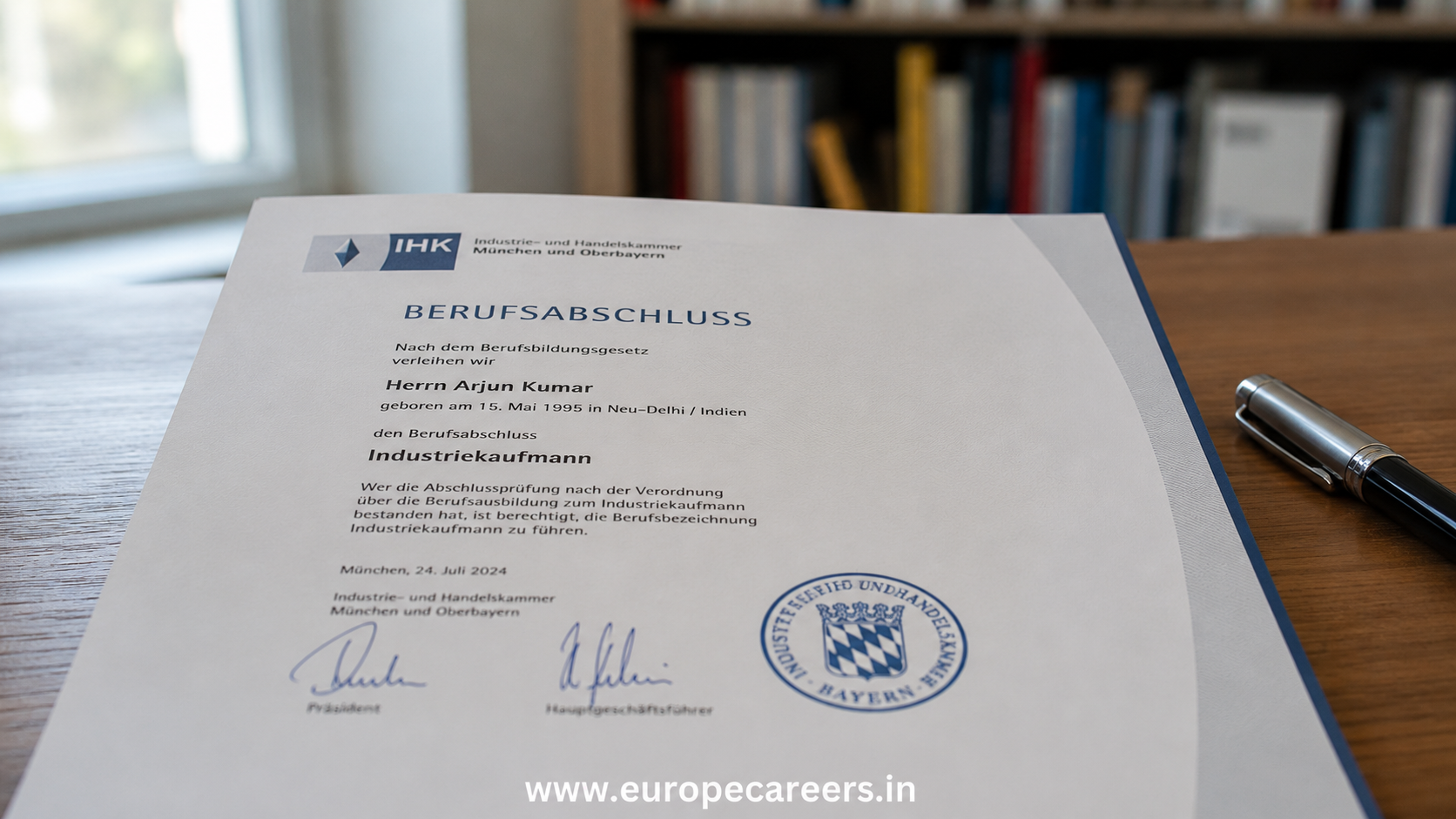 Before examining international recognition, it helps to understand what the Ausbildung qualification actually is and why it carries weight.
When you complete a German Ausbildung, you are awarded a Berufsabschluss — a state-recognised vocational qualification certified by the relevant German chamber. Depending on your profession, the certifying body is either:
- The IHK (Industrie- und Handelskammer) — Chamber of Commerce and Industry — for commercial, IT, logistics, and business professions
- The HWK (Handwerkskammer) — Chamber of Crafts — for skilled trades such as electrician, plumber, carpenter, and mechanic
These are not private certificates. They are issued by official German state bodies under the Berufsbildungsgesetz (BBiG) — the German Vocational Training Act. The qualification confirms that you have completed a nationally standardised training programme that combines at least two to three years of practical workplace training with theoretical classroom education.
Germany’s dual vocational training system is widely regarded as one of the most rigorous and respected in the world. This reputation is what gives the Ausbildung certificate its international standing.
Recognition Within Germany: The Foundation
Before going international, it is worth understanding that your Ausbildung certificate is valid and fully recognised in every German state — not just in the state where you trained. This is guaranteed by federal law.
This matters because it means your qualification is portable within the country with the largest economy in Europe, giving you a strong domestic base from which to build internationally.
Part 1 — Recognition Across the European Union
 This is where the Ausbildung certificate is most portable and most clearly recognised.
The EU Professional Qualifications Directive
The European Union operates under the EU Directive on the Recognition of Professional Qualifications (2005/36/EC). Under this framework, EU member states are obligated to recognise professional qualifications awarded in other member states, provided the qualification meets the standards required for that profession.
Germany is a full EU member state. Your Ausbildung Berufsabschluss is a state-recognised German qualification. This means that across all 27 EU member states — including France, Spain, Italy, Poland, the Netherlands, Sweden, and others — your qualification has a formal basis for recognition under EU law.
There are two important nuances:
For unregulated professions — which covers the majority of trades and commercial roles — employers in other EU countries can assess your Ausbildung certificate at their own discretion. Most will view a German IHK or HWK qualification favourably, and no formal approval process is required. You can apply for jobs and be hired based on your German qualification directly.
For regulated professions — which includes roles such as nursing, certain healthcare positions, engineering in some countries, architecture, and others where a government licence is required to work — you must go through a formal recognition procedure in the destination country. The good news is that the EU Directive creates a streamlined pathway for this, and your German qualification is automatically given serious consideration.
Austria: The Closest Equivalence
Austria has one of the most straightforward recognition processes for German Ausbildung graduates. Austria and Germany share very similar dual vocational training systems — both rooted in the same German-language professional culture and similar chamber structures.
There are professional training agreements between Germany, Austria, and Hungary that make recognition of qualifications easier than with most other countries. For many trades and professions, a German Ausbildung graduate can have their qualification assessed for equivalence to the Austrian apprenticeship examination, with the possibility of completing only supplementary examinations where gaps exist.
For EU and EEA qualifications in unregulated professions, Austrian employers routinely accept German Ausbildung certificates without formal government recognition being required.
Switzerland: Strong but Requires a Step
Switzerland is not an EU member but has bilateral agreements with the EU on the free movement of persons. German Ausbildung certificates are well-regarded in Switzerland, particularly in German-speaking cantons — Zurich, Bern, Basel, and others — where employers are deeply familiar with the German vocational system.
For regulated professions, Switzerland requires formal recognition through the relevant cantonal authority. For unregulated roles, particularly in industries like IT, logistics, hospitality, finance, and construction, Swiss employers often accept German vocational qualifications directly or with minimal process.
Switzerland is also a practical option because of language — if your Ausbildung was in a German-speaking trade, you can communicate directly in German, which is a major advantage in the German-speaking Swiss job market.
Other EU Countries: France, Netherlands, Spain, Scandinavia
 Across the rest of the EU, German Ausbildung graduates can work and have their qualifications recognised, though the practical ease varies.
In countries like France, the Netherlands, Belgium, and Scandinavian nations, employers in many sectors — particularly IT, engineering, logistics, healthcare, and hospitality — are familiar with and receptive to German vocational qualifications. The EU Directive provides the legal framework, and in shortage occupations across Europe, a German Berufsabschluss is a genuinely competitive credential.
For regulated professions, the destination country’s recognition authority handles the evaluation. This process may take months and may require you to sit an aptitude test or complete a short bridging course if differences between the German training and the local system are found.
The European Professional Card (EPC) also simplifies the recognition procedure for certain professional qualifications within the EU and EEA, and is available for professions including nursing, physiotherapy, pharmacy, mountain guiding, and real estate agents.
Part 2 — Recognition in the United Kingdom
The UK left the European Union in 2020. Since then, the EU’s automatic mutual recognition framework no longer applies between Germany and the UK.
German Ausbildung graduates who want to work in the UK now need to go through the UK’s own qualification recognition system, which varies significantly by profession.
For regulated professions — such as nursing, engineering, healthcare, and teaching — the relevant UK professional body handles recognition. For example:
- Nursing: the Nursing and Midwifery Council (NMC)
- Engineering: Engineering Council UK
- Healthcare roles: the Health and Care Professions Council (HCPC)
Each body has its own assessment criteria. German qualifications are generally taken seriously given the reputation of the German training system, but the process can take several months and may require English language evidence and supplementary assessments.
For unregulated professions — which covers the majority of IT, trade, commercial, and logistics roles — UK employers assess your German Ausbildung on its own merits. Many large UK employers, particularly in sectors with skills shortages, view German vocational qualifications very favourably. There is no legal barrier to being hired based on your Ausbildung certificate.
In terms of immigration, working in the UK as a non-EU national now requires a visa under the UK points-based system, typically the Skilled Worker visa. Your Ausbildung qualification and any relevant work experience contribute to meeting the points threshold.
Part 3 — Recognition in Canada
Canada is an increasingly popular destination for Ausbildung graduates, and the recognition pathway is clear — though it requires additional steps.
Canada’s qualification recognition system is province-based, not federal. This means the process and the body you contact depend on which province you plan to work in — Ontario, British Columbia, Alberta, Quebec, and others each have their own regulatory authorities.
For regulated trades and professions in Canada — including electricians, plumbers, welders, HVAC technicians, healthcare workers, and engineers — your German Ausbildung must be assessed by the relevant provincial regulatory authority. Most provinces have a Red Seal Program for skilled trades, which allows tradespersons to have their qualifications assessed for equivalency to Canadian standards.
German vocational training is held in high regard by Canadian assessors. In many skilled trades, the practical training component of a German Ausbildung is directly comparable to Canadian apprenticeship standards, and graduates often need only to demonstrate their skills practically or pass a bridging examination rather than repeat training from scratch.
For immigration to Canada, the credential evaluation is an important step. The Express Entry system uses the Educational Credential Assessment (ECA) to evaluate foreign qualifications for immigration scoring purposes. Organisations approved by Immigration, Refugees and Citizenship Canada (IRCC) — including WES (World Education Services) — provide these evaluations. An ECA report is valid for five years and can be used for immigration, employment, or university applications.
In terms of demand, Canada faces significant skilled trades shortages, and German-trained electricians, mechanics, healthcare workers, and IT professionals are well-positioned to find employment.
Part 4 — Recognition in Australia
Australia has a structured but accessible system for recognising overseas vocational qualifications. The German Ausbildung falls under what Australia classifies as a Technical and Vocational Education and Training (TVET) qualification — broadly equivalent to Australian Certificate III or Certificate IV level on the Australian Qualifications Framework (AQF).
Recognition in Australia works through two parallel processes:
Skills Assessment (for visa purposes): If you are applying for a skilled migration visa to Australia — such as the subclass 189, 190, or 491 — your German Ausbildung must be assessed by the designated Skills Assessment authority for your occupation. Each trade and profession has a specific body. For example:
- Trades and engineering: Trades Recognition Australia (TRA) or Engineers Australia
- IT professions: Australian Computer Society (ACS)
- Nursing: Australian Nursing and Midwifery Accreditation Council (ANMAC)
Qualification Recognition (for employment): For non-regulated professions, Australian employers assess your qualification independently. Many employers in industries facing labour shortages — construction, healthcare, logistics, IT — are familiar with the reputation of German vocational training and value it accordingly.
Recognition of Prior Learning (RPL) is another pathway available in Australia. If your German Ausbildung skills align with an Australian qualification but the formal mapping is imperfect, you can apply through a Registered Training Organisation (RTO) to have your skills and experience assessed and potentially converted to an Australian certificate without repeating full training.
Part 5 — Recognition in the UAE and Gulf Countries
The UAE and other Gulf Cooperation Council (GCC) countries — Saudi Arabia, Qatar, Bahrain, Kuwait, Oman — have no formal bilateral qualification recognition agreements with Germany. However, in practice, German vocational qualifications are respected in the Gulf job market, particularly in construction, engineering, logistics, healthcare, and hospitality sectors.
Private sector employers in the UAE — including in free zones like Dubai International Financial Centre and Abu Dhabi Global Market — regularly hire internationally trained professionals and assess qualifications on their own merits. A German IHK or HWK certificate from a well-known training company is a strong signal to Gulf employers.
There is no government-level recognition process to navigate for most private sector employment. Your Ausbildung certificate combined with German work experience and a strong professional profile is typically sufficient to secure employment offers from UAE-based companies.
For regulated healthcare professions in the UAE, the Dubai Health Authority (DHA) or the Health Authority Abu Dhabi (HAAD) handles licensing, and German nursing and medical assistant qualifications are generally assessed seriously given Germany’s healthcare reputation.
Part 6 — Recognition in India
This is a question that matters specifically to Indian nationals who completed Ausbildung in Germany and are considering returning home.
India does not have a formal bilateral vocational qualification recognition agreement with Germany. There is no single Indian authority that automatically converts a German Berufsabschluss to an Indian equivalency.
However, this does not mean the certificate has no value in India. In practical terms:
Indian employers in multinational companies, export-oriented industries, manufacturing, IT, and healthcare frequently value international qualifications, including German vocational certificates, on their own merits. The reputation of German training — particularly from companies like Bosch, Siemens, BMW, or large German healthcare groups — carries significant weight with Indian employers who operate in those sectors.
For Indian nationals who want to formally have their German Ausbildung recognised, the Association of Indian Universities (AIU) handles equivalency evaluations for foreign qualifications. This can be useful if you are applying for higher education in India after your Ausbildung.
For most employment in the Indian private sector, your German Ausbildung certificate alongside your work experience in Germany is a credible and valuable credential — even without formal government recognition.
The Key Distinction: Regulated vs Unregulated Professions
 Across every country discussed above, the single most important factor in determining how easy recognition will be is whether your profession is regulated or unregulated in the destination country.
Regulated professions require a government-issued licence before you can practise. Examples include nurses, doctors, pharmacists, architects, engineers (in some countries), lawyers, and certain tradespeople. For these roles, you must go through the relevant licensing authority in your destination country — regardless of where you trained. German qualifications are generally taken seriously in this process, but it takes time.
Unregulated professions — which cover IT, logistics, hospitality, finance, administration, customer service, many technical trades, and most commercial roles — allow employers to hire you based on their own assessment of your credentials. No government approval is needed. Your German Ausbildung certificate from the IHK or HWK is a strong credential in its own right.
What Strengthens International Recognition of Your Ausbildung
Regardless of which country you are targeting, certain factors consistently improve the portability of your German Ausbildung:
German language skills (maintained): For Austria, Switzerland, and German-speaking communities globally, continued German language ability is a practical advantage.
Work experience in Germany post-Ausbildung: Having worked in Germany for one, two, or three years after completing your training significantly strengthens your profile for overseas employers and immigration authorities. It demonstrates that your skills were validated not just in training but in real employment.
Meister qualification: The Meister (master craftsperson) is the next qualification level above Ausbildung in the German system. It is the highest professional certification in German crafts and trades. A Meister qualification from Germany carries even greater international recognition than an Ausbildung alone, and in many EU countries is directly comparable to a bachelor’s degree for professional purposes.
Europass Diploma Supplement: Germany issues a Europass document alongside vocational qualifications that describes your training in a standardised format recognised across Europe. Always request and carry this document — it significantly simplifies recognition processes in EU countries and beyond.
Sector: Healthcare, IT, and engineering Ausbildung qualifications tend to have stronger international recognition pathways than highly sector-specific or regional trade qualifications, simply because these sectors operate across borders with more standardised requirements.
Country-by-Country Summary Table
| Country | Recognition Level | Process Required |
|---|---|---|
| All 27 EU Member States | Strong — EU Directive applies | Formal for regulated professions; employer discretion for unregulated |
| Austria | Very strong — bilateral agreements | Simplified recognition; supplementary exams possible |
| Switzerland | Strong — bilateral EU agreement | Canton-level process for regulated; employer discretion otherwise |
| United Kingdom | Moderate — post-Brexit, no automatic recognition | Professional body assessment for regulated; employer discretion for unregulated |
| Canada | Good — Red Seal Program for trades | Provincial assessment required; ECA for immigration |
| Australia | Good — AQF equivalent (Certificate III/IV) | Skills assessment for visa; employer discretion for employment |
| UAE / Gulf | Practical acceptance — no formal bilateral agreement | Healthcare licensing bodies for regulated; employer discretion otherwise |
| India | Limited formal recognition — no bilateral agreement | AIU evaluation possible; private employer discretion common |
After Ausbildung: Your Career Pathway Options
Understanding recognition is only one part of the picture. Equally important is understanding your strategic options as an Ausbildung graduate.
Stay in Germany: Germany itself remains the strongest market for your qualification. The country has over 54,000 unfilled Ausbildung positions as of late 2025, and demand for skilled workers continues to grow. Staying in Germany gives you a path to permanent residency after 21 to 33 months of employment and is often the most straightforward route to long-term stability.
Move within the EU: Austria, the Netherlands, Sweden, and Ireland have active skilled worker shortages and strong recognition pathways for German Ausbildung graduates. Moving within the EU is logistically simpler than moving to non-EU countries.
Upgrade to Meister: Completing the Meister qualification in Germany before moving internationally significantly upgrades your credential recognition prospects globally.
Use Germany as a base: Many Ausbildung graduates work in Germany for several years, gain experience, build savings, and then make a more strategic international move with a stronger CV and more financial flexibility.
Frequently Asked Questions
Is the German Ausbildung certificate valid across all EU countries?
Yes, under the EU Directive on the Recognition of Professional Qualifications, German Ausbildung certificates have a formal recognition pathway across all 27 EU member states. For unregulated professions, employers can accept the certificate directly. For regulated professions, a formal recognition procedure with the destination country’s authority is required.
Does Ausbildung certificate count as a degree internationally?
The Ausbildung Berufsabschluss is a vocational qualification, not a university degree. However, in many countries — including for immigration scoring, employment eligibility, and further study — it is treated as a post-secondary qualification. In Germany itself, a Meister qualification earned after Ausbildung is recognised as equivalent to a bachelor’s degree for many purposes.
Can I use my Ausbildung certificate to migrate to Canada or Australia?
Yes. Both Canada and Australia have points-based immigration systems that award points for foreign qualifications. Your German Ausbildung — particularly in trades and healthcare — is a valued credential, but you will need a credential evaluation (ECA in Canada; Skills Assessment in Australia) as part of the visa process.
Is Ausbildung recognised in the UK after Brexit?
The automatic EU-based mutual recognition no longer applies after Brexit. However, German Ausbildung graduates can still have their qualifications recognised in the UK through relevant professional bodies for regulated professions, and UK employers in unregulated sectors are free to hire based on the certificate at their own discretion.
Which countries recognise Ausbildung most easily?
Austria and Switzerland have the most straightforward recognition processes for German Ausbildung graduates due to shared language, similar vocational systems, and bilateral agreements. Within the broader EU, the formal recognition framework makes it legally structured if not always instant.
Does my profession affect international recognition?
Significantly. Healthcare, IT, engineering, and logistics qualifications tend to have stronger international recognition pathways because these sectors have global skills shortages and standardised competency expectations. Highly local or niche trade qualifications may face more variation in recognition depending on the country.
Conclusion: Your Ausbildung Is a Strong International Credential — If You Plan Wisely
The German Ausbildung Berufsabschluss is not a certificate that disappears at the German border. It is a rigorous, state-recognised, internationally understood vocational qualification from one of the world’s most respected training systems.
Within the European Union it has the strongest foundation, backed by EU law and in many countries by employer familiarity with the German system. In English-speaking destinations like the UK, Canada, and Australia, formal recognition processes exist and are navigable. In the Gulf, it is valued by private employers in practice even without formal bilateral agreements.
What matters most is your profession, your destination, and your preparation. Research the specific recognition pathway for your trade in your target country before you move. Carry your Europass document. Consider upgrading to Meister if long-term international mobility matters to you. And if Germany itself offers what you need — as it does for millions of skilled workers — remember that it is one of Europe’s most stable, well-paying, and welcoming labour markets.
At EuropeCareers, we help international professionals navigate Ausbildung pathways, post-qualification careers in Germany, and career moves across Europe. Whether you are just starting your Ausbildung journey or planning your next step after completion, we are here to guide you.