
Germany Medical Entrance Exam for Indian Students: The Complete 2026 Guide

Introduction: Why Germany Is Now a Top Medical Destination for Indian Students
 Every year, over 22 lakh students appear for NEET in India. Only a fraction secures a government MBBS seat. For thousands of determined medical aspirants, studying abroad is no longer a fallback — it is a well-planned first choice.
Germany has emerged as one of the most compelling destinations. Public universities charge almost no tuition fees. The medical degree is recognised by the World Health Organization, India’s National Medical Commission, and medical bodies across Europe. And Germany’s healthcare system is facing a serious shortage of doctors — projected to need 20% more physicians by 2030.
But admission to medicine in Germany is structured differently from India. There is no single entrance exam that unlocks a seat. Instead, Indian students must navigate a layered system of exams, language qualifications, and document verifications — each playing a specific role in the process.
This guide by EuropeCareers walks you through every exam you need to know, in the order you need to plan for them.
Understanding the German Medical Degree: It Is Not Called MBBS
Before discussing entrance exams, it is important to understand what you are applying for.
Germany does not award an MBBS degree. The equivalent qualification is called Staatsexamen in Humanmedizin — the State Examination in Human Medicine. The programme typically runs for six years and three months, structured as follows:
- Years 1–2: Preclinical theoretical study (Vorklinik)
- Years 3–5: Clinical practical training (Klinik)
- Year 6 + 3 months: Mandatory clinical internship (Praktisches Jahr)
At the end of the programme, graduates receive a Zeugnis über die Ärztliche Prüfung (Certificate of Medical Examination) and then apply for Approbation — the official German medical licence to practice.
For Indian students, this degree is treated as equivalent to MBBS for the purpose of NMC recognition, provided certain conditions are met.
The Full Exam Map: What Indian Students Must Clear
 Indian students applying to study medicine in Germany face up to five distinct examinations or assessments at different stages of the journey. Here is the complete picture:
| Stage | Exam / Requirement | Mandatory? |
|---|---|---|
| Before applying | NEET UG | Yes (for NMC recognition) |
| Document verification | APS Certificate | Yes (for Indian students) |
| If Abitur equivalent not met | Studienkolleg + FSP | Depends on qualification |
| University admission | TMS (Test for Medical Studies) | Strongly recommended |
| After graduation | NEXT / FMGE (for India) or Approbation (for Germany) | Depends on where you practice |
Exam 1: NEET UG — Your Starting Point
 What it is: The National Eligibility cum Entrance Test (Undergraduate) is India’s centrally conducted medical entrance examination.
Why it matters for Germany: NEET qualification is mandatory for Indian students who wish to preserve the right to practice medicine in India after graduating abroad. The National Medical Commission requires a valid NEET score from the current or previous academic year as part of the eligibility for overseas medical education.
What score do you need? A minimum of 50% marks in NEET is required for general category students, though most advisors recommend targeting 60% or higher to strengthen your overall application profile.
Important clarification: German universities themselves do not demand NEET scores as part of their admission process. The requirement comes from India’s NMC, not from Germany. If you are certain you want to build your career in Germany and Europe rather than return to practice in India, the absence of a NEET score does not technically bar you from applying to a German medical university — but it would prevent you from obtaining a licence to practice in India later.
For most Indian students, clearing NEET is the first and non-negotiable step.
Exam 2: APS Certificate — The Document Verification Every Indian Applicant Needs
 What it is: The APS Certificate (Akademische Prüfstelle — Academic Evaluation Centre) is a document verification process specific to applicants from China, Vietnam, and India. It is operated by the German embassy.
Why it matters: German universities and the German embassy require Indian applicants to obtain this certificate before their application can be considered. It confirms that your school and degree certificates are genuine and meet German academic standards.
How the process works:
- You submit your academic documents — typically 10th, 12th, and any completed undergraduate certificates — to the APS India office
- APS reviews and verifies the documents, often including an interview
- Upon approval, you receive the APS certificate, which is then submitted as part of your university application
Timeline warning: The APS process takes time. Applications are reviewed on a rolling basis and the process including the interview can take several months. Most experienced counsellors advise beginning the APS process at least 12 to 18 months before your intended intake date — simultaneously with your German language preparation.
This step is often underestimated by first-time applicants. Missing the APS timeline can delay your entire application by a full year.
Exam 3: German Language — The Qualification That Decides Everything
 German language proficiency is not just an exam requirement. It is the foundation of your entire medical education in Germany. All undergraduate medicine programmes at public German universities are taught in German. Clinical training requires direct communication with German-speaking patients and medical teams.
The required levels:
- B2 (CEFR): Minimum requirement for most medical universities and for the Ausbildungsvisum process
- C1 (CEFR): Recommended for medicine, and sometimes required for Approbation later
- B2 or C1: Required for the Studienkolleg entrance exam (Aufnahmeprüfung) and the Feststellungsprüfung
Recognised German language examinations:
TestDaF (Test Deutsch als Fremdsprache)
The most widely recognised German language test for academic admission in Germany. Scored across four skills — reading, listening, writing, and speaking — each on a scale of TDN 3, TDN 4, or TDN 5. Most universities require TDN 4 in all four components for direct entry into medicine.
DSH (Deutsche Sprachprüfung für den Hochschulzugang)
The DSH is a university-administered language exam taken at German institutions. It tests academic German specifically in the context of university study. Unlike TestDaF, it can only be taken in Germany, which means it is typically used by students who are already in the country — for example, after completing a Studienkolleg.
Goethe-Zertifikat B2 / C1
Issued by the Goethe-Institut, which has examination centres in India including Delhi, Mumbai, Kolkata, and Pune. Goethe certificates are internationally recognised and widely accepted for visa applications, though some universities specifically prefer TestDaF or DSH for medical programmes.
Planning your timeline: Most students who begin German from zero require 18 to 24 months of consistent study to reach the B2 level. C1 typically takes an additional 6 to 12 months beyond B2. This is why German language study must begin immediately after Class 10 or at the latest in Class 11, running parallel to NEET preparation.
Exam 4: Studienkolleg and the Feststellungsprüfung (FSP)
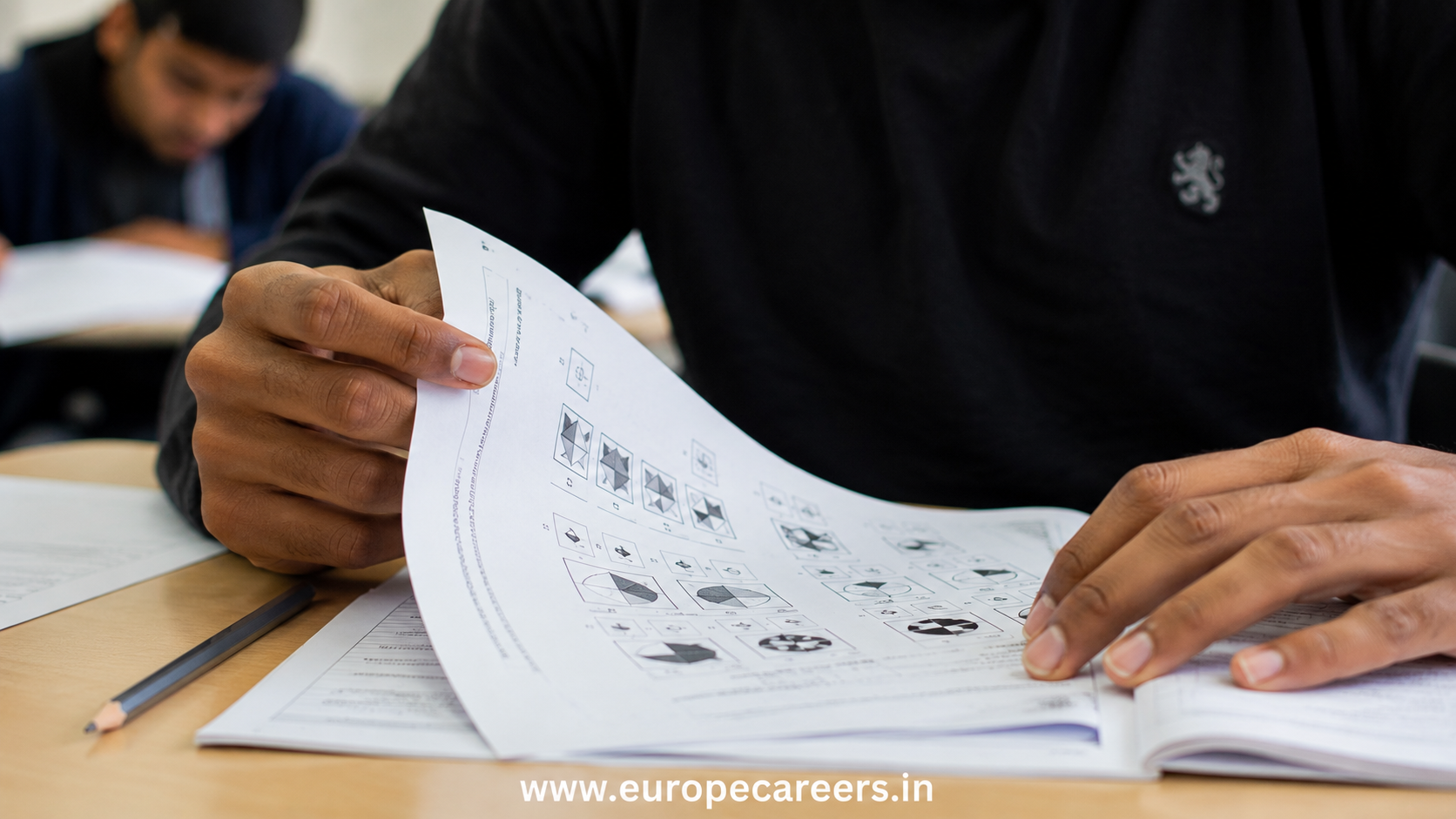 What it is: Most Indian students holding a Class 12 certificate do not automatically qualify for direct entry into German universities. The German system requires an academic qualification equivalent to the German Abitur (the German school-leaving certificate). When this equivalence is not met, students must complete a Studienkolleg — a one-year intensive preparatory course designed to bridge the gap.
Who needs it? Indian students with a standard 10+2 certificate from a State Board or CBSE generally need one of the following to satisfy the Abitur equivalency requirement:
- Completion of Studienkolleg followed by passing the Feststellungsprüfung, or
- One full year of undergraduate study at a recognised Indian university in a related field (such as BSc in Biology, Chemistry, or a pre-medical programme)
What is Studienkolleg? It is a government-run preparatory institution attached to German universities. For medical aspirants, the relevant stream is the M-Kurs (Medizin/Biology stream), which covers Biology, Chemistry, Mathematics, and German.
The Aufnahmeprüfung: Entry into Studienkolleg itself requires passing an entrance examination. This assesses your German language skills and basic subject knowledge. German at B2 level is typically required to be admitted.
The Feststellungsprüfung (FSP): After completing the one-year Studienkolleg, you sit the Feststellungsprüfung — the assessment exam that formally qualifies you for university admission. Passing the FSP gives you the Hochschulzugangsberechtigung (HZB) — the German Higher Education Entrance Qualification — which allows you to apply to medical universities.
The FSP in the M-Kurs typically covers Biology, Chemistry, Mathematics or Physics, and German. It is held at the end of the academic year and results are released before the university application window opens.
Exam 5: TMS — The Test for Medical Studies
 This is the exam that most directly influences your chances of being admitted to a German medical university, and the one that deserves the most focused preparation.
What is the TMS?
The TMS — Test für Medizinische Studiengänge — is a subject-specific aptitude test for medical degree programmes. It was developed according to international standards of psychological aptitude diagnostics and is administered by the TMS Coordination Office at the Heidelberg Medical Faculty. More than 30,000 applicants participate in the TMS every year, making it the largest subject-specific study aptitude test in the German-speaking world.
Crucially, the TMS does not test factual medical knowledge. It tests your cognitive abilities — reasoning, memory, visual perception, spatial thinking, concentration, and processing speed. A student who has never studied biology formally can score higher than a medical topper if they train the right skills.
Is it mandatory?
The TMS is not formally compulsory for all universities. However, most German medical faculties use TMS scores as a significant part of their selection process. Some universities weight the TMS at up to 60% of the total admission score. If you do not submit a TMS result, you compete only on your academic grades — and competition for medical seats is fierce, with over 40,000 students competing for approximately 9,500 seats annually at public universities.
For Indian students who have not completed the German Abitur and are applying through the Studienkolleg route, the TMS is especially valuable as it provides an objective, standardised score that compensates for differences between education systems.
The TMS exam format:
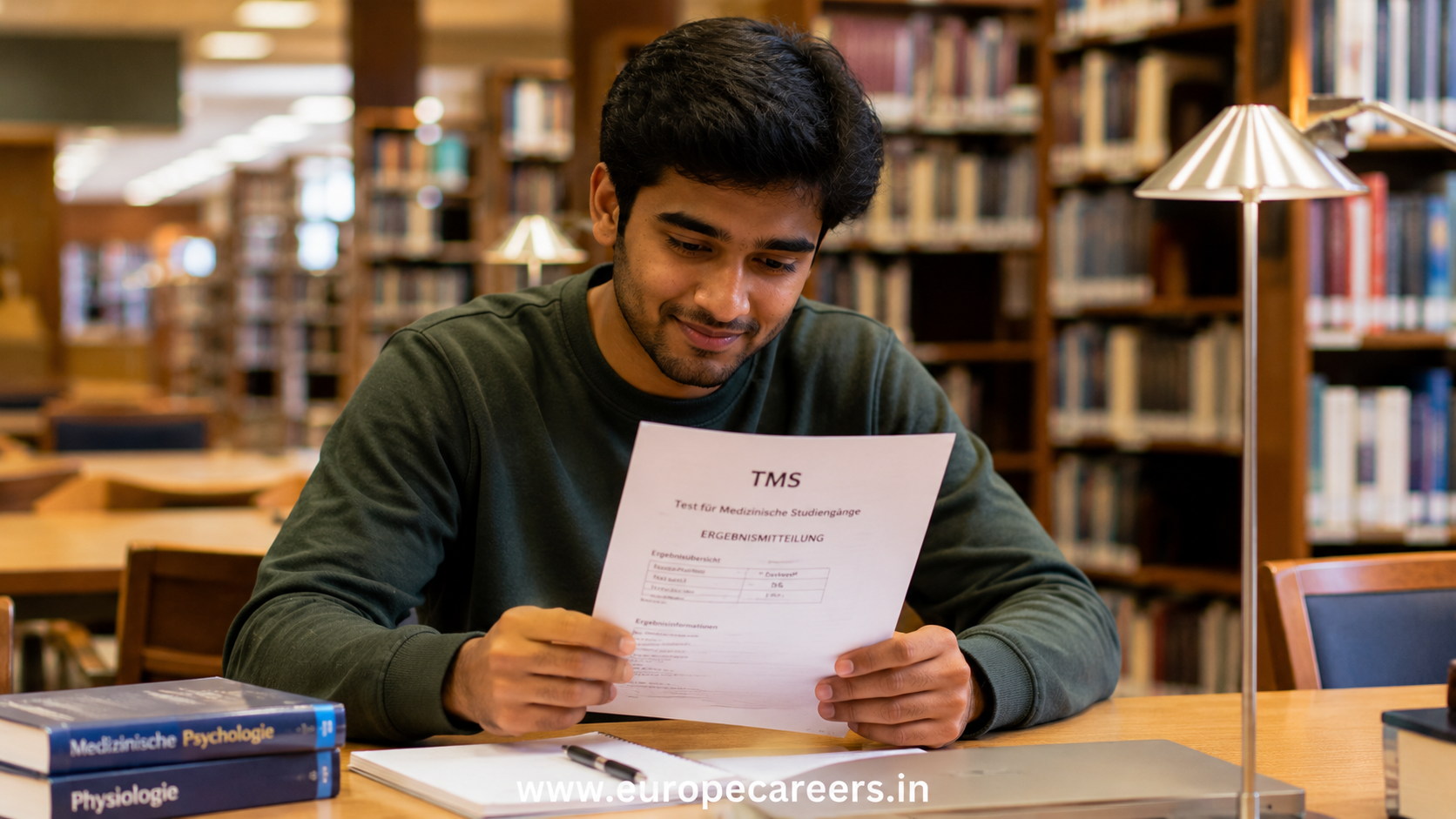
The TMS is a full-day paper-based examination conducted in German. It runs for five hours and six minutes across seven sub-tests, with a one-hour break after the fourth section. You are given a test booklet and a separate answer sheet. A pencil is provided.
The seven sub-tests are:
1. Muster zuordnen (Pattern Recognition)
You are shown a series of images — mostly histological patterns — and must identify tiny differences under significant time pressure. 24 tasks in 30 minutes. This tests visual discrimination and careful observation.
2. Medizinisch-naturwissenschaftliches Grundverständnis (Basic Medical and Scientific Understanding)
You read short scientific or medical texts and answer questions based only on the information given. No prior factual knowledge is required — everything needed to answer is within the passage. 24 tasks in 60 minutes. This tests reading comprehension and logical inference.
3. Schlauchfiguren (Tube Figures)
Three-dimensional spatial reasoning. You visualise the shape of a hollow tube and identify its cross-section from different angles. 20 tasks in 20 minutes.
4. Fakten lernen (Learning Facts)
A memory test. You are given a set of facts — names, ages, diagnoses — to memorise in a limited time, then tested on them after the information is removed. 30 tasks in 25 minutes plus study time.
5. Figuren lernen (Learning Figures)
Similar to facts learning but with visual figures. You memorise a set of images and are tested on which ones you saw and in what position. 20 tasks in 22 minutes plus study time.
6. Textverständnis (Reading Comprehension)
Longer reading passages with comprehension questions. Tests selective reading, identifying key information, and drawing conclusions. 20 tasks in 40 minutes.
7. Quantitative und formale Probleme (Quantitative and Formal Problems)
Mathematical and logical reasoning without a calculator. Algebra, geometry, sequences, and basic statistics are typical areas. 24 tasks in 50 minutes.
How TMS scoring works:
 The TMS is not scored based on the number of correct answers alone. Your score is relative — you are ranked against all other candidates sitting the exam that session.
You receive two metrics:
- A standard score between 70 and 130 (100 is the average; higher is better)
- A percentage rank showing what proportion of candidates scored below you
A percentage rank of 80 means you outperformed 80% of all other candidates. Most medical faculties prefer applicants with a percentile rank above 80. A rank above 90 significantly boosts your chances at top universities like Charité Berlin, Heidelberg, and LMU Munich.
Your TMS result is valid indefinitely. You may take the TMS once per calendar year.
TMS fee and logistics:
The registration fee is approximately €100 to €130. The exam is paper-based and conducted at designated centres in Germany. This means Indian applicants who have not yet relocated to Germany must travel to Germany specifically to sit the TMS. It is conducted twice a year, typically in spring and autumn. Results are released within approximately 10 days and can be downloaded in PDF format within four weeks.
Exam 6: HAM-Nat — The Hamburg Natural Science Test
For students specifically targeting Hamburg University or Marburg University, there is an additional entrance test worth knowing: the HAM-Nat (Hamburg Assessment Test for Medicine — Natural Sciences).
Unlike the TMS, which is ability-based, the HAM-Nat tests actual subject knowledge in Biology, Chemistry, Physics, and Mathematics. It is more similar in feel to India’s NEET in its requirement for factual recall, though the format and style differ.
The HAM-Nat is used primarily in Hamburg and is less widely recognised than the TMS across German universities as a whole. If Hamburg is your target institution, preparing for both TMS and HAM-Nat is advisable.
Exam 7: Approbation — The German Medical Licence After Graduation
Once you complete your medical degree and the six-year programme, you do not automatically become a licensed doctor in Germany. You must apply for Approbation — the official state-granted licence to practice medicine.
The Approbation process requires:
- Completion of the full six-year medical programme and all Staatsexamen stages
- Proof of German language proficiency (typically C1 level)
- Clean criminal record
- Medical fitness to practice
- Verification of your qualifications by the relevant state medical board (Landesärztekammer)
Once you hold Approbation, you are fully licensed to work as a doctor anywhere in Germany and, with additional recognition steps, across EU member states.
Exam 8: FMGE / NEXT — If You Plan to Return to India
Indian students who complete their medical degree in Germany and wish to practice medicine in India must clear a separate licensing examination set by India’s National Medical Commission.
Historically this was the FMGE (Foreign Medical Graduates Examination), commonly called the MCI Screening Test. The FMGE pass rate for foreign-trained graduates has been approximately 18% to 25%, reflecting the significant difference between the German curriculum (which is Germany-focused) and the Indian exam syllabus.
India is in the process of transitioning to the NExT (National Exit Test) as the unified licensing examination for all medical graduates — both Indian and foreign-trained. Under NExT, foreign-trained doctors will sit the same exam as Indian MBBS graduates, replacing the FMGE.
If returning to India to practice is part of your long-term plan, begin NExT or FMGE preparation during your final year of study in Germany, not after you return.
The Complete Timeline for Indian Students: From Class 11 to Medical Licence
Class 11 (Age 16–17)
Begin German language study. Target B1 within 12 months. Simultaneously prepare for NEET.
Class 12 (Age 17–18)
Clear NEET UG. Reach German B2 level. Begin APS document preparation.
After Class 12 (Year 1)
Complete APS verification process. Apply for Studienkolleg in Germany. Obtain student visa. Arrive in Germany.
Studienkolleg Year (Year 2)
Complete M-Kurs. Reach German C1 level. Sit and pass the Feststellungsprüfung (FSP). Register for and sit the TMS exam.
Medical University (Years 3–9)
Six-year medical programme including the Praktisches Jahr internship. Complete all Staatsexamen stages.
Post-Graduation
Apply for Approbation to practice in Germany. Or prepare for NExT/FMGE to practice in India.
Top German Medical Universities Indian Students Apply To
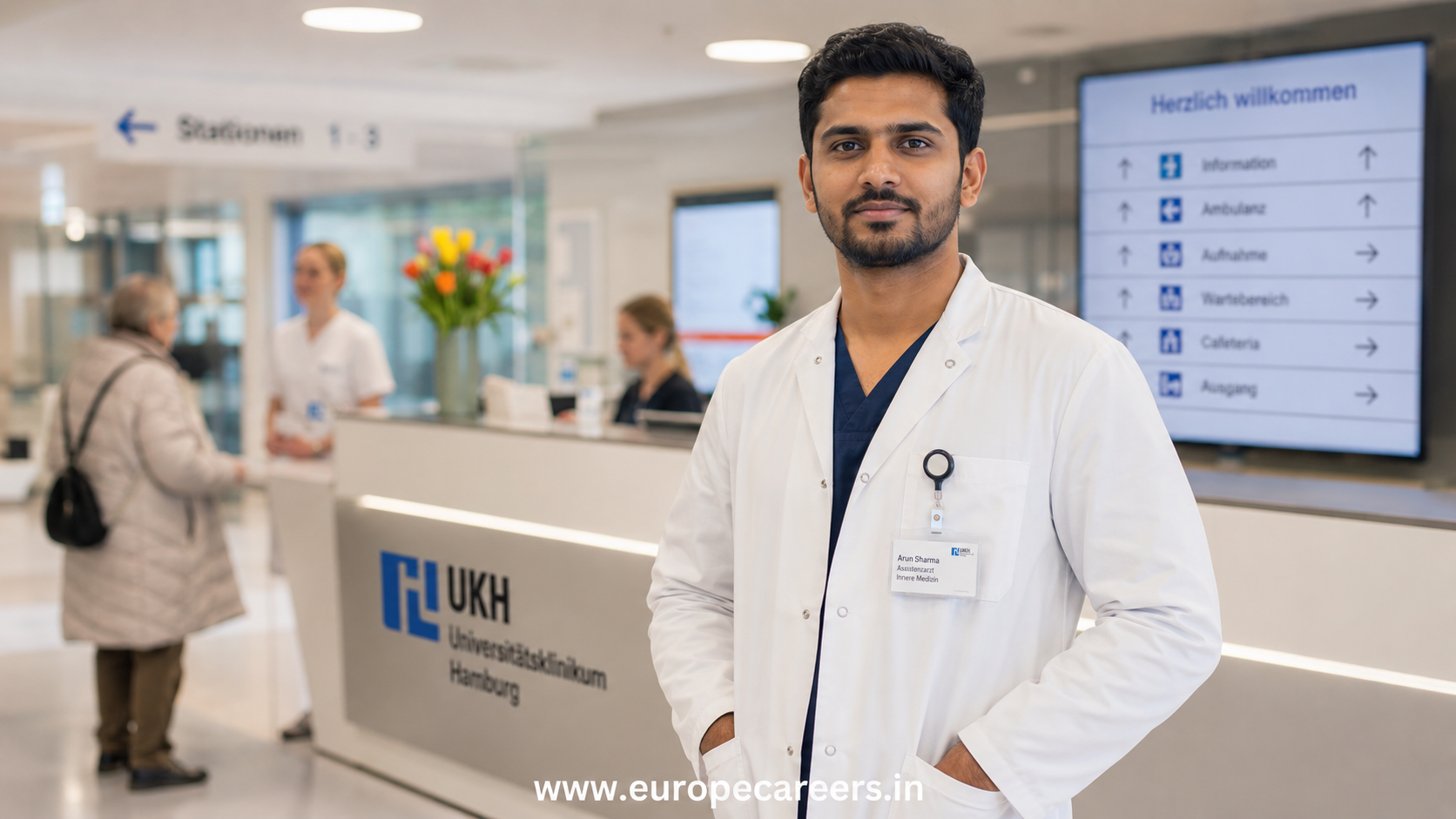 Germany has some of the most respected medical faculties in Europe. The following universities consistently attract Indian applicants and are highly regarded in international rankings:
Charité – Universitätsmedizin Berlin — One of Europe’s largest and oldest university hospitals, based in Germany’s capital. Extremely competitive.
Ludwig Maximilian University Munich (LMU) — Consistently ranked among Germany’s top research universities, with a world-class medical faculty.
Heidelberg University — Home to Germany’s oldest medical faculty and the TMS Coordination Office itself. Strong research focus.
RWTH Aachen University — Particularly strong in biomedical engineering and clinical research, and known for accepting international students.
University of Hamburg — Uses the HAM-Nat in addition to TMS for selection. Strong clinical training infrastructure.
University of Freiburg — Attractive for its location near the Swiss and French borders, offering exposure to cross-border European healthcare.
All public medical universities in Germany charge only a semester contribution of approximately €250 to €500 per semester, not tuition fees. This makes the real cost of a German medical degree dramatically lower than the UK, USA, or Australia.
What Does the Full Cost Look Like?
Indian students often focus on tuition fees when comparing countries. Germany’s near-zero tuition model changes the calculation entirely.
Semester contribution: €250 to €500 per semester (covers student union, public transport in many cities, and administrative costs)
Monthly living costs: €800 to €1,200 depending on the city (Berlin and Munich are more expensive; smaller university cities like Aachen, Freiburg, and Rostock are more affordable)
Health insurance: Compulsory for all students. Approximately €110 to €120 per month for students under the statutory scheme.
Blocked account requirement (2026): The German student visa requires proof of financial resources via a blocked account showing €1,091 per month as of 2026.
TMS exam fee: Approximately €100 to €130 plus travel to Germany if sitting the exam from outside the country.
APS certificate fee: Approximately €200, plus document preparation and courier costs.
Over six years, the total cost of a German medical degree for an Indian student — including living expenses, health insurance, and all exam fees — is typically a fraction of the cost of private MBBS colleges in India or medical programmes in the UK or Australia.
Frequently Asked Questions
Do Indian students need to pass NEET for medical admission in Germany?
German universities do not require NEET scores as part of their admission process. However, NEET qualification is mandatory for Indian students who want to retain the right to practice medicine in India after graduating from a foreign university, as required by India’s National Medical Commission.
Is the TMS exam conducted in India?
No. The TMS is a paper-based exam conducted only in Germany. Indian students who have not yet relocated must travel to Germany to sit the exam. The exam is held twice a year, typically in spring and autumn.
Can I study medicine in Germany without knowing German?
No. All undergraduate medical programmes at public German universities are taught entirely in German. A minimum of B2 level German is required for university admission, and C1 is recommended for clinical work. A small number of private universities offer English-taught medical programmes, but these charge significantly higher fees and are less widely recognised.
How competitive is medical admission in Germany?
Extremely competitive. Over 40,000 students compete for approximately 9,500 seats at public medical universities each year. A strong TMS score, excellent Feststellungsprüfung results, and C1-level German give Indian applicants the strongest possible profile.
How long does the whole process take from Class 12 to becoming a doctor in Germany?
Approximately 8 to 9 years from completing Class 12. This includes the Studienkolleg year, six years of the medical programme, and the Approbation process. Students who begin German language study in Class 11 can compress the overall timeline.
Is the German medical degree valid in India?
Yes, the German medical degree (Staatsexamen) is recognised by India’s NMC and the WHO, provided the student has a valid NEET score and subsequently clears the NExT or FMGE examination to obtain an Indian medical licence.
Conclusion: Plan Early, Start the Language First
The path to studying medicine in Germany as an Indian student is structured, demanding, and — if navigated correctly — extraordinarily rewarding. Near-zero tuition fees, world-class hospitals, a degree recognised across Europe and India, and a country that genuinely needs more doctors: the opportunity is real.
What separates successful applicants from those who get stuck is planning. The German language must come first and it must come early. The APS process must start before most students think it needs to. The TMS requires dedicated cognitive training, not just academic revision.
At EuropeCareers, we help Indian students map out this exact journey — from choosing when to start German classes to understanding which university’s TMS weighting gives you the best shot given your academic profile.
Germany is not the easiest medical route. It is one of the best.