
Benefits of Working as a Nurse in Germany: Complete 2026 Guide

Introduction: Why Indian Nurses Are Choosing Germany in 2026
 Every year, thousands of Indian nurses make one of the biggest decisions of their lives — where to build their international career.
Some choose the UK. Some choose Canada. Some choose the Gulf.
But in 2026, more and more Indian nurses are choosing Germany — and for very good reasons.
Germany is not just offering jobs. It is offering a full life. A stable salary. Free healthcare. A path to permanent residency in as little as 21 months. And eventually, one of the most powerful passports in the world.
This guide by EuropeCareers covers every real benefit of working as a nurse in Germany — written simply and honestly, so you can decide if Germany is the right move for you.
The Big Picture: Why Germany Needs You
Before we talk about benefits, you need to understand one important fact.
Germany is facing one of the worst nursing shortages in its history. The country has an ageing population — meaning more and more elderly people need care every year. At the same time, many experienced German nurses are retiring. The gap between the nurses Germany has and the nurses Germany needs is growing every single year.
This shortage is your opportunity.
Germany currently has over 200,000 unfilled nursing positions across hospitals, elderly care homes, rehabilitation centres, and private clinics. The government has introduced new laws specifically to make it easier for international nurses — including Indian nurses — to come and work in Germany.
You are not arriving as a guest. You are arriving as someone Germany genuinely needs.
Benefit 1: High Salary — Much More Than India
 Let us start with the number that matters most to most people.
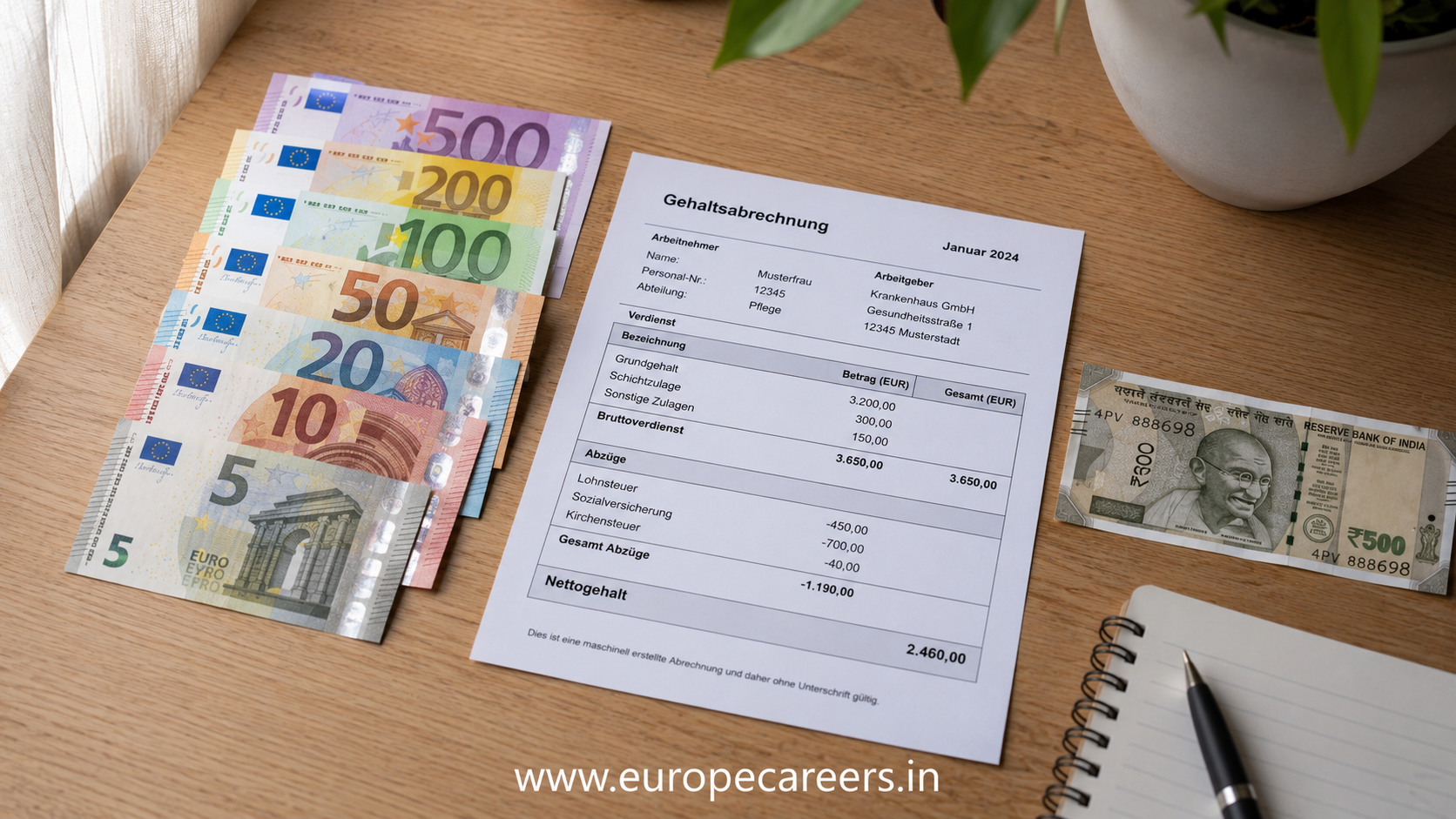
As a registered nurse in Germany, you can expect to earn between €2,800 and €4,800 gross per month, depending on your experience, specialisation, and which city you work in.
In Indian rupees, this works out to approximately ₹2.5 lakh to ₹4.3 lakh per month.
Even after taxes and social security deductions, your take-home pay (net salary) is typically between €1,800 and €2,600 per month — approximately ₹1.6 lakh to ₹2.3 lakh every month, in hand.
For context, most nurses in India earn between ₹15,000 and ₹35,000 per month. Working in Germany means earning five to ten times more — while living in one of Europe’s most stable and well-organised countries.
Salary by experience level:
| Experience Level | Monthly Gross Salary |
|---|---|
| Entry level (0–2 years) | €2,500 – €2,800 |
| Mid level (3–5 years) | €2,800 – €3,500 |
| Experienced (5+ years) | €3,500 – €4,800 |
| Specialist (ICU, OR, Anaesthesia) | €4,500 – €7,000+ |
And salaries are rising. Between 2026 and 2030, nurse salaries in Germany are expected to increase by 5 to 7 percent every year because of the growing shortage.
Benefit 2: Extra Allowances on Top of Your Salary
 Your base salary in Germany is just the starting point. On top of it, you receive several additional payments that can add hundreds of euros to your monthly income.
Night Shift Allowance: If you work night shifts, you receive an extra 15 to 25 percent on top of your hourly rate. This adds up quickly — nurses who regularly work night shifts earn significantly more than those on day shifts only.
Weekend and Holiday Bonus: Working on weekends or public holidays earns you an extra 25 to 50 percent on top of your normal rate. On special holidays like Christmas and New Year, this bonus can be even higher.
Overtime Pay: If you work more than your contracted hours, overtime is either paid in extra salary or converted into additional paid leave days. You are never expected to work extra hours for free.
Annual Performance Bonus: Many German hospitals and care homes pay a yearly bonus based on your performance and the facility’s results.
These allowances together can easily add €200 to €600 extra to your monthly income every month.
Benefit 3: Equal Pay — Same as German Nurses
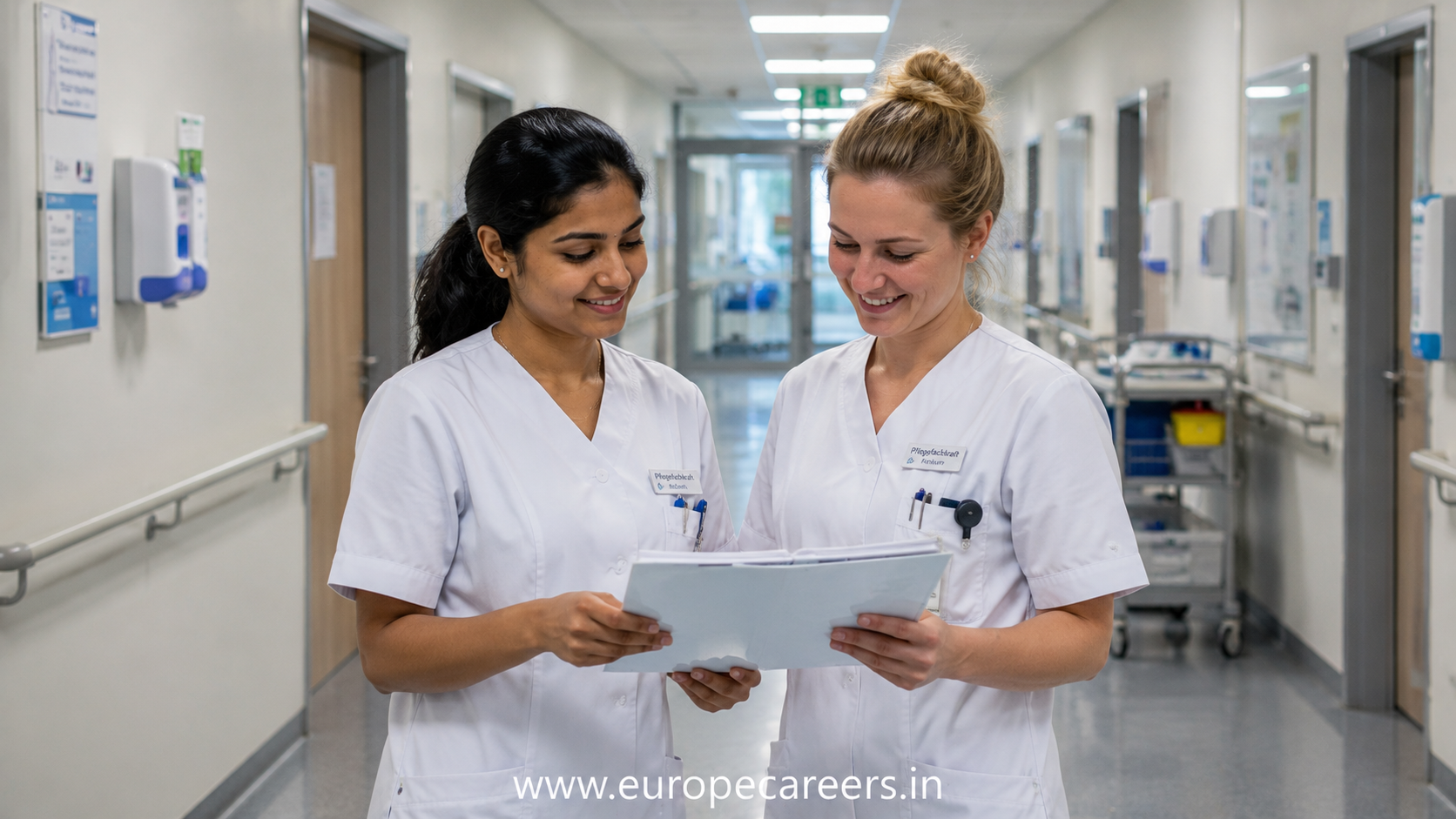 This point is very important for Indian nurses to understand.
In Germany, it is illegal to pay international nurses less than German nurses for the same work. You are fully protected by German labour law and collective bargaining agreements from your very first day of work.
This means you will not face the situation — common in some Gulf countries — where Indian nurses are paid on a different, lower scale than local or Western nurses. In Germany, your nationality does not determine your salary. Your qualification and your experience do.
You sit in the same pay band, receive the same benefits, and enjoy the same legal protections as every other nurse in Germany.
Benefit 4: Full Social Security — Health, Pension, Unemployment
One of the biggest real-world benefits of working in Germany is the social security system. As an employed nurse, you are automatically enrolled in all parts of it from day one.
Health Insurance (Krankenversicherung): Germany has a statutory health insurance system. As a nurse, you are covered for almost all medical costs — doctor visits, hospital stays, specialist consultations, medicines, dental care, and preventive health checks. Your family members who live with you in Germany are also covered under your insurance at no extra cost.
Pension Insurance (Rentenversicherung): Every month you work in Germany, both you and your employer contribute to your pension fund. This builds up a real retirement fund that gives you financial security in old age. Even if you return to India after several years, the pension contributions you made remain yours.
Unemployment Insurance (Arbeitslosenversicherung): If you ever lose your job in Germany, you receive unemployment benefit payments — typically 60 to 67 percent of your last net salary — for a defined period. This gives you a financial cushion while you find your next position.
Nursing Care Insurance (Pflegeversicherung): Germany has a dedicated insurance specifically covering long-term care needs. This protects you if you yourself ever need care in the future.
In short, Germany’s social security system means you are protected in almost every situation life can throw at you. This level of security simply does not exist in most countries where Indian nurses typically work.
Benefit 5: Permanent Residency in as Little as 21 Months
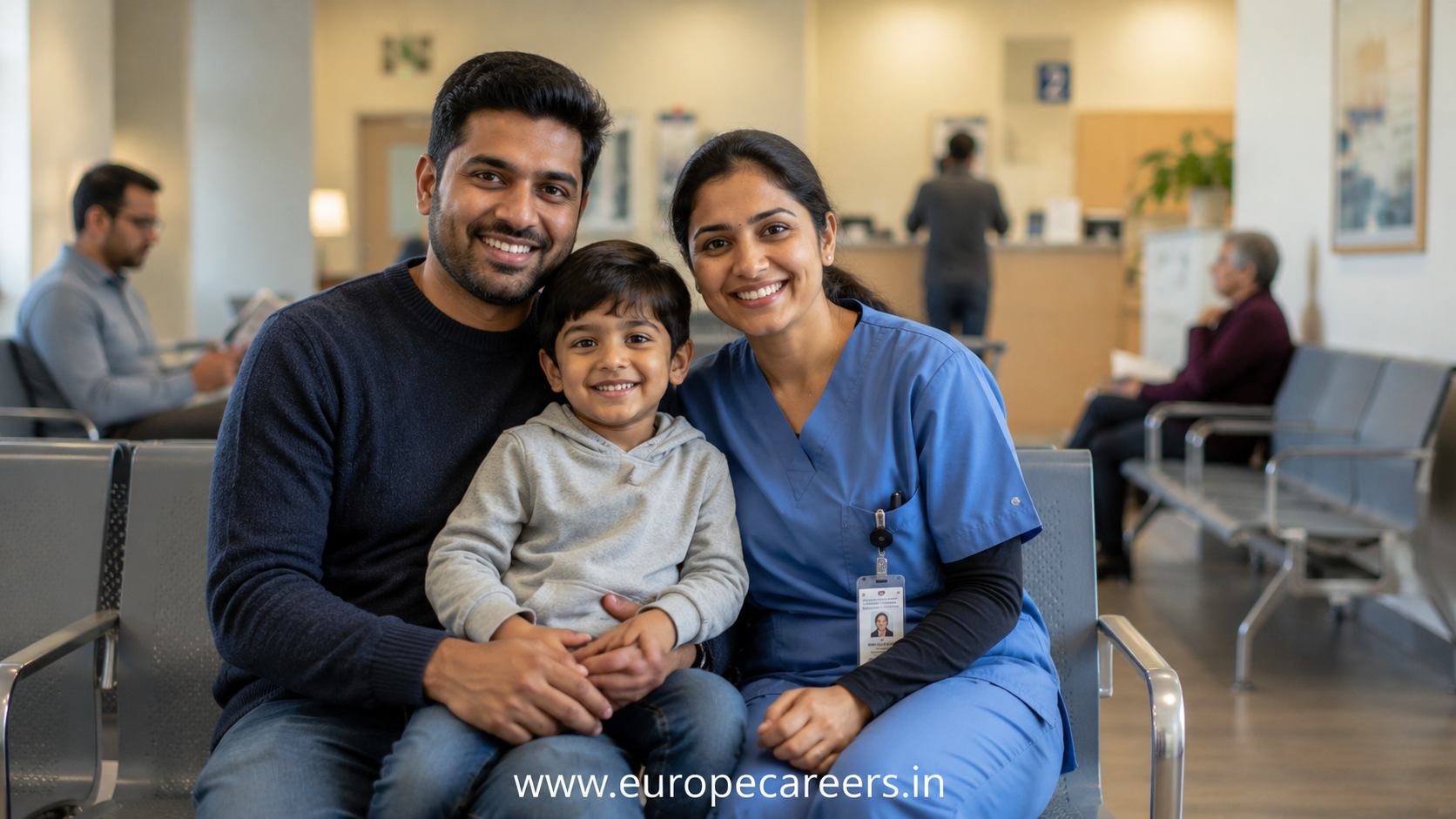 This is the benefit that makes Germany truly life-changing — especially compared to countries like the UAE or Qatar that offer no PR pathway at all.
As a nurse working legally in Germany, you can apply for permanent residency (called the Niederlassungserlaubnis) after just 21 months if your German language level is B1, or after 33 months with normal language requirements.
Permanent residency means you can live and work in Germany for the rest of your life without ever needing to renew a visa. It also means:
- You can change employers freely
- You can switch to a different profession if you choose
- You can travel across Europe freely
- Your children can attend school and university in Germany as residents
After receiving PR, you can apply for German citizenship after completing five years of legal residence in Germany. German citizenship gives you the right to live and work freely across all 27 European Union countries — one of the most powerful passports in the world.
For an Indian nurse, this pathway — from arriving in Germany to holding a German passport — is genuinely possible within seven to eight years. No other popular nursing destination offers this combination of speed and permanence.
Benefit 6: Free Healthcare for You and Your Family
As a nurse you know better than anyone how expensive healthcare can be. In Germany, this cost essentially disappears.
Under the statutory health insurance system, you pay a monthly contribution that is shared between you and your employer — meaning you pay roughly half, and your hospital pays the other half. In return, you receive comprehensive healthcare coverage with no additional bills for most treatments.
Your spouse and children who live with you in Germany are covered under your health insurance at no extra charge. You do not pay a separate premium for each family member.
This benefit alone is worth hundreds of euros per month compared to what you would pay for equivalent healthcare coverage in the UK, Canada, or Australia — where private top-up insurance, co-payments, and out-of-pocket costs are common.
Benefit 7: 30 Days Paid Leave Every Year
Germany takes rest seriously, and the law protects your right to it.
Most nurses working in German hospitals and care homes receive 28 to 30 days of paid annual leave every year. This is completely separate from public holidays, of which Germany has 9 to 13 per year depending on the state.
This means you have roughly 39 to 43 days off per year — including all paid leave and public holidays. In practice, this is enough to visit India once or twice a year while still maintaining a comfortable personal life in Germany.
On top of annual leave, Germany also offers:
Sick Leave: If you are ill, you receive 100 percent of your salary for the first six weeks. After six weeks, statutory sick pay kicks in at approximately 70 percent of your gross salary. You are never penalised financially for being sick.
Parental Leave (Elternzeit): If you have a child while working in Germany, you are entitled to up to three years of job-protected parental leave. The government pays Elterngeld (parental allowance) for the first 12 to 14 months — typically 65 to 67 percent of your previous net salary.
Compassionate Leave (Pflegezeit): If a close family member needs care, you can take up to six months of job-protected leave to look after them. Your position is guaranteed when you return.
Benefit 8: Bring Your Family to Germany
Working in Germany as a nurse opens the door not just for you but for your entire family.
Once you have a valid residence permit and an employment contract, you can apply for a Family Reunification Visa for your spouse and children. Under Germany’s Skilled Immigration Act, the requirements for family reunification have been made simpler — proof of large housing is no longer required, and the process has been made faster.
Once your spouse arrives in Germany on the family reunification visa, they are free to work in any profession — they do not need to be a nurse or healthcare worker. They can take up any job they are qualified for.
Your children are entitled to attend state schools in Germany for free, regardless of their age. Over time, they can access free higher education at German universities — one of the most valuable long-term financial benefits imaginable for Indian families.
Benefit 9: Your Employer Pays for Your German Language Training
German language skills are essential for nursing in Germany — and the good news is that many employers help you build those skills before and after you arrive.
Many German hospitals and care homes offer full sponsorship of German language courses for international nurses they are hiring. This can include:
- Paying for B1 or B2 level German classes in India before you travel
- Paying for language top-up courses after you arrive in Germany
- Providing in-house language training alongside your clinical work
- Offering mentorship programmes with German colleagues to help you learn on the job
A B2 German language course self-funded in India costs between ₹50,000 and ₹1,50,000. Having your employer cover this cost saves you significant money and removes one of the biggest financial barriers to moving to Germany.
Always confirm language training support during your job offer negotiation — many employers offer it but not all advertise it prominently.
Benefit 10: Work While Your Qualifications Are Being Recognised
One of the biggest practical headaches for Indian nurses wanting to work in Germany used to be the qualification recognition (Anerkennung) process. This process — where German authorities compare your Indian nursing degree against German nursing standards — could take months and had to be completed before you could enter Germany to work.
Germany has now changed this completely.
Under the new Recognition Partnership scheme introduced through the Skilled Immigration Act, you can:
- Enter Germany with just an A2 level of German and a job offer
- Begin working as a nursing assistant or in a supervised nursing role immediately
- Complete the recognition process while already in Germany and earning a salary
This means you no longer wait months in India with no income. You arrive, you start working, you earn money, and you complete recognition at the same time. This change alone has made Germany dramatically more accessible for Indian nurses in 2025 and 2026.
Benefit 11: Real Savings — Not Just a Good Salary
 A good salary only matters if you can actually save money. In Germany, the numbers work.
After paying rent, food, transport, health insurance, and other living costs, a nurse earning an average salary in Germany can realistically save between €300 and €800 every month — and often more in smaller, lower-cost cities.
Over one year, that is between €3,600 and €9,600 in savings. Over five years, between €18,000 and €48,000 — plus any remittances sent home.
Many Indian nurses in Germany send between €500 and €1,000 per month back home to support their families. Even after doing this, they still have money left for personal savings and a comfortable life in Germany.
The key is choosing the right city. Munich and Frankfurt are more expensive to live in but also pay higher salaries. Smaller cities like Leipzig, Dortmund, Nuremberg, and Hannover offer lower rent and similar salaries — making them excellent choices for maximising savings.
Benefit 12: Career Growth and Specialisation
Nursing in Germany is not a flat career. There are clear, well-defined paths upward.
Specialisation: After gaining experience, you can train in a specialised area such as ICU nursing, operating room nursing, anaesthesia nursing, paediatric nursing, palliative care, or psychiatric nursing. Specialised nurses earn 5 to 15 percent more than general nurses.
Ward Management: Experienced nurses can move into ward management (Stationsleitung) roles, taking responsibility for a team of nurses and earning a significantly higher salary.
Advanced Nursing Degrees: Germany allows working nurses to pursue part-time bachelor’s and master’s degrees in nursing science and health management — often with employer support. This opens doors to research, teaching, and senior management positions.
Meister and Further Certifications: Germany’s vocational education system has structured further education certificates for healthcare professionals that are recognised across Europe and improve both your earning power and career mobility.
The combination of clinical experience in a world-class healthcare system with German qualifications and language ability makes you an extremely attractive candidate — not just in Germany, but across Europe.
Benefit 13: Living in One of the World’s Most Organised Countries
Beyond the financial benefits, life in Germany is genuinely comfortable and well-organised — something Indian nurses who have lived there consistently mention.
Public Transport: Germany has one of the best public transport systems in the world. Buses, trains, trams, and metros run on time and cover almost every city and town. Many nurse contracts include a public transport subsidy.
Safety: Germany is one of the safest countries in the world. Crime rates are low, cities are well-maintained, and public spaces feel secure at any time of day or night.
International Community: Germany is home to over 150 nationalities. Most major German cities have active Indian communities, Indian grocery shops, Indian restaurants, and cultural organisations. Diwali and Holi are celebrated widely. You will not feel cut off from your culture.
Children’s Education: State schools in Germany are free and of high quality. Your children learn German quickly and integrate smoothly. German universities charge minimal fees — typically €250 to €500 per semester — meaning your children can access world-class higher education at almost no cost.
Healthcare for You: Working in healthcare, you understand the value of good medical care. Germany’s hospitals are well-equipped, well-staffed, and organised around patient welfare. As a nurse, you will work with modern equipment and evidence-based clinical protocols that keep you at the forefront of your profession.
Germany vs Other Countries: Quick Comparison for Indian Nurses
| Factor | Germany | UAE | UK | Canada |
|---|---|---|---|---|
| Monthly Net Salary | €2,800–€3,600 | AED 4,000–6,000 | £1,800–£2,400 | CAD 3,500–4,500 |
| Permanent Residency | 21–33 months | Not available | 5 years | 2–3 years |
| Free Healthcare | Yes | No | Yes (NHS) | Yes (partial) |
| Family Can Work Freely | Yes | Limited | Yes | Yes |
| Children’s Free Education | Yes | No | Yes | Yes |
| Path to Citizenship | Yes — 5 years | No | Yes — 6 years | Yes — 4–5 years |
| Language Required | German B2 | English | English | English |
Germany’s biggest disadvantage compared to the UAE or UK is the language requirement. German is not easy to learn. However, for Indian nurses willing to invest in the language, Germany offers a combination of benefits that no other country matches — especially the fast PR pathway and the EU citizenship destination.
Frequently Asked Questions
What is the salary of a nurse in Germany in 2026 in Indian rupees?
A nurse in Germany earns between €2,800 and €4,800 gross per month. At current exchange rates, this is approximately ₹2.5 lakh to ₹4.3 lakh per month before tax, and ₹1.6 lakh to ₹2.3 lakh after tax and deductions.
Can Indian nurses get permanent residency in Germany?
Yes. Indian nurses can apply for permanent residency after just 21 months if they have B1 level German, or after 33 months otherwise. After five years of legal residence, German citizenship is possible.
Is German language compulsory for nursing in Germany?
Yes. A minimum of B2 level German is required for most registered nursing positions. Many employers offer language training support. Some entry pathways under the Recognition Partnership allow entry with A2 German while completing B2 training in Germany.
Can I bring my husband or wife to Germany if I work as a nurse?
Yes. Once you have a valid work permit and employment contract, you can apply for a family reunification visa for your spouse. Your spouse can work freely in Germany in any profession once they arrive.
Do nurses pay tax in Germany?
Yes. Germany has a progressive income tax system. Nurses typically pay between 20 and 30 percent of their gross salary in total deductions including income tax and social security. The take-home pay remains competitive and comfortable for a good lifestyle in Germany.
Which is better for Indian nurses — Germany or the UK?
Both have strong advantages. Germany offers a faster PR pathway, EU citizenship, and fully subsidised healthcare. The UK offers English-language work and is geographically closer. The key difference: in Germany you build towards permanent EU residency quickly. In the UK, post-Brexit changes have made the pathway longer and the immigration environment less stable. For long-term settlement and European lifestyle, Germany is the stronger choice.
Conclusion: Germany Is Not Just a Job — It Is a Future
The benefits of working as a nurse in Germany are not just about money — though the money is excellent. They are about building a real, stable, long-term life in one of the world’s most organised and welcoming countries.
A competitive salary. Night and weekend allowances. Free healthcare for your whole family. Thirty days of paid leave. Permanent residency in under two years. German citizenship and an EU passport within eight years. The right to bring your family and give your children a world-class free education.
No other country puts all of these benefits together for international nurses in the same way that Germany does in 2026.
The language is the challenge. German is not easy, and reaching B2 takes time and effort. But for nurses who are willing to invest in the language, Germany rewards that investment with a level of stability, security, and opportunity that will change your life and your family’s life permanently.
At EuropeCareers, we help Indian nurses navigate every step of the Germany journey — from choosing the right German language course to understanding the Anerkennung process, finding the right employer, and applying for your visa.
Germany is waiting. And it needs nurses like you.