
How to Study in Poland: A-Z Guide for Indian Students 2026

Study in Poland for Indian Students: Complete Guide 2026
 Poland is no longer just a footnote in conversations about studying in Europe. Over the past decade, it has steadily grown into one of the most practical and sensible destinations for Indian students seeking quality education, international exposure, and career opportunities—all without the financial burden that comes with studying in countries like the UK, USA, or even Germany in some cases.
What makes Poland particularly interesting for Indian students is the combination of factors that rarely align elsewhere: genuine European education standards, hundreds of English-taught programs across disciplines, reasonable tuition fees, manageable living costs, a growing international student community, and post-study work opportunities that can open doors across the European Union.
This guide is designed to answer nearly every question an Indian student or parent might have about studying in Poland. Whether you’re a Class 12 student exploring undergraduate options, a graduate considering a master’s degree, or a parent trying to understand whether Poland is the right choice for your child, this article walks you through the entire journey—from choosing a course and university to understanding admission requirements, visa processes, costs, career prospects, and daily student life.
We’ll also be honest about the challenges. Poland is not perfect, and it’s not the right fit for everyone. The weather can be harsh, the language barrier is real, and students need to approach their finances and career planning carefully. But for those who do their research and choose wisely, Poland offers something increasingly rare: a genuine European education experience that doesn’t require a massive education loan.
Let’s start by understanding why more Indian students are now turning their attention to this Central European country.
Why Indian Students Are Choosing Poland
Poland has quietly become one of the most practical choices for Indian students looking to study in Europe. While countries like the UK, Germany, and Canada have always been popular, more students are now discovering that Poland offers something different—quality European education without the overwhelming price tag.
Access to European Education at a Reasonable Cost
One of the biggest reasons Indian students are turning to Poland is affordability. Tuition fees at Polish universities typically range from €2,000 to €4,000 per year for most bachelor’s and master’s programs, though some specialized courses like medicine can cost more. Compare this to the UK or even some Canadian provinces, and the difference becomes clear. Living expenses are also manageable—students can expect to spend around €400 to €600 per month on accommodation, food, and transportation, depending on the city. Warsaw and Kraków are slightly more expensive, but cities like Wrocław, Poznań, and Gdańsk offer a comfortable student life at lower costs.
This affordability doesn’t mean compromising on quality. Polish universities are part of the European Higher Education Area, which means degrees are recognized across Europe and increasingly valued worldwide.
Hundreds of Programs Taught Entirely in English
You don’t need to learn Polish to study in Poland. Most universities now offer a wide range of English-taught programs, especially at the master’s level. Engineering, IT, business, medicine, life sciences, psychology, and even humanities courses are available in English. This makes Poland particularly accessible for Indian students who want to avoid the language barrier that comes with studying in countries like Germany or France.
That said, learning basic Polish can be helpful for daily life and part-time work, and many universities offer free or low-cost Polish language courses for international students.
A Growing Hub for International Students
Poland hosts over 80,000 international students, and the Indian student community has been growing steadily. Universities in cities like Warsaw, Kraków, Wrocław, and Łódź have dedicated international offices, orientation programs, and student associations. You’ll find Indian student groups, cultural events, and even access to familiar food in bigger cities.
This international environment also means you’ll study alongside students from across Europe, Asia, Africa, and beyond—an experience that builds a truly global network.
Opportunities After Graduation
Poland allows international graduates to stay for up to nine months after completing their degree to look for work or start a business. If you secure a job, you can apply for a work permit or an EU Blue Card, which opens doors not just in Poland but across the European Union.
The Polish job market, especially in IT, engineering, finance, and business services, has been expanding. Cities like Kraków and Wrocław are home to offices of global companies like Google, IBM, and Shell. While salaries are lower than in Western Europe, the cost of living is also significantly less, and the experience you gain can be a strong foundation for an international career.
Strategic Location in Europe
Poland sits at the heart of Europe, bordered by Germany, Czech Republic, Slovakia, Ukraine, Belarus, Lithuania, and the Baltic Sea. This makes weekend trips to Berlin, Prague, Vienna, or the Baltic coast easy and affordable. Budget airlines and trains connect Polish cities to the rest of Europe, so studying here also means the chance to explore the continent.
What You Should Keep in Mind
Poland is not without its challenges. Winters can be harsh, especially if you’re coming from warmer parts of India. While major cities are cosmopolitan, smaller towns may feel less familiar. Some students also find the initial adjustment—navigating bureaucracy, setting up a bank account, registering residence—a bit tedious, though universities usually provide guidance.
Admission requirements vary by university and program. Most bachelor’s programs require your 12th-grade marks, and master’s programs look at your undergraduate degree and sometimes entrance exams or interviews. It’s important to research each university’s specific criteria and apply well in advance.
Poland is not the right fit for everyone, but for students seeking a balance between quality education, reasonable costs, European exposure, and real career opportunities, it’s worth serious consideration.
Is Poland a Good Study Destination for Indian Students?
 The short answer: it depends on your academic goals, budget, career plans, and personal preferences.
Who May Benefit from Studying in Poland
Poland is particularly suitable for Indian students who:
- Want to study in Europe but cannot afford the tuition fees of the UK, Ireland, or Scandinavian countries
- Are looking for English-taught programs without needing to learn a new language before admission
- Want exposure to European education standards and the chance to build an international career
- Are open to adapting to a new culture, weather, and lifestyle
- Plan to explore job opportunities in Europe after graduation
- Are financially prepared to cover tuition, living costs, and initial settlement expenses
- Have realistic expectations about career outcomes and are willing to build skills and language proficiency
Who Should Think Carefully Before Choosing Poland
Poland may not be the best choice if:
- You expect immediate high-paying jobs after graduation without additional effort
- You are not comfortable with cold winters and a lifestyle that differs significantly from India
- You are studying in a regulated profession (like medicine or nursing) and have not thoroughly checked whether the degree will be recognized in India or your target country for practice
- Your primary goal is immigration, and you have not researched Poland’s residence and work permit processes
- You are not open to learning basic Polish for daily life and better career prospects
- You are choosing Poland only because of low tuition fees without researching the university’s accreditation, course quality, or career services
What Parents Should Consider
Parents often worry about safety, cultural differences, return on investment, and whether a degree from Poland will be respected back home. Here’s what matters:
Safety: Poland is generally considered safe for international students. Most university cities have low crime rates, and campuses are well-secured. However, students should take normal precautions, especially in unfamiliar areas and at night.
Cultural adjustment: Students will need time to adapt. Food, weather, social norms, and daily routines will be different. Universities provide orientation and support, but students need to be open-minded and proactive.
Career prospects: A Polish degree is respected in Europe and recognized by many employers globally, especially in fields like IT, engineering, and business. However, for regulated professions like medicine or law, students must verify recognition requirements in their target country of practice.
Return on investment: Compared to many Western countries, the total cost of studying in Poland is lower. However, parents should plan for the full duration of the program, including accommodation, living expenses, travel, and emergency funds.
The decision to study in Poland should be based on careful research, honest conversations about expectations, and a clear understanding of both opportunities and limitations.
Education System in Poland
Understanding how higher education works in Poland will help you make informed decisions about courses, universities, and career planning.
Structure of Higher Education
Polish higher education follows the Bologna Process, which means it is structured in the same way as most European countries. This makes degrees earned in Poland recognized across the European Higher Education Area and increasingly accepted worldwide.
The system has three main levels:
Bachelor’s Degree (Licencjat or Inżynier)
Duration: Typically 3 to 4 years (engineering programs are usually 3.5 to 4 years)
This is the first level of higher education and is available to students who have completed their secondary education (equivalent to Class 12 in India). Bachelor’s programs provide foundational knowledge in a chosen field and prepare students for either the job market or further studies at the master’s level.
Master’s Degree (Magister)
Duration: Typically 1.5 to 2 years after a bachelor’s degree
Master’s programs offer advanced, specialized knowledge in a field. Many Indian students apply directly to master’s programs after completing their undergraduate degree in India. Some fields, like medicine, pharmacy, law, and psychology, offer long-cycle master’s programs that combine bachelor’s and master’s levels into one continuous program lasting 5 to 6 years.
Doctoral (PhD) Programs
Duration: Typically 3 to 4 years
PhD programs are research-focused and lead to a doctoral degree. Admission usually requires a master’s degree and a research proposal. Some PhD positions in Poland are funded, meaning students receive a stipend.
Public vs Private Universities
Poland has both public and private universities.
Public universities are state-funded and generally have a strong reputation, especially in fields like engineering, medicine, and sciences. Public universities offer both Polish-taught programs (which are often free for EU citizens) and English-taught programs (which charge tuition fees for international students, including Indians).
Private universities are independently run and funded through tuition fees. They tend to be more flexible in admissions and often focus on business, management, IT, and social sciences. Some private institutions have good industry connections and modern facilities, but it’s important to verify their accreditation and reputation before applying.
ECTS Credits
Polish universities use the European Credit Transfer and Accumulation System (ECTS). One academic year equals 60 ECTS credits. This system makes it easier to transfer credits between European universities and ensures consistency in workload and assessment.
A typical bachelor’s degree requires 180 to 240 ECTS credits, and a master’s degree requires 90 to 120 ECTS credits.
Academic Year and Grading
The academic year in Poland generally runs from October to June and is divided into two semesters: winter (October to January/February) and summer (February/March to June). Exams are held at the end of each semester.
Grading systems vary slightly by university, but most use a scale from 2 (fail) to 5 (excellent), with 3 being a pass. Some universities also use percentage-based or letter-grade systems for international programs.
Understanding this structure helps you plan your study path, whether you’re applying for a bachelor’s degree after 12th, a master’s after graduation, or exploring PhD opportunities.
Types of Universities in Poland
Poland has a diverse higher education landscape, and understanding the types of institutions will help you choose the right fit.
Public Universities
Public universities are established and funded by the Polish government. They are generally well-regarded, especially institutions with long academic traditions. Public universities offer a wide range of programs across disciplines—humanities, sciences, engineering, medicine, business, and more.
For international students, including Indians, public universities charge tuition fees for English-taught programs. These fees are usually lower than private institutions or universities in Western Europe.
Examples of well-known public universities include the University of Warsaw, Jagiellonian University, Warsaw University of Technology, and AGH University of Science and Technology.
Private Universities
Private universities operate independently and rely on tuition fees for funding. They tend to be more flexible in admission processes and often have smaller class sizes. Many private universities focus on practical, career-oriented programs in areas like business, IT, media, and management.
The quality of private universities varies. Some have strong industry ties and modern facilities, while others may not have the same level of academic reputation. It’s essential to verify accreditation, faculty credentials, campus facilities, and graduate outcomes before applying.
Technical Universities
Technical universities specialize in engineering, technology, architecture, and applied sciences. These institutions are highly regarded in Poland and across Europe, especially in fields like civil engineering, mechanical engineering, computer science, and automation.
Indian students interested in engineering or IT often consider technical universities because of their strong curricula, research facilities, and connections with tech companies.
Medical Universities
Medical universities in Poland offer programs in medicine, dentistry, pharmacy, nursing, and public health. Many of these programs are taught in English and attract students from around the world, including India.
Medical programs in Poland typically last six years for medicine and five years for dentistry and pharmacy. Admission is competitive, and students must meet specific academic requirements. Indian students considering medicine in Poland should carefully research recognition and licensing requirements if they plan to practice in India or another country after graduation.
Business and Economics Schools
Some universities and private institutions focus specifically on business, economics, finance, and management. These schools often emphasize practical skills, internships, and connections with the corporate sector.
Specialized Institutions
Poland also has specialized institutions for fields like arts, music, film, sports, and agriculture. These institutions offer focused programs and require specific entrance exams or portfolio submissions.
What to Check Before Choosing a University
Regardless of the type, always verify:
- Official accreditation by the Polish Ministry of Education and Science
- Recognition of the program by relevant professional bodies if you’re studying a regulated profession
- Availability of your chosen program in English
- Tuition fees and payment schedules
- Campus facilities, libraries, labs, and accommodation
- Support services for international students
- Career services and internship opportunities
- Alumni outcomes and employer connections
Choosing the right university is not just about rankings or fees—it’s about finding a place that matches your academic goals, learning style, and career plans.
Best Courses to Study in Poland for Indian Students
Poland offers a wide variety of courses across nearly every field of study. The choice of course should be based on your academic background, career interests, and future goals.
Here are some of the most popular and relevant courses for Indian students:
Medicine (MBBS)
Medical programs in Poland are among the most sought-after by international students. Polish medical universities offer six-year Doctor of Medicine (MD) programs taught in English. The curriculum follows European standards and includes clinical training in university hospitals.
Indian students often consider Poland for medicine because of the relatively lower tuition fees compared to private medical colleges in India or Western countries. However, it’s crucial to check whether the degree will be recognized by the Medical Council of India (now National Medical Commission) and whether you’ll need to clear licensing exams like FMGE or NExT to practice in India.
Nursing
Nursing programs in Poland are available at both bachelor’s and master’s levels. These programs are practical, include clinical placements, and prepare students for healthcare roles in Europe and beyond. Nursing is a regulated profession, so students planning to work in a specific country must verify recognition and registration requirements.
Engineering
Poland has a strong reputation for engineering education. Indian students can choose from disciplines like:
- Civil Engineering
- Mechanical Engineering
- Electrical Engineering
- Electronics and Telecommunication
- Environmental Engineering
- Aerospace Engineering
Engineering programs are usually 3.5 to 4 years at the bachelor’s level and 1.5 to 2 years at the master’s level. Technical universities in cities like Warsaw, Kraków, Wrocław, and Gdańsk are well-equipped with labs, research facilities, and industry partnerships.
Computer Science and Information Technology
With the global demand for IT professionals, computer science programs in Poland are highly relevant. Students can specialize in areas like:
- Software Engineering
- Artificial Intelligence
- Data Science
- Cybersecurity
- Web Development
- Mobile Application Development
- Cloud Computing
Many IT programs include internships, projects, and opportunities to work with tech companies. Poland’s growing tech sector and presence of international companies make this a practical choice for career-minded students.
Business Administration and Management
Business programs are popular among Indian students, especially at the master’s level. MBA and management programs in Poland focus on international business, entrepreneurship, finance, marketing, and leadership.
These programs often include case studies, group projects, and internships, preparing students for roles in multinational companies, startups, or their own ventures.
Finance and Economics
For students interested in banking, investment, financial analysis, or economic policy, Poland offers specialized programs in finance and economics. These programs cover financial markets, corporate finance, risk management, econometrics, and international trade.
Biotechnology and Life Sciences
Biotechnology programs combine biology, chemistry, and technology to prepare students for careers in pharmaceuticals, healthcare, research, and agriculture. Poland has research-oriented universities with labs and partnerships in the biotech sector.
Pharmacy
Pharmacy programs in Poland are five-year master’s programs taught in English. Students learn about drug development, pharmacology, clinical pharmacy, and healthcare systems. As with medicine, students planning to practice pharmacy in India or another country must verify recognition and licensing requirements.
Architecture
Architecture programs in Poland blend creativity, engineering, and design. Students learn architectural design, urban planning, construction technology, and sustainability. The programs are usually 3.5 to 4 years for a bachelor’s and 1.5 to 2 years for a master’s.
Artificial Intelligence and Data Science
With the rise of AI and data-driven decision-making, specialized programs in artificial intelligence, machine learning, and data science are increasingly available in Poland. These programs are ideal for students with a background in computer science, mathematics, or engineering.
Logistics and Supply Chain Management
Poland’s location in Central Europe makes it a logistics hub. Programs in logistics, supply chain management, and international trade are practical and career-focused, especially for students interested in operations, transportation, and global commerce.
Hospitality and Tourism Management
For students interested in the service industry, Poland offers programs in hospitality management, tourism, and hotel management. These programs include internships in hotels, restaurants, and tourism companies.
Psychology
Psychology programs in Poland are available at both bachelor’s and master’s levels. Students study cognitive psychology, clinical psychology, organizational psychology, and research methods. Some programs are taught in English, but availability may be limited.
Law
Law programs in Poland are generally taught in Polish, as the legal system is based on Polish law. However, some universities offer English-taught programs in European law or international law, which are more accessible to international students.
Which Course Should You Choose?
Your choice should be based on:
- Your academic background and interests
- Career goals and job market demand
- Eligibility requirements (some courses require specific subjects at the 12th or bachelor’s level)
- Recognition and licensing requirements if you plan to work in a regulated profession
- Availability of the program in English
- Tuition fees and duration of the program
Always research the specific curriculum, faculty, facilities, and career support before committing to a course.
Study in Poland After 12th
If you’ve just completed your Class 12 and are considering Poland for your undergraduate studies, here’s what you need to know.
Bachelor’s Degree Options
Polish universities offer three-year and four-year bachelor’s programs across a wide range of disciplines. Engineering programs are typically 3.5 to 4 years, while most arts, science, and business programs are three years.
You can apply for programs in fields like engineering, computer science, business, international relations, biotechnology, architecture, and more. Medicine, pharmacy, dentistry, and veterinary medicine are offered as long-cycle master’s programs (5 to 6 years) that you can apply for directly after 12th.
Eligibility Requirements
To apply for a bachelor’s program in Poland after Class 12, you typically need:
- A valid Class 12 certificate from a recognized board (CBSE, ICSE, State Boards)
- Minimum percentage requirements as specified by the university (often around 50-60%, but this varies)
- Completion of relevant subjects depending on the course (for example, Physics, Chemistry, and Mathematics for engineering; Biology, Chemistry, and Physics for medicine)
- English language proficiency (usually IELTS, TOEFL, or equivalent; some universities may accept Class 12 English marks or conduct their own English test)
Academic Documents You’ll Need
When applying, you’ll typically need:
- Class 10 certificate and marksheet
- Class 12 certificate and marksheet
- Passport (valid for at least the duration of your studies)
- Passport-size photographs
- English proficiency certificate (if required)
- Motivation letter or statement of purpose (some universities ask for this)
- Letter of recommendation (not always required for bachelor’s programs, but some universities may ask)
Documents not in English or Polish may need certified translations. Some universities also require apostille or consular legalization of educational certificates—check with the university before submitting.
English Language Requirements
Most English-taught programs require proof of English proficiency. Common accepted tests include:
- IELTS (typically a score of 5.5 to 6.5)
- TOEFL (usually 70 to 90)
- Cambridge English exams (B2 level or higher)
- Duolingo English Test (increasingly accepted by some universities)
Some universities may waive the English test requirement if your Class 12 was taught in English or if you pass their internal English assessment.
Application Timeline
The application process for bachelor’s programs generally opens in late autumn or early winter for the academic year starting in October. Many universities have rolling admissions, meaning they accept applications until seats are filled.
To maximize your chances:
- Start researching universities and programs by November or December
- Prepare and gather documents by January or February
- Submit applications between February and June
- Receive admission decisions between April and July
- Apply for your student visa as soon as you receive your admission letter
- Plan to arrive in Poland by late September for orientation
University-Specific Entrance Requirements
Some programs, especially medicine, may require:
- Entrance exams in subjects like Biology, Chemistry, or Physics
- Interviews (in-person or online)
- Additional documentation like a CV or portfolio (for creative programs)
Always check the university’s official website or contact their admissions office to confirm exact requirements.
Things to Keep in Mind
- Not all programs are available in English at the bachelor’s level. Engineering, IT, business, and medicine have good English-taught options, but fields like law, humanities, and some social sciences may be limited.
- Check if the university is officially recognized and accredited by the Polish Ministry of Education.
- Compare tuition fees, living costs, and total expenses before deciding.
- If you’re applying for medicine, verify recognition and licensing requirements in India if you plan to return and practice.
Studying in Poland after 12th is a genuine option, but it requires planning, meeting eligibility criteria, and choosing the right university and program.
Study in Poland After Graduation
If you’ve completed your bachelor’s degree in India and are considering a master’s program in Poland, here’s what you need to understand.
Master’s Degree Opportunities
Master’s programs in Poland are widely available in English across most disciplines. These programs typically last 1.5 to 2 years and follow the European Higher Education Area standards, making them recognized across Europe and increasingly valued globally.
Popular master’s programs for Indian graduates include:
- MBA and Business Management
- Computer Science and IT
- Data Science and Artificial Intelligence
- Engineering (various specializations)
- Finance and Economics
- International Relations
- Biotechnology
- Architecture
- Supply Chain and Logistics Management
- Public Health
- Environmental Science
Eligibility Requirements
To apply for a master’s program in Poland, you generally need:
- A completed bachelor’s degree (three or four years) from a recognized Indian university
- Academic transcripts showing subjects studied and marks obtained
- A degree certificate
- Minimum percentage or CGPA as specified by the university (often 50-60% or higher, depending on the program and university)
- Relevant academic background (for example, a bachelor’s in engineering or computer science for a master’s in IT, or a bachelor’s in commerce or business for an MBA)
- English language proficiency (IELTS, TOEFL, or equivalent)
Academic Background and Course Compatibility
Polish universities usually require that your bachelor’s degree is related to the master’s program you’re applying for. For example:
- A bachelor’s in Computer Science, IT, or Electronics can qualify you for master’s programs in Computer Science, Artificial Intelligence, or Cybersecurity.
- A bachelor’s in Commerce, Economics, or Business can qualify you for MBA or Finance programs.
- A bachelor’s in Mechanical Engineering can qualify you for a master’s in Mechanical or Industrial Engineering.
Some universities allow students from different but related backgrounds to apply, especially for interdisciplinary programs like Data Science or Business Analytics. However, you may need to complete bridging courses or provide a strong motivation letter explaining your interest and preparedness.
Documents You’ll Need
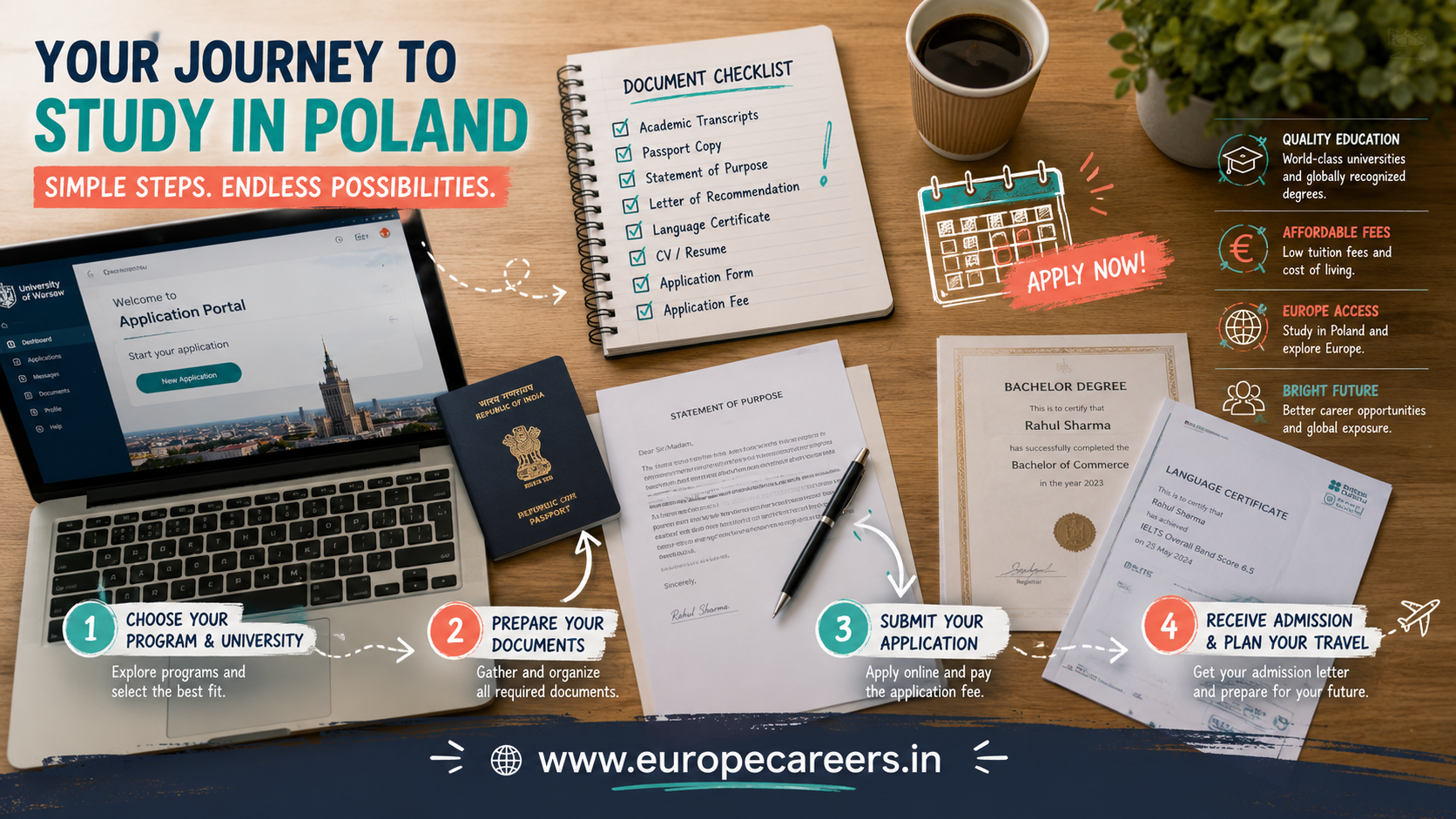 When applying for a master’s program, you’ll typically need:
- Bachelor’s degree certificate
- Complete academic transcripts (semester-wise or year-wise marksheets)
- Class 10 and 12 certificates (some universities ask for these)
- Passport
- Passport-size photographs
- English proficiency certificate (IELTS, TOEFL, etc.)
- Motivation letter or statement of purpose
- Curriculum Vitae (CV or resume)
- Letters of recommendation (usually 1 to 2, from professors or employers)
- Portfolio or work samples (for creative programs like architecture, design, or media)
Certified translations and apostille may be required depending on the university.
English Language Requirements
Most master’s programs require:
- IELTS: 6.0 to 6.5 overall
- TOEFL: 80 to 90
- Cambridge English: B2 or C1 level
Some universities may accept other English proficiency certificates or conduct their own English assessment.
Work Experience
Most master’s programs do not require work experience. However, MBA programs and some specialized management or executive programs may prefer or require 1 to 3 years of professional experience. Check the program requirements carefully.
Application Process and Timeline
Master’s program applications generally open in late autumn (November-December) for the October intake. Some universities also offer a February/March intake for select programs.
Recommended timeline:
- Research programs and universities: October to December
- Prepare documents and apply: January to May
- Receive admission decisions: March to July
- Apply for visa: As soon as you receive admission
- Travel to Poland: September for October intake
Conversion Courses and Bridging Programs
If your bachelor’s degree is not directly related to your desired master’s program, some universities offer bridging or preparatory courses to help you meet the requirements. These courses usually last one semester and cover foundational subjects.
Things to Keep in Mind
- Master’s programs in Poland are more widely available in English than bachelor’s programs, making them a practical choice for Indian graduates.
- Check if the program’s curriculum matches your career goals and interests.
- Verify the total duration, tuition fees, and whether internships or thesis work are part of the program.
- If you’re applying to a technical master’s program, ensure your bachelor’s degree includes relevant subjects (mathematics, programming, engineering fundamentals, etc.).
- Contact the university’s admissions office if you’re unsure about eligibility or course compatibility.
Studying in Poland after graduation is a realistic pathway for Indian students seeking European education, career opportunities, and international exposure at a manageable cost.
Study Medicine in Poland for Indian Students
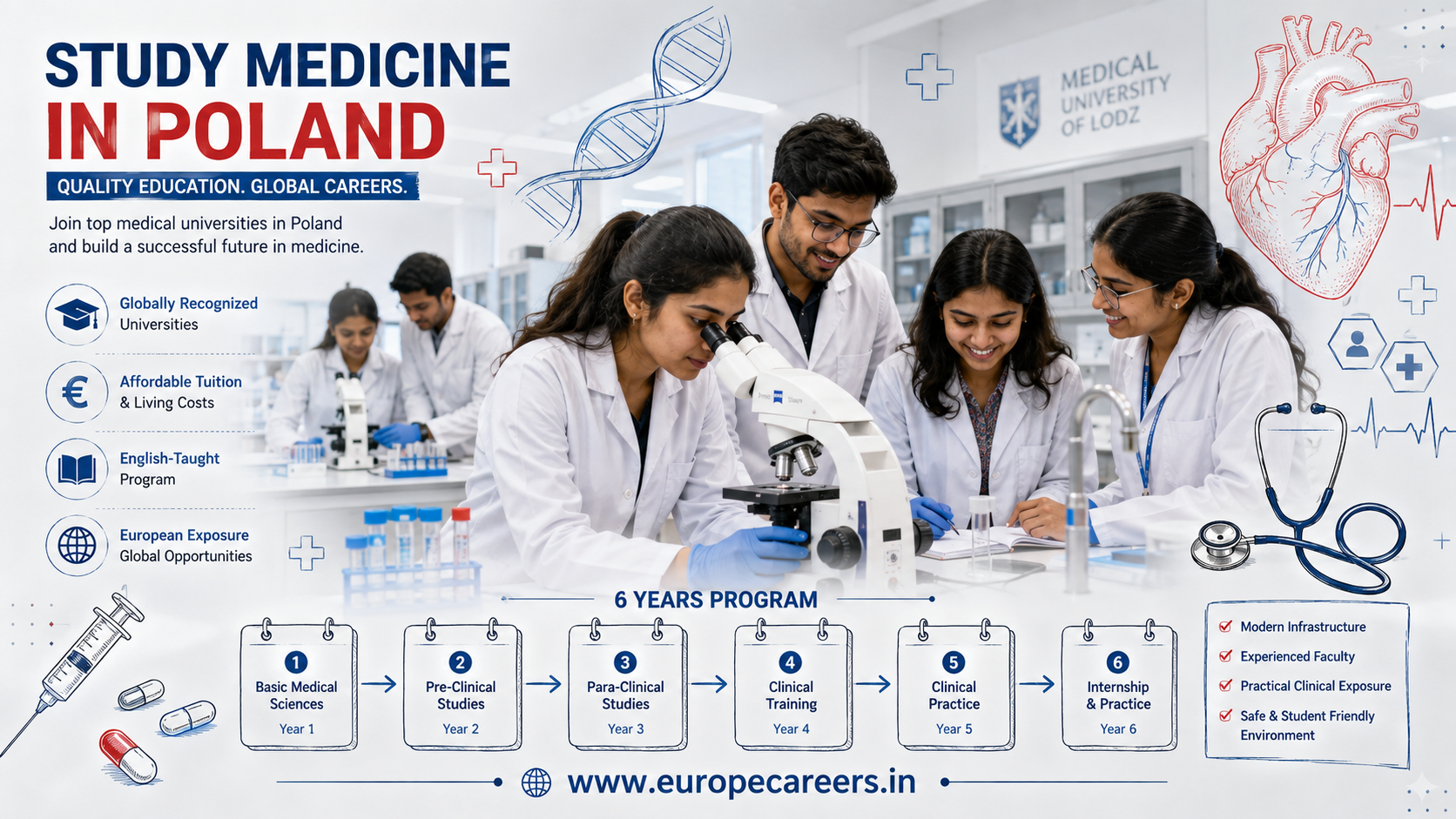 Medicine is one of the most popular fields for Indian students considering Poland. However, it’s also one of the most complex in terms of admission, cost, and recognition. Here’s what you need to know.
Medical Education in Poland
Polish medical universities offer six-year Doctor of Medicine (MD) programs taught in English. The curriculum follows European standards and is divided into preclinical years (basic medical sciences) and clinical years (hospital rotations, patient care, diagnostics).
Medical universities in Poland are well-equipped with modern labs, simulation centers, and teaching hospitals. Many have a long history of medical education and are recognized by international bodies like the World Health Organization (WHO) and listed in the World Directory of Medical Schools.
Eligibility for Indian Students
To apply for MBBS (MD) in Poland after Class 12, you typically need:
- Completion of Class 12 with Physics, Chemistry, and Biology
- Minimum aggregate percentage (often 50-60% in PCB, but varies by university)
- NEET qualification: While Polish universities do not require NEET scores for admission, the National Medical Commission (NMC) in India requires Indian students studying medicine abroad to qualify NEET to be eligible to practice in India after returning. This is an important requirement if you plan to return to India.
- English language proficiency (IELTS, TOEFL, or equivalent; some universities may accept Class 12 English marks)
Admission Process
Medical programs in Poland are competitive. The admission process usually involves:
- Submission of academic documents (Class 10, 12, passport, etc.)
- Entrance exam or interview (subjects like Biology, Chemistry, Physics, and sometimes English)
- Some universities conduct online or in-person entrance tests
- Admission decision based on entrance test performance, academic records, and interview
Application deadlines are typically between May and July for the October intake. Some universities have multiple rounds of admissions.
Duration and Structure
The medical program in Poland lasts six years. The first two to three years focus on basic sciences (anatomy, physiology, biochemistry, pharmacology, pathology), and the later years focus on clinical rotations in various specialties (surgery, internal medicine, pediatrics, gynecology, etc.).
Students also complete clinical training in university hospitals and healthcare facilities.
Tuition Fees
Tuition fees for medicine in Poland vary by university but generally range from €10,000 to €14,000 per year. Over six years, this amounts to approximately €60,000 to €84,000. Some universities may charge higher fees.
While this is significantly lower than private medical colleges in India or Western countries, it’s still a substantial investment. Students should plan for the full six years, including living expenses, accommodation, health insurance, books, and travel.
Living Expenses
In addition to tuition, students should budget for:
- Accommodation: €200 to €400 per month (dormitory or shared apartment)
- Food: €150 to €250 per month
- Transport: €20 to €40 per month
- Health insurance: approximately €50 to €100 per month
- Study materials and personal expenses: €50 to €100 per month
Total living expenses can range from €500 to €800 per month, depending on the city and lifestyle.
Recognition and Licensing
This is the most important consideration for Indian students.
Recognition in India: The National Medical Commission (NMC) requires Indian students who study medicine abroad to:
- Qualify the NEET exam before admission
- Complete their degree from a university listed in the World Directory of Medical Schools
- Clear the Foreign Medical Graduate Examination (FMGE), now being replaced by NExT (National Exit Test), to obtain a license to practice in India
Polish medical universities are generally listed in the World Directory of Medical Schools, but students must verify the specific university’s status before applying. Even with a recognized degree, you must clear the licensing exam to practice in India.
Recognition in Europe and other countries: Polish medical degrees are recognized across the European Union and many other countries. However, if you plan to practice in a specific country (UK, USA, Canada, Australia, etc.), you must fulfill that country’s licensing requirements, which usually include exams, clinical assessments, and language proficiency.
Why Indian Students Choose Poland for Medicine
- Lower tuition fees compared to private medical colleges in India or Western countries
- English-taught programs
- European education standards
- Clinical training in modern hospitals
- International student environment
- Opportunity to explore healthcare systems in Europe
Challenges and Considerations
- High total cost over six years (tuition + living expenses)
- Competitive admissions
- Need to clear FMGE/NExT to practice in India
- Cultural and language adjustment
- Cold weather and different lifestyle
- Limited financial aid or scholarships for international students in medical programs
Important Advice
If you’re considering studying medicine in Poland:
- Verify that the university is recognized by the National Medical Commission and listed in the World Directory of Medical Schools
- Ensure you have qualified NEET before applying
- Plan your finances carefully for the full six years
- Understand the FMGE/NExT requirements and pass rates
- Be realistic about career outcomes and licensing challenges
- Consider whether you’re prepared to live in Poland for six years and adapt to a new culture and climate
Studying medicine in Poland is a serious decision that requires thorough research, financial planning, and a clear understanding of recognition and career pathways.
English-Taught Programs in Poland
One of the main reasons Poland is accessible to Indian students is the wide availability of English-taught programs. Here’s what you need to know.
Availability of English-Taught Programs
Polish universities offer hundreds of programs taught entirely in English, especially at the master’s level. Bachelor’s programs in English are also available but may be more limited in some fields.
Common English-taught programs include:
- Engineering (all major branches)
- Computer Science and IT
- Business and Management
- Finance and Economics
- Medicine and Dentistry
- Pharmacy
- Biotechnology
- Architecture
- Data Science and Artificial Intelligence
- International Relations
- Psychology
- Nursing
- Public Health
Some fields, like law (Polish law), humanities, and social sciences, may have fewer English-taught options at the bachelor’s level, though master’s programs may be available.
Who Can Apply?
Any international student, including Indian students, can apply for English-taught programs as long as they meet the academic and language requirements.
You do not need to know Polish to study in an English-taught program, though learning basic Polish is helpful for daily life, part-time work, and career opportunities.
English Proficiency Requirements
To apply for an English-taught program, you’ll typically need to demonstrate English proficiency through:
- IELTS (usually 5.5 to 6.5 for bachelor’s; 6.0 to 7.0 for master’s)
- TOEFL (typically 70 to 90)
- Cambridge English (B2 or C1 level)
- Duolingo English Test (some universities accept this)
- Pearson PTE Academic
Some universities may waive the English test requirement if:
- Your previous degree was taught in English (you may need a certificate from your university confirming this)
- You scored high marks in English in Class 12
- You pass the university’s internal English assessment
Always check the specific university’s requirements.
Medium of Instruction
In English-taught programs, lectures, seminars, exams, assignments, and thesis work are conducted in English. Course materials, textbooks, and research papers are also in English.
However, during clinical rotations or internships, especially in medicine or nursing, some interactions with patients or staff may be in Polish. Universities usually provide language support or translators where necessary.
How to Verify if a Program is Taught in English
Before applying, verify the medium of instruction by:
- Checking the university’s official website
- Reading the program’s curriculum and course descriptions
- Contacting the university’s international admissions office
- Reviewing the admission requirements (English-taught programs will specify English proficiency requirements)
Do not rely solely on third-party agents or websites. Always confirm with the university directly.
Benefits of English-Taught Programs
- No need to learn Polish before admission
- Access to quality European education without a language barrier
- Easier integration with international students
- Opportunity to improve your English academic and professional communication skills
- Greater mobility within Europe and globally
Limitations
- Fewer English-taught programs at the bachelor’s level in some fields
- Daily life outside the classroom may require basic Polish (grocery shopping, public transport, healthcare)
- Part-time jobs often require Polish language skills
- Limited social integration if you don’t learn Polish
Most universities offer free or low-cost Polish language courses for international students. Taking advantage of these courses can significantly improve your experience in Poland.
Admission Requirements for Indian Students
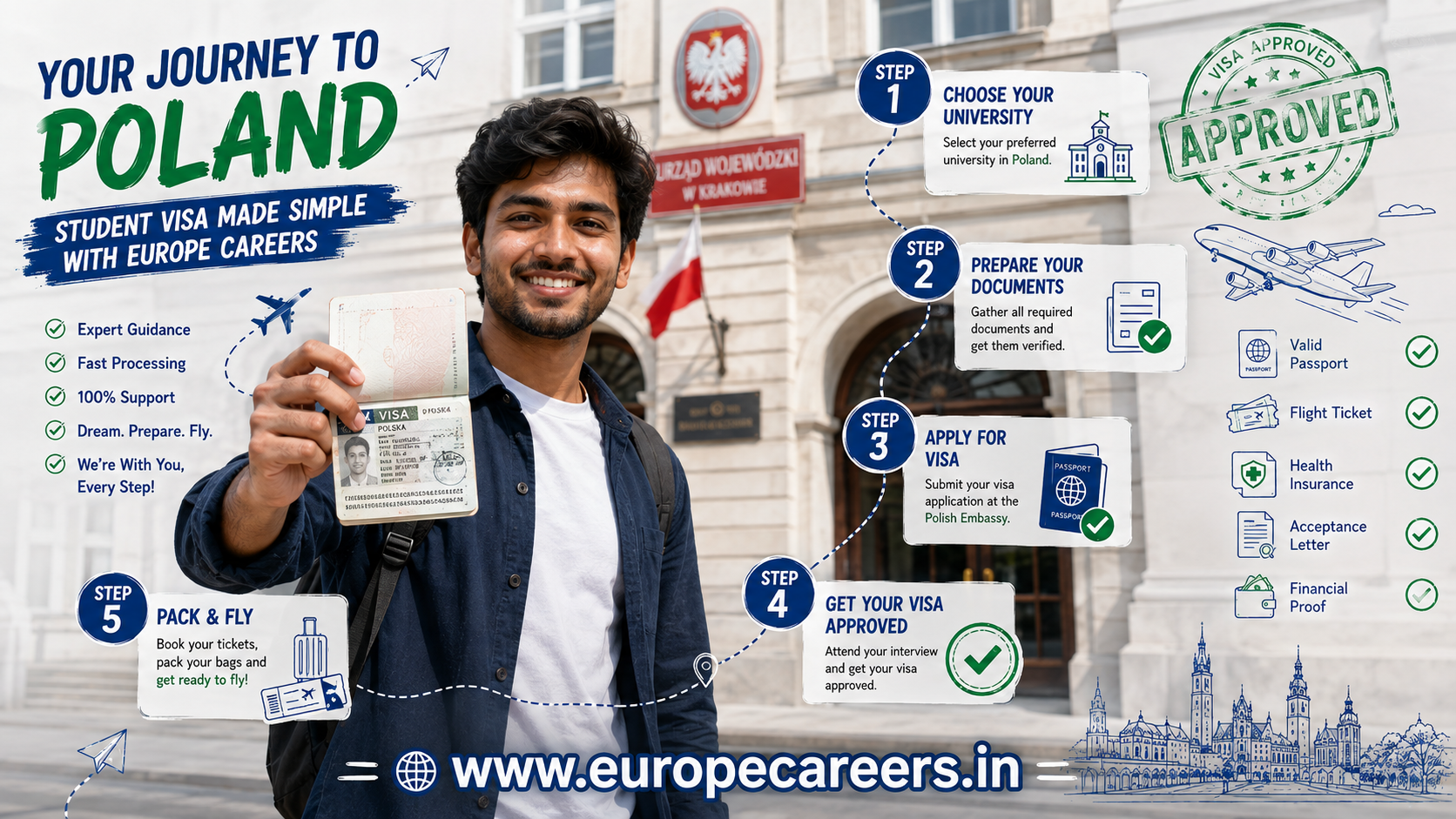 Admission requirements vary by university, program, and level of study, but here’s a comprehensive checklist of what you’ll typically need.
Academic Documents
For Bachelor’s Programs:
- Class 10 certificate and marksheet
- Class 12 certificate and marksheet
- Transcripts showing subjects studied and marks obtained
- School leaving certificate (if applicable)
For Master’s Programs:
- Bachelor’s degree certificate
- Complete academic transcripts (all semesters or years)
- Class 10 and 12 certificates (some universities ask for these)
For PhD Programs:
- Master’s degree certificate
- Academic transcripts
- Research proposal
- Publications or research experience (if applicable)
Passport
A valid passport is required for admission and visa purposes. Ensure your passport is valid for at least the duration of your intended studies plus a few months.
Passport-Size Photographs
Most universities require recent passport-size photographs (usually 2 to 4). Check the university’s specifications for size and background color.
English Language Proficiency
You’ll need to submit:
- IELTS, TOEFL, Cambridge English, Duolingo, or another accepted test score
- OR a certificate from your previous institution confirming that your education was conducted in English
- OR proof of passing the university’s internal English test
Motivation Letter or Statement of Purpose
Many universities require a motivation letter explaining:
- Why you want to study the chosen program
- Your academic background and interests
- Your career goals
- Why you chose that particular university
Keep it concise (usually 1 to 2 pages), honest, and focused on your genuine motivations and plans.
Curriculum Vitae (CV)
A CV or resume is often required, especially for master’s and PhD programs. Include:
- Personal details
- Educational background
- Work experience (if any)
- Skills
- Achievements, projects, or publications
- Extracurricular activities
Letters of Recommendation
Some programs, especially at the master’s and PhD levels, require 1 to 2 letters of recommendation. These should be from:
- Professors or academic supervisors who know your academic abilities
- Employers (if you have work experience relevant to the program)
Letters should be on official letterhead, signed, and include the recommender’s contact details.
Medical Certificate or Health Insurance
Some universities may require:
- A medical certificate confirming you are fit to study
- Proof of health insurance (this is also required for the visa application)
Financial Documents
While not always required for university admission, financial documents showing you can support yourself during your studies may be requested, especially for the visa application. This can include:
- Bank statements
- Sponsor’s affidavit (if your parents or someone else is funding your studies)
- Scholarship letters
- Proof of funds
Certified Translations
If your documents are not in English or Polish, you’ll need certified translations. Translators must be sworn translators or notarized, depending on the university’s requirements.
Apostille or Consular Legalization
Some universities and Polish authorities require that educational documents be apostilled (if India is part of the Hague Convention, which it is) or legalized by the Polish Consulate. This process authenticates your documents for use in Poland.
The process involves:
- Getting your documents notarized
- Submitting them to the Ministry of External Affairs for apostille
- OR submitting them to the Polish Consulate for legalization
Check with the university whether apostille or consular legalization is required before you start the process.
Entrance Exams or Interviews
Some programs, especially medicine, may require:
- Entrance exams in subjects like Biology, Chemistry, Physics, or Mathematics
- Interviews (in-person or online)
- Portfolio submission (for architecture, design, or art programs)
Application Fee
Many universities charge an application fee, typically ranging from €50 to €200. This is usually non-refundable.
Important Tips
- Start gathering documents early, as obtaining apostille, translations, and transcripts can take time
- Keep both physical and digital copies of all documents
- Double-check each university’s specific requirements on their official website
- If you’re unsure about any document, contact the university’s admissions office
- Keep a checklist and tick off each item as you complete it
Meeting the admission requirements is the first critical step in your journey to study in Poland. Incomplete or incorrect applications are often rejected, so attention to detail matters.
Poland University Admission Process – Step by Step
Understanding the admission process will help you stay organized and meet deadlines. Here’s a step-by-step guide.
Step 1: Choose Your Course and Field of Study
Start by identifying:
- What you want to study (engineering, business, medicine, IT, etc.)
- What level (bachelor’s, master’s, PhD)
- Your academic background and eligibility
- Your career goals
Your choice should be based on your interests, strengths, and future plans, not just on low tuition fees or easy admission.
Step 2: Research Universities
Once you’ve identified your field, research universities that offer the program. Consider:
- Official accreditation and recognition
- Availability of the program in English
- Tuition fees
- Location (city, climate, cost of living)
- Campus facilities (labs, libraries, accommodation)
- Career services and internship opportunities
- International student support
- Reputation and alumni outcomes
Create a shortlist of 3 to 5 universities that match your criteria.
Step 3: Check Eligibility and Admission Requirements
Visit each university’s official website and carefully read the admission requirements for your chosen program. Check:
- Academic qualifications required
- Minimum percentage or GPA
- Subject requirements
- English proficiency requirements
- Entrance exams or interviews
- Document requirements
- Application deadlines
If anything is unclear, contact the university’s international admissions office.
Step 4: Prepare Your Documents
Gather all required documents:
- Educational certificates and transcripts
- Passport
- Photographs
- English proficiency certificate
- Motivation letter
- CV
- Letters of recommendation (if required)
- Portfolio (if required)
Get certified translations and apostille where needed. This can take several weeks, so start early.
Step 5: Submit Your Application
Most Polish universities have online application portals. You’ll need to:
- Create an account on the university’s application portal
- Fill in the application form with your personal, academic, and contact details
- Upload scanned copies of all required documents
- Write or upload your motivation letter
- Pay the application fee (if applicable)
- Submit the application before the deadline
Some universities also accept applications by email or post, but online portals are more common.
Step 6: Pay the Application Fee
If the university charges an application fee, you ‘ll typically pay it online via credit/debit card or bank transfer. Keep the payment receipt as proof.
Step 7: Attend Entrance Exam or Interview (if Required)
Some programs, especially medicine, engineering, or competitive master’s programs, may require:
- An entrance exam (online or in-person)
- An interview (video call or in-person)
- A skills assessment or portfolio review
Prepare thoroughly if your program requires this step. Universities usually notify you of the date, format, and topics well in advance.
Step 8: Wait for the Admission Decision
After submitting your application, the university will review your documents and assess your eligibility. This process can take anywhere from 2 weeks to 2 months, depending on the university and program.
You’ll receive an admission decision via email. This could be:
- An acceptance letter (congratulations!)
- A conditional acceptance (you need to fulfill certain conditions, like submitting additional documents or improving your English score)
- A rejection (you can apply to other universities or programs)
Step 9: Accept the Offer and Pay Tuition Deposit
If you’re accepted, the university will send you:
- An official letter of acceptance or admission
- Instructions for accepting the offer
- Details about tuition fees and payment schedules
Most universities require you to pay a tuition deposit or the first semester’s fees to confirm your place. This is usually due within a few weeks of receiving the acceptance.
Step 10: Receive Official Admission Documents
Once you’ve confirmed your acceptance and paid the required fees, the university will issue:
- An official admission letter
- A certificate of acceptance or enrollment certificate
- Other documents required for your visa application
These documents are essential for applying for your student visa.
Step 11: Apply for Your Student Visa
With your admission documents in hand, you can now apply for your Poland student visa. We’ll cover the visa process in detail in the next sections, but the basic steps are:
- Gather visa documents (passport, admission letter, financial proof, insurance, etc.)
- Book an appointment at the Polish Consulate or Visa Application Centre in India
- Submit your visa application
- Attend the visa interview
- Wait for the visa decision
- Collect your visa
Start the visa process immediately after receiving your admission letter, as processing can take several weeks.
Step 12: Arrange Accommodation
While waiting for your visa, start looking for accommodation. Options include:
- University dormitories (apply early, as spaces are limited)
- Private student residences
- Shared apartments with other students
- Private rentals
Many universities provide accommodation support or have dedicated housing offices for international students.
Step 13: Book Your Travel
Once your visa is approved, book your flight to Poland. Aim to arrive at least a week before the academic year starts (usually late September or early October) to:
- Settle into your accommodation
- Attend orientation sessions
- Register with the university
- Complete residence registration
- Open a bank account
- Get familiar with the city
Step 14: Complete University Registration
When you arrive in Poland, you’ll need to complete the university registration process, which may include:
- Submitting original documents (bring your passport, admission letter, certificates, etc.)
- Paying any remaining fees
- Receiving your student ID card
- Enrolling in courses
- Attending orientation sessions
- Meeting your academic advisor
Step 15: Register Your Residence
International students in Poland are required to register their residence address with the local authorities within a few days of arrival. Your university’s international office will usually guide you through this process.
Important Timeline Tips
- Start researching universities: 10 to 12 months before the intended start date
- Apply to universities: 6 to 8 months before
- Receive admission: 4 to 6 months before
- Apply for visa: 3 to 4 months before
- Arrive in Poland: 1 to 2 weeks before the academic year starts
Following this step-by-step process will help you stay organized, meet deadlines, and avoid last-minute stress.
How to Choose the Right University in Poland
Choosing the right university is one of the most important decisions you’ll make. Here’s a practical checklist to help you evaluate your options.
Official Accreditation and Recognition
This is the most important factor. Ensure the university is:
- Officially recognized by the Polish Ministry of Education and Science
- Accredited by relevant Polish accreditation bodies
- Listed in international databases like the World Higher Education Database (WHED) or the World Directory of Medical Schools (for medical programs)
Studying at an unrecognized or unaccredited institution can lead to serious problems, including difficulties with visa applications, degree recognition, and career prospects.
Program Curriculum
Review the curriculum of your chosen program. Check:
- What subjects are covered
- How many semesters the program lasts
- Whether internships or practical training are included
- Whether a thesis or final project is required
- Elective options and specializations
A well-designed curriculum should match your academic interests and career goals.
Language of Instruction
Confirm that the program is genuinely taught in English if that’s what you’re applying for. Check:
- Course descriptions
- Exam language
- Whether all professors teach in English
Some programs may have a few courses in Polish, which could be challenging if you don’t speak the language.
Tuition Fees and Payment Structure
Understand the full cost:
- Annual tuition fees
- Payment schedule (semester-wise or annual)
- Application fees
- Additional fees (lab fees, library fees, student association fees)
- Deposit requirements
Compare fees across universities, but don’t choose based solely on the lowest price. Quality and recognition matter more.
Location and City
Consider:
- Cost of living in the city
- Climate and weather
- Size of the city (large cities like Warsaw and Kraków are more expensive but offer more opportunities)
- Public transport connectivity
- Proximity to the Indian community or international student groups
- Safety and quality of life
University Facilities
Visit the university’s website or contact their admissions office to learn about:
- Campus facilities (classrooms, labs, libraries)
- Research facilities
- Sports and recreation facilities
- IT infrastructure and internet access
- Accessibility for students with disabilities
Accommodation Options
Check if the university offers:
- On-campus dormitories or student housing
- Assistance in finding private accommodation
- Housing costs and availability
Universities with dedicated housing support make settling in easier for international students.
International Student Support
A good university should have:
- An international office or department for foreign students
- Orientation programs for new students
- Visa and residence permit support
- Academic advising
- Counseling and mental health services
- Language courses (Polish language classes)
Career Services and Internship Opportunities
Check if the university provides:
- Career counseling
- Job placement assistance
- Internship opportunities or partnerships with companies
- Career fairs and networking events
- Alumni networks
Universities with strong industry connections can significantly improve your career prospects.
Reputation and Alumni Outcomes
While rankings are not everything, consider:
- The university’s reputation in your field of study
- Alumni success stories
- Employer feedback
- Research output and publications (for research-focused programs)
Talk to current students or alumni if possible. Online student forums, Facebook groups, and LinkedIn can be helpful for this.
Recognition of Qualifications
If you’re studying a regulated profession (medicine, nursing, pharmacy, law, etc.), verify that:
- The degree is recognized in India or your target country of practice
- You understand the licensing or registration requirements
- Graduates from the university have successfully qualified in those countries
University Size and Student Body
Consider whether you prefer:
- A large university with diverse programs and a large international student population
- A smaller, more specialized institution with closer faculty-student interaction
Both have advantages; it depends on your learning style and preferences.
Communication and Responsiveness
When you contact the university with questions, notice:
- How quickly they respond
- How clear and helpful their answers are
- Whether they provide information in English
- Whether they seem organized and professional
A responsive and supportive admissions office is often a sign of good overall student support.
Red Flags to Watch Out For
Avoid universities that:
- Are not officially recognized or accredited
- Make unrealistic promises (guaranteed jobs, easy visas, automatic recognition)
- Have very low tuition fees without clear explanations
- Have poor online reviews from multiple sources
- Do not provide clear information about their programs or admissions
- Pressure you to apply quickly without giving you time to research
Final Advice
- Apply to 3 to 5 universities to increase your chances of admission
- Compare offers carefully before deciding
- Don’t choose based solely on rankings, fees, or advertisements
- Trust your research and instincts
- Seek advice from education consultants if needed, but verify information independently
Choosing the right university sets the foundation for your entire study experience and future career. Take the time to research thoroughly.
Tuition Fees in Poland for Indian Students
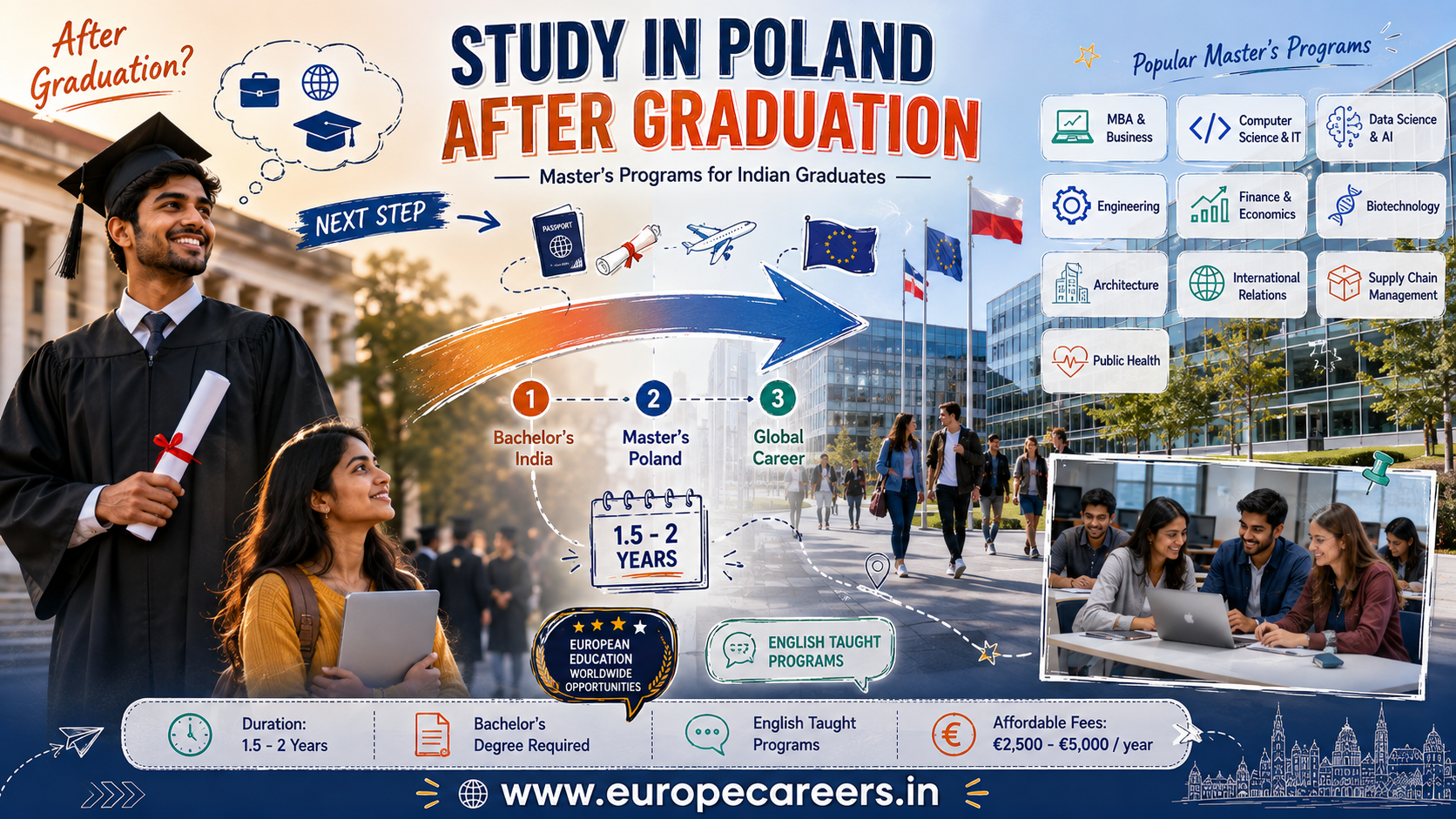 Understanding tuition fees and how they vary is essential for financial planning.
Why Tuition Fees Vary
Tuition fees in Poland are not fixed and depend on:
- The type of university (public or private)
- The program and field of study
- The level of study (bachelor’s, master’s, PhD)
- The language of instruction (English-taught programs generally have fees; Polish-taught programs at public universities are free for EU citizens but charge fees for non-EU students like Indians)
General Tuition Fee Ranges
Here are approximate annual tuition fees for English-taught programs at Polish universities:
Bachelor’s Programs:
- Business, Management, Economics: €2,000 to €4,000 per year
- Engineering (Civil, Mechanical, Electrical, etc.): €2,500 to €4,500 per year
- Computer Science and IT: €2,500 to €4,500 per year
- Humanities and Social Sciences: €2,000 to €3,500 per year
Master’s Programs:
- MBA and Business Management: €3,000 to €6,000 per year
- Engineering: €2,500 to €4,500 per year
- Computer Science, AI, Data Science: €3,000 to €5,000 per year
- Finance and Economics: €2,500 to €4,000 per year
- Architecture: €3,000 to €5,000 per year
Medical Programs:
- Medicine (MBBS/MD): €10,000 to €14,000 per year (6-year program)
- Dentistry: €10,000 to €13,000 per year (5-year program)
- Pharmacy: €6,000 to €9,000 per year (5-year program)
- Nursing: €3,000 to €5,000 per year
These figures are approximate and vary by university. Always check the official university website for current tuition fees.
Public vs Private Universities
Public universities generally have lower tuition fees for English-taught programs but are more competitive and may have stricter admission requirements.
Private universities may charge higher fees but often have more flexible admissions, smaller class sizes, and modern facilities.
Application Fees
Many universities charge a non-refundable application fee, usually between €50 and €200. This fee is separate from tuition.
Payment Structure
Most universities require:
- A deposit or first semester’s tuition payment upon acceptance to confirm your place
- Remaining tuition fees paid in installments (usually semester-wise or annually)
Some universities offer discounts for paying the full year’s fees upfront.
Additional University Fees
In addition to tuition, you may need to pay:
- Student association or union fees: €20 to €50 per year
- Library and IT access fees: €30 to €100 per year
- Lab or equipment fees (for engineering, science, or medical programs): varies
- Exam retake fees (if you fail an exam and need to retake it)
- Graduation and diploma fees: €50 to €200
Tuition Fees for PhD Programs
PhD programs in Poland can be:
- Free (if you’re admitted to a funded position at a public university)
- Fee-based: €3,000 to €6,000 per year
Some PhD students receive a stipend or scholarship, especially if they’re involved in research projects.
How Fees Compare to Other Countries
Compared to other popular study destinations:
- UK: £10,000 to £30,000+ per year
- USA: $20,000 to $50,000+ per year
- Germany: Free to €3,000 per semester (plus living costs)
- Ireland: €10,000 to €20,000 per year
- Canada: CAD 15,000 to CAD 35,000 per year
Poland’s tuition fees are significantly lower than the UK, USA, and Ireland, making it an affordable European option.
Financial Planning Tips
- Calculate the total cost for the entire program (multiply annual fees by the number of years)
- Add living expenses, accommodation, travel, insurance, and personal expenses
- Plan for at least 10-15% extra for unexpected costs
- Check if the university offers installment payment options
- Explore scholarship opportunities
- Keep exchange rate fluctuations in mind when budgeting
Can Fees Change?
Universities may increase tuition fees each year, though increases are usually modest. Check if your fee is fixed for the duration of the program or subject to annual adjustments.
Understanding tuition fees helps you plan your budget realistically and avoid financial stress during your studies.
Cost of Living in Poland
Beyond tuition fees, you’ll need to budget for daily living expenses. Here’s a breakdown of what to expect.
Accommodation
Accommodation is usually the largest monthly expense.
University Dormitories:
- €150 to €300 per month
- Shared rooms are cheaper; single rooms cost more
- Basic facilities (bed, desk, shared bathroom and kitchen)
- Limited availability, so apply early
Private Student Residences:
- €250 to €450 per month
- Modern facilities, often include utilities and internet
- Private or shared rooms
- Common areas, study rooms, laundry facilities
Shared Apartments:
- €200 to €400 per month per person
- Rent a flat with 2 to 4 other students
- Utilities (electricity, water, heating, internet) may be extra: €50 to €100 per month
- More independence and privacy
Private Studio or One-Bedroom Apartment:
- €400 to €700 per month in major cities
- Full independence but higher cost
Accommodation costs are generally lower in smaller cities like Lublin, Białystok, or Olsztyn, and higher in Warsaw, Kraków, and Wrocław.
Food
Cooking at Home:
- €150 to €250 per month
- Supermarkets like Biedronka, Lidl, Kaufland, and Auchan are affordable
- Fresh vegetables, fruits, bread, dairy, and grains are inexpensive
- Indian spices and ingredients are available in Asian or international stores
Eating Out:
- Budget meal at a cafeteria or fast food: €3 to €6
- Mid-range restaurant meal: €7 to €12
- Indian or Asian restaurant: €8 to €15
Most students cook at home to save money and eat out occasionally.
Transportation
Public Transport:
- Monthly student pass: €15 to €30
- Most cities offer discounts for students
- Buses, trams, and metro (in Warsaw) are reliable and affordable
Bicycle:
- Many students use bicycles, especially in smaller cities
- Bike-sharing systems are available in larger cities
Taxi or Ride-Sharing (Uber, Bolt):
- Occasional use: €5 to €15 per trip within the city
Utilities (if Not Included in Rent)
If you’re renting a private apartment, expect to pay:
- Electricity: €30 to €60 per month
- Water: €20 to €40 per month
- Heating: €30 to €80 per month (higher in winter)
- Internet and mobile: €15 to €30 per month
Total: €100 to €200 per month, depending on usage and apartment size.
Health Insurance
International students in Poland are required to have health insurance.
- Basic insurance: €50 to €100 per month
- Comprehensive insurance: €100 to €150 per month
Some universities include insurance in their fees or help students arrange it.
Study Materials and Books
- Textbooks and supplies: €30 to €100 per semester
- Many students buy used books, use the library, or download digital resources
Mobile Phone
- Prepaid or monthly plans: €10 to €20 per month
- Includes calls, texts, and data
- Popular providers: Orange, Play, T-Mobile, Plus
Personal Expenses and Entertainment
- Clothing, toiletries, personal care: €30 to €60 per month
- Gym membership: €20 to €40 per month
- Cinema ticket: €5 to €8
- Social activities, cafes, outings: €50 to €100 per month
Emergency and Miscellaneous
Always budget for unexpected expenses:
- Medical expenses not covered by insurance
- Travel home in emergencies
- Visa or residence permit renewal fees
- Urgent purchases
Set aside at least €100 to €200 for emergencies.
Total Monthly Cost of Living
Most students live on a budget of €500 to €700 per month by sharing accommodation, cooking at home, and using student discounts.
Cost Differences by City
- Warsaw and Kraków: Higher accommodation costs, more expensive dining and entertainment
- Wrocław, Poznań, Gdańsk: Moderate costs, good balance of affordability and lifestyle
- Lublin, Białystok, Olsztyn, Rzeszów: Lower costs, more budget-friendly
Tips to Save Money
- Share accommodation with other students
- Cook at home and buy groceries from discount supermarkets
- Use student discounts for transport, museums, cinemas, and events
- Buy used textbooks or borrow from the library
- Avoid expensive cafes and restaurants
- Plan your budget and track expenses
Understanding the cost of living helps you plan realistically and avoid financial stress during your studies in Poland.
Best Student Cities in Poland
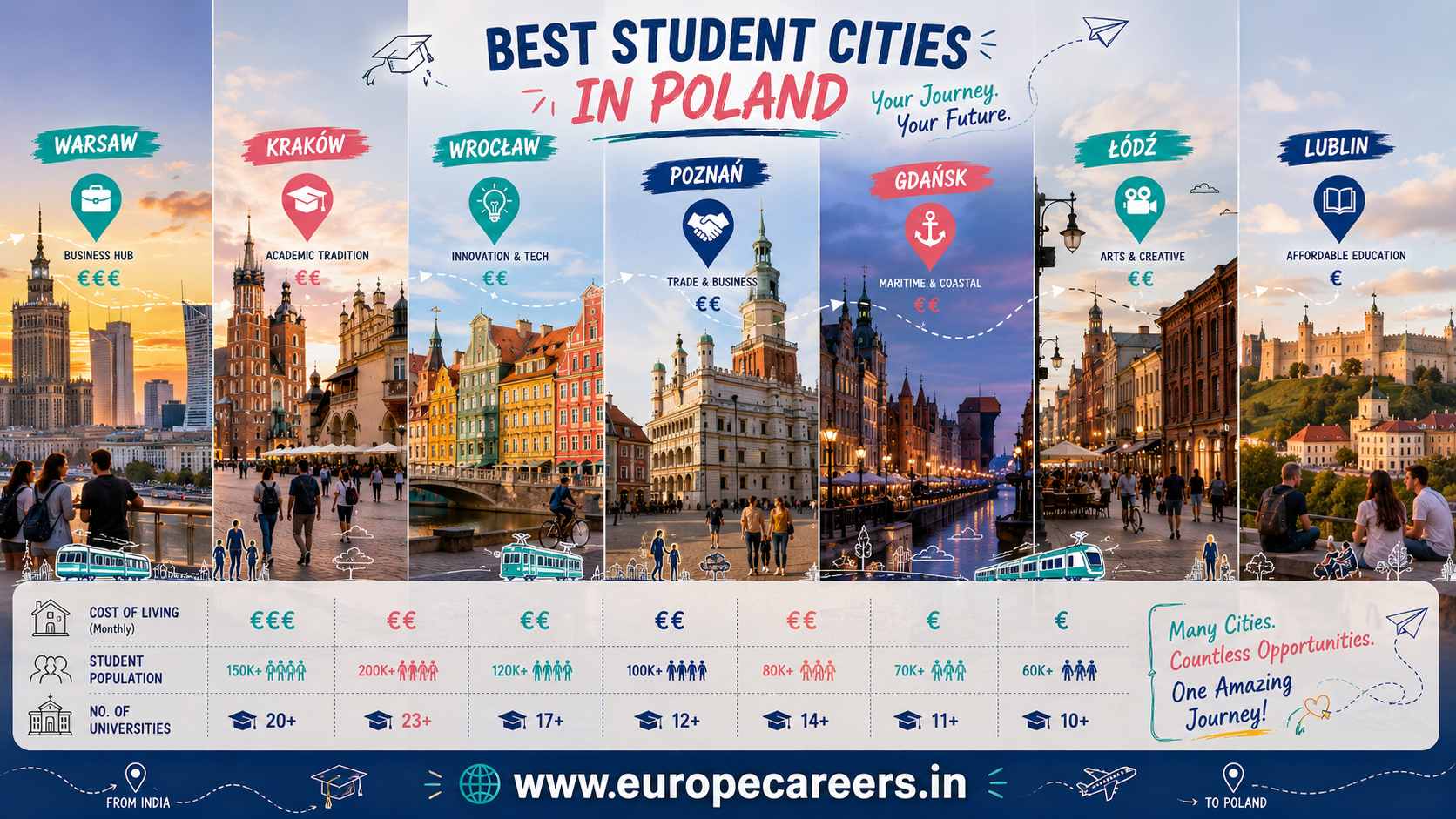 Poland has several cities that are popular with international students. Each offers a different experience in terms of lifestyle, cost, and opportunities.
Warsaw
Overview:
Warsaw is the capital and largest city of Poland. It’s the political, economic, and cultural center of the country.
Universities:
- University of Warsaw
- Warsaw University of Technology
- Medical University of Warsaw
- SGH Warsaw School of Economics
- Kozminski University
Student Life:
Warsaw has a vibrant student community, with numerous cafes, libraries, cultural events, and nightlife options. The city is modern, with excellent public transport (metro, buses, trams) and international connectivity.
Cost of Living:
Higher than other Polish cities. Accommodation ranges from €250 to €500+ per month. Overall monthly expenses: €600 to €900.
Pros:
- Major academic hub with top universities
- Job opportunities, especially in IT, finance, and business services
- International companies and career prospects
- Museums, theaters, parks, and cultural events
- Good transport and infrastructure
Cons:
- Higher cost of living
- Can feel overwhelming for students from smaller towns
- Winters can be harsh
Who Should Choose Warsaw:
 Students looking for career opportunities, networking, and access to major companies. Suitable for business, IT, engineering, and economics students.
Kraków
Overview:
Kraków is one of Poland’s oldest and most beautiful cities, known for its medieval architecture, historic sites, and vibrant cultural scene.
Universities:
- Jagiellonian University (one of the oldest universities in Europe)
- AGH University of Science and Technology
- Kraków University of Economics
- Medical University of Kraków
Student Life:
Kraków has a large student population and a lively atmosphere. The Old Town, Kazimierz (Jewish Quarter), and Wawel Castle are popular spots. The city hosts festivals, concerts, and events year-round.
Cost of Living:
Moderate to high. Accommodation: €250 to €450 per month. Overall monthly expenses: €550 to €850.
Pros:
- Beautiful, historic city
- Strong academic reputation
- Large international student community
- Cultural events and tourism
- Close to mountains (Tatra Mountains) for weekend trips
Cons:
- Slightly higher cost of living
- Tourist crowds in the Old Town
- Accommodation can be competitive
Who Should Choose Kraków:
Students who want a mix of quality education, culture, and lifestyle. Suitable for all fields, especially humanities, engineering, and medicine.
Wrocław
Overview:
Wrocław is a vibrant city in southwestern Poland, known for its beautiful architecture, numerous bridges, and youthful energy.
Universities:
- Wrocław University of Science and Technology
- University of Wrocław
- Wrocław University of Economics and Business
- Medical University of Wrocław
Student Life:
Wrocław has a large student population and is often ranked as one of the best cities for students in Poland. It’s known for its festivals, nightlife, and open-minded atmosphere.
Cost of Living:
Moderate. Accommodation: €200 to €400 per month. Overall monthly expenses: €500 to €750.
Pros:
- Student-friendly and lively
- Lower cost of living than Warsaw or Kraków
- Growing IT and business hub
- Beautiful city with canals and historic sites
- Excellent transport
Cons:
- Smaller than Warsaw, fewer multinational companies
- Winters can be cold and gray
Who Should Choose Wrocław:
Students seeking a balance between quality education, affordability, and lifestyle. Great for engineering, IT, business, and social sciences.
Poznań
Overview:
Poznań is a major city in western Poland, known for its economic development, trade fairs, and academic institutions.
Universities:
- Adam Mickiewicz University
- Poznań University of Technology
- Poznań University of Economics and Business
- Poznań University of Medical Sciences
Student Life:
Poznań has a strong student community, with cafes, clubs, and cultural activities. The city is known for its business-friendly environment and international connections.
Cost of Living:
Moderate. Accommodation: €200 to €400 per month. Overall monthly expenses: €500 to €750.
Pros:
- Affordable and well-organized
- Strong academic programs
- Business and trade opportunities
- Close to Germany (good for travel and job prospects)
- Safe and clean
Cons:
- Less internationally known than Warsaw or Kraków
- Smaller international community
Who Should Choose Poznań:
Students interested in business, trade, logistics, or engineering. Good for those who want a quieter, more organized city.
Gdańsk
Overview:
Gdańsk is a coastal city on the Baltic Sea, known for its maritime history, beaches, and shipbuilding industry.
Universities:
- University of Gdańsk
- Gdańsk University of Technology
- Medical University of Gdańsk
Student Life:
Gdańsk offers a unique coastal lifestyle with access to beaches, the seaside promenade, and water sports. The city has a rich history and beautiful Old Town.
Cost of Living:
Moderate. Accommodation: €200 to €400 per month. Overall monthly expenses: €500 to €750.
Pros:
- Coastal location and access to the sea
- Historic and beautiful
- Growing IT and logistics sector
- Part of the Tri-City area (Gdańsk, Sopot, Gdynia)
- Relaxed, seaside atmosphere
Cons:
- Winters are cold and windy
- Smaller international student community compared to Warsaw or Kraków
Who Should Choose Gdańsk:
Students who love the sea, coastal life, and a relaxed pace. Suitable for engineering, logistics, marine studies, and tourism.
Łódź
Overview:
Łódź is Poland’s third-largest city, known for its film school, textile industry heritage, and growing creative scene.
Universities:
- University of Łódź
- Łódź University of Technology
- Medical University of Łódź
- National Film School
Student Life:
Łódź has a strong arts and creative culture, with festivals, film events, and galleries. It’s less touristy and more affordable than other major cities.
Cost of Living:
Low to moderate. Accommodation: €150 to €350 per month. Overall monthly expenses: €450 to €650.
Pros:
- Very affordable
- Strong creative and cultural scene
- Centrally located (easy to travel to Warsaw, Wrocław, Kraków)
- Less crowded
- Good medical and technical universities
Cons:
- Less international recognition
- Smaller international student community
- Industrial past means some areas are still being revitalized
Who Should Choose Łódź:
Budget-conscious students, those interested in film, arts, or creative industries, and students who prefer a less touristy environment.
Lublin
Overview:
Lublin is a historic city in eastern Poland, known for its multicultural heritage and strong academic tradition.
Universities:
- Catholic University of Lublin
- Maria Curie-Skłodowska University
- Medical University of Lublin
- Lublin University of Technology
Student Life:
Lublin has a significant student population and a friendly, welcoming atmosphere. It’s less expensive and less crowded than major cities.
Cost of Living:
Low. Accommodation: €150 to €300 per month. Overall monthly expenses: €400 to €600.
Pros:
- Very affordable
- Historic and cultural
- Strong medical and humanities programs
- Safe and student-friendly
- Close to the Ukrainian border (interesting cultural mix)
Cons:
- Smaller city with fewer job opportunities
- Less international exposure
- Limited entertainment compared to larger cities
Who Should Choose Lublin:
Students on a tight budget, those studying medicine or humanities, and students who prefer a quieter, more traditional Polish experience.
How to Choose Your City
Consider:
- Your budget (smaller cities are more affordable)
- Career goals (larger cities have more job opportunities)
- Lifestyle preferences (do you prefer a fast-paced city or a relaxed town?)
- Climate (coastal cities are windier, central cities have colder winters)
- University reputation in your field
- Availability of your chosen program
Each city offers something unique. Visit university websites, join student forums, and connect with current students to learn more before deciding.
Scholarships for Indian Students in Poland
 While scholarships for international students in Poland are limited compared to some other countries, there are still opportunities worth exploring.
University Scholarships
Many Polish universities offer scholarships or tuition fee waivers for outstanding international students. These are typically:
- Merit-based (awarded based on academic performance)
- Need-based (awarded based on financial circumstances)
- Program-specific (for certain fields like engineering or medicine)
Scholarships may cover:
- Full or partial tuition fees
- Monthly stipend for living expenses
- Accommodation support
How to Apply:
- Check the university’s website for scholarship opportunities
- Apply during the admission process (many scholarships are automatically considered if you meet the criteria)
- Submit additional documents if required (financial statements, motivation letters, recommendation letters)
Examples of universities offering scholarships include the University of Warsaw, Warsaw University of Technology, Jagiellonian University, and AGH University of Science and Technology.
Polish Government Scholarships
The Polish government offers scholarships to international students through programs like:
The Banach Scholarship Programme:
- For students from developing countries
- Covers tuition, accommodation, and monthly stipend
- Competitive and limited
Ignacy Łukasiewicz Scholarship Programme:
- For students from Eastern Europe, Central Asia, and other regions
- Covers tuition and living costs
- Typically for Polish-taught programs, but some English options exist
How to Apply:
Applications are usually submitted through the Polish embassy or online portals. Deadlines are typically in early spring for the October intake.
European Union Programs
Erasmus+ Programme:
- Primarily for students already enrolled in European universities
- Offers mobility grants for studying or interning in Poland
- Not typically available for direct admission from India, but relevant for students already in Europe
External and Private Scholarships
Some organizations and foundations offer scholarships for Indian students studying abroad, including Poland:
- Fulbright-Nehru Fellowships (primarily for the USA, but worth checking)
- Inlaks Scholarships (for exceptional students studying abroad)
- Narotam Sekhsaria Foundation Scholarships
- Corporate and foundation scholarships (check with organizations in your field)
These scholarships are highly competitive and require strong academic records, leadership experience, and clear career goals.
PhD Scholarships and Research Grants
PhD students in Poland may find funded positions, especially in STEM fields. Funding can include:
- Full tuition waiver
- Monthly stipend (€500 to €1,200)
- Research grants
Check with individual universities and research institutions for available positions.
Scholarship Tips
- Start your search early
- Check university websites and contact admissions offices directly
- Apply to multiple scholarships to increase your chances
- Prepare strong motivation letters and recommendation letters
- Maintain a high academic record
- Be realistic: full scholarships are rare and competitive
Even if you don’t receive a full scholarship, partial scholarships or fee waivers can significantly reduce your financial burden.
Poland Student Visa for Indian Students
Once you’ve been accepted to a Polish university, the next major step is applying for your student visa. Here’s what you need to know.
Type of Visa
Indian students need a National Visa (Type D) to study in Poland for programs longer than 90 days. This visa allows you to stay in Poland for the duration of your studies and, once you arrive, you’ll apply for a temporary residence permit (Karta Pobytu) for students.
For short courses or language programs lasting less than 90 days, you would need a Schengen visa (Type C), but this is uncommon for degree programs.
When to Apply
Apply for your student visa as soon as you receive your official admission letter and other required documents from the university. Visa processing can take 4 to 8 weeks or longer, especially during peak application periods (June to September).
Start your visa process at least 2 to 3 months before your intended travel date.
Where to Apply
Indian students apply for a Polish student visa at:
- Polish Consulates in India (New Delhi, Mumbai)
- Visa Application Centres (VFS Global handles visa applications for Poland in India)
Check the official website of the Polish Consulate or VFS Global for the latest information, appointment booking, and fee details.
Visa Application Process Overview
- Receive admission letter from the university
- Gather all required documents
- Book an appointment at the visa application center
- Fill out the visa application form
- Submit documents and pay the visa fee
- Attend the visa interview (if required)
- Wait for visa processing
- Collect your visa or passport
We’ll cover each step in detail in the next section.
Visa Processing Time
Standard processing time is 15 to 30 days, but it can take longer depending on:
- Application volume
- Additional document verification
- Interview requirements
- Time of year (peak season sees delays)
Plan accordingly and avoid last-minute applications.
Visa Fee
The visa fee for a Polish National Visa (Type D) is approximately €180 (check current rates with the consulate or VFS Global). Additional service charges may apply if you’re using a visa application center.
Can Your Visa Be Rejected?
Yes, visa applications can be rejected if:
- Documents are incomplete, incorrect, or inconsistent
- Financial proof is insufficient
- Admission documents are not genuine
- You cannot demonstrate intent to return to India after studies
- Previous visa violations or immigration issues
To minimize rejection risk:
- Submit complete and accurate documents
- Provide strong financial proof
- Be honest in your application and interview
- Follow all instructions carefully
Visa Validity and Residence Permit
Your initial student visa will allow you to enter Poland and stay for a few months. Once you arrive, you must apply for a temporary residence permit for students at the local Voivodeship Office (provincial government office). This permit covers the duration of your studies and can be renewed annually.
Your university’s international office will usually guide you through this process.
Important Notes
- Visa rules and requirements can change. Always verify the latest information with the official Polish Consulate or embassy.
- Do not book non-refundable flights or accommodation until your visa is approved.
- Ensure your passport is valid for at least 12 months beyond your intended stay.
- Keep copies of all documents submitted.
The visa process may seem complex, but by preparing carefully and following instructions, most students successfully obtain their visas.
Poland Student Visa Requirements – Document Checklist
Here’s a comprehensive checklist of documents you’ll typically need for your Poland student visa application.
1. Valid Passport
- Must be valid for at least 12 months beyond your intended stay
- Must have at least two blank pages
- Include photocopies of the passport’s data page
2. Completed Visa Application Form
- Fill out the national visa application form accurately
- Available on the Polish Consulate or VFS Global website
- Sign the form
3. Passport-Size Photographs
- Two recent passport-size photographs (usually 35mm x 45mm)
- White background
- Follow the specified photo guidelines
4. University Admission Letter
- Official letter of acceptance or admission from the Polish university
- Must state the program name, duration, language of instruction, and start date
- Should be on university letterhead with official stamps and signatures
5. Proof of Payment of Tuition Fees
- Receipt showing you’ve paid the tuition deposit or first semester/year fees
- Or a confirmation from the university that fees have been paid or will be paid upon arrival
6. Proof of Accommodation in Poland
- University dormitory confirmation, OR
- Rental agreement or accommodation confirmation, OR
- Invitation letter from a host in Poland (if staying with someone initially)
7. Financial Proof (Proof of Sufficient Funds)
You must demonstrate that you have enough money to cover tuition, living expenses, and return travel. This can include:
- Bank statements (yours or your sponsor’s) for the last 3 to 6 months
- Sponsor’s affidavit or declaration (if parents or others are funding your studies)
- Scholarship letters (if applicable)
- Fixed deposit statements
- Income tax returns of the sponsor
- Salary slips of the sponsor
The amount required varies, but generally you should show funds covering:
- Tuition fees for at least the first year
- Living expenses (approximately €500 to €700 per month for the duration of your stay)
- Return travel costs
Some consulates require proof of at least €3,000 to €5,000 in liquid funds, but check current requirements.
8. Health Insurance
- Valid health insurance covering medical expenses in Poland and the Schengen Area
- Minimum coverage: €30,000
- Must be valid from the date of arrival in Poland
- Can be purchased from insurance providers in India or Poland
- Some universities offer insurance packages
9. Medical Certificate
- Some consulates require a medical certificate stating you are fit to study and free from contagious diseases
- Should be issued by a registered medical practitioner
- May need to be recent (within 3 months of application)
10. Educational Documents
- Class 10 certificate and marksheet
- Class 12 certificate and marksheet
- Bachelor’s degree and transcripts (if applying for a master’s program)
- Any other relevant educational certificates
- Certified translations if documents are not in English or Polish
- Apostille or consular legalization if required
11. Motivation Letter or Statement of Purpose
- Explain why you want to study in Poland
- Your academic and career goals
- Why you chose the specific program and university
- How the program fits your future plans
- Why you will return to India after completing your studies
12. Proof of Ties to India
To demonstrate that you intend to return to India after your studies, provide:
- Family ties (parents, siblings living in India)
- Property ownership documents
- Employment letter (if you’re currently working)
- Any other evidence showing your intention to return
13. Travel Itinerary or Flight Reservation
- Tentative flight booking (do not purchase non-refundable tickets until your visa is approved)
- Some consulates may not require this at the application stage
14. Previous Visas and Travel History
- Photocopies of previous visas (Schengen, US, UK, etc.) if applicable
- Stamps showing international travel
15. Visa Application Fee Receipt
- Proof of payment of the visa fee
- Keep the receipt for your records
16. Additional Documents (if applicable)
- Parental consent letter (if you’re under 18)
- Marriage certificate (if applicable)
- Guardianship documents
- Any additional documents requested by the consulate
Important Tips
- Submit original documents along with photocopies (originals will be returned)
- Ensure all documents are clear, complete, and up-to-date
- Organize documents in the order specified by the consulate
- Translate documents that are not in English or Polish by certified translators
- Double-check the consulate’s website for any updates or changes to requirements
- Keep digital and physical copies of everything you submit
Missing or incorrect documents are the most common reasons for visa delays or rejections, so attention to detail is critical.
Poland Student Visa Process from India – Step by Step
 Let’s walk through the entire visa application process in detail.
Step 1: Receive Your University Admission
Before you can apply for a visa, you need an official admission letter from your Polish university. This letter should include:
- Your full name and passport details
- Program name and duration
- Start date
- Confirmation of acceptance
- University stamp and signature
Step 2: Gather All Required Documents
Using the checklist from the previous section, gather all documents. This includes:
- Passport
- Admission letter
- Financial proof
- Accommodation proof
- Health insurance
- Academic certificates
- Photographs
- Motivation letter
Ensure everything is complete, certified, translated, and organized.
Step 3: Book an Appointment
Visit the official website of VFS Global (Poland visa application center in India) or the Polish Consulate website to book an appointment.
You’ll need to:
- Create an account
- Select the visa type (National Visa – Student)
- Choose your preferred appointment date and location (Delhi, Mumbai, or other VFS centers)
- Pay the appointment booking fee (if applicable)
Book your appointment at least 1 to 2 months before your intended travel date, as slots fill up quickly during peak season.
Step 4: Fill Out the Visa Application Form
Download and complete the national visa application form from the consulate or VFS website. Fill it out carefully:
- Use clear, legible handwriting or type
- Provide accurate information matching your passport and other documents
- Sign and date the form
Step 5: Pay the Visa Fee
The visa fee (approximately €180) can be paid:
- Online during appointment booking
- At the visa application center on the day of submission
Keep the payment receipt.
Step 6: Attend Your Visa Appointment
On the day of your appointment:
- Arrive on time
- Bring all original documents and photocopies
- Dress formally and professionally
- Be polite and respectful
At the appointment, you will:
- Submit your application form and documents
- Provide biometric data (fingerprints and photograph)
- Possibly attend a brief interview
Step 7: Visa Interview (if Required)
Not all applicants are called for an interview, but if you are, be prepared to answer questions like:
- Why do you want to study in Poland?
- Why did you choose this university and program?
- How will you finance your studies?
- What are your career plans after graduation?
- Do you have family or friends in Poland or Europe?
- Why should we grant you a visa?
Tips for the interview:
- Be honest and confident
- Provide clear, concise answers
- Don’t memorize scripted responses—be natural
- Show genuine interest in your studies
- Demonstrate your intention to return to India
Step 8: Submit Your Application
After submitting your documents and completing biometrics/interview, you’ll receive:
- An acknowledgment receipt with an application reference number
- Information about how to track your application
Your passport and documents will be sent to the Polish Consulate for processing.
Step 9: Track Your Application
You can track your visa application status online using:
- The reference number provided
- The VFS Global tracking portal
- Email or SMS updates (if you opted in)
Processing typically takes 15 to 30 days, but can be longer.
Step 10: Collect Your Passport and Visa
Once processing is complete, you’ll be notified via email or SMS. You can:
- Collect your passport in person from the VFS center
- Opt for courier delivery (additional fee)
Check your passport immediately to ensure:
- The visa is correctly issued
- Personal details are accurate
- Visa validity dates match your program duration
If there are any errors, contact the consulate immediately.
Step 11: Prepare for Travel
Once your visa is approved:
- Book your flight to Poland
- Arrange accommodation
- Pack essential documents (passport, visa, admission letter, financial documents, insurance)
- Inform your university of your arrival date
- Attend pre-departure orientation (if your consultant or university offers one)
Step 12: Enter Poland
When you arrive in Poland:
- Present your passport and visa at immigration
- Show your admission letter and accommodation proof if asked
- Proceed to collect your luggage and exit
Step 13: Apply for Temporary Residence Permit
Within a few days of arrival, you’ll need to apply for a temporary residence permit (Karta Pobytu) at the local Voivodeship Office. Your university will guide you through this process.
Documents typically required:
- Passport and visa
- University enrollment confirmation
- Accommodation proof
- Financial proof
- Health insurance
- Photographs
- Application form and fee
The residence permit allows you to stay in Poland for the duration of your studies and can be renewed annually.
What If Your Visa Is Rejected?
 If your visa is rejected:
- You’ll receive a written explanation stating the reason
- You have the right to appeal the decision within 14 days
- You can reapply after addressing the issues that