CV Format for European Employers: Complete 2026 Guide for Indian Professionals

Applying for jobs in Europe is more competitive than ever. Whether you’re targeting opportunities in Germany, Poland, Romania, Hungary, Slovakia, the Czech Republic, Ireland, the Netherlands, or other European countries, one document can determine whether you receive an interview invitation or an immediate rejection—your CV.
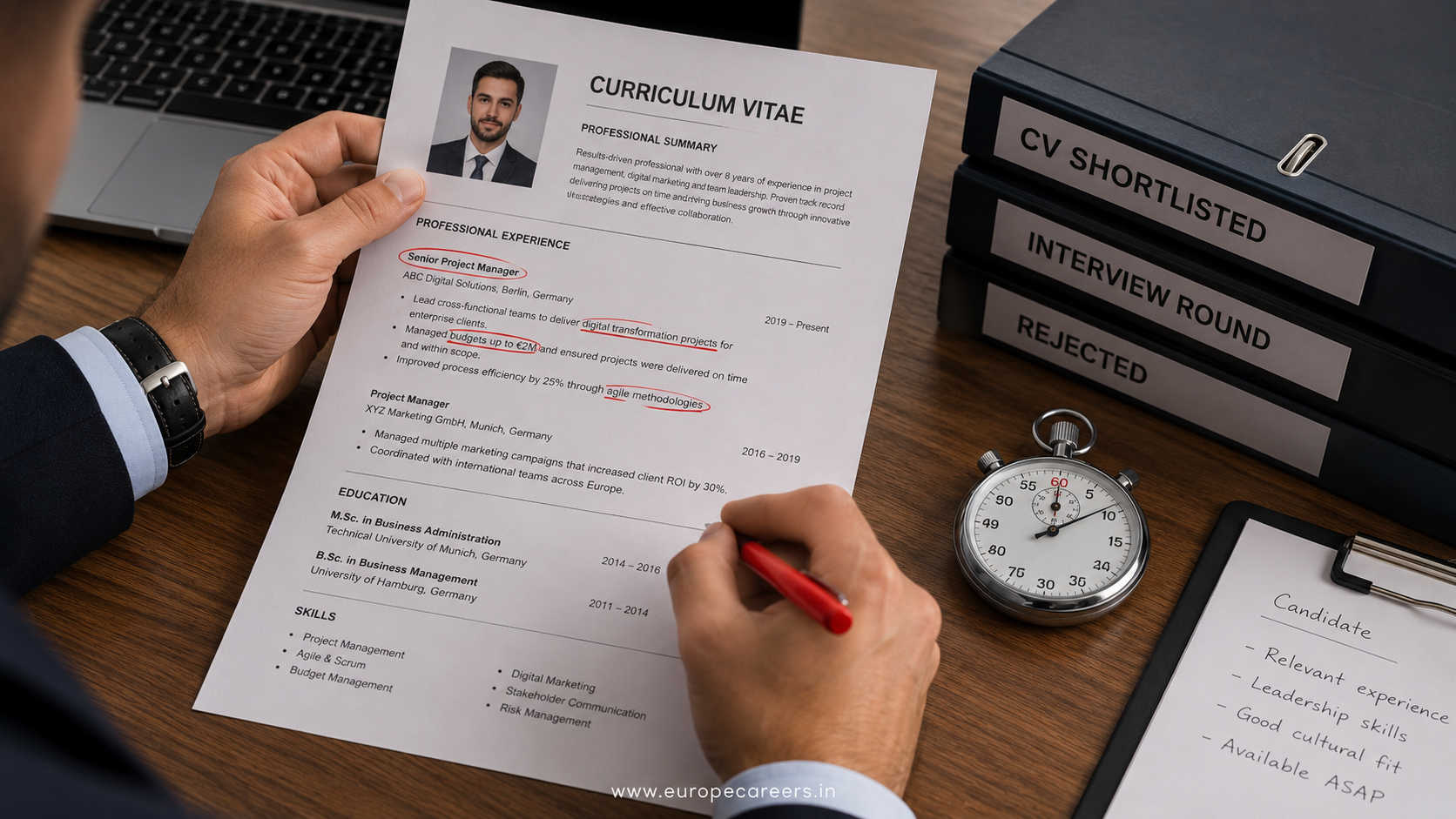
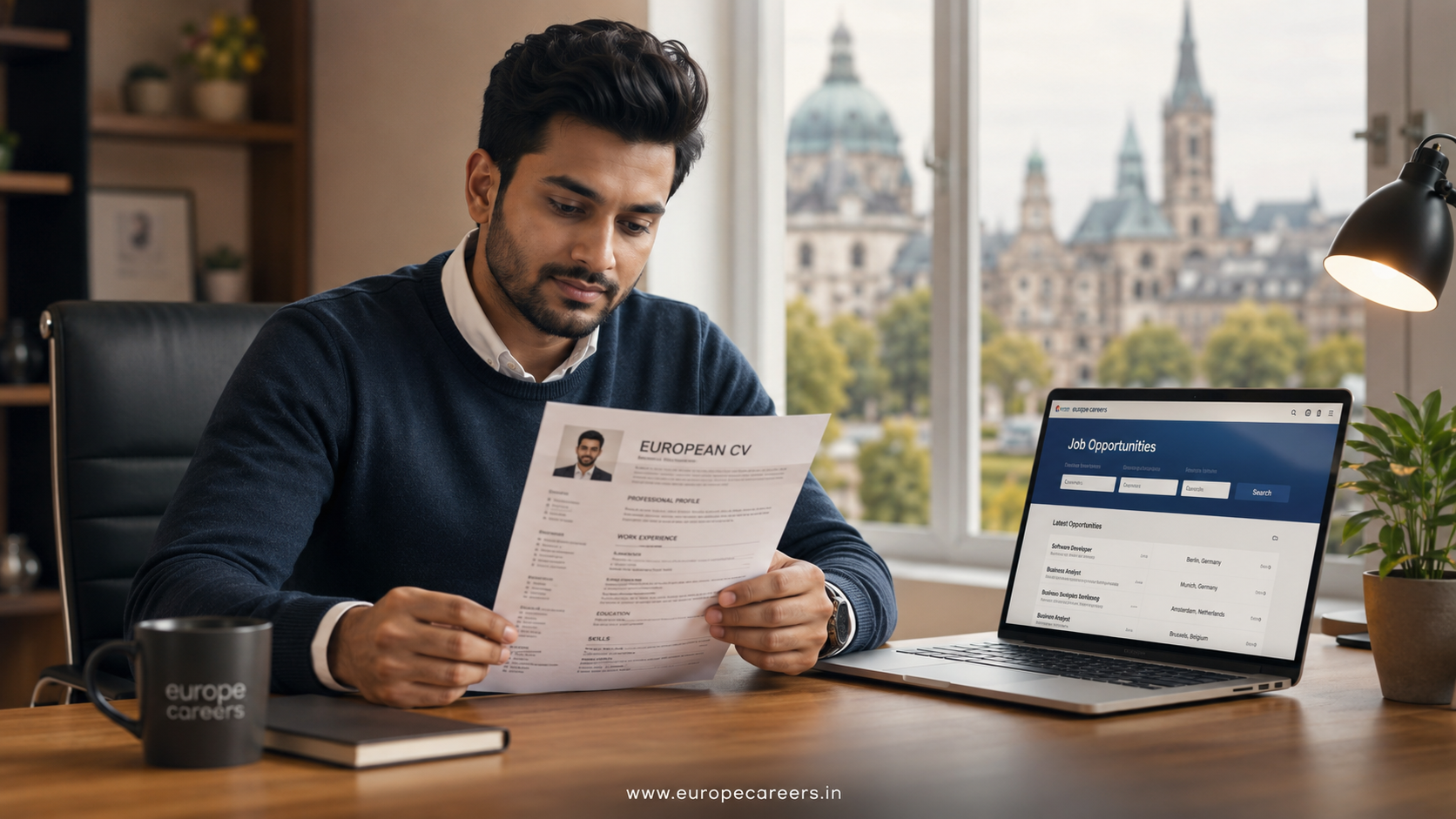 Many qualified Indian professionals fail to secure interviews not because they lack experience or skills but because their CV does not meet European hiring standards. Recruiters in Europe typically spend less than 10 seconds reviewing a CV before deciding whether to continue reading. A poorly structured resume, missing keywords, or an outdated format can significantly reduce your chances of being shortlisted.
European employers value professionalism, clarity, and relevance. They expect applicants to present their qualifications in a structured, concise, and easy-to-read format. In many companies, especially multinational organizations, your CV is first reviewed by an Applicant Tracking System (ATS) before it reaches a recruiter. If your CV isn’t optimized for these systems, it may never be seen by a hiring manager.
This comprehensive guide explains everything you need to know about creating a European-standard CV in 2026. Whether you are a nurse, doctor, warehouse worker, engineer, IT professional, hospitality employee, skilled tradesperson, or recent graduate, you’ll learn how to create a CV that meets employer expectations and improves your chances of securing a job in Europe.
By the end of this guide, you’ll understand:
- The difference between an Indian resume and a European CV
- The ideal European CV structure
- ATS-friendly formatting techniques
- Country-specific CV preferences
- Common mistakes to avoid
- Tips to increase your interview success rate
If you’re planning to build your career in Europe, this guide will help you create a professional CV that makes a strong first impression.
Why Your CV Is So Important in Europe
 Your CV is much more than a summary of your education and work experience. It serves as your professional introduction and often determines whether you move forward in the hiring process.
Unlike informal job applications, European employers rely heavily on structured documentation to evaluate candidates. Your CV demonstrates not only your qualifications but also your communication skills, attention to detail, and professionalism.
For international candidates, the CV becomes even more important because employers use it to assess whether you possess the required skills, work experience, certifications, language proficiency, and legal eligibility for the position.
A professionally written CV can:
- Increase interview invitations
- Improve ATS ranking
- Highlight relevant experience effectively
- Showcase international readiness
- Demonstrate career progression
- Build credibility with recruiters
A poorly written CV, on the other hand, may contain unnecessary information, inconsistent formatting, grammatical mistakes, or missing keywords, all of which reduce your chances of getting shortlisted.
How European Employers Review Your CV
 Understanding how recruiters evaluate applications can help you prepare a stronger CV.
Most companies receive hundreds of applications for a single vacancy. To manage this volume efficiently, recruiters spend only a few seconds scanning each CV during the initial review.
Typically, they look for:
- Relevant job title
- Total years of experience
- Industry background
- Technical skills
- Certifications
- Language proficiency
- Career progression
- Employment stability
- Educational qualifications
Many organizations also use ATS software to filter applications before a recruiter reviews them manually.
The ATS searches for specific keywords related to the job description. If your CV lacks these keywords or uses complex formatting that the system cannot read, it may be rejected automatically.
This is why keyword optimization is just as important as professional formatting.
What Is a European CV?
A European CV is a professional document designed according to hiring standards commonly followed across European countries.
Unlike resumes used in some other regions, European CVs focus on presenting factual information in a clear, structured, and organized manner.
A standard European CV generally includes:
- Personal information
- Professional summary
- Work experience
- Education
- Technical skills
- Soft skills
- Language proficiency
- Certifications
- Professional memberships
- References (only if requested)
Depending on the country and employer, some candidates may also include a professional photograph, LinkedIn profile, or portfolio link.
Difference Between an Indian Resume and a European CV
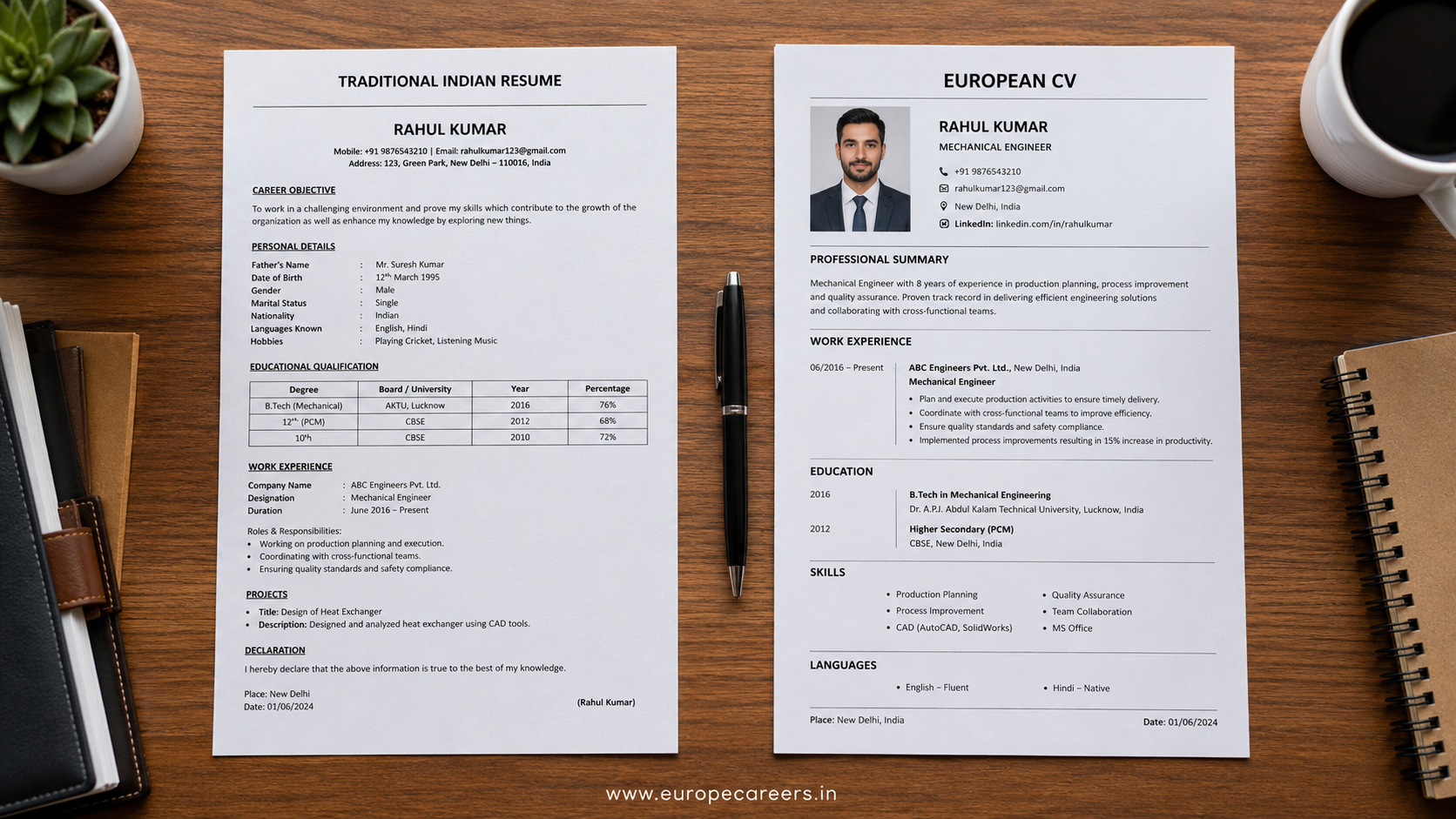
Although both documents serve the same purpose, there are several important differences between an Indian resume and a European CV.
| Feature | Indian Resume | European CV |
|---|---|---|
| Length | 2–4 pages | 1–2 pages preferred |
| Layout | Flexible | Structured and professional |
| Keywords | Often ignored | Extremely important |
| ATS Compatibility | Less common | Highly important |
| Professional Summary | Optional | Strongly recommended |
| Language Skills | Sometimes omitted | Highly valued |
| Achievements | Limited | Encouraged |
| Tailored for Job | Sometimes | Expected for every application |
| Cover Letter | Optional | Frequently required |
European employers generally prefer concise documents that emphasize measurable achievements rather than lengthy job descriptions.
Why Many Indian Candidates Get Rejected
Thousands of highly skilled Indian professionals apply for European jobs every year. Unfortunately, many applications are rejected before the interview stage.
The most common reasons include:
Using an Outdated Resume Format
Many candidates continue using resume templates designed years ago. Modern European recruiters expect clean, professional layouts with proper spacing, headings, and organization.
Including Too Much Personal Information
European employers usually do not require details such as:
- Father’s name
- Mother’s name
- Religion
- Caste
- Marital status
- Passport number
- Aadhaar number
- PAN card
- Blood group
Adding unnecessary personal information can make your CV appear outdated.
Writing Long Paragraphs
Recruiters scan CVs quickly.
Large blocks of text reduce readability and make it difficult to identify important information.
Instead, use concise bullet points that clearly explain your responsibilities and achievements.
Not Customizing the CV
Submitting the same CV for every job application is one of the biggest mistakes applicants make.
Each vacancy has different requirements.
Your CV should be customized using relevant keywords from the job description.
Ignoring ATS Optimization
Many applicants use graphics, tables, icons, text boxes, or unusual fonts.
These elements may confuse ATS software, causing your application to be rejected before a recruiter reviews it.
Industries Hiring International Professionals in Europe
European employers continue to experience labour shortages across multiple sectors, creating strong opportunities for qualified international candidates.
Some of the most in-demand industries include:
| Industry | Popular Roles |
| Healthcare | Nurses, Doctors, Caregivers, Physiotherapists |
| Manufacturing | Production Workers, Machine Operators, Quality Inspectors |
| Warehouse & Logistics | Warehouse Associates, Forklift Operators, Order Pickers |
| Hospitality | Chefs, Waiters, Housekeeping Staff, Hotel Receptionists |
| Construction | Electricians, Welders, Plumbers, Carpenters |
| Engineering | Mechanical, Electrical, Civil and Industrial Engineers |
| Information Technology | Software Developers, Cybersecurity Specialists, Data Analysts |
| Automotive | CNC Operators, Assembly Workers, Maintenance Technicians |
A professional European-standard CV significantly improves your chances of being shortlisted across these industries.
Benefits of Creating a European-Standard CV
Investing time in preparing a professional CV offers several advantages.
Higher Interview Success Rate
Recruiters immediately recognize candidates who understand European hiring standards.
Better ATS Performance
Proper formatting and keyword optimization increase your chances of passing automated screening systems.
Stronger Professional Image
A clean and organized CV reflects professionalism and attention to detail.
Improved International Opportunities
A well-prepared CV can be used to apply for jobs across multiple European countries with minor modifications.
Increased Recruiter Confidence
When your CV clearly demonstrates your qualifications, employers are more likely to contact you for interviews.
What You’ll Learn in This Complete Guide
In the next sections of this guide, you’ll learn:
- The ideal European CV structure
- How to write each section effectively
- What recruiters expect to see
- ATS-friendly formatting tips
- How to create an impressive professional summary
- How to describe your work experience
- Which skills to highlight
- How to showcase certifications and language proficiency
- Europass CV vs. custom CV
- Country-specific CV preferences
- Common mistakes that lead to rejection
- A complete European CV sample
- Cover letter writing tips
- Frequently asked questions about European CVs
By following these best practices, you’ll be able to create a CV that meets modern European recruitment standards and improves your chances of securing interviews with employers across Europe.
Coming Up in Part 2
In the next part, we’ll cover the complete European CV format step by step, including:
- Personal Information
- Professional Summary
- Work Experience
- Education
- Skills
- Language Proficiency
- Certifications
- ATS Formatting Tips
- Best Fonts and Layout
- Professional CV Design Guidelines
Complete European CV Format (Step-by-Step Guide)
 A well-organized CV allows recruiters to quickly identify your qualifications and suitability for the role. Unlike traditional resumes that often contain unnecessary information, a European CV focuses on relevant experience, measurable achievements, and clear presentation.
Whether you’re applying for warehouse jobs in Poland, nursing jobs in Germany, engineering roles in the Czech Republic, or hospitality positions in Ireland, the following structure is widely accepted by European employers.
The Ideal Structure of a European CV
A professional European CV should generally include the following sections:
- Contact Information
- Professional Summary
- Work Experience
- Education
- Technical Skills
- Soft Skills
- Language Proficiency
- Certifications & Licenses
- Professional Memberships (Optional)
- Projects or Achievements (Optional)
- References (If Requested)
Keeping your CV to one or two pages is recommended unless the employer specifically asks for more detailed information.
1. Contact Information
Your contact details should appear at the top of the first page. Recruiters should be able to reach you easily without searching through the document.
Include:
- Full Name
- Mobile Number (with country code)
- Professional Email Address
- Current City and Country
- LinkedIn Profile (Optional)
- Portfolio or GitHub (for IT and creative roles)
Example
Mayank Pal
Phone: +91 98765 43210
Email: mayank.pal@email.com
Location: Kanpur, India
LinkedIn: linkedin.com/in/mayankpal
Avoid Including
European employers generally do not require:
- Father’s Name
- Mother’s Name
- Religion
- Caste
- Aadhaar Number
- PAN Card
- Passport Number
- Blood Group
- Marital Status (unless specifically requested)
Adding unnecessary information can make your CV look outdated.
2. Write a Strong Professional Summary
The Professional Summary is one of the first sections recruiters read. It should quickly explain who you are, what experience you have, and why you’re suitable for the position.
Keep it between 4 and 6 lines.
Good Example (Warehouse Worker)
Experienced Warehouse Associate with over five years of experience in inventory management, order picking, packaging, and forklift operations. Skilled in maintaining warehouse safety standards, inventory accuracy, and timely dispatch of goods. Seeking an employer-sponsored opportunity in Europe to contribute to efficient warehouse operations.
Good Example (Nurse)
Registered Nurse with six years of clinical experience in emergency care, ICU, and general wards. Experienced in patient care, medication administration, infection control, and electronic health records. Committed to delivering high-quality healthcare and pursuing a nursing career in Europe.
Good Example (Mechanical Engineer)
Mechanical Engineer with eight years of experience in manufacturing, preventive maintenance, quality assurance, and production optimization. Strong knowledge of CAD software, Lean Manufacturing, and industrial safety standards.
3. Work Experience
This section carries the most weight during recruitment.
Always list your work experience in reverse chronological order, starting with your latest employer.
For each job, include:
- Job Title
- Company Name
- Location
- Employment Period
- Key Responsibilities
- Achievements
Example
Warehouse Operator
ABC Logistics Pvt. Ltd., Noida, India
January 2021 – Present
Responsibilities
- Managed daily warehouse operations involving over 5,000 products.
- Performed inventory counting and stock reconciliation.
- Operated forklifts and pallet trucks safely.
- Coordinated order picking and packaging.
- Maintained warehouse cleanliness according to safety regulations.
Achievements
- Improved order accuracy from 94% to 99%.
- Reduced dispatch delays by 18%.
- Received Employee of the Month award twice.
Recruiters value measurable achievements more than generic responsibilities.
Use Action Verbs
Instead of writing:
- Responsible for inventory
Write:
- Managed inventory
- Coordinated warehouse operations
- Supervised production
- Improved efficiency
- Reduced errors
- Implemented quality checks
- Trained new employees
- Increased productivity
Strong action verbs make your CV more impactful.
4. Education
List your education in reverse chronological order.
Include:
- Qualification
- Institution
- City
- Graduation Year
Example:
Bachelor of Science in Nursing
King George’s Medical University
Lucknow, India
2020
Example:
Diploma in Mechanical Engineering
Government Polytechnic Kanpur
2018
Should You Mention Grades?
Mention grades only if:
- You’re a recent graduate.
- The employer requests them.
- Your academic performance is particularly strong.
Otherwise, your work experience should take priority.
5. Technical Skills
Recruiters often scan this section quickly.
Use bullet points rather than paragraphs.
Warehouse Worker
- Inventory Management
- Forklift Operation
- Barcode Scanner
- RF Scanner
- SAP Warehouse Module
- Order Picking
- Packaging
- Stock Control
Nurse
- Patient Care
- ICU Experience
- Emergency Nursing
- Medication Administration
- Electronic Medical Records
- Infection Control
- IV Cannulation
- Basic Life Support (BLS)
Engineer
- AutoCAD
- SolidWorks
- PLC
- Lean Manufacturing
- Six Sigma
- Quality Control
- Preventive Maintenance
- Root Cause Analysis
6. Soft Skills
European employers value interpersonal skills as much as technical expertise.
Common examples include:
- Communication
- Teamwork
- Leadership
- Problem Solving
- Time Management
- Adaptability
- Customer Service
- Critical Thinking
- Attention to Detail
- Decision Making
Avoid rating yourself (for example, “Leadership: 10/10”). Simply list relevant skills.
7. Language Proficiency
Language ability is a major advantage when applying for jobs in Europe.
List every language you know and indicate your proficiency.
Example:
English – Fluent
German – B1 (Goethe Certified)
Hindi – Native
Polish – Beginner (A1)
If you have an internationally recognized language certificate such as Goethe, IELTS, TOEFL, or TELC, include it in this section or under certifications.
8. Certifications and Professional Licenses
Professional certifications strengthen your CV and demonstrate your commitment to continuous learning.
Examples include:
Healthcare
- BLS
- ACLS
- Nursing Registration
- Infection Control Training
Engineering
- AutoCAD Certification
- Six Sigma Green Belt
- ISO Internal Auditor
- OSHA Safety Training
Warehouse
- Forklift Operator License
- SAP Warehouse Management Training
- Occupational Health and Safety
- Inventory Management Certification
Mention the issuing organization and the year of completion whenever possible.
9. Professional Achievements
If you have notable accomplishments, create a dedicated section.
Examples:
- Reduced warehouse inventory errors by 30%.
- Increased production output by 20%.
- Managed a team of 40 employees.
- Successfully completed 500+ patient procedures.
- Led a quality improvement project that reduced defects by 15%.
Quantifiable achievements make your CV more persuasive.
10. Hobbies and Interests (Optional)
Some European employers appreciate a brief section on hobbies if they reflect positive personal qualities.
Examples:
- Volunteering
- Marathon Running
- Reading Business Books
- Photography
- Cycling
- Community Service
- Learning Foreign Languages
Avoid mentioning controversial topics such as politics or religion.
Best Fonts for a European CV
Choose professional, easy-to-read fonts.
Recommended fonts:
- Calibri
- Arial
- Aptos
- Helvetica
- Verdana
Use a font size between 10 and 12 points for body text and 14 to 16 points for headings.
CV Formatting Tips
To create a professional-looking CV:
- Keep margins consistent.
- Use bold headings for each section.
- Maintain uniform spacing throughout.
- Use bullet points instead of long paragraphs.
- Save the file as a PDF.
- Name the file professionally (e.g., Rahul_Sharma_Warehouse_CV.pdf).
- Ensure there are no spelling or grammar errors.
- Limit the CV to one or two pages.
Checklist Before Sending Your CV
Before submitting your application, review the following checklist:
Checklist Item Status Professional contact information ✓ Clear professional summary ✓ Relevant work experience ✓ Updated education details ✓ Technical skills listed ✓ Soft skills included ✓ Language proficiency mentioned ✓ Certifications added ✓ ATS-friendly formatting ✓ Saved as PDF ✓ Proofread for errors ✓ Completing this checklist can significantly improve the quality of your application and increase your chances of getting shortlisted by European employers.
ATS-Friendly CV, Europass CV & Country-Wise CV Preferences
Creating a professional-looking CV is only half the battle. In today’s recruitment process, your CV must first pass through an Applicant Tracking System (ATS) before it reaches a recruiter. Many qualified candidates are rejected automatically because their CVs are not optimized for these systems.
In this section, you’ll learn how ATS software works, how to create an ATS-friendly CV, when to use a Europass CV, and what employers in different European countries expect from applicants.
What Is an Applicant Tracking System (ATS)?
An Applicant Tracking System (ATS) is recruitment software that helps employers manage and screen job applications. Large companies and international recruitment agencies receive hundreds or even thousands of applications for a single vacancy. Instead of reviewing every CV manually, they use ATS software to filter candidates based on predefined criteria.
The ATS scans your CV for:
- Relevant job titles
- Industry-specific keywords
- Skills
- Work experience
- Education
- Certifications
- Language proficiency
- Employment history
Only the most relevant applications are shortlisted for recruiter review.
Why ATS Matters for European Jobs
Many employers across Europe use ATS platforms to simplify hiring and reduce the time spent reviewing applications.
If your CV is not ATS-compatible, it may never be seen by a recruiter—even if you have the right qualifications and experience.
An ATS-friendly CV increases your chances of moving to the next stage of the hiring process by ensuring that your information is easy for the software to read and categorize.
How to Make Your CV ATS-Friendly
Use Standard Section Headings
ATS software recognizes common headings. Use clear titles such as:
- Professional Summary
- Work Experience
- Education
- Skills
- Certifications
- Languages
Avoid creative headings like “My Journey” or “Career Highlights,” as some systems may not interpret them correctly.
Include Keywords from the Job Description
Read the job advertisement carefully and identify frequently used terms.
For example, if a warehouse job mentions:
- Inventory Management
- RF Scanner
- Forklift Operation
- Order Picking
- SAP Warehouse Management
Include these exact terms in your CV if they accurately reflect your experience.
Using relevant keywords improves your ATS score and increases your chances of being shortlisted.
Keep the Layout Simple
ATS software performs best with straightforward formatting.
Use:
- Standard fonts (Arial, Calibri, Aptos, Helvetica)
- Black text
- Clear headings
- Bullet points
- Consistent spacing
Avoid:
- Tables
- Text boxes
- Icons
- Graphics
- Images
- Complex designs
- Multiple columns
Although these elements may look attractive, they can confuse ATS software.
Save Your CV in the Correct Format
Unless the employer specifies otherwise, submit your CV as a PDF.
Some employers may request a Microsoft Word document (.docx), so always read the application instructions carefully.
Use Reverse Chronological Order
Always list your most recent work experience first, followed by previous positions.
This is the format preferred by most European employers and ATS systems.
ATS-Friendly Example
Instead of writing:
“Worked in warehouse.”
Write:
- Managed warehouse inventory for more than 8,000 products.
- Performed order picking using RF scanners.
- Operated forklifts while following safety regulations.
- Coordinated packaging and dispatch activities.
- Maintained inventory accuracy above 99%.
Specific descriptions with relevant keywords improve your ATS performance.
What Is a Europass CV?
The Europass CV is a standardized resume format developed by the European Union to help candidates present their qualifications consistently across member countries.
It is one of the most recognized CV formats in Europe and is available in multiple languages.
The Europass format includes sections for:
- Personal Information
- Professional Summary
- Work Experience
- Education
- Skills
- Digital Competencies
- Language Proficiency
- Certifications
- Additional Information
Advantages of a Europass CV
Using a Europass CV offers several benefits:
- Recognized across Europe
- Professional appearance
- Easy to create
- Suitable for international applications
- Standardized structure
- Available in multiple languages
- Widely accepted by educational institutions and some government organizations
Disadvantages of a Europass CV
While useful, the Europass CV isn’t always the best choice.
Some employers prefer customized CVs because they:
- Look more personalized
- Highlight achievements more effectively
- Can be tailored for specific jobs
- Stand out from other applications
For private companies, a customized ATS-friendly CV is often a better option.
Europass CV vs. Custom CV
Feature Europass CV Custom CV Standardized Format Yes No ATS Friendly Yes Yes Easy to Create Yes Moderate Customizable Limited High Accepted Across Europe Yes Yes Better for Private Companies Sometimes Usually Highlights Personal Branding Limited Strong For most professionals applying to private employers, a customized European CV tailored to the job description generally provides better results.
Country-Wise CV Preferences in Europe
Although the overall structure of a European CV is similar across countries, there are small differences in employer expectations.
Germany
German employers prefer:
- Professional formatting
- Detailed work experience
- Clear career progression
- Relevant certifications
- German language proficiency (if applicable)
A professional passport-style photo is still accepted by many employers, although it is becoming less common.
Supporting documents such as certificates, recommendation letters, and educational transcripts are often requested.
Poland
Polish employers typically prefer:
- One- or two-page CVs
- ATS-friendly formatting
- Strong technical skills
- English-language CVs unless otherwise requested
- Relevant work experience
Warehouse, manufacturing, logistics, and production roles often focus on practical experience rather than lengthy descriptions.
Romania
Romanian recruiters appreciate concise and well-organized CVs.
Applicants should emphasize:
- Technical skills
- Professional experience
- Foreign language abilities
- Certifications
For international workers, English-language CVs are commonly accepted.
Hungary
Hungarian employers usually expect:
- Professional summaries
- Clear employment history
- Technical competencies
- Industry certifications
- Language skills
Candidates applying for manufacturing or automotive positions should highlight production targets, quality standards, and safety procedures.
Slovakia
Slovakia has a strong manufacturing and automotive sector.
Recruiters often prioritize:
- Machine operation experience
- Production line work
- Technical certifications
- Shift work experience
- Industrial safety knowledge
Achievements related to productivity and quality improvement are highly valued.
Czech Republic
Employers in the Czech Republic generally prefer concise, ATS-friendly CVs with measurable achievements.
Candidates should emphasize:
- Engineering skills
- Manufacturing experience
- Technical training
- Foreign language proficiency
- Software knowledge
Netherlands
Dutch employers usually prefer:
- Simple design
- One- or two-page CV
- Clear achievements
- Strong communication skills
- English proficiency
Photos are generally not required.
Ireland
Irish recruiters value:
- Relevant work experience
- Professional summaries
- Quantifiable achievements
- Soft skills
- Industry certifications
Applicants should focus on accomplishments rather than simply listing responsibilities.
Belgium
Belgian employers appreciate:
- Well-structured formatting
- Language proficiency
- International experience
- Professional certifications
Depending on the region, knowledge of French, Dutch, or German can be advantageous.
Austria
Austrian employers often expect:
- Formal presentation
- Complete employment history
- Qualifications and licenses
- Language skills
- Professional appearance
Including a passport-style photo is still relatively common in some industries.
Common CV Mistakes That Lead to Rejection
Many otherwise qualified candidates fail to secure interviews because of avoidable mistakes.
Using the Same CV for Every Job
Every job has unique requirements.
Tailor your CV by incorporating relevant keywords and emphasizing the experience most applicable to the position.
Including Irrelevant Information
Avoid adding:
- Religion
- Political affiliation
- Aadhaar number
- PAN number
- Family details
- Salary expectations (unless requested)
Keep the content focused on your professional qualifications.
Spelling and Grammar Errors
Even small mistakes can create a poor first impression.
Always proofread your CV carefully or ask someone else to review it before submission.
Writing Long Paragraphs
Recruiters prefer concise bullet points over lengthy text blocks.
Aim for clarity and readability.
Exaggerating Experience
Never include false qualifications or inflated job titles.
Most employers verify educational credentials, employment history, and professional licenses during the hiring process.
Honesty builds trust and protects your professional reputation.
Using an Unprofessional Email Address
Avoid email addresses such as:
Instead, use a professional format such as:
Expert Tips to Increase Your Interview Calls
Follow these best practices to maximize your chances of getting shortlisted:
- Tailor your CV for each application.
- Match keywords from the job description.
- Highlight measurable achievements.
- Keep your CV to one or two pages.
- Use professional formatting and fonts.
- Include relevant certifications.
- Mention language proficiency clearly.
- Proofread carefully before sending.
- Save the file as a PDF unless instructed otherwise.
- Pair your CV with a customized cover letter.
A well-crafted, ATS-friendly CV demonstrates professionalism and makes it easier for recruiters to identify your strengths, increasing your chances of receiving interview invitations from employers across Europe.
European CV Sample, Cover Letter & Documents Required
After creating an ATS-friendly CV, the next step is submitting a complete and professional job application. Most European employers expect more than just a CV. Depending on the role and country, you may also need a cover letter, educational certificates, professional licenses, language certificates, and other supporting documents.
This section provides practical CV examples, explains how to write an effective cover letter, and lists the documents commonly required when applying for jobs across Europe.
European CV Sample Format
Below is a simple European CV structure suitable for most industries.
Personal Information
Rahul Sharma
Mobile: +91 98765 43210
Email: rahul.sharma@email.com
Location: Kanpur, Uttar Pradesh, India
LinkedIn: linkedin.com/in/rahulsharma
Professional Summary
Experienced Warehouse Associate with over five years of expertise in warehouse operations, inventory management, order picking, packaging, and forklift operation. Proven ability to maintain inventory accuracy, improve dispatch efficiency, and follow international safety standards. Seeking an employer-sponsored opportunity to contribute to warehouse operations in Europe.
Work Experience
Warehouse Associate
ABC Logistics Pvt. Ltd.
Noida, India
January 2021 – Present
Responsibilities
- Managed inventory for more than 8,000 products.
- Operated forklifts safely according to warehouse procedures.
- Performed order picking using barcode scanners.
- Coordinated packing and dispatch of customer orders.
- Maintained warehouse cleanliness and safety.
Achievements
- Increased inventory accuracy to 99%.
- Reduced dispatch delays by 20%.
- Trained five new warehouse employees.
Warehouse Assistant
XYZ Supply Chain Pvt. Ltd.
Lucknow, India
June 2018 – December 2020
- Received and inspected incoming shipments.
- Maintained stock records.
- Assisted with loading and unloading goods.
- Prepared shipping documentation.
Education
Diploma in Logistics Management
ABC Institute
Lucknow, India
2018
Technical Skills
- Warehouse Operations
- Inventory Control
- RF Scanner
- Barcode Scanner
- Forklift Operation
- SAP Warehouse Management
- Packaging
- Dispatch Planning
Soft Skills
- Teamwork
- Communication
- Problem Solving
- Time Management
- Adaptability
- Attention to Detail
Languages
English – Fluent
Hindi – Native
German – A2
Certifications
Forklift Operator Certification
Occupational Safety Training
SAP Warehouse Basics
Sample Professional Summary for Different Professions
Warehouse Worker
Warehouse professional with five years of experience in logistics, inventory control, order picking, packaging, and dispatch operations. Skilled in warehouse management systems and committed to maintaining safety and operational efficiency.
Registered Nurse
Compassionate Registered Nurse with six years of experience in ICU, emergency care, and general medicine. Experienced in patient assessment, medication administration, infection prevention, and multidisciplinary collaboration. Seeking nursing opportunities with European healthcare providers.
Mechanical Engineer
Mechanical Engineer with eight years of experience in manufacturing, preventive maintenance, quality assurance, and process optimization. Proficient in AutoCAD, Lean Manufacturing, and industrial safety practices.
Hotel Professional
Customer-focused hospitality professional with extensive experience in front office operations, guest services, reservations, and complaint resolution. Dedicated to delivering exceptional guest experiences while maintaining high service standards.
How to Write a European Cover Letter
A cover letter introduces you to the employer and explains why you are applying for the role.
While your CV focuses on qualifications and experience, your cover letter highlights your motivation and suitability for the position.
Most European employers appreciate receiving both documents.
Structure of a Professional Cover Letter
Your cover letter should include:
- Your contact information
- Employer details
- Greeting
- Introduction
- Why you are suitable
- Why you want to join the company
- Closing statement
- Signature
Keep it to one page.
Sample Cover Letter
Dear Hiring Manager,
I am writing to express my interest in the Warehouse Associate position advertised by your company. With over five years of experience in warehouse operations, inventory management, order picking, and forklift operation, I am confident that I can contribute effectively to your logistics team.
Throughout my career, I have maintained high inventory accuracy, ensured timely order dispatch, and followed workplace safety procedures. I am comfortable working in fast-paced environments and collaborating with multicultural teams.
I am excited about the opportunity to work in Europe and further develop my professional skills while contributing to your organization’s success.
Thank you for considering my application. I look forward to discussing how my experience aligns with your requirements.
Yours sincerely,
Rahul Sharma
Documents Required for European Job Applications
Most employers request supporting documents in addition to your CV.
The exact requirements vary by country and profession, but commonly requested documents include:
Document Purpose Updated CV Professional profile Cover Letter Application introduction Passport Identity verification Educational Certificates Qualification proof Experience Certificates Employment verification Professional Licenses Industry-specific requirements Language Certificates Proof of language skills Training Certificates Additional qualifications Recommendation Letters Employer references Passport-Size Photograph Required by some employers Always scan documents clearly and save them as PDF files.
Naming Your Files Professionally
Avoid file names such as:
- CV Final Final.pdf
- Resume Latest 3.pdf
- New Resume Updated.pdf
Instead use professional names like:
Rahul_Sharma_CV.pdf
Rahul_Sharma_Cover_Letter.pdf
Rahul_Sharma_Degree_Certificate.pdf
Professional file names make your application organized and easier for recruiters to manage.
How to Email Your CV to European Employers
Your email should be short, professional, and polite.
Sample Email
Subject: Application for Warehouse Associate Position
Dear Hiring Manager,
Please find attached my CV and cover letter for the Warehouse Associate position.
I have more than five years of experience in warehouse operations and would appreciate the opportunity to contribute to your organization.
Thank you for your time and consideration. I look forward to hearing from you.
Kind regards,
Rahul Sharma
Job Application Checklist
Before applying, ensure that your application includes:
✓ Updated ATS-friendly CV
✓ Professional cover letter
✓ Educational certificates
✓ Experience certificates
✓ Passport copy
✓ Language certificates (if available)
✓ Professional licenses
✓ Recommendation letters (if available)
✓ Correct file names
✓ PDF format
✓ No spelling or grammar mistakes
Interview Preparation Tips After Sending Your CV
Receiving an interview invitation is just the beginning. Proper preparation can significantly improve your chances of success.
Here are some practical tips:
- Research the company before the interview.
- Review the job description carefully.
- Be ready to discuss your work experience with examples.
- Prepare answers to common interview questions.
- Practice introducing yourself confidently.
- Keep your documents organized and accessible.
- Dress professionally for online and in-person interviews.
- Test your internet connection if attending a virtual interview.
- Be punctual and maintain a positive attitude.
Employers value candidates who are well-prepared, professional, and genuinely interested in the role.
Final Tips Before Applying
A professional CV alone does not guarantee success. The most successful applicants combine a well-written CV with a tailored cover letter, complete supporting documents, and thorough interview preparation.
Remember these key points:
- Customize your CV for every job application.
- Use measurable achievements instead of generic responsibilities.
- Highlight skills relevant to the job description.
- Keep your formatting clean and ATS-friendly.
- Proofread every document before submitting it.
- Follow the employer’s application instructions carefully.
Taking the time to prepare a complete, professional application package can significantly improve your chances of securing interviews and employer-sponsored opportunities across Europe.
Expert Tips, Europe Careers Support, Conclusion & SEO FAQs
A professionally written CV is one of the most valuable investments you can make in your international career. It is often the first impression a recruiter has of you, and in many cases, it determines whether you are invited for an interview.
However, a strong CV alone is not enough. Success in the European job market requires careful preparation, accurate documentation, language skills where required, and a strategic approach to job applications.
This final section shares expert recommendations to improve your chances of getting hired, explains how Europe Careers supports candidates, and answers the most common questions about European CVs.
Expert Tips to Increase Your Chances of Getting Hired in Europe
Thousands of candidates apply for European jobs every month. Employers receive applications from different countries, making competition strong. The following best practices can help your application stand out.
1. Tailor Your CV for Every Job
Avoid sending the same CV to every employer.
Study the job description carefully and include relevant skills, responsibilities, certifications, and keywords that match the vacancy. A customized CV demonstrates genuine interest and improves your chances of passing ATS screening.
2. Focus on Achievements, Not Just Responsibilities
Recruiters are interested in the results you’ve delivered.
Instead of writing:
- Responsible for warehouse operations.
Write:
- Improved inventory accuracy from 95% to 99%.
- Reduced order processing time by 18%.
- Trained 12 new warehouse associates.
Measurable achievements make your CV more persuasive.
3. Keep Your Skills Updated
Continuous learning is highly valued by European employers.
Consider earning certifications in:
- Occupational Health & Safety
- Lean Manufacturing
- Six Sigma
- SAP
- Project Management
- Digital Skills
- Language Proficiency
- Industry-specific software
Adding recent certifications shows your commitment to professional growth.
4. Learn the Local Language
Although many multinational companies operate in English, knowledge of the local language can significantly improve your employment opportunities.
For example:
- German for Germany and Austria
- Polish for Poland
- Czech for the Czech Republic
- Slovak for Slovakia
- Hungarian for Hungary
Even achieving an A1 or A2 level demonstrates motivation and adaptability.
5. Maintain a Professional Online Presence
Many recruiters review candidates’ online profiles before scheduling interviews.
Ensure that:
- Your LinkedIn profile matches your CV.
- Your profile photo is professional.
- Your employment history is accurate.
- Your contact information is up to date.
- Your profile highlights key achievements and certifications.
A complete online profile strengthens your credibility.
6. Prepare for Interviews
Receiving an interview invitation is a positive sign, but preparation is essential.
Before your interview:
- Research the company.
- Understand the job description.
- Practice answering common interview questions.
- Prepare examples of your achievements.
- Test your internet connection for online interviews.
- Keep your documents ready.
Confidence and preparation often leave a lasting impression.
How Europe Careers Can Help
Applying for jobs in Europe involves much more than creating a CV. Candidates often need guidance with documentation, language preparation, employer communication, and visa procedures.
Europe Careers supports professionals throughout their international recruitment journey.
Our services include:
Professional CV Preparation
Our recruitment experts help candidates create ATS-friendly, European-standard CVs tailored to specific industries and job roles.
Profile Evaluation
We review your education, work experience, certifications, and career goals to recommend suitable opportunities across Europe.
Interview Preparation
Receive guidance on:
- HR interviews
- Technical interviews
- Video interviews
- Employer expectations
- Professional communication
Job Matching
Based on your qualifications and experience, we connect you with suitable employer-sponsored opportunities in sectors such as:
- Healthcare
- Warehouse & Logistics
- Manufacturing
- Hospitality
- Construction
- Engineering
- Skilled Trades
- Information Technology
Documentation Assistance
We assist with preparing and organizing documents such as:
- Educational certificates
- Experience letters
- Professional licenses
- Language certificates
- Passport documentation
Visa Guidance
Our team provides information on work visa documentation, employer requirements, and relocation preparation to help candidates understand the application process.
Final Checklist Before Applying for Jobs in Europe
Before submitting your application, review this checklist:
Task Complete ATS-friendly CV prepared ✓ Professional summary updated ✓ Relevant keywords included ✓ Cover letter customized ✓ Educational certificates ready ✓ Experience letters available ✓ Language certificates attached (if applicable) ✓ Professional email address used ✓ CV saved as PDF ✓ Documents proofread ✓ Completing this checklist improves the professionalism of your application and reduces the likelihood of avoidable mistakes.
Conclusion
A well-crafted European CV is more than a document—it is your personal marketing tool. It communicates your experience, skills, and professionalism to employers before you have the opportunity to speak with them.
Understanding European recruitment standards, optimizing your CV for Applicant Tracking Systems (ATS), and tailoring each application to the specific role can significantly improve your chances of securing interviews.
Whether you are applying for positions in healthcare, engineering, logistics, hospitality, manufacturing, or skilled trades, investing time in preparing a high-quality CV is an important step toward achieving your career goals.
As Europe’s demand for skilled professionals continues to grow, candidates who present themselves professionally will be better positioned to take advantage of international employment opportunities.
Start by creating a CV that reflects your strengths, highlights your achievements, and meets the expectations of European employers.
Frequently Asked Questions (FAQs)
What is the ideal CV format for European employers?
A European CV should be well-structured, easy to read, ATS-friendly, and generally one to two pages long. It should include contact details, a professional summary, work experience, education, skills, certifications, and language proficiency.
How long should a European CV be?
Most employers prefer a CV that is one page for fresh graduates and up to two pages for experienced professionals.
Is the Europass CV accepted by European employers?
Yes. The Europass CV is recognized across Europe, especially by educational institutions and some public-sector organizations. However, many private companies prefer a customized CV tailored to the specific job.
Should I include a photograph on my CV?
Requirements vary by country. Some employers in Germany and Austria may accept a professional photo, while employers in countries such as Ireland and the Netherlands often prefer CVs without one.
What file format should I use?
PDF is the preferred format because it preserves the layout across different devices unless the employer specifically requests a Word document.
How important is ATS optimization?
Very important. Many employers use Applicant Tracking Systems to screen applications. An ATS-friendly CV improves your chances of reaching a recruiter.
Should I customize my CV for every job?
Yes. Tailoring your CV to the job description increases relevance and improves your chances of being shortlisted.
What is the biggest mistake applicants make?
Submitting the same generic CV for every application and failing to highlight measurable achievements.
Do I need a cover letter?
Many European employers prefer receiving a cover letter along with the CV, especially for professional and skilled roles.
Can Europe Careers help me prepare a European-standard CV?
Yes. Europe Careers provides guidance on CV preparation, profile evaluation, interview readiness, and job application support to help candidates meet European recruitment standards.
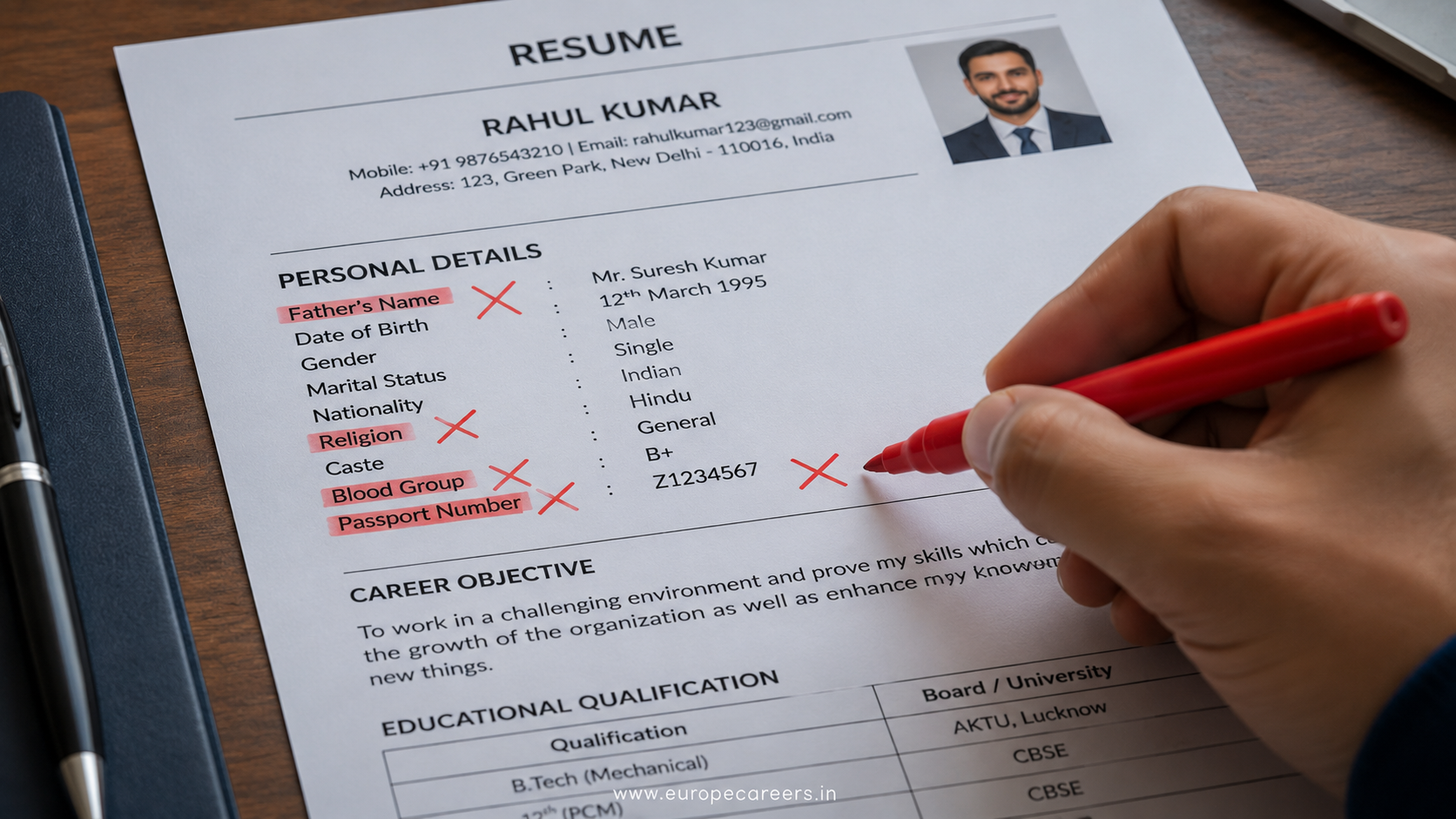 A well-organized CV allows recruiters to quickly identify your qualifications and suitability for the role. Unlike traditional resumes that often contain unnecessary information, a European CV focuses on relevant experience, measurable achievements, and clear presentation.