
Ausbildung in Germany — Age Limit & Degree Impact for International Students

What Is Ausbildung?
 international students who want to build a stable and successful career in Europe. With no strict age limit and flexible entry for degree holders, Ausbildung in Germany opens doors that a traditional university route often cannot. In this complete guide by EuropeCareers, we cover everything — age limits, degree impact, visa rules, salary, and how to apply.
Ausbildung is the German word for vocational training or apprenticeship. It is one of Germany’s most respected and structured pathways to skilled employment. Unlike a university degree, Ausbildung combines practical workplace training with theoretical classroom education — typically over a period of 2 to 3.5 years.
For international students and job seekers, Ausbildung offers a powerful route to legal employment, stable income, and long-term residency in Germany — even without a university degree.
Is There an Age Limit for Ausbildung in Germany?
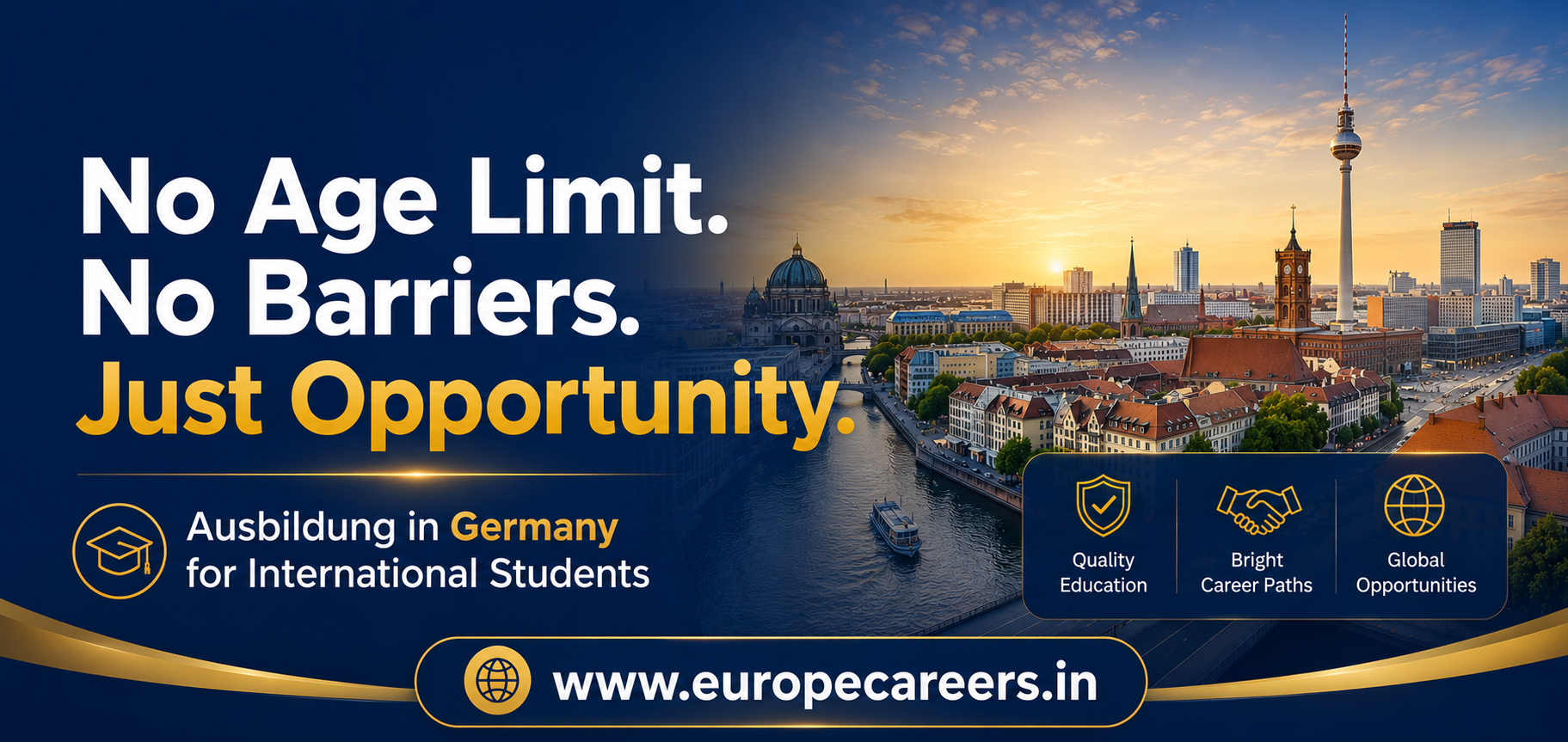 This is one of the most commonly asked questions — and the answer may surprise you.
Officially, there is no strict age limit for Ausbildung in Germany.
German law does not set a maximum age for starting an apprenticeship. However, in practice, age does play a role and here is what you need to know:
For German and EU Citizens
Most apprentices in Germany are between 16 and 25 years old. This is simply because the system is traditionally designed for school leavers entering the workforce for the first time.
For International Applicants (Non-EU)
The situation is more flexible than many people assume:
- Applicants aged 18 to 35 are commonly accepted by employers, especially in sectors facing skill shortages such as healthcare, hospitality, logistics, and construction
- Some employers accept applicants up to 40 years of age, particularly in caregiving and nursing professions
- The German government actively encourages Ausbildung for international adults as part of its skilled worker immigration strategy
Practical Considerations by Age
| Age Range | Outlook |
|---|---|
| 18 – 25 | Ideal age, widest range of opportunities |
| 26 – 30 | Very good, especially in high-demand sectors |
| 31 – 35 | Good, some employers may prefer younger candidates |
| 36 – 40 | Possible, mainly in care, nursing, and trades |
| 40+ | Challenging but not impossible, case by case |
Does Your Existing Degree Affect Ausbildung?
Yes — and this is a very important point for international applicants who already hold a bachelor’s, master’s, or other university degree.
1. You Are Still Eligible
Having a university degree does not disqualify you from doing an Ausbildung. Germany welcomes degree holders into vocational training, especially when their degree is from abroad and not easily recognised.
2. Your Training Duration May Be Shortened
This is one of the biggest advantages for degree holders. If your existing educational background or work experience is relevant to the Ausbildung field, you may apply for a shortened training period (Verkürzung).
- A standard Ausbildung lasts 2 to 3.5 years
- With a relevant degree or prior experience, it can be reduced to 1.5 to 2 years
- This must be agreed upon with the employer and the relevant Chamber (IHK or HWK)
3. Your Degree Field Matters
The impact of your degree on Ausbildung depends on how closely related it is to the training programme:
| Your Degree | Effect on Ausbildung |
|---|---|
| Same or related field | High chance of duration shortening |
| Partially related field | Possible partial shortening |
| Unrelated field | Full duration, but still eligible |
4. Ausbildung Can Complement a Degree
Many international graduates choose Ausbildung because their foreign degree has not received full Anerkennung (recognition) in Germany. In such cases, completing an Ausbildung gives them a German-recognised qualification, making them highly employable.
5. Dual Degree Advantage
Holding both a foreign university degree and a completed German Ausbildung makes you an exceptionally strong candidate in the German job market. Employers value the combination of academic knowledge and practical German training.
Which Ausbildung Programmes Are Most Open to International Adults?
 If you are an international applicant — especially above 25 years of age — these sectors are most welcoming:
- Nursing and Elderly Care (Pflege) — Extremely high demand, age-friendly
- Medical Assistant (MFA) — Growing need across Germany
- IT and Digital Professions — Younger field, welcomes diverse backgrounds
- Hospitality and Gastronomy — Flexible and internationally open
- Logistics and Warehouse Management — High volume of openings
- Construction and Trades (Handwerk) — Practical skills valued over age
Visa and Legal Eligibility for International Students
To do an Ausbildung in Germany as a non-EU national, you need:
- A recognised school leaving certificate (at least equivalent to German Hauptschulabschluss)
- Basic German language skills — usually B1 level minimum, B2 preferred
- A valid Ausbildungsvisum (Training Visa) — issued under Section 16a of the German Residence Act
- An Ausbildung contract signed with a German employer
During your Ausbildung, you receive a monthly training allowance (Ausbildungsvergütung) — typically between €1,200 and €1,800 depending on the sector and region.
Key Takeaways
- There is no official age limit for Ausbildung, but younger applicants have a wider range of opportunities
- International applicants aged 18 to 35 have the best chances across most sectors
- A university degree does not block you from doing Ausbildung — it can actually shorten your training period
- Ausbildung is an excellent alternative or complement to degree-based Anerkennung
- Germany actively needs skilled international workers and Ausbildung is one of the clearest legal pathways to build your career there
Let EuropeCareers Guide You
At EuropeCareers, we specialise in helping international professionals and students find the right Ausbildung programme in Germany — regardless of age or educational background. From matching you with the right employer to supporting your visa application and language preparation, we are with you every step of the way.