
Ausbildung in Austria for Foreigners 2026 — Complete Guide for Indian Students
Introduction
If you have been searching for a way to build a career in Europe without spending years in university or taking on massive student debt, Ausbildung in Austria might be exactly what you are looking for. It is one of Europe’s best-kept secrets for international students — a government-backed dual vocational training system where you earn a monthly salary while you learn, graduate with a state-recognised qualification, and have a direct path to permanent residency in the heart of the EU.
At EuropeCareers, we guide Indian students and young professionals through every stage of the Ausbildung process — from German language preparation and finding a training company to visa applications and settling in Austria. This article covers everything you need to know.
What Is Ausbildung? Understanding the System
 The word Ausbildung is German for vocational training or apprenticeship. In Austria, it refers to a formal dual training system where apprentices spend roughly 80% of their time training in a real company and 20% attending a part-time vocational school called the Berufsschule. The apprentice programme in Austria lasts between 2 and 4 years depending on the chosen apprenticeship, and is completed with a final apprenticeship examination. There are currently around 200 commercial, industrial, and service-oriented apprenticeships covering all areas of the economy, from optometry and baking to electrical engineering, district heating technology, retail, and process engineering. Work in Austria
This is fundamentally different from a university degree. You are not a student sitting in a classroom for four years. You are an employee from day one — contributing to real work, building real skills, getting paid every month, and earning a qualification that is recognised across Austria, Germany, and the broader EU.
Is Ausbildung in Austria Open to Foreigners and Indian Students?
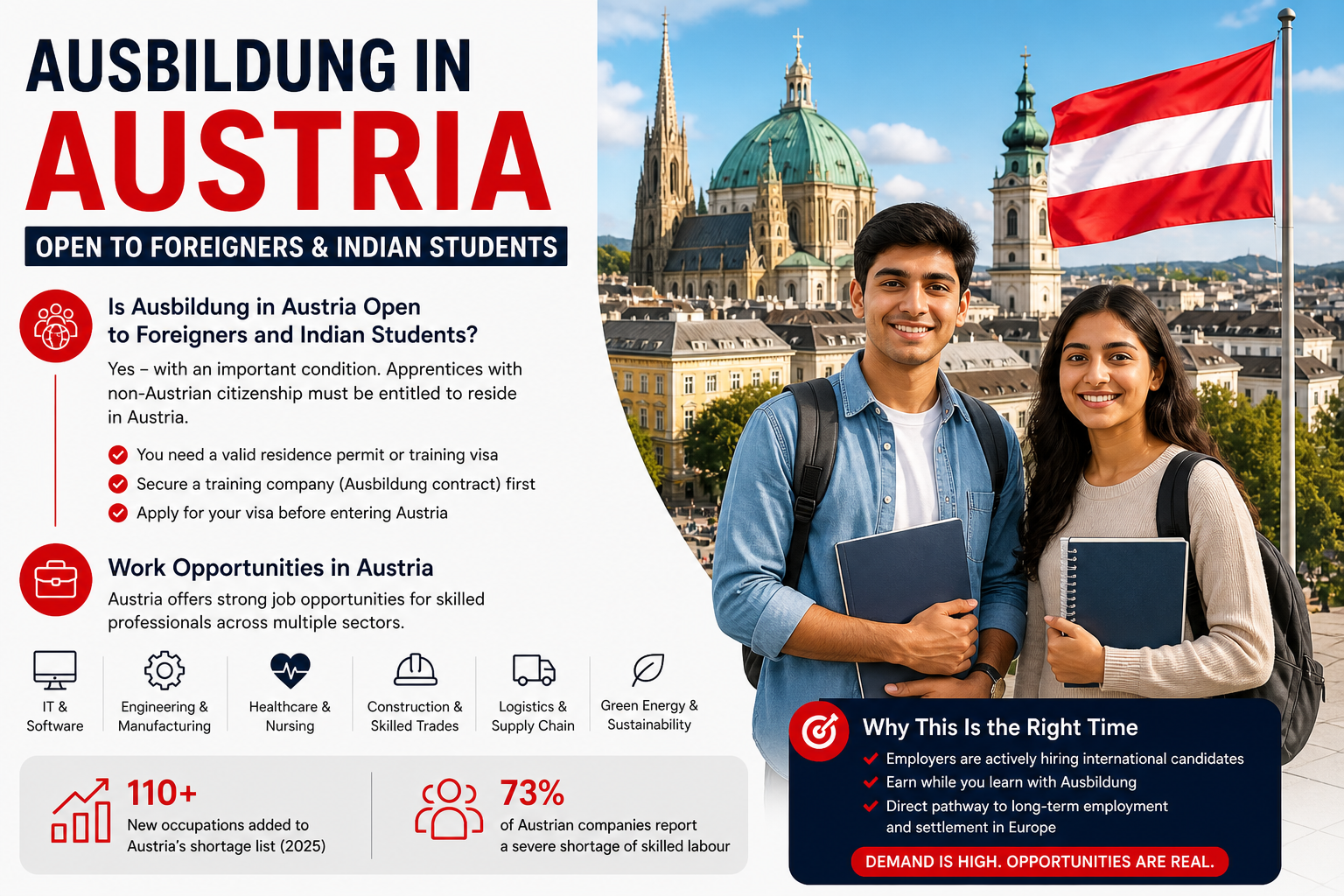 Yes — with an important condition. Apprentices with non-Austrian citizenship must be entitled to reside in Austria. This means you need a valid residence permit or training visa before you can begin. For Indian students coming from outside the EU, this means securing a training company first, then applying for your visa before entering Austria. Work in Austria
Austria offers strong job opportunities for skilled professionals across IT, engineering, healthcare, construction, logistics, and green energy sectors. With over 110 new occupations added to the national shortage list in 2025 and 73% of Austrian companies reporting a severe shortage of skilled labour, Austria actively recruits foreign professionals to sustain its growing economy. This labour shortage is precisely what makes now an excellent time to pursue Ausbildung as an Indian student — demand is genuinely high and employers are actively looking internationally. Y-Axis
Ausbildung in Austria vs Ausbildung in Germany — Key Difference
Many Indian students have heard about Ausbildung in Germany, which is the more widely promoted version. Austria runs an almost identical system. Austria’s costs are similar to Germany at €600 to €1,200 per month for living expenses, with comparable apprentice wages ranging from €515 to €1,200 per month. The structure, the dual system approach, the final examination process, and the career pathways are essentially the same. GoAusbildung
However, Austria has some distinct advantages. The country is smaller and more navigable for newcomers. Vienna, Salzburg, Graz, and Innsbruck are beautiful, internationally-minded cities with strong Indian communities and excellent public transport. Austria is also known for its exceptional quality of life, regularly ranking among the top ten most liveable countries in the world. And crucially, an Austrian Ausbildung qualification is recognised across all EU countries just as a German one would be.
Salary and Monthly Allowance During Ausbildung in Austria
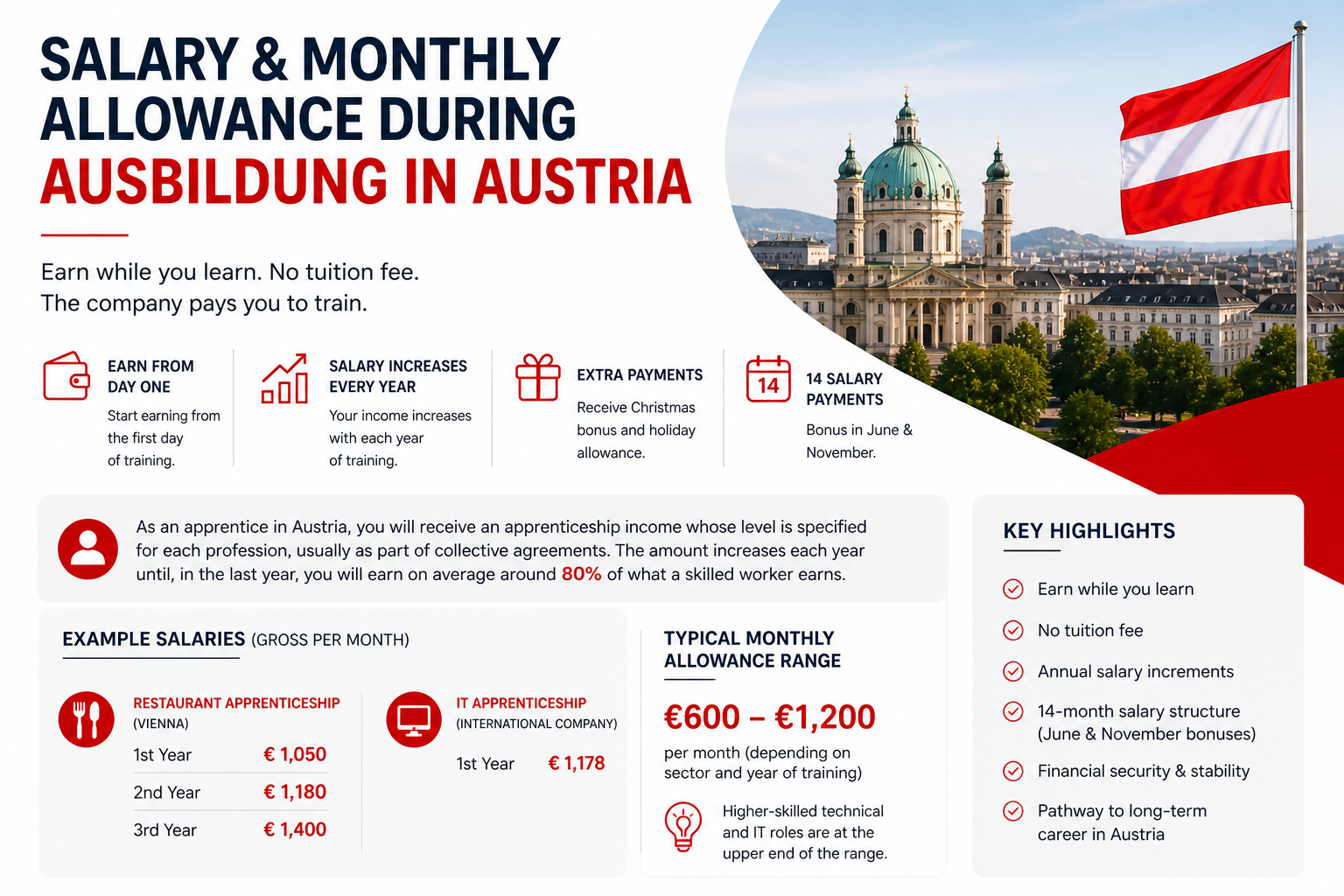 This is one of the most exciting aspects of the Austrian Ausbildung for Indian students — you earn from day one. There is no tuition fee. The company pays you to train with them.
As an apprentice in Austria, you will receive an apprenticeship income whose level is specified for each apprenticeship profession, usually as part of collective agreements concluded by the various sectors. The amount increases with each apprenticeship year until, in the last apprenticeship year, you will be earning on average around 80% of what a skilled worker earns. You will also receive special payments such as a Christmas bonus and holiday allowance. EURES
The apprentice’s salary increases annually and the apprentice also receives 14 monthly salary payments, like regular employees. That 14-month salary structure — standard for Austrian employment — means you receive a bonus equivalent to one month’s pay in June and another in November, giving you greater financial security than Ausbildung in Germany typically provides. Work in Austria
Looking at real figures from current listings: in the hospitality sector, a restaurant apprenticeship in Vienna pays €1,050 in the first year, rising to €1,180 in the second year and €1,400 in the third year gross per month. An IT apprenticeship with an international company starts at €1,178 per month in the first year. iAgora
In general, Austrian Ausbildung monthly allowances typically range from around €1,100 to €1,900 per month depending on the sector and year of training, with higher-skilled technical and IT roles at the upper end.
Available Ausbildung Sectors for Indian Students in Austria
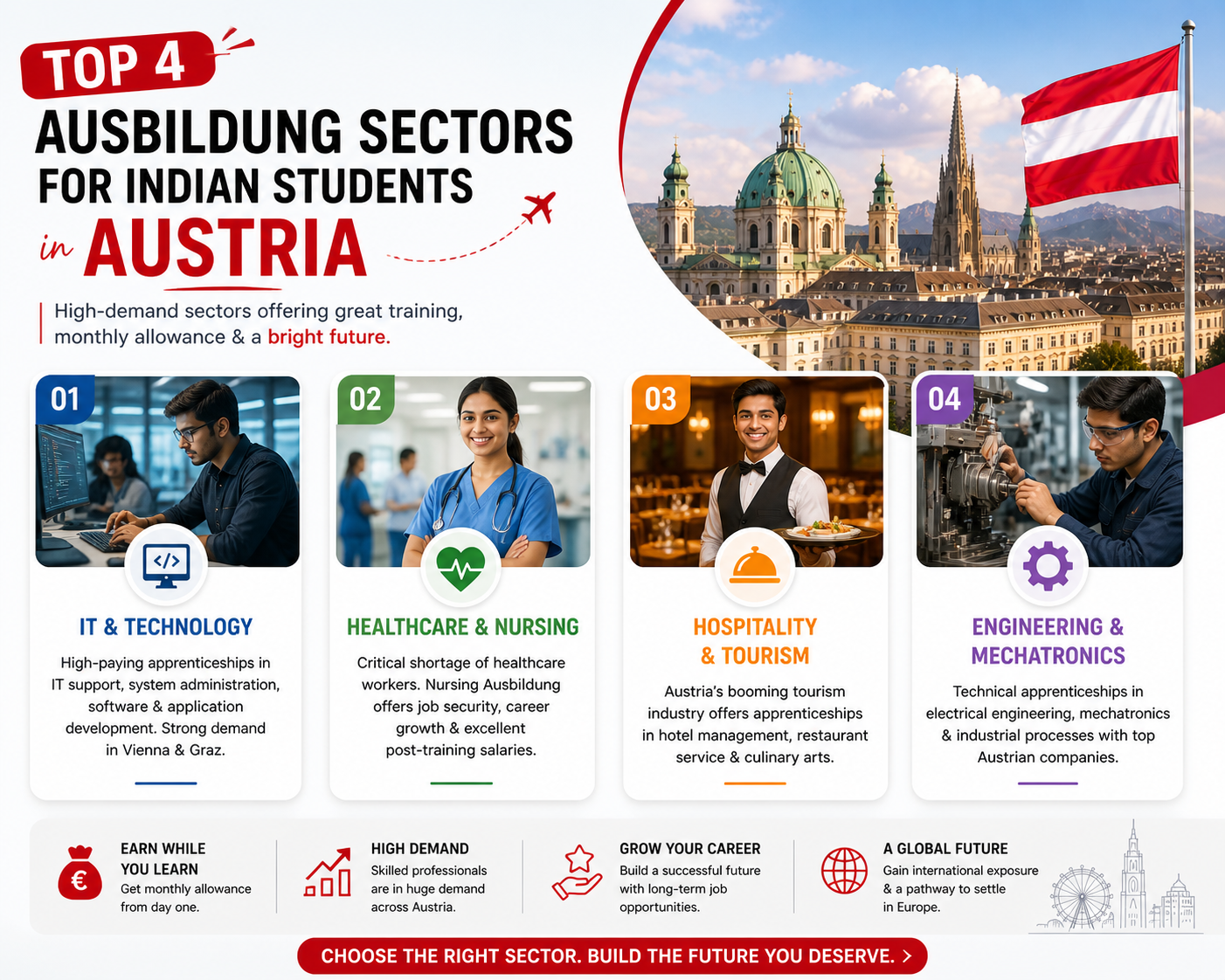
Austria offers Ausbildung training across a wide range of industries. The most in-demand sectors for international applicants include the following.
IT and Technology — IT support, system administration, application development, and software roles are among the highest-paying apprenticeships and are in strong demand due to Austria’s growing tech sector, particularly in Vienna and Graz.
Healthcare and Nursing — With Austria’s ageing population, healthcare workers are critically short. Nursing Ausbildung typically requires B2 German proficiency but offers strong job security and excellent post-training salaries.
Hospitality and Tourism — Austria’s world-famous tourism industry, from Alpine ski resorts to Vienna’s luxury hotels, regularly takes on international apprentices in hotel management, restaurant service, and culinary arts.
Engineering and Mechatronics — Technical apprenticeships in electrical engineering, mechatronics, and industrial processes are available with major Austrian manufacturers and energy companies.
Business and Commerce — Office administration, retail management, and business management apprenticeships are widely available and suited to students with strong organisational skills.
Logistics and Supply Chain — Companies like DHL and major Austrian logistics firms regularly recruit apprentices, with starting salaries among the more competitive in the sector.
Construction and Skilled Trades — Electricians, plumbers, carpenters, and other skilled tradespeople are in critical shortage across Austria, making this a strong option for students interested in hands-on technical work.
Eligibility Criteria for Indian Students
To qualify for Ausbildung in Austria as an Indian student, you need to meet the following conditions.
You must have completed compulsory education, which in the Indian context means your Class 10 or Class 12 certificate. You must have a valid passport and be eligible to apply for an Austrian residence permit for the purpose of training. You need German language proficiency — more on this below. You must find a company willing to offer you a training contract (Lehrvertrag) before you can apply for your visa. There is generally no strict age upper limit, though most programmes are designed for candidates up to their mid-twenties.
German Language Requirement — How Much Do You Need?
German is the language of instruction in Austrian vocational schools, and it is the working language in most training companies. This is the single most important thing to prepare before applying.
For most standard Ausbildung programmes, you need a minimum of B1 German. For healthcare and nursing roles, B2 is typically required. German Ausbildung language requirements as of 2025 remain a minimum B1 level, with a growing preference among employers in healthcare and technical sectors for candidates holding B2 certification. Austria specifically recognises certificates from the Goethe-Institut, ÖSD (Austrian exam board), Telc, and the Austrian Integration Fund (ÖIF). Terratern
The honest timeline: going from zero German to B1 takes most Indian students around 8 to 12 months of dedicated study. Reaching B2 typically takes 12 to 18 months. EuropeCareers helps our students plan their language preparation journey well in advance, so they arrive at the visa stage fully prepared.
How to Apply for Ausbildung in Austria — Step by Step wise the process
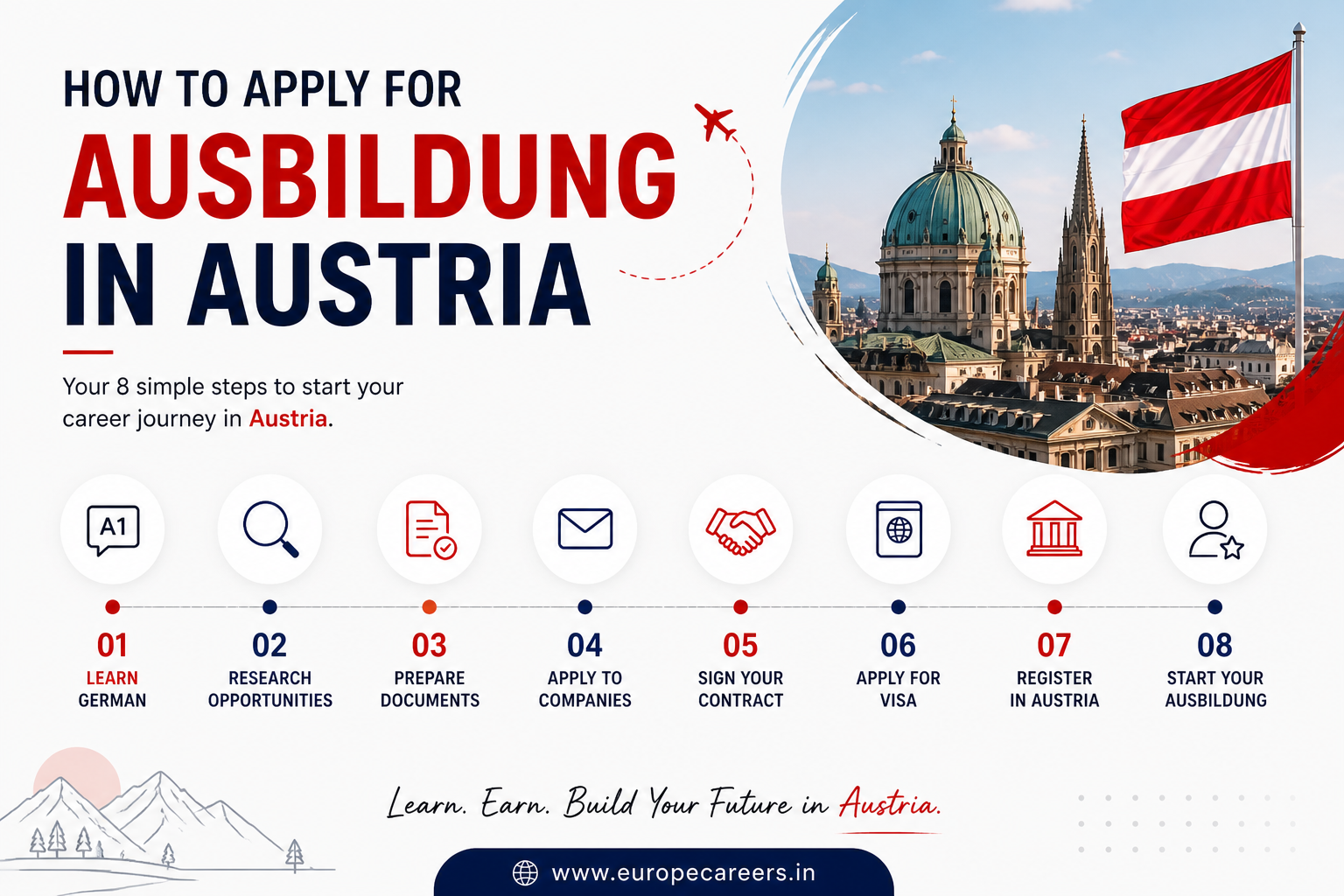 The process for Indian students follows a clear sequence. Here is how EuropeCareers guides students through it.
Step 1 — Start German language preparation. Begin at A1 level and work consistently towards B1 or B2. Goethe-Institut centres across India are the most respected option. Plan for 10 to 18 months depending on your target level.
Step 2 — Research Ausbildung sectors and positions. Identify the field that matches your interests and skills. Use the Austrian apprenticeship portal (Lehrstellen.at) and the Federal Ministry of Labour and Economy’s occupation list to explore available training professions.
Step 3 — Prepare your application documents. These include a German-format CV (Lebenslauf), a cover letter in German, certified translations of your Class 10 and 12 certificates, your German language certificate, and a valid passport copy.
Step 4 — Apply to Austrian companies. Contact companies directly or through job portals. EuropeCareers maintains relationships with Austrian employers actively seeking international trainees, which significantly improves your chances.
Step 5 — Sign your Lehrvertrag. Once a company offers you a position, you sign the apprenticeship contract. The company registers this with the relevant Chamber of Commerce (Wirtschaftskammer). This contract is the core document for your visa application.
Step 6 — Apply for your Austrian training visa or Red-White-Red Card. With your signed Lehrvertrag in hand, apply at the Austrian Embassy or Consulate in India. You will need your contract, passport, language certificate, accommodation proof, and health insurance.
Step 7 — Register on arrival. Once in Austria, register at your local municipal office (Meldeamt) within three days of arriving. Complete your enrolment at the Berufsschule assigned to your training profession.
Step 8 — Begin your Ausbildung. You are now a paid trainee in one of Europe’s most stable and prosperous economies. Your salary starts from day one.
Visa and Residence Permit — What Indian Students Need to Know
As a non-EU citizen, you need to apply for an Austrian national visa (Category D) for the purpose of vocational training. This is distinct from a student visa. Austria offers Red-White-Red Cards for skilled apprentices in shortage occupations. The Red-White-Red Card is Austria’s flagship skilled immigration permit and provides a clear route from apprenticeship to long-term residency. GoAusbildung
After completing your Ausbildung and working full-time in Austria for two years in your trained profession, you become eligible to apply for permanent residency. After five continuous years of legal residence, you can apply for the EU long-term residence permit, which is effectively permanent and grants you the right to live and work in any EU country.
Austria is part of the Schengen Area, allowing students and residents to travel freely across 26 or more European countries, including Germany, France, Italy, and the Netherlands. Intersighteducation
Cost of Living in Austria During Ausbildung
Living costs in Austria are higher than in some parts of Europe but comparable to Germany. In Vienna, expect to spend around €900 to €1,200 per month covering rent, food, transport, health insurance, and personal expenses. In smaller cities like Graz, Linz, or Innsbruck, €700 to €900 per month is more realistic.
In addition to the training allowance paid by the training company, apprentices in Austria can apply for various federal and provincial grants to cover expenses such as living costs, travel to the training site, accommodation, and further training. These benefits include grants, subsidised training courses, and free annual public transport passes. European Commission
Many Austrian Ausbildung employers also provide meal allowances, accommodation support, or subsidised transport passes as part of the training package — particularly in the hospitality and tourism sector.
Health insurance is mandatory. If no other insurance protection is available, students can insure themselves at a preferential rate of €73.48 per month as of 2025. Once you are employed as an apprentice, you are typically covered under the company’s social insurance automatically. Austrian Migration
Career Pathways After Ausbildung in Austria
Completing your Ausbildung in Austria is not the end of the journey — it is the beginning of a very strong one. After passing your final apprenticeship examination, you receive the Lehrabschlussprüfung certificate, which is recognised across Austria and the EU.
From there, your options are extensive. You can continue working full-time with your training company, which often converts apprentices to permanent employees at the end of training. You can pursue a master craftsman’s examination (Meisterprüfung), which is equivalent to a bachelor’s degree and qualifies you to run your own business or take on senior roles. You can also pursue further university education — there is an “apprenticeship with Matura” model which combines practical vocational training with the advantages of the school leaving exam, allowing pupils to qualify to study at university. And after two years of full-time employment in your trained field, you can apply for permanent residency under the Red-White-Red Card Plus. Work in Austria
Austria offers a unique salary structure where employees receive 13th and 14th month salaries as bonuses, providing greater financial stability. Work experience gained in Austria also opens doors to careers in other German-speaking countries like Germany, Switzerland, and Liechtenstein. Intersighteducation
Scholarships and Financial Support for International Apprentices in Austria
Austria allocated €915 million for the integration of young people into the labour market in 2022, and in 2024 the promotion of in-company training increased to €280 million. The Austrian government provides funding including grants, subsidised training courses, and free annual public transport passes for apprentices. European Commission
For Indian students specifically, the OeAD (Austrian Agency for International Cooperation in Education and Research) offers various grants. The OeAD runs several scholarship programmes that generally provide grantees with a monthly stipend and may also arrange accident and health insurance. The Ernst Mach Grant provides €1,040 per month for research and study visits. The Austrian Development Cooperation (ADC) offers fully funded scholarships including tuition, monthly stipends, and travel expenses for students from developing countries including India. LeapScholar
Advantages and Challenges — An Honest Assessment
What works in your favour: You earn from day one with no tuition fees. Austria has one of the highest quality-of-life rankings in the world. The 14-month salary structure gives you more financial security than most apprenticeship systems. The Red-White-Red Card provides a genuinely accessible path to EU permanent residency. The qualification is recognised across the entire EU. Austria’s labour shortage means employers are actively seeking international candidates. Vienna is one of the most multicultural and liveable cities in Europe.
What you need to prepare for: German language is non-negotiable — without B1 minimum, you simply cannot succeed. Finding a company to offer you a training contract from abroad takes effort and persistence. Living costs in Vienna are significant and your early-year apprenticeship salary may be tight. The application process takes 10 to 18 months from language preparation to visa approval. Austria’s immigration system, while improving, still requires careful documentation and patience.
Why EuropeCareers Recommends Ausbildung in Austria Right Now
The timing for Indian students has rarely been better. With over 110 new occupations added to Austria’s national shortage list in 2025 and 73% of Austrian companies reporting a severe shortage of skilled labour, Red-White-Red Card approvals have risen by 35% year-on-year. Austria is not just tolerating international workers — it is actively competing to attract them. Y-Axis
For Indian students who want to build a life in Europe, earn well while training, avoid student debt, and have a clear and legally sound path to permanent residency, Ausbildung in Austria is one of the most underrated opportunities available in 2026. It requires preparation — specifically German language — but it rewards that preparation generously.
At EuropeCareers, we walk with you through every step: German language planning, company matching, document preparation, visa filing, and post-arrival support. Our goal is not just to get you to Austria — it is to make sure you thrive once you are there.
Frequently Asked Questions
Can Indian students do Ausbildung in Austria? Yes, provided you have a valid Austrian residence permit or training visa, a signed apprenticeship contract with an Austrian company, and the required German language proficiency.
What is the monthly salary during Ausbildung in Austria? Salaries range from approximately €600 to €1,200 per month depending on the sector and year of training. Apprentices also receive 14 monthly payments per year including a Christmas bonus and holiday allowance.
How much German do I need for Ausbildung in Austria? A minimum of B1 level is required for most programmes. Healthcare and nursing sectors require B2. Certificates from the Goethe-Institut, ÖSD, or Telc are the most widely accepted.
Is Ausbildung in Austria the same as in Germany? The system is almost identical. Both use the dual training model with vocational school and company training. Austria’s qualification is recognised across the EU just as Germany’s is, and Austria additionally offers the 14-month salary structure as a notable benefit.
How long does Ausbildung in Austria take? Between 2 and 4 years depending on the profession. Most standard programmes are 3 years.
Can Ausbildung lead to permanent residency in Austria? Yes. After completing your Ausbildung and working for two years in your trained profession, you are eligible for the Red-White-Red Card Plus, which allows free access to the Austrian labour market. After 5 years of continuous legal residence, you can apply for EU permanent residency.
Does Ausbildung in Austria count across the EU? Yes. The qualification (Lehrabschlussprüfung) is recognised across EU member states and comparable to EQF Level 4, making it valid for employment and further education across Europe.