
MBBS in Georgia for Indian Students 2026 — Fees, Universities & Why Germany is the Smarter Long-Term Choice

Introduction
 Every year, thousands of Indian students search for an affordable MBBS abroad — and Georgia keeps appearing near the top of the list. It is easy to understand why. Georgia offers affordable MBBS programmes with annual tuition fees usually between $4,000 to $8,000, and the cost of living is also budget-friendly, at around ₹12,000 to ₹15,000 per month. For a family that could not secure a government seat in India, that sounds like a lifeline. Shuraa Education
But affordability is only one piece of the puzzle. At EuropeCareers, we believe Indian students deserve the full picture — not just the attractive headline, but the reality of what happens after graduation, how recognised your degree actually is in the global job market, and what your long-term career looks like depending on which country you choose.
This article gives you a thorough guide to MBBS in Georgia and then makes an honest, data-backed case for why Germany is the superior investment for most serious medical aspirants.
What is MBBS in Georgia? The Basics
Georgia is a small country at the crossroads of Europe and Asia. It has emerged rapidly as a medical education hub, primarily because of its English-medium programmes, relatively simple admission process, and lower cost compared to Western Europe. Georgia has become one of the most popular destinations for international students, with over 10,000 learners, including more than 8,000 Indian students, pursuing an MBBS in Georgia. Upgrad
The degree awarded in Georgia is called MD (Doctor of Medicine), which is equivalent to an MBBS. The MBBS course duration in Georgia is 6 years, including 5 years of academic learning and 1 year of clinical internship. Medical universities in Georgia are listed in the World Directory of Medical Schools and recognised by global bodies such as WHO, WFME, ECFMG, and the National Medical Commission of India, making graduates eligible to appear for FMGE/NExT and other international licensing examinations. Select Your University
A major recent development Indian students must be aware of: according to an official announcement by the Education Minister of Georgia, public (state-run) universities will no longer admit international students to MBBS (MD) programmes. Instead, Indian students will have to shortlist from a list of private universities in Georgia. This is a significant policy shift that directly impacts cost planning. Education Vibes
MBBS in Georgia Fees for Indian Students — Complete Breakdown
Tuition Fees
The average yearly MBBS fee in Georgia for 2026 ranges between ₹3 to ₹8 lakhs (approximately $4,000 to $8,000 USD), which means MBBS in Georgia is more affordable than India. Eklavya Overseas
Since public universities are now closed to international students, all Indian students must enrol at private institutions. MBBS fees at private universities may go up to ₹4.5 to ₹6.5 lakhs per annum. Eklavya Overseas
Total Course Cost
The total cost of studying MBBS in Georgia is highly affordable, ranging between ₹25 to ₹40 lakhs for the 6-year course duration. Some estimates, when living expenses, hostel, food, and travel are included, place the figure between ₹30 and ₹50 lakhs for the entire six years. RMC Education
Living Expenses
The cost of living is budget-friendly, at around ₹12,000 to ₹15,000 per month. This makes Georgia considerably cheaper to live in than Germany or most Western European countries. Shuraa Education
Visa
Indian students need a D3 student visa, which allows a 90-day stay initially. After reaching Georgia, students must apply for a Temporary Residence Card within 45 days. The visa fee typically ranges between ₹1,500 to ₹1,700 and processing time is approximately 10 to 45 days. Shuraa Education
Top Medical Universities in Georgia for Indian Students
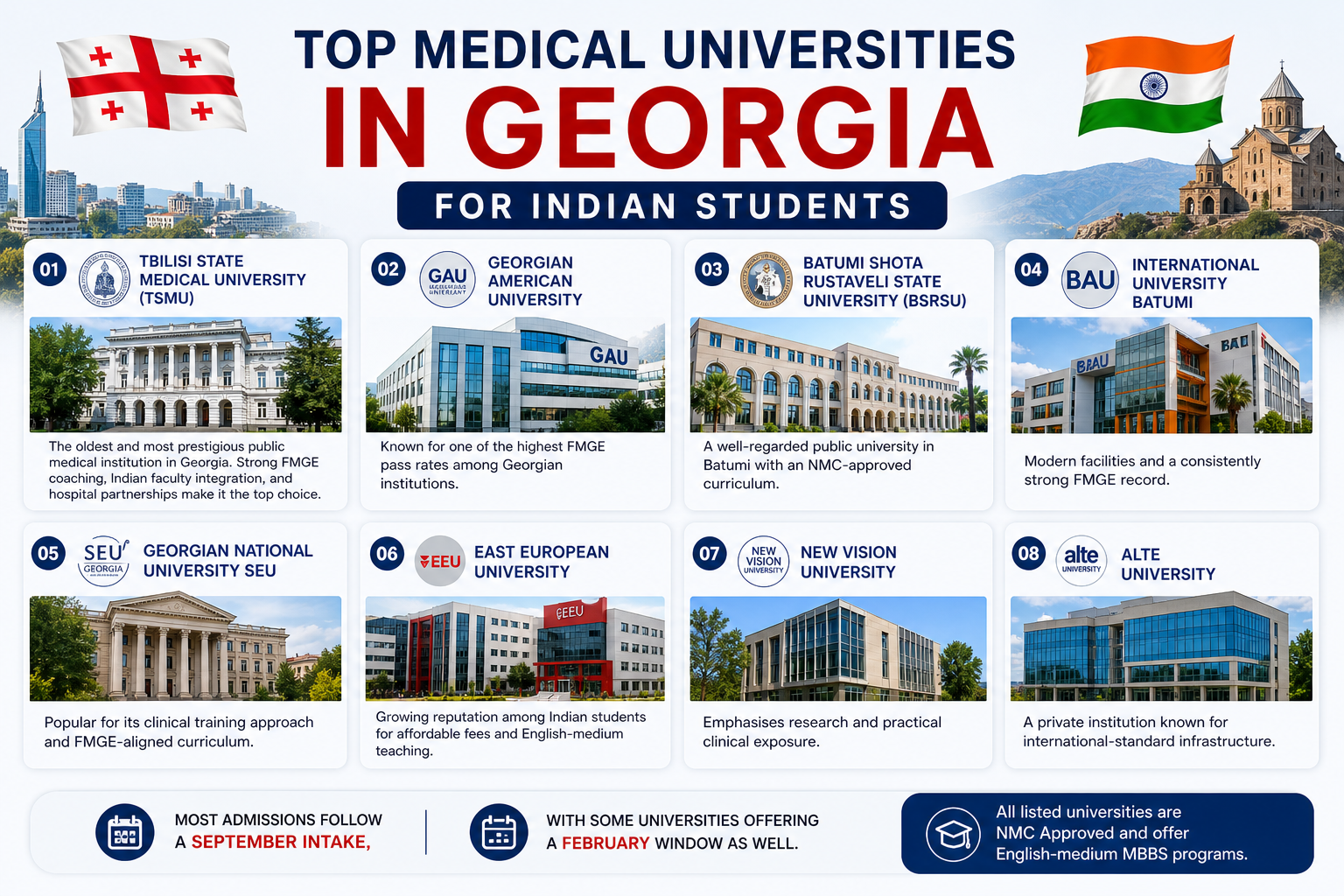
The following universities are consistently recommended for Indian students, with a track record of NMC approval and FMGE performance:
Tbilisi State Medical University (TSMU) — The oldest and most prestigious public medical institution in Georgia. Strong FMGE coaching, Indian faculty integration, and hospital partnerships make it the top choice.
Georgian American University (GAU) — Known for one of the highest FMGE pass rates among Georgian institutions.
Batumi Shota Rustaveli State University (BSRSU) — A well-regarded public university in Batumi with an NMC-approved curriculum.
BAU International University Batumi — Modern facilities and a consistently strong FMGE record.
Georgian National University SEU — Popular for its clinical training approach and FMGE-aligned curriculum.
East European University — Growing reputation among Indian students for affordable fees and English-medium teaching.
New Vision University — Emphasises research and practical clinical exposure.
Alte University — A private institution known for international-standard infrastructure.
Most admissions follow a September intake, with some universities offering a February window as well.
Eligibility Criteria for Indian Students
The admission process in Georgia is notably simpler than Germany, which is both an advantage and — as we will discuss — a double-edged sword.
You need to be at least 17 years old by 31st December of the admission year. You must have completed Class 12 with Physics, Chemistry, and Biology, with a minimum aggregate of 50% for the general category and 40% for reserved categories. NEET qualification is mandatory for all Indian students who plan to practise in India. Most universities do not require IELTS or TOEFL since the programmes are taught in English, though some conduct personal interviews instead. Some universities have made it a compulsory criterion that students must have cleared IELTS or TOEFL with a valid score, while universities that do not require these scores arrange personal interviews instead. Select Your University
Admission Process — Step by Step
The process is refreshingly straightforward. Select your university, check that it is NMC-approved, and fill out the application form online. Submit your Class 10 and 12 mark sheets, NEET scorecard, passport copy, birth certificate, recent passport photos, a medical fitness report, and bank statements. Once accepted, you will receive an invitation letter. Pay the first-year tuition fees, apply for your D3 student visa at the Georgian Embassy or via VFS in India, and travel to Georgia to begin your studies.
There is no Studienkolleg, no language exam, no blocked account requirement. For students who want to start medical school quickly, Georgia is genuinely the faster path.
FMGE and NExT — The Critical Factor Every Indian Student Must Understand
This is where the honest conversation begins. For Indian students, the degree from any foreign university is only the starting point. To actually practise medicine in India, you must clear the FMGE or its successor, the NExT exam.
The FMGE passing percentage of Georgia in 2024 was 35.65%. A total of 4,221 Indian students appeared for FMGE 2024 from Georgian universities, out of which 1,505 students cleared the exam. Careers360
This is actually the highest FMGE pass rate among popular MBBS destinations abroad, better than Russia, China, and Bangladesh. However, it still means that roughly 65% of Georgian MBBS graduates do not clear FMGE on the first attempt. The FMGE has a low pass rate averaging 10 to 25% across the country overall, and the NExT is a more demanding, clinical and competency-based programme. mbbs in georgia
Quality of education varies significantly across medical universities. In 2024, the top three universities in Georgia produced 34.62% of all FMGE passers from the country, while the other Georgian universities combined accounted for 28.49%. University selection within Georgia is therefore critically important. Rmgoe
Additionally, recent NMC regulations require students to complete another internship in India after passing the FMGE exam. This needs to be done within 10 years of completing MBBS abroad. So to practise medicine in India after MBBS in Georgia, a student must do internships in both Georgia and India. Abroadeducation
Advantages and Disadvantages of MBBS in Georgia — Honestly Assessed
What Georgia gets right: The fees are genuinely affordable. The English-medium teaching removes a major language barrier. Admission is fast and straightforward. The country is safe, with a 74 out of 100 Safety Index score according to Numbeo. Indian food is widely available. Students can build friendships with a large Indian student community. The clinical training at top universities is improving steadily. Medical programmes in Georgia follow the European Credit Transfer System, making it easier for students to transfer to or pursue further studies in other European countries. Shuraa Education
What Georgia gets wrong: Quality is inconsistent across universities — choosing the wrong institution can seriously damage your FMGE prospects. The key disadvantages include language barriers in clinical settings, lack of sufficient clinical exposure and practical training at some institutions, passing NExT or FMGE to practise in India, inconsistent university standards, and adapting to cultural and climatic differences. The degree carries limited weight in Europe or Western countries compared to a German Staatsexamen. You cannot practise anywhere in the EU with a Georgian MD without additional equivalence processes. The post-study career options outside of India are significantly narrower. Select Your University
Germany vs Georgia for MBBS — The Definitive Comparison for Indian Students
 Now we get to the heart of this article. Both Georgia and Germany offer medically accredited degrees for Indian students. But they are not equivalent choices. Here is why EuropeCareers recommends Germany as the superior long-term investment for students who are genuinely serious about building a global medical career.
1. University Ranking and Global Prestige
Germany has 30 medical universities ranked in the QS World Rankings for Medicine. Charité Berlin, LMU Munich, Heidelberg University, and the Technical University of Munich are among the top 60 globally. Georgian universities, while NMC-approved and respectable, do not feature in the global medicine rankings in a comparable way. If you plan to pursue postgraduate education, research fellowships, or clinical positions outside of India, a German Staatsexamen opens doors that a Georgian MD simply does not.
2. Tuition Fees — Germany Wins Decisively
This surprises most people. Germany’s public universities charge zero tuition. You pay only a semester contribution of €80 to €350, which often includes a local transport pass. Georgia’s private universities — which are now the only option for Indian students following the policy change — charge €4,000 to €8,000 per year in tuition. Over six years, that is €24,000 to €48,000 in tuition alone. A German public university student pays roughly €1,500 to €2,100 in total semester contributions over six years. Germany is cheaper on paper at the tuition level.
3. Living Costs — Georgia Wins
This is where Georgia has a genuine edge. Living costs in Georgia are around ₹12,000 to ₹15,000 per month — roughly €120 to €150. Germany’s cost of living is significantly higher at approximately €992 per month. For families on a tighter budget, this difference matters over six years. However, German students can legally work part-time for 20 hours per week during term and 40 hours during holidays, which substantially offsets living costs. A working student in Germany can realistically earn €400 to €700 per month, reducing the gap considerably.
4. Language Requirements — Georgia Wins Short-Term, Germany Wins Long-Term
Georgia teaches entirely in English. You can start studying medicine almost immediately with no language preparation. Germany requires German at B2 or C1 level plus a Studienkolleg year for most Indian students — adding roughly 18 months to 2 years to the overall timeline.
However, this investment pays back enormously. German-speaking doctors can practise across all 27 EU member states and many countries worldwide. A Georgian MD graduate needs to pass country-specific equivalence exams for virtually every Western nation. For students willing to invest time upfront, German language proficiency is a career multiplier that lasts a lifetime.
5. Career Scope — Germany Wins by a Wide Margin
This is the most important comparison of all. After a German Staatsexamen and your Approbation, you can practise medicine freely anywhere in Germany and across Europe. Doctor salaries in Germany range from €70,000 to €130,000 per year. You can pursue specialist training — Facharzt — in one of the most advanced healthcare systems in the world. If you later want to practise in the UK, USA, or Australia, your German medical degree is regarded highly and simplifies licensing processes.
After a Georgian MD, to practise in India you must still clear FMGE or NExT, with a national pass rate of around 35.65% from Georgia. To practise in Europe, you need equivalence recognition that is not automatic. To practise in the UK or USA, you clear PLAB or USMLE just as you would from any other foreign degree. The Georgian degree does not accelerate any of these pathways. The German degree does.
6. Admission Difficulty — Georgia Wins
There is no denying it: Georgia is easier to get into. Minimum 50% in Class 12, a NEET score, and your application is largely complete. Germany requires 85%+ in Class 12, a solid NEET score, B2 to C1 German language proficiency, completion of Studienkolleg, passing the Feststellungsprüfung, and competing for a tiny pool of non-EU seats. Only about 5% of German medical seats are available to international students.
For students who have strong academics and are willing to prepare properly, Germany is absolutely achievable. For students who need a faster or lower-barrier entry point, Georgia is the practical starting point — provided they choose their university very carefully.
7. Recognition — Germany Wins
A German Staatsexamen is recognised without question by WHO, NMC, WFME, and virtually every medical licensing body in the world. It is treated as equivalent to a full European medical degree everywhere in the EU. A Georgian MD is recognised by WHO and NMC, which means it is valid for FMGE/NExT purposes in India and for licensing exam eligibility in the USA, UK, and Australia — but it is not automatically recognised for direct practice in EU countries the way a German degree is.
Quick Comparison at a Glance
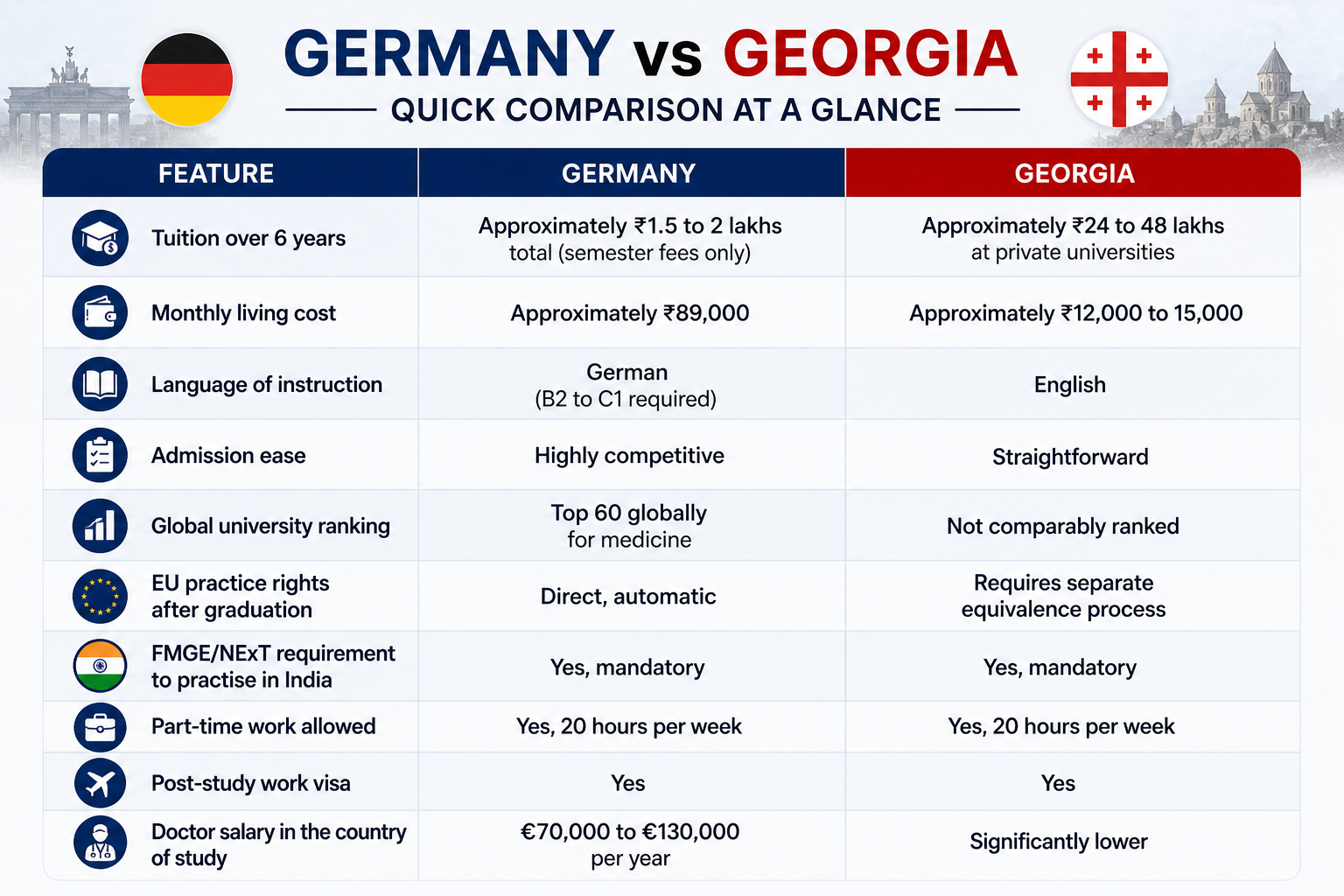
Tuition over 6 years: Germany — approximately ₹1.5 to ₹2 lakhs total (semester fees only). Georgia — approximately ₹24 to ₹48 lakhs at private universities.
Monthly living cost: Germany — approximately ₹89,000. Georgia — approximately ₹12,000 to ₹15,000.
Language of instruction: Germany — German (B2 to C1 required). Georgia — English.
Admission ease: Germany — highly competitive. Georgia — straightforward.
Global university ranking: Germany — top 60 globally for medicine. Georgia — not comparably ranked.
EU practice rights after graduation: Germany — direct, automatic. Georgia — requires separate equivalence process.
FMGE/NExT requirement to practise in India: Both — yes, mandatory.
Part-time work allowed: Both — yes, 20 hours per week.
Post-study work visa: Both — yes.
Doctor salary in the country of study: Germany — €70,000 to €130,000 per year. Georgia — significantly lower.
Who Should Choose Georgia and Who Should Choose Germany?
Choose Georgia if you have a limited budget and cannot stretch to German living costs, if you need to start medical school quickly without a language preparation year, if your academic scores are below the 85% threshold that German universities typically expect, or if your primary goal is to return to India and practise there after clearing FMGE.
Choose Germany if you have strong academics and the commitment to learn German, if you want the most globally prestigious and universally recognised medical degree possible, if your goal is to build a career in Europe, the UK, USA, or Australia, if you want to practise medicine in the EU without additional equivalence hurdles, or if you want the lowest possible tuition fees combined with a world-class degree.
Final Word from EuropeCareers
Georgia is a legitimate, safe, and affordable option for MBBS — and for the right student in the right circumstances, it makes genuine sense. We have guided students to Georgia and will continue to do so when it is the honest best fit for their profile.
But if you ask us which destination offers more for your money over a 30-year medical career, the answer is Germany — without hesitation. The language barrier is real, the preparation time is longer, and the admission process is harder. But every one of those challenges is an investment that pays back in career opportunities, salary, global mobility, and the respect that comes with one of the world’s most coveted medical qualifications.
At EuropeCareers, our job is not to send you wherever is easiest. Our job is to send you where you will thrive.
If you are ready to explore either path seriously, reach out to us for a free personalised assessment. We will look at your academics, your NEET score, your budget, your timeline, and your career goals — and give you an honest recommendation tailored to you.
Frequently Asked Questions
Is MBBS in Georgia valid in India? Yes, provided your university is NMC-approved. You must clear FMGE or NExT to practise in India.
Is NEET required for MBBS in Georgia? Yes, NEET qualification is mandatory for all Indian students under NMC guidelines.
Can Indian students get admission to public universities in Georgia? No. As of the latest policy update, public universities in Georgia have stopped admitting international students to MBBS programmes. All Indian students now apply to private universities.
Is MBBS in Germany free? At public universities, tuition is free. Students pay only a semester contribution of €80 to €350. Living costs are approximately €992 per month.
Which is better — MBBS in Georgia or Germany? For students prioritising affordability, speed of admission, and English-medium instruction, Georgia is a strong choice. For students prioritising global career scope, EU practice rights, university prestige, and long-term earning potential, Germany is the superior option.