Study in Germany vs Other European Countries: What Students Should Consider

Every admission season, one of the most common questions Indian students and their parents ask our academic counsellors at Europe Careers is:
“Should I choose Germany for my higher studies, or would another European country like France, Italy, Poland, Ireland, or the Netherlands be a better fit for my profile and budget?”
Continental Europe has established itself as one of the most attractive global destinations for Indian students seeking world-class academic standards, international exposure, and affordable tuition. However, selecting an overseas study destination based on a single factor — such as low tuition fees or social media hype — frequently leads to poor decisions.
Every European country operates within its own distinct higher education framework, language environment, living cost structure, and immigration rules. An option that suits a mechanical engineering graduate seeking research-heavy public universities in Germany may look very different for a business student looking for an entirely English-speaking environment in Ireland, or an aspiring medical student exploring cost-effective programmes in Poland or Italy.
In this comprehensive guide, our Europe Careers team provides a balanced, realistic comparison between studying in Germany and exploring other prominent European destinations — evaluating tuition fees, living expenses, language barriers, admission procedures, the German APS requirement, part-time work regulations, and post-study career opportunities.

Why Indian Students Compare Germany With Other European Countries
For many years, Germany was the default European choice for Indian STEM (Science, Technology, Engineering, and Mathematics) graduates due to its public university tuition policies and industrial prowess. However, the international education landscape in Europe has diversified substantially:
- Diversified English-Taught Offerings: Countries such as the Netherlands, France, and Poland now offer thousands of accredited Bachelor’s and Master’s programmes taught entirely in English.
- Variable Cost Models: While Germany requires a standardized blocked account (€11,904), countries like Italy provide income-based tuition waivers (ISEE), and Poland offers lower day-to-day living costs.
- Academic Entry Differences: Admission criteria for direct Bachelor’s entry after the Indian 12th standard vary widely. Germany traditionally expects 13 years of schooling (requiring Studienkolleg or a foundation year), whereas countries like Ireland or Poland often accept 12-year CBSE/ICSE schooling directly.
- Language Expectations: While coursework may be delivered in English, everyday life and local employer integration require conversational proficiency in the local language across non-English speaking European nations.
Germany at a Glance
Germany is Europe’s largest economy and hosts over 400 state-accredited higher education institutions divided into research universities (Universitäten) and universities of applied sciences (Fachhochschulen / HAW).
- Tuition Model: Most public universities do not charge general tuition fees for standard consecutive Master’s and Bachelor’s degrees. Students pay an administrative Semesterbeitrag (semester contribution) ranging between €150 and €400 per semester, which commonly includes regional public transport passes.
- Exceptions: The federal state of Baden-Württemberg charges non-EU students €1,500 per semester. Additionally, select institutions such as the Technical University of Munich (TUM) have introduced tuition fees for non-EU students in select programs. Private universities charge market-rate tuition fees.
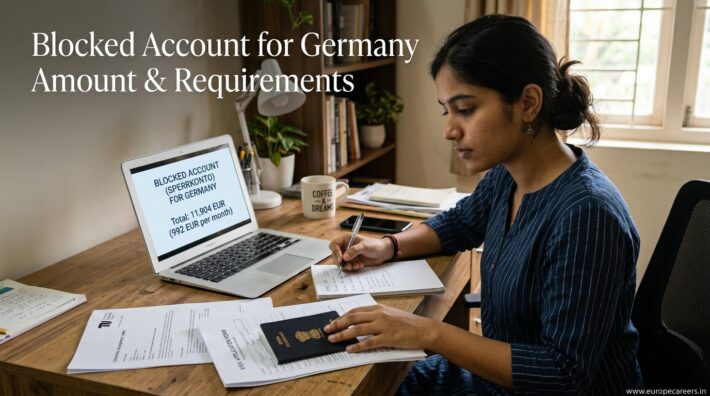
- Financial Proof: Standard student visa applications in 2026 require an annual blocked account (Sperrkonto) of €11,904 (€992 per month).
- Part-Time Work Rights: International students from third countries are legally permitted to work up to 140 full days or 280 half days per calendar year (under updated statutory regulations published by Make it in Germany).
- Post-Study Rights: Graduates of German higher education institutions can apply for an 18-month job-seeker residence permit (Aufenthaltserlaubnis zur Arbeitsplatzsuche) to secure qualified employment.
Other European Countries at a Glance
1. France
France is globally celebrated for its prestigious business schools (Grandes Écoles), engineering academies, and public universities. Public universities charge moderate differentiated tuition for non-EU students (approx. €2,850/year for Bachelor’s and €3,879/year for Master’s), though many institutions offer tuition waivers. International students are entitled to housing subsidies (CAF) and can work up to 964 hours per year. Graduates of Master’s degrees can obtain a 1-to-2-year post-study residence authorization (RECE).
2. Italy
Italy offers historic institutions, leading design and architecture academies, and low-cost English-taught engineering and medical programmes (IMAT). Public university tuition fees are calculated based on family income (ISEE parificato), often resulting in nominal fees between €500 and €3,000 per year. Regional scholarships (such as DSU, EDISU, or LazioDisco) can provide tuition waivers and annual living stipends for eligible applicants.
3. Poland
Poland has emerged as a major destination for Indian students seeking quality European education at very affordable costs. Tuition fees generally range between €2,000 and €4,500 per year for engineering, management, and IT programs. Living costs in cities like Warsaw, Krakow, or Wroclaw (€450 to €700/month) are significantly lower than in Western Europe. Full-time international students on student visas have the legal right to work without needing separate work permits.
4. Ireland
As the primary native English-speaking member of the European Union, Ireland is a hub for global technology and pharmaceutical European headquarters. While tuition fees are higher (€10,000 to €25,000+ per year) and Dublin faces rental housing shortages, Ireland offers a streamlined 2-year Third Level Graduate Scheme (Stamp 1G) for Master’s graduates, facilitating direct recruitment into multinational corporate teams.
5. The Netherlands
Dutch research universities and universities of applied sciences offer Europe’s largest selection of English-taught degree programmes outside the UK and Ireland. Tuition fees for non-EU students typically range between €8,000 and €20,000 per year. Following graduation, international students can benefit from a 1-year orientation year permit (Zoekjaar) to seek employment.
6. Austria
Sharing a German-language higher education structure with Germany, Austrian public universities charge non-EU students a fixed fee of €726.72 per semester plus a student union fee. While undergraduate degrees are predominantly German-taught, Master’s courses in technology and natural sciences feature expanding English offerings. Graduates are eligible for a 12-month post-study job seeker visa.
Germany vs Other European Countries: Tuition Fees Comparison
Understanding tuition models is critical to accurate budgeting. International education tuition in Europe falls into four structural categories:
| Country | Public University Tuition Model | Private University Range | Key Considerations |
|---|---|---|---|
| Germany | €0 tuition at most public universities; €150–€400 semester contribution | €6,000 – €18,000 / year | Baden-Württemberg state and select institutions (e.g. TUM) charge non-EU fees (€1,500–€6,000/sem). |
| France | Approx. €2,850 (UG) / €3,879 (PG) per year | €8,000 – €25,000 / year | Many public universities offer partial fee waivers; top business schools are private. |
| Italy | €500 – €3,500 / year (income-adjusted via ISEE) | €6,000 – €20,000 / year | Significant regional merit/need scholarship opportunities (DSU). |
| Poland | €2,000 – €5,000 / year | €2,000 – €6,000 / year | Standardized, transparent fee structures for international students across all faculties. |
| Ireland | €10,000 – €25,000+ / year | €9,000 – €18,000 / year | Higher investment; premium English-speaking multinational ecosystem. |
| Netherlands | €8,000 – €20,000 / year | €9,000 – €18,000 / year | Institutional non-EU fee rates apply across all state research universities. |
| Austria | €726.72 / semester (€1,453 / year) | €8,000 – €22,000 / year | Fixed statutory tuition for non-EU students at public universities. |
Germany vs Other European Countries: Living Costs
A critical mistake many Indian families make is evaluating countries solely on university tuition while ignoring the total cost of living. Living costs are heavily determined by the chosen city rather than the country as a whole:
- Metropolitan Centers: Cities like Munich, Frankfurt, Paris, Dublin, Amsterdam, and Milan require €1,100 to €1,600+ per month, primarily driven by severe rental accommodation shortages.
- Mid-Sized Student Cities: Cities such as Leipzig, Dresden, Toulouse, Valencia, Bologna, and Wroclaw generally require €650 to €900 per month for rent, utilities, food, and public transport.
- Total Cost Reality: A student paying €3,000 annual tuition in a mid-sized Polish or Italian city may spend less overall than a student paying €0 tuition in Munich or Hamburg where monthly rent alone can exceed €700.
Germany vs Other European Countries: Language Requirements
While European universities have expanded English-taught degree options, the language requirement operates on two levels: academic study and daily life / employment:
- In the Classroom: If you enroll in an English-taught programme, your lectures, assignments, and exams will be in English. Standard requirements are IELTS (typically 6.0–6.5) or TOEFL.
- Outside the Classroom: In Germany, France, Italy, Austria, and Poland, day-to-day life, supermarket interactions, tenancy contracts, city registration, and most critically, working in local companies or part-time student jobs requires conversational knowledge of the national language.
- Long-Term Career Integration: To transition into qualified engineering, medical, or corporate careers in Germany after graduation, reaching at least B1/B2 level German is essential. In Ireland, by contrast, professional integration occurs naturally in English.
Germany and the APS Certificate for Indian Students
A critical differentiator specific to Germany is the APS Certificate (Akademische Prüfstelle), administered by the German Embassy in New Delhi.
Key facts Indian applicants must understand regarding APS:
- What It Is: A mandatory academic verification process that verifies the authenticity of Indian school, diploma, and university certificates before university application or visa filing.
- Who Needs It: Indian students holding Indian qualifications who wish to enroll in higher education programmes in Germany.
- What It Is NOT: APS is an authenticity check; it is not an admission offer, nor does it guarantee visa issuance.
- Other Countries: Students applying to France, Italy, Poland, Ireland, or the Netherlands do not require an APS certificate. They follow their respective national authentication procedures (such as Campus France, Italian CIMEA / Declaration of Value, or standard apostille).
Germany vs Other European Countries: Financial Proof for Visa
Before a European embassy issues a national student visa (D-Visa), applicants must provide verifiable evidence that their living expenses are guaranteed:
- Germany: Requires a formal Blocked Account (Sperrkonto) containing €11,904 (€992/month), an official Formal Sponsorship (Verpflichtungserklärung), or an approved full scholarship.
- France: Requires proof of minimum monthly resources (approx. €615 per month, totaling €7,380 for one academic year) demonstrated via bank statements, sponsor guarantees, or scholarships.
- Italy: Requires verifiable family liquid funds (approx. €6,000 per year) and proof of accommodation, frequently verified through parental bank statements.
- Poland: Requires proof of funds covering living costs (approx. 800 PLN / ~€185 per month plus return travel and tuition), usually shown via a personal or parental bank statement.
- Ireland: Requires proof of immediate access to at least €10,000 for living expenses, alongside proof that tuition fees have been paid in full or as required.

Part-Time Work During Studies
Working part-time allows international students to gain professional experience, build local networks, and offset personal living expenses:
| Country | Permitted Working Hours During Term | Vacation Work Hours | Key Workplace Observations |
|---|---|---|---|
| Germany | 140 full days or 280 half days per calendar year | Full-time permitted within the 140-day quota | Minimum wage applies (€12.41+/hr); conversational German significantly expands job availability. |
| France | Up to 964 hours per year (approx. 20 hours/week) | Full-time during official holidays | Minimum wage (SMIC); French language capability is important for customer-facing roles. |
| Italy | Up to 20 hours per week (max 1,040 hours/year) | Standard holiday provisions | Part-time job market is more competitive; Italian language proficiency is strongly required. |
| Poland | Permitted without work permit for full-time degree students | Full-time permitted | Growing English-speaking support, logistics, and hospitality sectors in major cities. |
| Ireland | Up to 20 hours per week | Up to 40 hours/week during June–Sept and Dec 15–Jan 15 | Strong native English environment; minimum wage €12.70/hr. |
| Netherlands | Up to 16 hours per week (requires employer work permit) | Full-time during summer months | Work permit application required; Dutch student jobs are regulated. |
Important Advisory: Part-time income should always be viewed as supplementary pocket money rather than a guaranteed mechanism to pay university tuition or primary living expenses.
Post-Study Work Opportunities
Your post-graduation career opportunities depend heavily on national economic sectors and immigration pathways:
- Germany (18 Months): Graduates can apply for an 18-month job search visa. Finding qualified employment matching your degree allows transition into an EU Blue Card or national skilled work permit (Aufenthaltserlaubnis zur Erwerbstätigkeit).
- Ireland (24 Months for Master’s): The Third Level Graduate Scheme allows Master’s graduates two years to work full-time and transition to General Employment Permits or Critical Skills Employment Permits.
- France (12 to 24 Months): The RECE visa permits Master’s graduates up to 12 months (often extendable to 24 months for Indian graduates under bilateral agreements) to seek employment or launch an enterprise.
- Netherlands (12 Months): The Zoekjaar (Orientation Year) grants 12 months to search for a role as a highly skilled migrant (kennismigrant).
- Poland (9 Months): Graduates can extend their legal residence for up to 9 months to search for employment, with simplified transition to single work and residence permits (karta pobytu).
Comprehensive Comparison Table: Germany vs Other European Countries
To evaluate these study destinations objectively, review this side-by-side comparison across all key academic and immigration dimensions:
| Evaluation Factor | Germany | France | Italy | Poland | Ireland | Netherlands |
|---|---|---|---|---|---|---|
| Public Tuition | €0 at most public universities (€150–€400 sem. fee) | Approx. €2,850–€3,879 / year | €500–€3,500 / year (income-adjusted) | €2,000–€4,500 / year | €10,000–€25,000+ / year | €8,000–€20,000 / year |
| Monthly Living Costs | €850 – €1,200 | €750 – €1,400 | €600 – €1,200 | €450 – €750 | €1,100 – €1,700 | €1,000 – €1,600 |
| Primary Language | German | French | Italian | Polish | English | Dutch |
| English Programs | Extensive at Master’s; selective at Bachelor’s | Extensive at business schools & Master’s | Wide range at Master’s & Medicine | Broad range across engineering & IT | 100% English native environment | Over 2,000 English programmes |
| Academic Verification | Mandatory APS Certificate | Campus France procedure | Declaration of Value / CIMEA | Standard document apostille | Direct university document check | Nuffic / university evaluation |
| Visa Financial Proof | €11,904 Blocked Account | €615 / month bank proof | Verifiable family liquid funds | Bank statements & tuition proof | €10,000+ liquid bank proof | University tuition & living escrow |
| Part-Time Work Limit | 140 full / 280 half days per year | 964 hours per year | 20 hours per week | Permitted during full-time studies | 20 hrs/week term (40 hrs holidays) | 16 hrs/week (work permit required) |
| Post-Study Search | 18 Months | 12 – 24 Months | 12 Months | 9 Months | 24 Months (for Master’s) | 12 Months (Zoekjaar) |
Questions Students Should Ask Before Choosing a Country
- What is my total two-year budget? (Tuition fees + 24 months of living expenses + airfare + insurance).
- Am I willing to learn a local European language? (If you plan to stay long-term in Germany, France, or Italy, language commitment is non-negotiable).
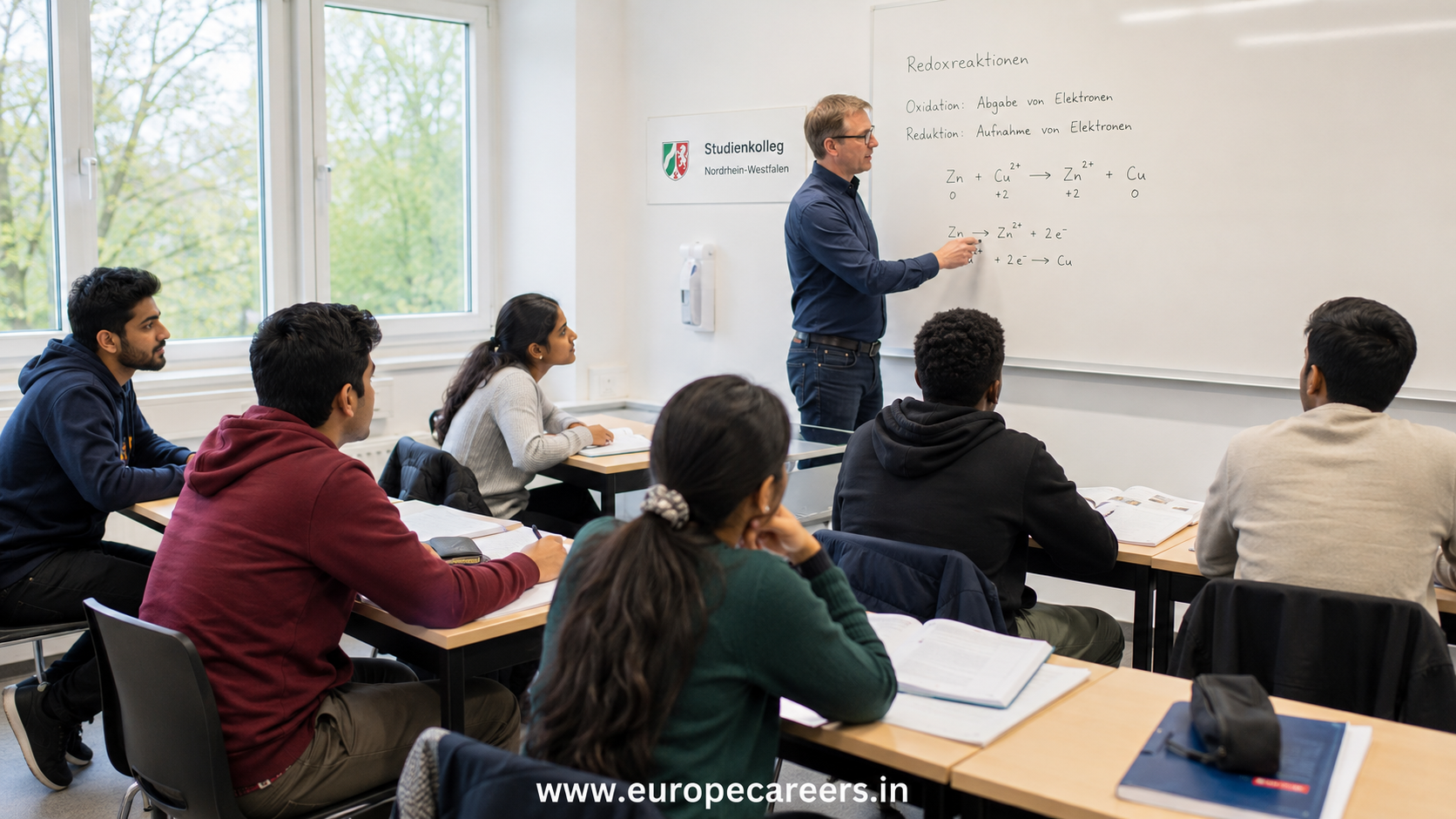
- Do I meet the direct admission requirements? (Do I need a preparatory course like Studienkolleg, or can I gain direct entry with my 12th standard mark sheet?).
- Is the degree fully state-accredited? (Does the program confer recognized ECTS credits that qualify for EU Blue Card work visas?).
- What is the local housing reality? (Are university dormitories available, or is there an acute private rental shortage in the city?).
- What are the regional career pathways for my sector? (e.g. Automotive & Mechanical Engineering in Germany, Luxury & Fashion in France/Italy, Tech & Pharma in Ireland/Netherlands).
Who Should Consider Germany and Who Should Consider Other Countries?
Rather than ranking one destination above another, consider which profile best aligns with your goals:
Germany May Be Right For You If:
- You are targeting engineering, technical, computer science, or natural science specializations at public research universities.
- You have strong academic consistency and are prepared to navigate the APS verification process early.
- You have the financial capability to deposit the mandatory €11,904 blocked account deposit.
- You are committed to learning the German language up to B1/B2 to secure internships and long-term employment.
Other European Countries May Be Better Suited If:
- Choose Ireland if you want an entirely native English-speaking environment with direct access to multinational tech headquarters and a guaranteed 2-year post-study work visa.
- Choose Italy if you have modest family finances and wish to compete for need-based regional scholarships (DSU) that waive tuition and provide living stipends.
- Choose Poland if you want an affordable, high-quality European degree with low living expenses and direct admission after the Indian 12th standard without complex pre-evaluations.
- Choose France if you are targeting elite business schools, luxury management, culinary arts, or aerospace engineering.
- Choose the Netherlands if you seek an innovative, internationally focused curriculum with the widest selection of English-taught courses in Continental Europe.
How Europe Careers Helps Students Compare and Decide
At Europe Careers, our objective is not to steer every candidate toward one country, but to identify the pathway that offers the highest probability of academic success and career return on investment for your family. Our comprehensive student services include:
- Academic Profile Evaluation: Reviewing transcripts, ECTS equivalencies, and subject eligibility across multiple European educational systems.
- Realistic Budget Modeling: Calculating the complete financial requirement — comparing tuition fees, city-specific living costs, and visa financial proof requirements.
- Accredited University Shortlisting: Identifying state-recognized universities and checking admission requirements, deadlines, and entrance exams.
- APS & Document Verification Guidance: Guiding Indian applicants through the APS process for Germany and document apostilles for other European countries.
- Language & Test Preparation: Providing structured German language courses (A1–B2) and IELTS/TOEFL coaching.
- Visa File Assembly: Preparing complete visa dossiers aligned with the official requirements of German, French, Italian, or Polish diplomatic missions.
Frequently Asked Questions (FAQ)
1. Is Germany really free for Indian students?
At most public universities in Germany, international students pay zero tuition fees for standard degree programmes. However, students must still pay a semester contribution (€150–€400) and cover their own living expenses (minimum €11,904/year in a blocked account). Select states (Baden-Württemberg) and specific institutions (TUM) charge tuition fees for non-EU students.
2. Is studying in Germany cheaper than in other European countries?
Not always. While tuition at German public universities is low or zero, living costs can be substantial (€850–€1,200/month). In countries like Poland or southern Italy, tuition fees are modest, but living costs are significantly lower, resulting in a comparable or lower total two-year budget.
3. Which European countries offer English-taught programmes?
The Netherlands, Ireland, Germany, France, Poland, and Italy offer thousands of accredited Bachelor’s and Master’s programmes delivered entirely in English.
4. Do Indian students need an APS certificate for all European countries?
No. The APS certificate is strictly a requirement for Indian students applying to higher education institutions in Germany. It is not required for France, Italy, Poland, Ireland, or the Netherlands.
5. What is the blocked account requirement for Germany in 2026?
The published requirement for standard higher education student visas is €11,904 for one year, allowing a maximum monthly withdrawal of €992.
6. Can international students work part-time in Germany?
Yes. Non-EU international students can work up to 140 full days or 280 half days per calendar year under statutory German immigration regulations.
7. How long can I stay in Germany after graduating?
Graduates of German universities can apply for an 18-month job seeker residence permit to find employment relevant to their degree.
8. Is German language proficiency required for English-taught courses in Germany?
For academic admission into an English-taught course, German proficiency is usually not required. However, basic to intermediate German (A2–B1) is vital for daily life, part-time jobs, and long-term career placement.
9. Is French mandatory to study in France?
No, there are many English-taught Master’s programmes in business, management, and technology. However, French is highly advantageous for daily life and internship placement.
10. Can I study medicine in Europe in English?
Yes. Italy offers English-taught medical degrees (IMAT) at public universities, and Poland, Romania, and Hungary host established 6-year English medical programmes recognized by international medical councils.
11. Why is Ireland popular among Indian students?
Ireland is an English-speaking country with Europe’s leading technology and pharmaceutical European hubs and provides a 2-year post-study work visa for Master’s graduates.
12. Is Poland recognized across Europe?
Yes. Poland is an EU member state, and degrees issued by Polish accredited universities conform to the European Bologna Process, conferring transferable ECTS credits recognized across the European Higher Education Area.
13. Can Indian students apply directly after 12th standard?
In Poland, Ireland, and France, direct entry after the Indian 12th standard is common. In Germany, direct admission depends on your school board curriculum; many Indian students complete a 1-year foundation course (Studienkolleg) or one year of undergraduate study in India first.
14. What are regional scholarships in Italy?
Regional government bodies in Italy (such as DSU in Tuscany or EDISU in Piedmont) offer need-based scholarships covering full university tuition and providing free meal cards and cash stipends based on family financial records.
15. What is the post-study work visa in the Netherlands?
The Netherlands offers an Orientation Year permit (Zoekjaar), giving international graduates 12 months to work freely or seek a sponsored role as a highly skilled migrant.
16. Can I fund my entire education through part-time work?
No. Part-time work can help offset food and personal leisure costs, but should not be relied upon to cover university tuition or primary accommodation.
17. Does Europe Careers charge fees for initial consultations?
Our advisory team provides initial profile reviews to help candidates understand their options transparently before enrolling in specialized counselling programs.
18. Does Europe Careers guarantee university admission or visas?
No genuine consultancy can guarantee admission or visa issuance. University admissions committees evaluate academic merit independently, and visa decisions rest exclusively with national diplomatic missions.
Final Thoughts: Choose the Pathway That Fits You
There is no universally “best” country for international education in Europe. A world-class destination is one that matches your specific academic background, financial budget, linguistic willingness, and long-term career ambition.
By evaluating the total cost of attendance — tuition, housing, living expenses, language preparation, and post-study opportunities — Indian students can make a calculated, confident choice that delivers lasting educational and professional value.
Planning Your Higher Education in Europe?
If you are an Indian student or parent exploring study opportunities in Germany, France, Italy, Poland, Ireland, or the Netherlands, the advisory team at Europe Careers is here to help you compare country options, verify prerequisites, and build an organized application file.
- Website: www.europecareers.in
- Email: support@europecareers.in
- Explore Related Guides: Read our detailed breakdown on Blocked Account for Germany: 2026 Amount & Requirements, our guide on How to Study in Poland: A-Z Guide for Indian Students, and our FAQ About Working & Living in Germany.