
Germany Opportunity Card vs Job Seeker Visa: Which Is Better?

Germany Opportunity Card vs Job Seeker Visa is one of the most searched comparisons among international professionals planning to move to Germany for work. Both options allow you to enter Germany and look for a job — but they work very differently. Choosing the wrong one can cost you time, money, and opportunity.
In this complete guide by EuropeCareers, we break down both visas side by side so you can make the right decision for your career.
What Is the Germany Opportunity Card?
 The Germany Opportunity Card — known in German as the Chancenkarte — is a brand new visa introduced in Germany in June 2024. It is based on a points system and allows skilled international professionals to enter Germany and search for a job for up to one year.
You do not need a job offer to apply. You simply need to score enough points based on your qualifications, work experience, age, language skills, and other factors.
This makes the Opportunity Card one of the most flexible and accessible immigration options Germany has ever introduced.
What Is the Germany Job Seeker Visa?
 The Germany Job Seeker Visa is an older, well-established visa that also allows international professionals to enter Germany and look for work — but for a shorter period of six months.
Unlike the Opportunity Card, the Job Seeker Visa does not use a points system. Instead, you must meet a fixed set of eligibility requirements — primarily holding a recognised university degree that is equivalent to a German qualification.
Germany Opportunity Card vs Job Seeker Visa — Key Differences
| Feature | Opportunity Card (Chancenkarte) | Job Seeker Visa |
|---|---|---|
| Introduced | June 2024 | Long established |
| Duration in Germany | Up to 12 months | Up to 6 months |
| Job offer required | No | No |
| Selection method | Points system | Fixed eligibility criteria |
| Degree requirement | Not always mandatory | University degree required |
| Vocational qualification accepted | Yes | No |
| Part-time work allowed | Yes — up to 20 hours/week | No |
| Trial work allowed | Yes — up to 2 weeks | No |
| Language requirement | Flexible (adds points) | Not strictly required |
| Minimum qualification | Recognised degree or vocational training | Recognised university degree only |
| Financial proof required | Yes | Yes |
| Extension possible | Yes | No |
How Does the Germany Opportunity Card Points System Work?
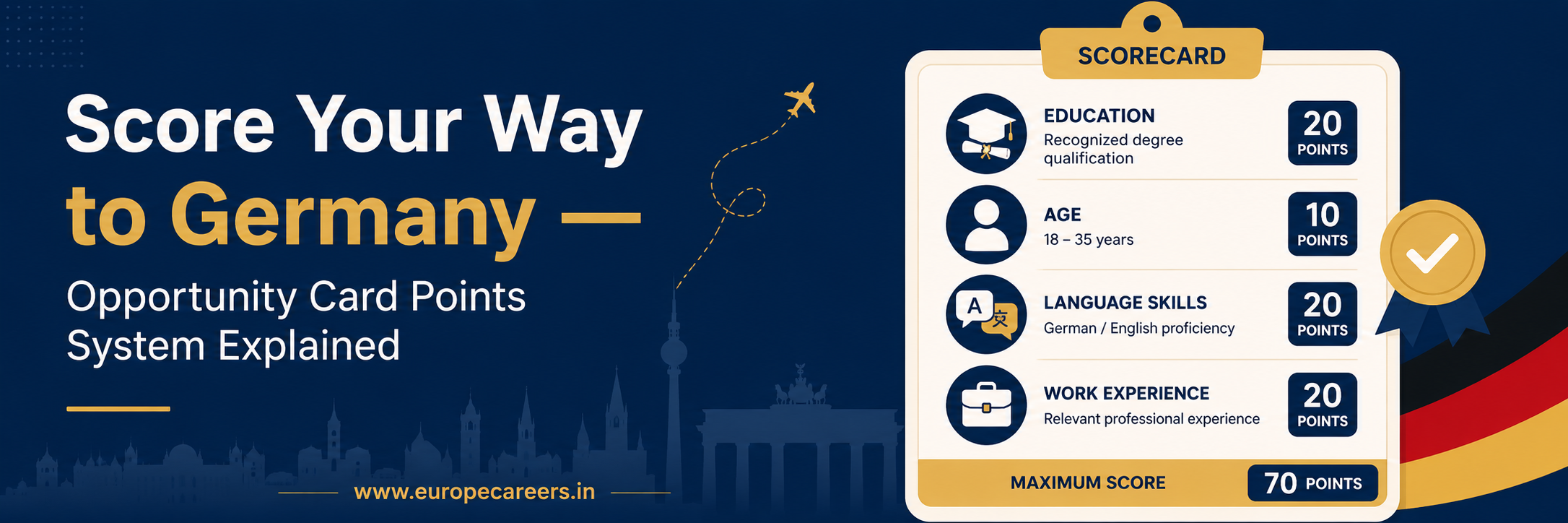
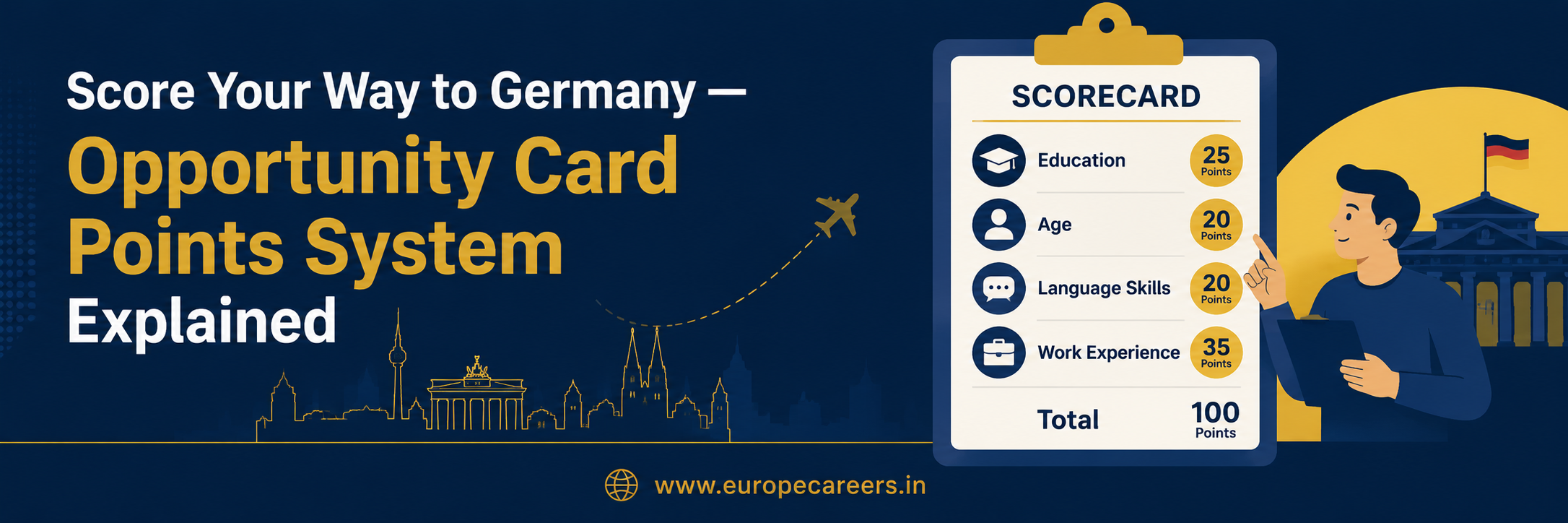 To qualify for the Germany Opportunity Card, you must score a minimum of 6 points from the following criteria:
| Criteria | Points |
|---|---|
| Qualification related to a shortage occupation in Germany | 2 points |
| Work experience of at least 3 years in your field | 1 point |
| Age below 35 years | 2 points |
| Age between 35 and 40 years | 1 point |
| German language skills at A1 level or above | 1 point |
| English language skills at B2 level or above | 1 point |
| Previous stay in Germany (study, work, or training) | 1 point |
| Spouse or partner with a German-recognised qualification | 1 point |
Important: If you hold a fully recognised German-equivalent qualification, you automatically qualify without needing to calculate points.
Who Should Apply for the Germany Opportunity Card?
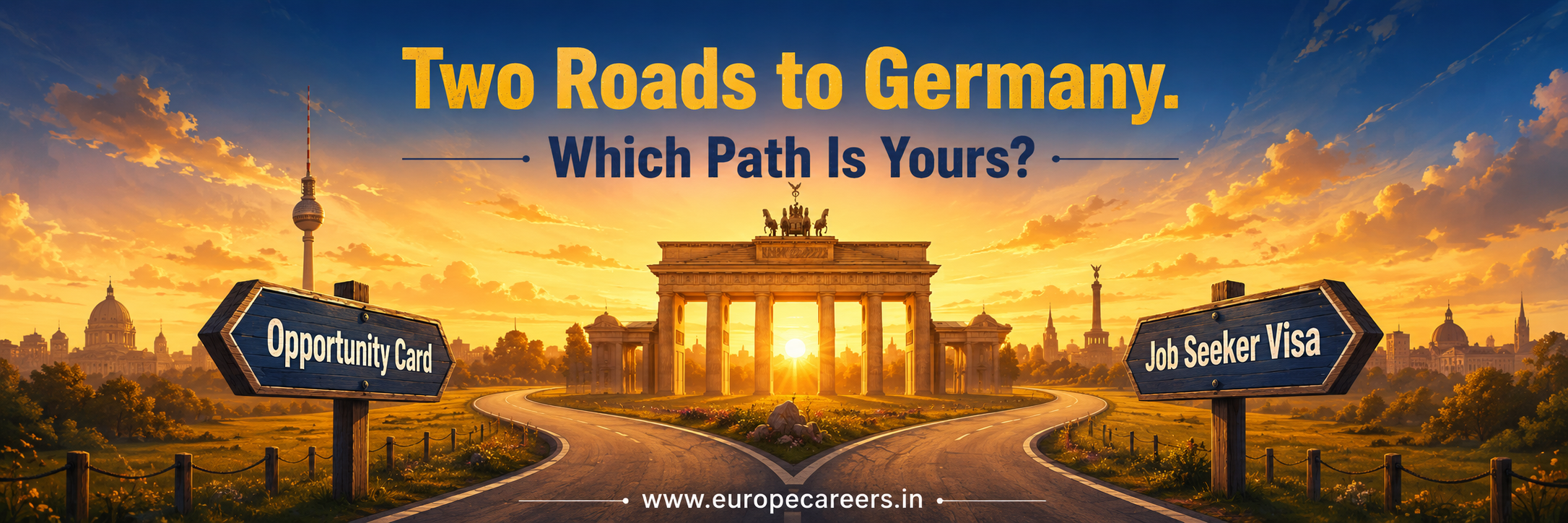 The Opportunity Card is the better choice if you:
- Have a vocational training qualification (not just a university degree)
- Are below 35 years of age and can score points easily
- Want more time — 12 months — to search for a job in Germany
- Want to work part-time (up to 20 hours per week) while job hunting
- Want to do trial work with potential employers for up to 2 weeks
- Do not yet have your foreign degree formally recognised in Germany
- Come from a field listed as a shortage occupation in Germany
Who Should Apply for the Germany Job Seeker Visa?
The Job Seeker Visa is the better choice if you:
- Hold a university degree that is already recognised as equivalent to a German qualification
- Have strong professional experience and are confident of finding a job quickly
- Are applying from a country with a fast German embassy processing time
- Prefer a simpler, older, well-understood visa process
- Do not score enough points for the Opportunity Card
Financial Requirements — What You Need to Prove
Both visas require you to prove that you can financially support yourself during your stay in Germany without working full time.
| Visa | Minimum Funds Required |
|---|---|
| Opportunity Card | Approx. €1,027 per month — around €12,324 for 12 months |
| Job Seeker Visa | Approx. €1,027 per month — around €6,162 for 6 months |
You can show this through:
- A blocked account (Sperrkonto) — most commonly used
- A formal sponsorship letter from a person in Germany
- Proof of sufficient savings in your bank account
Processing Time Comparison
| Visa | Typical Processing Time |
|---|---|
| Opportunity Card | 4 to 12 weeks depending on embassy and country |
| Job Seeker Visa | 4 to 8 weeks depending on embassy and country |
Processing times vary significantly by country. Indian applicants, for example, may experience longer wait times due to high application volumes at German embassies.
What Happens After You Find a Job in Germany?
 Once you find a job in Germany on either visa, the next steps are similar:
- Sign your employment contract with your German employer
- Apply to convert your visa to a Work Permit or EU Blue Card at the local Foreigners Office (Ausländerbehörde)
- Begin working legally in your new role
- After the required period, apply for permanent residency (Niederlassungserlaubnis)
Shortage Occupations in Germany — 2026
Having a qualification in a shortage occupation gives you extra points for the Opportunity Card and significantly improves your job search chances on either visa. Current shortage sectors include:
- Nursing and Healthcare — Extremely high demand
- IT and Software Development — Growing sector
- Engineering — Mechanical, electrical, and civil
- Construction and Trades — Consistent demand
- Logistics and Transport
- Teaching and Education
- Hospitality and Gastronomy
Germany Opportunity Card vs Job Seeker Visa — Which Is Better?
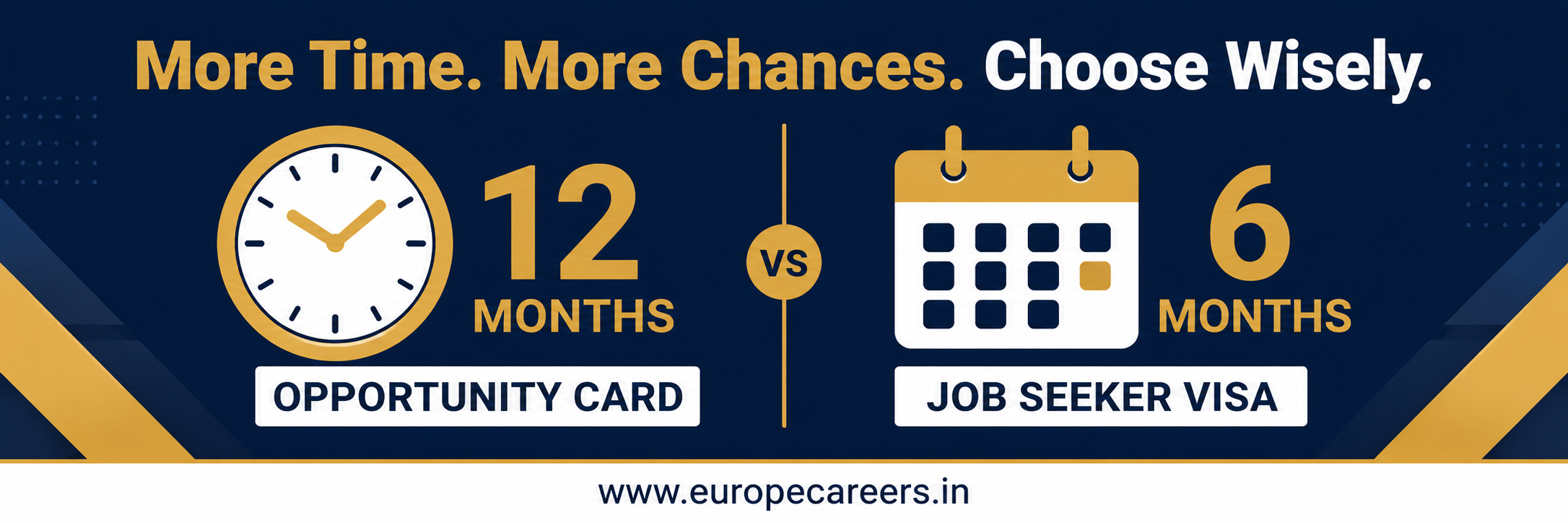 The honest answer is: it depends on your profile.
Choose the Opportunity Card if you have a vocational qualification, want 12 months to find a job, are under 35, or want the flexibility to work part time while searching.
Choose the Job Seeker Visa if you have a fully recognised university degree, strong experience, and want a simpler, faster process with a 6-month timeline.
For most international applicants — especially from India, the Philippines, Nigeria, and other high-volume countries — the Germany Opportunity Card is the stronger and more flexible option in 2026.
Frequently Asked Questions
Q: Can I apply for both the Opportunity Card and Job Seeker Visa at the same time? No. You can only hold one visa at a time. Choose the one that best matches your profile.
Q: Can I bring my family on the Opportunity Card? Family reunion is generally not permitted during the job search phase. Once you convert to a work permit, you can apply for family reunification.
Q: Does the Opportunity Card lead to permanent residency? Not directly. But once you find a job and convert to a work permit or EU Blue Card, you are on the path to permanent residency.
Q: Is the Opportunity Card available for all nationalities? Yes. The Germany Opportunity Card is open to nationals of all non-EU countries who meet the eligibility criteria.
Q: What if I do not find a job within the 12 months? You must leave Germany when your Opportunity Card expires. You can reapply from your home country after a waiting period.
Key Takeaways
- The Opportunity Card is newer, more flexible, and lasts 12 months — ideal for vocational qualification holders and younger applicants
- The Job Seeker Visa is older, stricter, and lasts 6 months — better suited for recognised university degree holders
- Both allow you to enter Germany and search for work without a job offer
- The Opportunity Card allows part-time work and trial employment — the Job Seeker Visa does not
- For most international applicants in 2026, the Opportunity Card is the better choice