
German Language Requirements for Nurses: A1 to B2 Explained
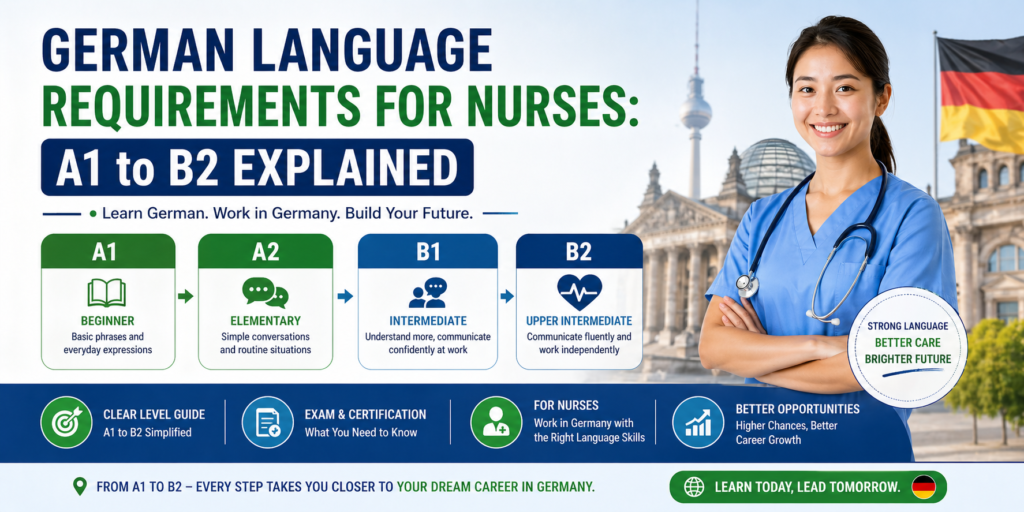
If you’re considering a nursing career in Germany, one critical hurdle stands between you and employment: German language proficiency. Whether you’re pursuing an Ausbildung (apprenticeship), applying for direct nursing positions, or seeking credential recognition, understanding the language requirements—and how to meet them—is absolutely essential. This comprehensive guide breaks down everything you need to know about German language levels from A1 to B2, specifically tailored to nursing professionals.
Table of Contents
- Why German Language Matters for Nursing
- The CEFR Framework Explained
- A1 Level: Complete Beginner
- A2 Level: Elementary
- B1 Level: Lower-Intermediate
- B2 Level: Upper-Intermediate
- Language Requirements by Career Path
- Nursing-Specific Vocabulary
- How to Reach B2 Proficiency
- Testing and Certification
- Common Challenges and Solutions
- Timeline and Planning
Why German Language Matters for Nursing {#why-german-language-matters}
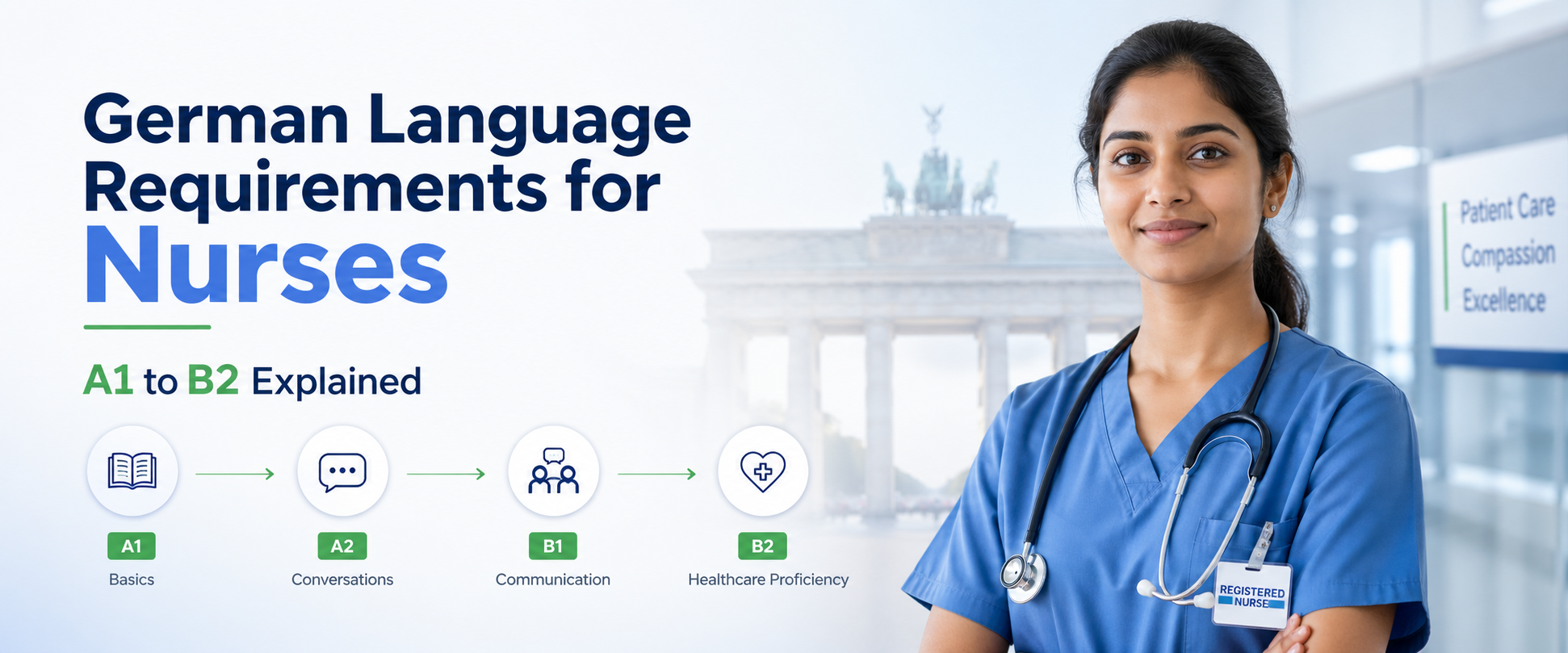 German language proficiency isn’t just a bureaucratic requirement—it’s a matter of patient safety. Nurses communicate daily with patients, doctors, colleagues, and families. A misunderstanding about medication, symptoms, or treatment can have serious consequences. This is why German healthcare employers and regulatory bodies take language requirements seriously.
Beyond patient safety, strong German skills dramatically improve your:
- Job prospects: Employers actively prefer candidates with B2 or higher proficiency
- Integration: You’ll form friendships and understand workplace culture faster
- Career advancement: Management and specialized roles require stronger communication abilities
- Confidence: You’ll feel less stressed navigating healthcare settings
- Salary negotiations: Better German often correlates with higher starting salaries
Germany’s nursing shortage is real—hospitals are actively recruiting—but they won’t compromise on language requirements. According to the German Healthcare Association (Deutscher Pflegerat), patient communication is non-negotiable, making language proficiency a legitimate hiring criterion, not an arbitrary barrier.
The CEFR Framework Explained {#the-cefr-framework}
Before diving into specific levels, you need to understand the Common European Framework of Reference for Languages (CEFR). This standardized system measures language proficiency across all European languages and is recognized internationally.
The CEFR has six levels:
- A1: Complete Beginner
- A2: Elementary/Survival Level
- B1: Lower-Intermediate/Threshold
- B2: Upper-Intermediate/Vantage
- C1: Advanced/Effective Operational Proficiency
- C2: Mastery/Native-like Fluency
For nursing in Germany, you’ll typically need B2 as a minimum for registered nurse positions, though some assistant roles accept B1. Let’s explore what each level means in practical terms.
A1 Level: Complete Beginner {#a1-level}
What A1 Means
A1 is the entry point—the level you start at if you have zero German knowledge. At this level, you can:
- Introduce yourself and basic personal information
- Understand simple, everyday expressions
- Ask for help in very basic situations
- Recognize common words in written form
- Count, tell time, and use basic numbers
- Participate in simple exchanges about familiar topics
Nursing Context at A1
Can you function as a nurse at A1? Absolutely not. A1 is fundamentally insufficient for any healthcare role, including nursing assistant positions. Patient communication would be nearly impossible, and you’d struggle to understand doctor’s orders, medication instructions, or emergency protocols.
A1 Examples in Healthcare
Imagine working at A1 proficiency:
- You understand “Guten Morgen” (good morning) but not patient explanations of symptoms
- You recognize numbers but can’t understand complex dosage instructions
- You can say your name but cannot explain treatment procedures to patients
- You grasp basic phrases but miss critical safety information
- Your comprehension of medical terminology is essentially zero
Typical Duration to Reach A1
Time to complete: 2-4 weeks of full-time study or 2-3 months of part-time study
A1 is typically considered the “quick win” level—fast to reach but insufficient for your goals.
A1 Study Focus
If you’re starting from zero:
- Basic alphabet and pronunciation
- Present tense verb conjugations (fundamental only)
- Common greetings and courtesy phrases
- Numbers 0-100
- Days of the week, months
- Simple personal information (name, age, occupation)
A2 Level: Elementary {#a2-level}
What A2 Means
A2 is the “survival level.” You’ve moved beyond absolute basics and can now handle simple, predictable situations. At A2, you can:
- Have basic conversations about familiar topics
- Understand the main points in simple written and spoken German
- Ask and answer questions about daily activities
- Describe your background, immediate environment, and matters in immediate need
- Fill out basic forms and handle simple written communication
- Understand common medical/health-related words
Nursing Context at A2
Can you function as a nurse at A2? Marginally, and only in the most supportive roles. Some facilities might hire at A2 if you’re also pursuing B1/B2 certification, but full independent nursing practice remains impossible. Patient safety is compromised without deeper language comprehension.
A2 Examples in Healthcare
At A2 proficiency, you might:
- Understand “Der Patient hat Schmerzen” (The patient has pain) and recognize it’s a problem
- Ask simple questions like “Wie geht es Ihnen?” (How are you?)
- Recognize basic medical terms related to body parts (Kopf = head, Arm = arm, Bein = leg)
- Understand simple instructions from supervisors in familiar contexts
- Struggle with complex patient histories or unusual symptoms
- Become confused when conversations deviate from predictable patterns
Typical Duration to Reach A2
Total time (from zero): 6-12 weeks of full-time study or 3-6 months of consistent part-time study
A2 builds on A1 basics, introducing more verb tenses and complex sentence structures.
A2 Study Focus
Building on A1 foundation:
- Past and future tense basics
- Common adjectives and adverbs
- Present perfect tense introduction
- Expanded vocabulary (approximately 1,000-1,500 words)
- Simple medical vocabulary (patient, doctor, hospital, medicine, pain)
- Restaurant, shopping, travel scenarios
- Beginning healthcare-related conversations
B1 Level: Lower-Intermediate {#b1-level}
What B1 Means
B1 is the threshold level—the “lower-intermediate” milestone where language learners can handle many real-world situations independently. At B1, you can:
- Understand the main points of complex German text on familiar topics
- Participate actively in conversations and give your opinion
- Handle most situations encountered while traveling or living in Germany
- Produce connected text on topics of personal interest
- Understand workplace instructions and general conversations
- Deal with unexpected situations in German with reasonable composure
- Write simple emails and messages about familiar topics
Nursing Context at B1
Can you function as a nurse at B1? Yes, but with limitations. Some healthcare employers will hire nursing assistants (Pflegehelfer) or assistants in nursing at B1, particularly if you’re also enrolled in an Ausbildung program that includes continued language development. However, registered nurse positions (Krankenpfleger/in) almost always require B2 minimum.
For Ausbildung programs, B1 is often the entry requirement, with the assumption you’ll reach B2 during your three-year training.
B1 Examples in Healthcare
At B1 proficiency, you could:
- Understand patient conversations about their health history and current symptoms
- Communicate treatment plans and discharge instructions to patients
- Ask clarifying questions when something is unclear
- Participate in team meetings and understand most of what colleagues discuss
- Write basic patient notes or documentation
- Understand doctor’s orders in most situations
- Handle common medical emergencies with scripted knowledge
- Struggle with specialized medical terminology or complex diagnoses
- Feel uncertain about nuanced communication or emotional situations
Realistic B1 Scenario
A B1-level nurse encounters a patient complaining of chest pain. You can:
- Understand the patient is describing chest pain (“Ich habe Brustschmerzen”)
- Ask clarifying questions: “Seit wann?” (Since when?) “Wie intensiv?” (How intense?)
- Recognize this is serious and alert a doctor
- Document the basic complaint in patient notes
- Explain the next steps: “Der Arzt wird gleich kommen” (The doctor will come soon)
However, you might:
- Miss subtle details about radiation of pain or associated symptoms
- Struggle if the patient speaks quickly or uses unfamiliar terms
- Doubt yourself when explaining complex medical procedures
- Feel anxious in high-pressure situations requiring rapid German communication
Typical Duration to Reach B1
Total time (from zero): 3-4 months of full-time intensive study or 8-12 months of consistent part-time study
B1 is a significant milestone—you’ve moved from “survival mode” to “functional communication.”
B1 Study Focus
Building on A2 foundation:
- Complex present and past tenses (Perfekt, Präteritum)
- Conditional statements
- Passive voice introduction
- Medical vocabulary expansion (symptoms, treatments, procedures, medications)
- Healthcare professional communication patterns
- Written German for documentation
- Listening comprehension of longer passages
- Subjunctive mood basics
- Approximately 2,000-2,500 active vocabulary words
- Formal communication in professional settings
B1 Healthcare Vocabulary Examples
Common medical terms nurses use at B1:
- Fieber (fever)
- Blutdruck (blood pressure)
- Puls (pulse)
- Wunde (wound)
- Medikament (medication)
- Diagnose (diagnosis)
- Behandlung (treatment)
- Krankenhaus (hospital)
- Rettungswagen (ambulance)
- Notfall (emergency)
B2 Level: Upper-Intermediate {#b2-level}
What B2 Means
B2 is the “vantage” level and the professional standard for healthcare communication in German-speaking countries. At B2, you can:
- Understand complex texts on a wide range of topics
- Express yourself fluently and spontaneously without needing to search for words
- Participate actively in discussions, expressing views and defending opinions
- Produce clear, detailed text on a variety of subjects
- Understand technical discussions in your field of expertise
- Communicate with fluency and confidence
- Adapt language to different situations and audiences
- Understand subtle meaning, implications, and humor
Nursing Context at B2
Can you function as a nurse at B2? Yes, fully and independently. B2 is the standard requirement for:
- Registered nurse (Krankenpfleger/in) positions
- Direct nursing job applications
- Most Ausbildung nursing programs
- Nursing assistant roles with advancement potential
- Leadership and supervisory nursing roles
- Specialized nursing positions (ICU, emergency, surgical nursing)
- Health professions with patient communication requirements
With B2, you’re not just surviving—you’re thriving. You can handle complex patient interactions, participate fully in team meetings, explain complex procedures, document thoroughly, and manage emergencies with appropriate German communication.
B2 Examples in Healthcare
At B2 proficiency, you could:
- Conduct comprehensive patient assessments and ask nuanced follow-up questions
- Explain complex treatment procedures, surgical preparations, and recovery expectations
- Understand and contribute to rounds and medical consultations
- Document detailed, medically accurate patient notes
- Teach patients about medication side effects, contraindications, and proper use
- Handle difficult conversations with patients and families with empathy and clarity
- Understand and correct misunderstandings immediately
- Participate confidently in professional development and training discussions
- Navigate German healthcare bureaucracy and regulations
- Understand jokes, cultural nuances, and informal workplace communication
Realistic B2 Scenario
A B2-level nurse encounters a post-operative patient with infection concerns. You can:
- Conduct a thorough assessment: “Wie fühlen Sie sich heute Morgen? Haben Sie Fieber gehabt? Können Sie mir die Symptome detailliert beschreiben?”
- Recognize warning signs independently: elevated temperature, wound redness, increased pain
- Explain findings to the doctor: “Der Patient berichtet von Kopfschmerzen, Müdigkeit und die Wundstelle ist geschwollen und warm”
- Educate the patient: “Das ist ein mögliches Zeichen einer Infektion. Wir werden den Arzt informieren und möglicherweise ein Antibiotikum verschreiben”
- Document comprehensively with medical terminology
- Understand the doctor’s response and treatment plan fully
- Answer patient questions about antibiotics, monitoring, and expected recovery timeline
Typical Duration to Reach B2
Total time (from zero): 6-8 months of intensive full-time study or 18-24 months of regular part-time study
Alternatively: Successfully completing a B1 nursing Ausbildung program with German language component
B2 represents a genuine milestone—you’ve crossed from “student of the language” to “professional communicator.”
B2 Study Focus
Building on B1 foundation:
- Advanced grammar structures (subjunctive II, complex tenses)
- Idiomatic expressions and colloquialisms
- Advanced medical terminology and healthcare systems knowledge
- Specialized nursing vocabulary (medications, procedures, equipment)
- Professional documentation skills
- Academic and technical writing
- Persuasion, negotiation, and complex argumentation
- Approximately 3,500-4,000 active vocabulary words
- Passive listening comprehension of fast, native-speed German
- Understanding regional accents and dialects
- Cultural competency in German healthcare settings
- Professional ethics and communication standards
B2 Healthcare Vocabulary Examples
Advanced medical terms nurses use at B2:
- Anamnese (patient history)
- Auskultation (auscultation)
- Palpation (palpation)
- Dekubitus (pressure ulcer)
- Blutung (bleeding)
- Thrombose (thrombosis)
- Infiltrat (infiltrate)
- Applikation (application/administration)
- Antikoagulans (anticoagulant)
- Intravenös (intravenous)
- Prophylaxe (prophylaxis)
- Kontraindikation (contraindication)
- Wechselwirkung (interaction)
Language Requirements by Career Path {#language-requirements-by-path}
Understanding the exact language requirements for your specific path is crucial for planning.
Nursing Ausbildung (3-Year Apprenticeship)
Entry requirement: B2 (C1 preferred by some programs)
Reality: Most programs officially require B2, but some accept high-level B1 with commitment to improve. The theoretical component of the Ausbildung includes German language instruction, so facilities accept candidates at B1 who show potential.
Recommended level: Aim for B2 before applying. The Ausbildung is demanding enough without struggling with language simultaneously.
During Ausbildung: You’ll develop specialized vocabulary and advanced communication skills through practical experience. Many trainees reach C1 level by graduation.
Testing: Some programs require official certification (TELC, Goethe, or ÖSD exams)
Direct Nursing Assistant (Pflegehelfer) Positions
Entry requirement: B1 minimum, B2 preferred
Reality: Some facilities hire at B1, particularly if you have relevant healthcare experience from your home country. However, B2 makes you significantly more competitive.
Testing: Increasingly required, especially in major cities
Registered Nurse (Krankenpfleger/in) Direct Positions
Entry requirement: B2 minimum, C1 for complex specialties
Reality: Non-negotiable. Registered nurse positions involve complex patient communication, documentation, and team interaction. Employers routinely test language proficiency.
Plus credential recognition: You’ll also need to complete the Approbation process (credential recognition), which itself requires B2 German and includes written and oral exams.
Testing: Official exam results required (TELC, Goethe, ÖSD, or TestDaF)
Nursing Management and Supervisory Roles
Entry requirement: C1 preferred, B2 minimum
Reality: Leadership requires not just language proficiency, but cultural competency and persuasion skills. Most healthcare managers have C1.
Specialized Nursing Roles (ICU, Surgery, Emergency)
Entry requirement: B2 minimum, C1 preferred
Reality: Specialized nursing demands rapid communication, understanding complex medical information, and ability to remain calm under pressure. Language must be nearly automatic.
Nursing-Specific Vocabulary {#nursing-vocabulary}
Knowing general German at B2 isn’t enough—you need nursing-specific vocabulary. Here’s a comprehensive breakdown of essential terms organized by context.
Basic Patient Communication
| German | English | Example Usage |
|---|---|---|
| Wie geht es Ihnen? | How are you? | “Wie geht es Ihnen heute Morgen?” |
| Wo tut es weh? | Where does it hurt? | “Wo tut es weh?” |
| Schmerzen | Pain | “Haben Sie Schmerzen?” |
| Fieber | Fever | “Sie haben Fieber von 38,5 Grad” |
| Übelkeit | Nausea | “Haben Sie Übelkeit?” |
| Erbrechen | Vomiting | “Haben Sie erbrochen?” |
| Schwindel | Dizziness | “Haben Sie Schwindel?” |
| Müdigkeit | Fatigue | “Fühlen Sie sich müde?” |
| Appetit | Appetite | “Wie ist Ihr Appetit?” |
| Schlaf | Sleep | “Wie haben Sie geschlafen?” |
Vital Signs and Measurements
| German | English |
|---|---|
| Blutdruck | Blood pressure |
| Puls | Pulse |
| Temperatur | Temperature |
| Atemfrequenz | Respiratory rate |
| Sauerstoffsättigung | Oxygen saturation |
| Gewicht | Weight |
| Größe | Height |
| Körpertemperatur | Body temperature |
Medical Procedures and Treatments
| German | English |
|---|---|
| Injektion | Injection |
| Infusion | Infusion |
| Kathetisierung | Catheterization |
| Wundreinigung | Wound cleaning |
| Verbandswechsel | Dressing change |
| Desinfektion | Disinfection |
| Sterilisierung | Sterilization |
| Operation | Surgery |
| Blutentnahme | Blood draw |
| EKG | EKG |
| Röntgen | X-ray |
| Ultraschall | Ultrasound |
Medications and Pharmaceutical Terms
| German | English | Example |
|---|---|---|
| Medikament | Medication | “Nehmen Sie dieses Medikament” |
| Tablette | Tablet | “Eine Tablette zweimal täglich” |
| Kapsel | Capsule | “Bitte die Kapsel schlucken” |
| Tropfen | Drops | “Fünf Tropfen pro Tag” |
| Spritze | Syringe/Injection | “Die Spritze wird intravenös gegeben” |
| Dosierung | Dosage | “Die Dosierung ist zu hoch” |
| Nebenwirkung | Side effect | “Welche Nebenwirkungen gibt es?” |
| Kontraindikation | Contraindication | “Es gibt eine Kontraindikation” |
| Wechselwirkung | Interaction | “Gibt es Wechselwirkungen?” |
| Allergie | Allergy | “Sind Sie allergisch gegen etwas?” |
| Unverträglichkeit | Intolerance | “Ich habe eine Unverträglichkeit” |
Body Parts and Anatomy
| German | English |
|---|---|
| Kopf | Head |
| Gehirn | Brain |
| Auge | Eye |
| Ohr | Ear |
| Nase | Nose |
| Mund | Mouth |
| Hals | Throat |
| Brust | Chest/Breast |
| Lunge | Lung |
| Herz | Heart |
| Bauch | Abdomen |
| Leber | Liver |
| Niere | Kidney |
| Magen | Stomach |
| Darm | Intestine |
| Arm | Arm |
| Bein | Leg |
| Fuß | Foot |
| Haut | Skin |
| Knochen | Bone |
| Muskel | Muscle |
Common Diseases and Conditions
| German | English |
|---|---|
| Diabetes | Diabetes |
| Bluthochdruck | Hypertension |
| Herzinfarkt | Heart attack |
| Schlaganfall | Stroke |
| Pneumonie | Pneumonia |
| Bronchitis | Bronchitis |
| Asthma | Asthma |
| Angina | Angina |
| Arthritis | Arthritis |
| Arthrose | Osteoarthritis |
| Krebs | Cancer |
| Nierenversagen | Kidney failure |
| Infekt | Infection |
| Gastroenteritis | Gastroenteritis |
| Depression | Depression |
| Angststörung | Anxiety disorder |
Hospital and Workplace
| German | English |
|---|---|
| Krankenhaus | Hospital |
| Klinik | Clinic |
| Pflegeheim | Nursing home |
| Ambulanz | Ambulatory care |
| Notaufnahme | Emergency department |
| Intensivstation | Intensive care unit |
| Operationssaal | Operating room |
| Isolierstation | Isolation ward |
| Stationsleitung | Unit manager |
| Schichtwechsel | Shift change |
| Dienst | Shift/Duty |
| Bereitschaft | On-call |
| Übergabe | Handoff/Report |
| Dokumentation | Documentation |
| Dienstplan | Schedule |
Professional Communication
| German | English | Context |
|---|---|---|
| Untersuchung | Examination | “Ich mache eine Untersuchung” |
| Befund | Finding/Result | “Hier ist der Befund” |
| Diagnose | Diagnosis | “Die Diagnose ist klar” |
| Prognose | Prognosis | “Die Prognose ist gut” |
| Behandlungsplan | Treatment plan | “Hier ist Ihr Behandlungsplan” |
| Pflege | Care | “Die Pflege ist wichtig” |
| Genesung | Recovery | “Ihre Genesung dauert…” |
| Entlassung | Discharge | “Die Entlassung ist morgen” |
| Verlegung | Transfer | “Sie werden auf die andere Station verlegt” |
How to Reach B2 Proficiency {#reaching-b2}
Understanding the levels is one thing; actually reaching B2 is quite another. Here’s a practical roadmap.
Timeline Options
Full-time intensive study: 6-8 months
- 20-30 hours per week classroom instruction
- 10-15 hours per week self-study and homework
- Total investment: 700-900 hours
- Best for: Those who can take time off work, career changers
Part-time evening/weekend study: 18-24 months
- 8-12 hours per week classroom instruction
- 5-10 hours per week self-study
- Best for: Working professionals, those with limited funds
- More gradual but often more sustainable
Intensive + self-study hybrid: 12-15 months
- 8-10 weeks intensive course (bring you to A2/B1)
- 10-12 months sustained part-time study
- Most cost-effective for working professionals
- Combines motivation boost with practicality
Learning Methods and Effectiveness
1. Classroom Instruction (Highly Recommended)
Why it’s essential: Classroom learning provides structure, immediate feedback, and social interaction. You practice speaking with native speakers and teachers trained in language education.
Best platforms:
- Goethe-Institut (Germany’s official cultural institute)
- Highly respected worldwide
- Official exam preparation
- Cost: €800-1,500 per course (4-6 weeks)
- Quality: Excellent
- TELC Language Centers
- Multiple locations across Germany
- Flexible scheduling
- Cost: €600-1,200 per course
- Quality: Excellent
- Volkshochschulen (VHS)
- Public adult education centers across Germany
- Most affordable option
- Cost: €200-400 per course (8-12 weeks)
- Quality: Good to excellent
- Best value for money
- Private Language Schools
- Highly variable quality
- Cost: €500-2,000+ per course
- Research thoroughly before enrolling
2. Self-Study Supplements
Self-study alone won’t get you to B2, but it accelerates progress.
Effective self-study tools:
- Duolingo (A1-B1)
- Cost: Free or €7/month premium
- Time: 15-30 minutes daily
- Best for: Daily reinforcement, vocabulary building
- Limitation: Lacks speaking practice
- Babbel (A1-B2)
- Cost: €7-10/month
- Time: 30-60 minutes per lesson
- Best for: Structured, self-paced learning
- Includes: Interactive lessons, cultural content
- Rosetta Stone (A1-B2)
- Cost: €100-200/month (expensive)
- Immersive methodology
- Best for: Those who learn by immersion
- Limitation: Less explicit grammar instruction
- Pimsleur (A1-B1)
- Cost: $15/month
- Audio-based learning
- Best for: Building listening and speaking skills
- Time: 30 minutes daily
- LingQ (A1-B2)
- Cost: Free-$10/month
- Learning from content (articles, podcasts, videos)
- Best for: Vocabulary building in context
- Limitation: Minimal structured grammar
- YouTube Channels
- Easy German (Free)
- Deutsch mit Marija (Free)
- Slow German (Free, Intermediate)
- Best for: Listening comprehension, cultural insights
3. Language Exchange and Conversation Practice
Critical for B2: You cannot reach B2 without speaking practice.
Methods:
- Tandem Exchange Partners
- Find language exchange partners: Tandem app, Meetup.com, italki
- Cost: Free to €10-15/hour (with tutors)
- Frequency: Aim for 1-2 hours per week
- Benefit: Real conversation with feedback
- Conversation Classes with Native Speakers
- Platforms: iTalki, Verbling, Preply
- Cost: $10-25/hour depending on experience
- Frequency: 2-4 hours per week optimal
- Benefit: Structured feedback, personalized instruction
- Language Meetup Groups
- German language meetups (often free)
- Cost: Free or €2-5 per session
- Where to find: Meetup.com, Facebook groups
- Benefit: Community, motivation, real-world practice
4. Immersion and Real-World Practice
Most powerful accelerator: Moving to Germany or maximizing German exposure
Immersion strategies:
- Move to Germany: Dramatically accelerates progress (6 months of immersion ≈ 18 months of classroom study)
- Work in healthcare settings: Forces German language use and medical vocabulary
- Media immersion: German news, podcasts, movies, books
- German news podcasts (DLF Nachrichten, Langsam Gesprochene Nachrichten)
- German medical TV shows (In aller Freundschaft, Charité)
- German healthcare documentaries
- Online German medical communities: Participate in German healthcare forums (requires B1+)
Specific Study Plan to Reach B2 from A1 (9-Month Timeline)
Months 1-2: A1 Foundation
- Classroom: 12 weeks, 4 hours/week = 48 hours
- Self-study: 30 minutes daily = 30 hours
- Tandem exchange: 1 hour/week = 8 hours
- Total: 86 hours
- Focus: Pronunciation, basic verb conjugations, survival phrases
- Goal: Pass A1 exam (if pursuing certification)
Months 3-4: A2 Elementary
- Classroom: 8 weeks, 5 hours/week = 40 hours
- Self-study: 45 minutes daily = 36 hours
- Tandem exchange: 1.5 hours/week = 12 hours
- Focus: Past tense, expanded conversations, elementary medical terms
- Total: 88 hours
Months 5-6: B1 Lower-Intermediate
- Classroom: 8 weeks, 6 hours/week = 48 hours
- Self-study: 1 hour daily = 48 hours
- Conversation practice: 2 hours/week = 16 hours
- Medical vocabulary focus: Medical texts, healthcare videos
- Total: 112 hours
- Goal: Pass B1 exam
Months 7-9: B2 Upper-Intermediate
- Classroom: 12 weeks, 4 hours/week = 48 hours (advanced grammar, specialized vocabulary)
- Self-study: 1.5 hours daily = 72 hours (including medical reading)
- Conversation practice: 3 hours/week = 36 hours
- Total: 156 hours
- Focus: Professional communication, medical terminology, exam preparation
- Goal: Pass B2 exam, develop professional confidence
Total investment: ~442 hours of formal instruction + 186 hours self-study = 628 hours Cost estimate (Volkshochschule): €1,200-1,800 Alternative cost (intensive course + tutoring): €2,500-4,000
Testing and Certification {#testing-certification}
Official certification isn’t always legally required, but it’s increasingly expected, especially for:
- Direct nursing positions
- Ausbildung program applications
- Credential recognition (Approbation)
- EU work permits in some countries
- Employer hiring preferences
Major German Language Certifications
Goethe-Institut Exams
Most prestigious worldwide recognition
- A1-B2 levels available
- Cost: €80-150 per exam
- Recognition: Universally accepted in Germany and internationally
- Difficulty: Rigorous; ensures genuine proficiency
- Validity: Lifelong
- Components: Reading, writing, listening, speaking
B2 exam details:
- Reading comprehension: 75 minutes
- Listening comprehension: 40 minutes
- Written expression: 75 minutes
- Speaking: 15 minutes (interview format)
- Total time: ~3.5 hours
- Passing score: 60% on all sections
TELC (The European Language Certificates)
German most popular choice for B2
- A1-B2+ levels available
- Cost: €70-150 per exam
- Recognition: Highly respected in Germany
- Difficulty: Practical, real-world focus
- Validity: Lifetime
- Components: Reading, writing, listening, speaking
TELC B2 specifics:
- More practical than Goethe
- Lower cost than Goethe
- Faster scheduling (multiple test dates per month)
- Good option for healthcare professionals (practice tests available)
ÖSD (Österreichisches Sprachdiplom)
Austrian standard, respected in Germany
- A1-B2 levels available
- Cost: €90-130 per exam
- Recognition: Accepted throughout German-speaking countries
- Strength: Strong emphasis on practical communication
- Validity: Lifetime
TestDaF
Primarily for university entrance, increasingly for nursing
- Levels: B2-C1 only (not A1-B1)
- Cost: €235 per exam (most expensive option)
- Recognition: International, professional level
- Used for: Credential recognition (Approbation), some nursing programs
- Difficulty: Challenging; tests advanced proficiency
TestDaF exam structure:
- Listening: 100 points
- Reading: 100 points
- Writing: 100 points
- Speaking: 100 points
- Total: 400 points
- Passing: 200+ points (TDN 3 equivalent to B2)
Which Certification Should Nurses Choose?
For Ausbildung application: TELC B2 or Goethe-Institut B2
- Cost-effective
- Widely recognized
- Practical focus
- Recommendation: TELC (faster scheduling, slightly lower cost)
For direct nursing positions: TELC B2 or TestDaF
- Both universally accepted
- TELC for faster processing
- TestDaF if you want C1-level recognition
- Recommendation: TELC B2 (faster, less expensive than TestDaF)
For Approbation (credential recognition): TestDaF or Goethe-Institut C1
- Some recognize B2 with specific scores
- TestDaF increasingly preferred for official recognition
- Recommendation: Check specific Approbation requirements in your target Bundesland (state)
Exam Preparation Timeline
From B1 to B2 exam-ready: 8-12 weeks
- Official practice tests: Essential (purchase from test providers)
- Mock exams: 1-2 weeks before actual exam
- Focused writing/speaking practice: 4-6 hours/week
- Vocabulary review: Daily 30-minute sessions
Cost Summary for Testing
| Exam | Cost | Validity | Best For |
|---|---|---|---|
| TELC B2 | €100-150 | Lifetime | Nursing jobs, Ausbildung |
| Goethe B2 | €120-150 | Lifetime | Prestige, universality |
| TestDaF | €235 | Lifetime | Credential recognition |
| ÖSD B2 | €100-130 | Lifetime | Austrian-German recognition |
Common Challenges and Solutions {#challenges-solutions}
Most nurses pursuing B2 German encounter similar obstacles. Here’s how to overcome them.
Challenge #1: “German Grammar is Extremely Difficult”
The problem: German has complex grammar—four cases (Nominativ, Akkusativ, Dativ, Genitiv), three genders (masculine, feminine, neuter), and numerous verb tenses. Learners often feel overwhelmed by exceptions.
Why it happens: English is relatively simple grammatically. German’s inflectional system seems counterintuitive to English speakers.
Solutions:
- Focus on patterns, not rules: Rather than memorizing all case rules, recognize patterns. The accusative case (Akkusativ) marks direct objects. The dative case (Dativ) marks indirect objects. Learn these concepts rather than memorizing lists.
- Use grammar in context: Don’t study grammar in isolation. Learn sentences where grammar matters. “Ich gebe dem Patienten die Tablette” (I give the patient the tablet) teaches case usage in context.
- Accept imperfection: B2 doesn’t require perfect grammar. Native speakers forgive case mistakes. Focus on communication clarity over grammatical perfection.
- Spaced repetition: Use Anki (flashcard app) for systematic review of difficult grammar patterns. 10 minutes daily beats 2 hours weekly.
- Work with a tutor: For 4-6 weeks, invest in a German tutor (€15-25/hour on iTalki) to clarify confusing grammar points. This accelerates understanding.
Challenge #2: “Medical Vocabulary Is Endless”
The problem: Healthcare has thousands of specialized terms. You can’t possibly learn them all, creating anxiety about preparedness.
Why it happens: Every procedure, medication, and condition has specific terminology. Legitimate concern.
Solutions:
- Prioritize by frequency: Learn the 200 most common medical terms first. 80% of healthcare communication uses ~20% of available vocabulary.
- Learn word families: Medical German uses many Latin-based roots. Learning “Inflamm-” (inflammation) helps you understand dozens of terms: Entzündung (inflammation), Magenentzündung (gastritis), Hirnhautentzündung (meningitis).
- Create healthcare-specific flashcards: Rather than general German vocab apps, build cards focused on your specialty (ICU, surgery, pediatrics, etc.).
- Immerse in healthcare media: Watch German medical dramas (In aller Freundschaft), read healthcare news (Pflegezeitschrift), listen to medical podcasts. You’ll encounter vocabulary in context.
- Workplace mentoring: Once working in a German healthcare setting, ask colleagues for terminology explanations. Real colleagues are patient teachers.
- Medical glossaries: Purchase or access German-English medical glossaries specific to your specialty.
Challenge #3: “I Understand German but Can’t Speak Fluently”
The problem: Passive comprehension (understanding) often outpaces active production (speaking). You understand your German instructor but freeze when answering.
Why it happens: Speaking requires faster processing than listening. Anxiety and pressure increase hesitation.
Solutions:
- Speaking practice is non-negotiable: Allocate 50% of study time to speaking (conversation classes, tandem exchanges, language meetups). Listening and reading can’t build speaking skills.
- Think-aloud exercises: Narrate your daily activities in German, even alone. “Ich nehme eine Dusche. Das Wasser ist warm. Ich wasche meine Haare.” (I’m taking a shower. The water is warm. I’m washing my hair.) Builds confidence and fluency.
- Embrace mistakes: Speaking errors are learning opportunities. Native speakers make mistakes too. Fluency (talking without long pauses) matters more than accuracy at B2.
- Reduce cognitive load: Before conversations, prepare key phrases. Knowing 10-15 pre-planned sentences reduces anxiety and allows more natural conversation flow.
- Record yourself: Use your phone to record speaking practice. Listening back highlights pronunciation and fluency issues.
- Conversation classes specifically: Invest in conversation-focused classes rather than grammar-heavy courses. You need time to speak, not time listening to explanations.
Challenge #4: “German Accents and Regional Dialects Confuse Me”
The problem: Different regions of Germany speak differently. Swiss German (Schweizerdeutsch) is nearly a separate language. Bavarian (Bairisch) dialect is hard to follow.
Why it happens: Even native German speakers from different regions struggle with each other’s dialects.
Solutions:
- Focus on standard German first: Master Hochdeutsch (standard German) before worrying about dialects. Most formal settings use standard German anyway.
- Healthcare uses standard German: Hospitals use relatively standardized German regardless of region. Medical communication is formal.
- Accept that you’ll need adjustment time: Even B2 speakers spend their first weeks adjusting to regional accents. This is normal and temporary.
- Exposure over time: Regular immersion in a region helps you attune to local speech patterns. After 4-6 weeks in Bavaria, you’ll understand Bavarian German much better.
- Don’t let dialects derail you: If you don’t understand a dialectal phrase, ask clarification in standard German. Bavarians understand standard German perfectly.
Challenge #5: “Working Full-Time While Learning German Is Overwhelming”
The problem: Many aspiring nurses work while learning German, creating exhaustion and slow progress.
Why it happens: Economic necessity or visa requirements force combined study and work.
Solutions:
- Accept slower progress: Part-time study (12-24 months to B2) is still progress. Consistency beats intensity.
- Micro-learning: Instead of hour-long study sessions, commit to 30-minute daily sessions. These are easier to sustain long-term.
- Integrate German into existing routines:
- Commute: Listen to German podcasts instead of music
- Lunch breaks: Complete one Duolingo lesson
- Evenings: Watch 20 minutes of German TV instead of scrolling
- Weekends: One conversation class or language meetup
- Workplace German advantage: Working in any customer-facing role accelerates German learning. Use work as practice.
- Employer support: Many German employers support language learning. Ask about paid language courses or flexible scheduling for classes.
- Study smarter, not harder: Use active recall and spaced repetition (Anki) rather than passive review. This requires less total time.
Challenge #6: “German Healthcare Setting Expects Fluency I Don’t Have”
The problem: You begin a nursing job before fully reaching B2, creating stress and potential errors.
Why it happens: Employment needs don’t always align with language readiness. Some start before they’re fully prepared.
Solutions:
- Transparency with employers: Be honest about your current level. Ask for mentoring, slower speech, written instructions, or patient assignments that don’t require extensive German initially.
- Buddy system: Request to work alongside experienced colleagues who can translate, clarify, and provide real-time feedback.
- Create a glossary: Write down new medical terms daily. Review every evening. You’ll surprise yourself how quickly you build healthcare vocabulary.
- Use visual aids: Photos, diagrams, and medical illustrations transcend language barriers. Use them to communicate when words fail.
- Written communication: Don’t hesitate to write something down when speaking feels too risky. Nurses often write in patient charts anyway.
- Continued formal study: Don’t abandon language classes when you start working. Continue part-time study to close gaps.
- Give yourself grace: Most German healthcare professionals understand that nursing is learned, and language is learned. They’re patient with effort.
Timeline and Planning {#timeline-planning}
Realistic Timeline Expectations
Here’s what you need to know about timing:
Absolute minimum time to B2: 6 months of full-time intensive study (40+ hours/week) More realistic full-time: 8-10 months Part-time (10-15 hours/week): 18-24 months Part-time while working full-time: 24-36 months
Backwards Planning: When Do You Need B2?
For Ausbildung starting September 2025:
- Application deadline: Usually January 2025
- B2 certification needed: By application (6 months before start)
- Start learning: January 2024 for January 2025 application
- Timeline: 12-month intensive or 18-month part-time
For direct nursing job starting immediately:
- Need B2 before applying
- Job search: Usually 2-3 months after B2 certification
- Start learning: 8-10 months before desired start date
For Approbation credential recognition:
- Language exam usually required: TestDaF or B2+ certification
- Total timeline: B2 study (8-10 months) + Approbation process (6-12 months) = 14-22 months to working as registered nurse
12-Month B2 Learning Plan (Full-Time Intensive)
Months 1-2: Foundation (A1)
- Language school: 4 hours/week × 8 weeks = 32 hours
- Self-study: 1 hour daily = 60 hours
- Total: 92 hours
- Goal: A1 certification
- Focus: Fundamentals, confidence building
Months 3-4: Elementary (A2)
- Language school: 5 hours/week × 8 weeks = 40 hours
- Self-study: 1 hour daily + 3 hours weekly conversation = 95 hours
- Total: 135 hours
- Goal: A2 certification
- Focus: Expand vocabulary, past tense, conversation confidence
Months 5-6: Lower-Intermediate (B1)
- Language school: 6 hours/week × 8 weeks = 48 hours
- Self-study: 1.5 hours daily + 4 hours weekly conversation = 130 hours
- Medical vocabulary focus begins
- Total: 178 hours
- Goal: B1 certification, begin professional communication
Months 7-9: Upper-Intermediate (B2)
- Language school: 6 hours/week × 12 weeks = 72 hours
- Self-study: 2 hours daily (including medical texts) + 5 hours weekly conversation = 150 hours
- Healthcare-specific instruction: 2 hours weekly = 24 hours
- Total: 246 hours
- Goal: B2 certification
- Focus: Professional German, medical terminology, exam preparation
Months 10-12: Consolidation & Specialization
- Language school: 3 hours/week × 12 weeks = 36 hours
- Self-study: 1.5 hours daily (healthcare focus) = 90 hours
- Conversation practice: 3 hours weekly = 36 hours
- Total: 162 hours
- Goal: B2+ fluency, professional confidence, specialized knowledge
- Focus: Exam prep, healthcare communication, cultural competency
12-month total: 813 hours formal + self-study investment
Budget Planning
Full-time intensive approach:
| Item | Cost |
|---|---|
| Language school (Volkshochschule, 48 weeks) | €1,200-1,800 |
| Self-study materials (books, apps, software) | €300-500 |
| Conversation tutoring (iTalki, 50 hours @ €12/hour) | €600 |
| Exam fees (B1 + B2) | €250-300 |
| Medical German course (specialized) | €400-600 |
| Total | €2,750-4,200 |
Cost-saving version:
| Item | Cost |
|---|---|
| Volkshochschule (most courses) | €800-1,200 |
| Free resources (YouTube, Duolingo, Meetups) | €0 |
| One tandem exchange partner | €0 |
| B2 exam only (skip B1) | €100-150 |
| Total | €900-1,350 |
Questions to Ask Before Starting
- Can I commit 25+ hours/week for 8-12 months? (Full-time learning requires this)
- Do I have €1,500-4,000 to invest? (Financial commitment is real)
- Can I move to Germany or access German immersion? (Dramatically accelerates progress)
- Do I have healthcare experience in my native language? (Helps with medical terminology transfer)
- Am I prepared for initial frustration? (A1-A2 can feel like slow progress)
- Will a German employer support my learning? (Some provide courses or flexible scheduling)
Conclusion: Your Path to German Proficiency in Healthcare
Reaching B2 German proficiency for nursing in Germany is absolutely achievable. It’s not easy, but it’s entirely within your control. Thousands of international nurses have done it before you; you can too.
Your success depends on:
- Choosing the right learning method for your lifestyle
- Committing to consistent practice, especially speaking
- Investing sufficient time, understanding the timeline
- Seeking certification to validate and formalize your proficiency
- Staying motivated through inevitable plateaus and challenges
The good news: German healthcare providers understand language learning. They’re actively recruiting. They’re willing to mentor and support. What they need is genuine effort and commitment from you—demonstrated through achieving B2 certification.
Start today. In 8-12 months, you could be working as a nurse in Germany, communicating confidently with patients, colleagues, and supervisors. Patient safety demands it. Your career advancement requires it. Your success depends on it.
The journey from A1 to B2 is long, but it leads to one of Europe’s most rewarding healthcare systems. German nurses are respected, well-compensated, and work in world-class facilities. Your German language proficiency unlocks all of that.
Begin your journey to B2 this week.
Quick Reference: Language Levels Summary
| Level | Patient Communication | Healthcare Function | Nursing Role | Time to Achieve (from A1) |
|---|---|---|---|---|
| A1 | Impossible | Cannot work | None | 4-8 weeks |
| A2 | Basic greetings only | Minimal support roles | Unlikely | 12-16 weeks |
| B1 | Simple conversations | Assistant positions possible | Nursing assistant | 3-4 months |
| B2 | Fluent professional | Full independent practice | Registered nurse, Ausbildung | 6-10 months |
| C1 | Fluent, nuanced | Specialized/management | Management, specialists | 12-18 months |
Further Resources
- Goethe-Institut: https://www.goethe.de
- TELC Language Tests: https://www.telc.net
- Volkshochschulen Directory: https://www.volkshochschule.de
- Slow German Podcast: https://www.langsamgesprochenenachrichten.de
- Easy German YouTube Channel: https://www.youtube.com/c/EasyGerman
- German Medical Terminology: https://www.medizinische-deutsche.de
- iTalki Tutoring Platform: https://www.italki.com
- Anki Flashcard App: https://apps.ankiweb.net