Ausbildung vs Direct Nursing Jobs in Germany – Which is Better?
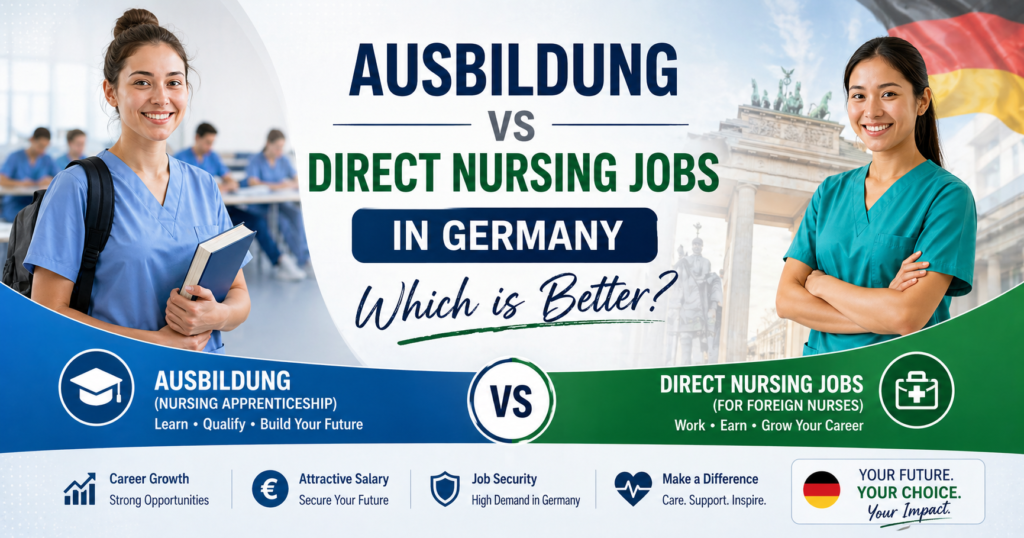
Germany’s healthcare system is renowned for its excellence, and it’s no surprise that nursing has become one of the most attractive career paths for both domestic and international professionals. If you’re considering a nursing career in Germany, you’ve likely encountered two main entry routes: pursuing an Ausbildung (apprenticeship) or applying directly for nursing positions with existing qualifications. But which path is right for you? Let’s break it down.
Understanding the Two Paths
What is Ausbildung?
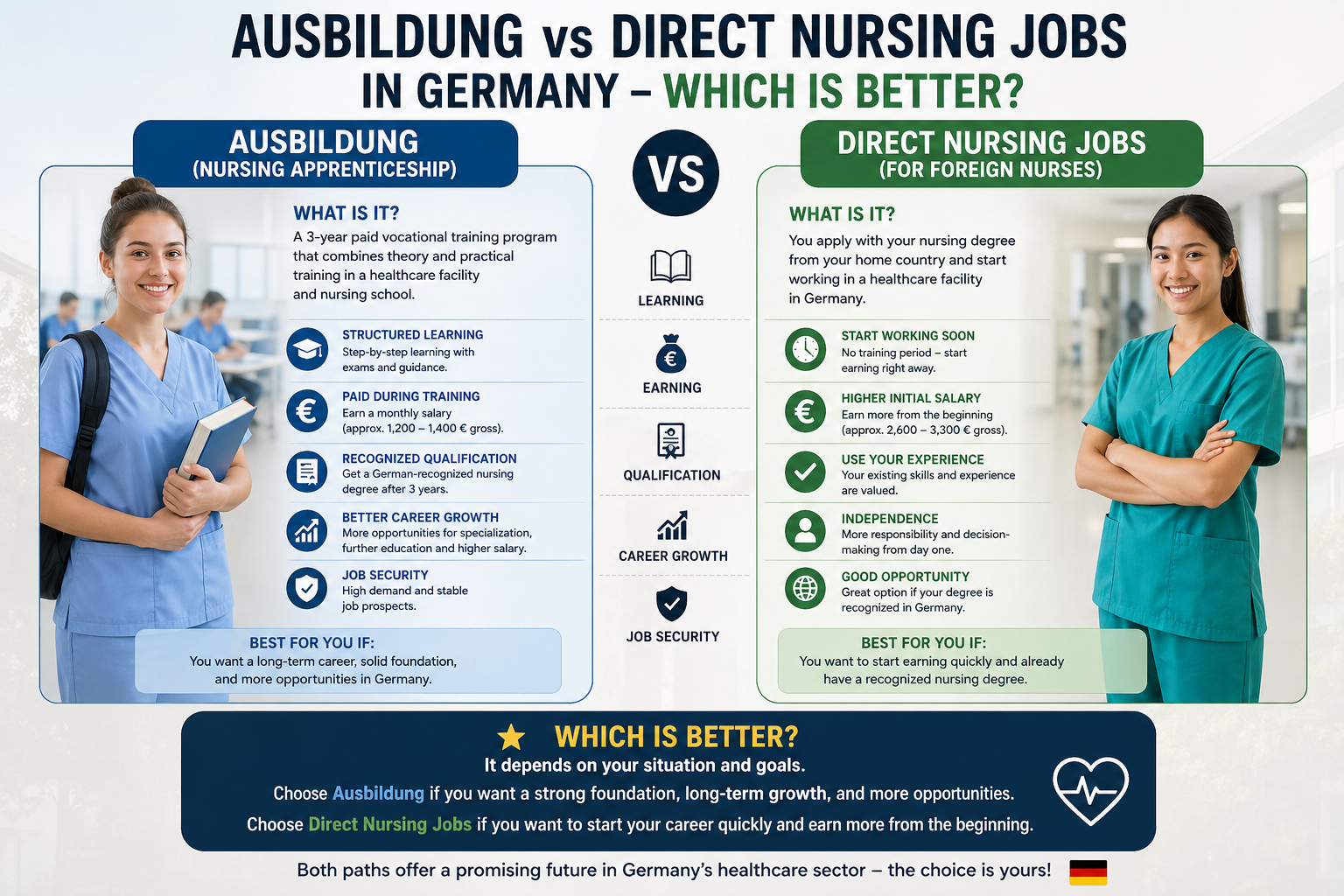
An Ausbildung is a formal, structured apprenticeship program that combines theoretical classroom learning with practical, on-the-job training. In nursing, this typically lasts three years and is offered by hospitals, care facilities, and training centers across Germany. The program is regulated by the Pflegeberufsgesetz (Nursing Care Professions Act), ensuring standardized quality across the country.
Upon completion, you receive a nationally recognized qualification that’s valued throughout Germany and increasingly across Europe.
Direct Nursing Jobs: An Alternative Route
Direct nursing positions are available for those who already hold nursing qualifications from their home country or another German institution. These roles range from entry-level nursing assistant positions to registered nurse (Krankenpfleger/in) roles, depending on your credentials.
The Ausbildung Advantage
1. Formal Recognition and Career Security
The Ausbildung qualification is legally recognized throughout Germany and the entire EU. This translates to job security and the ability to work anywhere in the German healthcare system without worrying about credential disputes or additional certifications.
If you’re an international candidate, completing an Ausbildung in Germany ensures your qualification is never questioned—a significant advantage over bringing foreign qualifications, which may require additional validation through the Approbation process.
2. Comprehensive Training
German apprenticeships are known for their thoroughness. During your Ausbildung, you’ll gain:
- Theoretical knowledge covering anatomy, physiology, pharmacology, and patient care principles
- Practical skills in real healthcare settings with experienced mentors
- Soft skills development, including communication, teamwork, and emotional resilience
- Exposure to diverse settings, from hospitals to nursing homes to rehabilitation centers
This holistic approach creates nurses who are not just technically competent but also psychologically prepared for the demands of the profession.
3. Paid Training
Unlike many apprenticeships in other countries, German nursing Ausbildung participants typically receive a monthly stipend (usually €500–€900 for starting trainees). This makes it financially accessible and acknowledges that you’re contributing meaningful work to healthcare facilities.
4. Structured Career Progression
After completing your Ausbildung, there’s a clear pathway for advancement:
- Registered Nurse (Gesundheits- und Krankenpfleger/in)
- Specialized nurse roles (e.g., ICU, pediatrics)
- Nursing management and leadership positions
- Further education opportunities (Bachelor’s and Master’s degrees)
5. Strong Employer Support
Healthcare facilities that offer Ausbildung programs often invest in their trainees’ development. Many facilities provide mentoring, professional development support, and a clear intention to hire graduates—reducing uncertainty about post-qualification employment.
The Direct Nursing Job Advantage
1. Faster Market Entry
If you hold a valid nursing qualification, you can often begin working within months rather than waiting three years. For those with pressing financial needs or those already with substantial experience, this is a major advantage.
2. Immediate Income
Starting a direct nursing job means immediate, full salary. German registered nurses earn between €2,200 and €3,200 gross monthly (depending on experience, facility, and region), compared to the apprentice stipend.
3. Experience-Based Progression
Experienced nurses from other countries often bring valuable skills and perspectives. In direct positions, your prior experience is recognized and compensated accordingly, with the potential for faster advancement to senior roles.
4. Flexibility for Career Changers
If you’ve already built a career elsewhere, jumping directly into a nursing role allows you to apply your professional maturity and possibly bring interdisciplinary skills to the healthcare setting.
The Challenges You Should Know About
 Ausbildung Challenges
 Ausbildung Challenges
- Time commitment: Three years is a significant investment, especially if you’re relocating from abroad
- Language requirements: Most programs require B2 German proficiency (some accept C1)
- Competitive entry: Depending on your country of origin, the application process can be rigorous
- Lower initial salary: The apprentice stipend, while helpful, is modest compared to qualified nurse salaries
Direct Nursing Job Challenges
- Credential recognition complexity: International qualifications often require validation through the Approbation process, which can be lengthy and costly (typically €500–€2,000)
- Language barriers: Even with a nursing degree, B2/C1 German proficiency is essential for patient safety and job applications
- Limited availability in some regions: Direct positions may be harder to find outside major cities
- Integration pressure: You may face higher expectations to “catch up” to German nursing standards if your training differs significantly
The Financial Picture
Let’s compare the financial reality:
Ausbildung Route (3 years)
- Monthly stipend: €500–€900
- Total earned during training: €18,000–€32,400
- Salary after qualification: €2,300–€2,800 (first-year registered nurse)
Direct Job Route (starting immediately)
- Salary from month one: €1,800–€2,200 (assistant level) or €2,500–€3,200 (registered nurse)
- Must invest in qualification recognition: €500–€2,000
- Potential to reach €3,000+ within 2–3 years with experience
For most people, the direct job route offers better financial returns in the short to medium term. However, the Ausbildung provides better long-term job security and higher ceiling earnings once fully established.
Language and Integration Considerations
Both paths require strong German language skills:
- Ausbildung: B2 minimum (many providers prefer C1)
- Direct nursing jobs: B2 minimum for assistant roles; C1 preferred for registered nurse positions
If you’re not yet at B2, the Ausbildung might actually be advantageous, as many programs include German language support and immersion that accelerates fluency. A direct job is challenging without strong language skills because patient safety depends on clear communication.
The Credential Recognition Factor
This deserves special attention. Germany respects qualifications earned within its borders far more than foreign credentials. If you have a nursing degree from outside Germany:
- You’ll need to complete the Approbation (state licensing) process
- This can take 3–12 months and may require additional exams
- Some qualifications are easier to recognize than others (EU degrees generally smoother than non-EU)
By contrast, an Ausbildung completed in Germany sidesteps this entire process.
So, Which Is Better?
Choose Ausbildung if:
- You’re building a career from the ground up in Germany
- You value job security and long-term stability
- You want unquestionable credential recognition
- You’re willing to invest three years for a strong foundation
- You want structured mentoring and professional development
- You’re not fluent in German yet (the program includes language support)
Choose a Direct Nursing Job if:
- You already hold a recognized nursing qualification
- You need immediate income
- Your foreign credential is easily recognized (especially if EU-based)
- You have significant prior healthcare experience
- You’re located in or willing to relocate to a major hiring hub
- You’re confident in your German language abilities
A Hybrid Perspective
Many successful healthcare professionals in Germany actually combine both approaches. Some work directly in healthcare roles (perhaps as nursing assistants) while simultaneously pursuing an Ausbildung. This provides:
- Immediate income
- Real-world experience
- Faster pathway to becoming a registered nurse
- Employer support for formal training
Some employers actively support this dual track, allowing flexible scheduling so employees can complete formal qualifications while working.
The Future of Nursing in Germany
Germany faces a significant nursing shortage, with an estimated shortage of 200,000 nurses by 2030. This means:
- Job security is exceptionally high for qualified professionals
- Both Ausbildung graduates and experienced direct hires are in demand
- Salaries are likely to increase further
- Opportunities for specialization and advancement are abundant
The shortage actually works in your favor regardless of which path you choose—German healthcare facilities are actively recruiting.
Making Your Decision
Before deciding, ask yourself:
- What’s my timeline? (immediate income vs. long-term stability)
- What are my qualifications? (existing nursing credentials vs. career changer)
- How confident am I in German? (influences which route is feasible)
- What’s my financial situation? (can I afford three years at apprentice stipend?)
- Where do I want to work? (specific regions or facility types?)
- What’s my long-term career vision? (specialist roles, leadership, teaching?)
The Bottom Line
There’s no universally “better” choice—it depends on your personal circumstances. However, if you’re starting from scratch as an international candidate without German healthcare qualifications, the Ausbildung is often the stronger long-term choice. It eliminates credential recognition issues, provides comprehensive training tailored to German standards, and creates clear pathways for advancement.
For those with existing nursing qualifications and strong German language skills, direct nursing jobs offer faster entry and immediate earnings, provided your credentials can be recognized.
The good news? Germany’s healthcare sector is booming. Whichever path you choose, you’re entering a field with genuine job security, competitive salaries, and meaningful career development opportunities. The key is to make an informed decision based on your unique situation—and then commit fully to your chosen path.
Useful Resources
- Pflegeberufsgesetz (German Nursing Care Professions Act): Official regulations for nursing training
- Approbation: Information on credential recognition at www.anerkennung-in-deutschland.de
- BAMF (Federal Office for Migration and Refugees): Language courses and integration support
- DGB (German Trade Union Federation): Healthcare worker rights and salary information
- RbP (Registered Nurses Association): Professional networking and career guidance
Start your nursing journey in Germany today—both paths lead to rewarding careers in one of Europe’s most advanced healthcare systems.