
Ausbildung in Germany: Complete Guide for International Students (2026)
Ausbildung in Germany: Complete Guide for International Students (2026)
Introduction: A Smarter Way to Build Your Future in Germany
Let’s be honest — studying abroad is expensive. Tuition fees, living costs, and the uncertainty of finding a job after graduation can be overwhelming. But what if there was a way to live and work in Germany, earn a monthly salary while you train, and still build a long-term career there?
That’s exactly what Ausbildung in Germany offers.
Ausbildung (pronounced “ows-bil-doong”) is Germany’s world-famous vocational training system, and it’s quietly becoming one of the most practical and sought-after pathways for international students and young professionals. Every year, thousands of people from India, Pakistan, the Philippines, Nigeria, Nepal, and across the world are choosing Ausbildung over a traditional university degree — and for very good reasons.
In this guide, we’re going to break down everything you need to know about Ausbildung in Germany in 2026 — from what it actually is, to how to apply, how much you’ll earn, and what your life looks like after you complete it. No fluff. Just everything you need to make an informed decision.
What is Ausbildung in Germany?
Ausbildung literally means “education” or “training” in German, but in practice, it refers to Germany’s dual vocational training system. It’s a government-regulated program where you train for a specific profession by splitting your time between a company (practical training) and a vocational school (theoretical knowledge).
Think of it as learning on the job — but in a highly structured, officially recognized way.
Unlike internships or casual work programs, Ausbildung leads to a nationally recognized qualification. Once you complete it, your certification is valid across Germany and is respected throughout the European Union.
There are over 325 officially recognized Ausbildung professions in Germany — ranging from IT specialists and mechatronics engineers to healthcare workers, chefs, and banking professionals. So whether you’re interested in technology, healthcare, or hospitality, there’s likely an Ausbildung path for you.
For international students, Ausbildung in Germany is particularly attractive because it gives you a legal pathway to enter the German labor market, earn while you learn, and eventually build permanent residency.
Types of Ausbildung in Germany
 Before you apply, it helps to understand that there are two main types of vocational training in Germany:
1. Dual Ausbildung (Duales Ausbildungssystem)
This is the most common and widely recognized type. In the dual system, you split your time between:
- A company or employer — where you gain hands-on practical experience (3–4 days per week)
- A Berufsschule (vocational school) — where you study the theory behind your profession (1–2 days per week)
The dual system is especially popular in technical, IT, healthcare, and trade professions. Your employer pays your salary throughout the training period, which means you’re not paying to study — you’re earning while you learn.
2. School-Based Ausbildung (Schulische Ausbildung)
This type takes place entirely within a vocational school or specialized institution. It’s more common in social care, healthcare, and certain creative fields.
The downside? School-based programs don’t always come with a salary, though some do offer a training allowance. For international students on a budget, the dual system is generally the more financially attractive option.
Benefits of Doing Ausbildung in Germany
Here’s why Ausbildung in Germany stands out compared to other study-abroad options:
You earn while you train. Unlike a university degree where you’re only spending money, Ausbildung pays you a monthly training salary (more on exact amounts below). This significantly reduces your financial burden.
Strong job security. Germany is facing a severe skilled worker shortage — particularly in IT, healthcare, and engineering. Companies are actively recruiting internationally because there simply aren’t enough local candidates. If you complete your Ausbildung, your chances of getting hired afterward are genuinely high.
Pathway to permanent residency (PR). This is huge. After completing your Ausbildung and working for two years in your trained profession, you become eligible to apply for a permanent settlement permit in Germany. This is one of the most reliable PR pathways available.
Recognized qualification. Your Ausbildung certificate is a government-regulated, nationally recognized qualification. It’s not just a company certificate — it carries real weight in the German job market.
Free or subsidized healthcare and social benefits. During Ausbildung, you’re considered an employee. That means you’re covered by Germany’s health insurance system, social security, and pension contributions — the employer covers a significant part of this.
No tuition fees. The Berufsschule (vocational school) part of your training is free. All you need is a training contract with a company.
Eligibility Criteria for Ausbildung in Germany
Now let’s talk about what you actually need to qualify. This is where many students have questions, so let’s go through it clearly.
Educational Qualification
Most Ausbildung programs require at least a completed secondary school education (equivalent to 10th or 12th grade). For more technical programs, a higher secondary qualification is preferred. You’ll need to get your certificates officially recognized or evaluated — a process known as credential recognition in Germany.
German Language Skills
This is non-negotiable for most programs. You will need at least B1 level German, and many employers — especially in healthcare and customer-facing roles — require B2 level or higher.
A few programs in IT and hospitality accept candidates with B1, but don’t count on it. The more German you know, the better your chances of landing a good training contract. If you haven’t started learning German yet, enrolling in a German Language Course (A1 to B2) should be your first step. (See our guide: German Language Course for Ausbildung — How to Prepare)
Age
There’s no official upper age limit for Ausbildung, but practically speaking, most applicants fall between 17 and 35 years old. Companies are open to mature applicants, especially in fields with high shortages.
Health Requirements
Some professions — particularly in healthcare, nursing, and physical trades — may require a health fitness certificate. This is checked at the time of the training contract.
Work Permit / Visa Eligibility
Non-EU nationals must hold a valid Ausbildung visa or be in the process of obtaining one. We’ll cover the visa process in detail below.
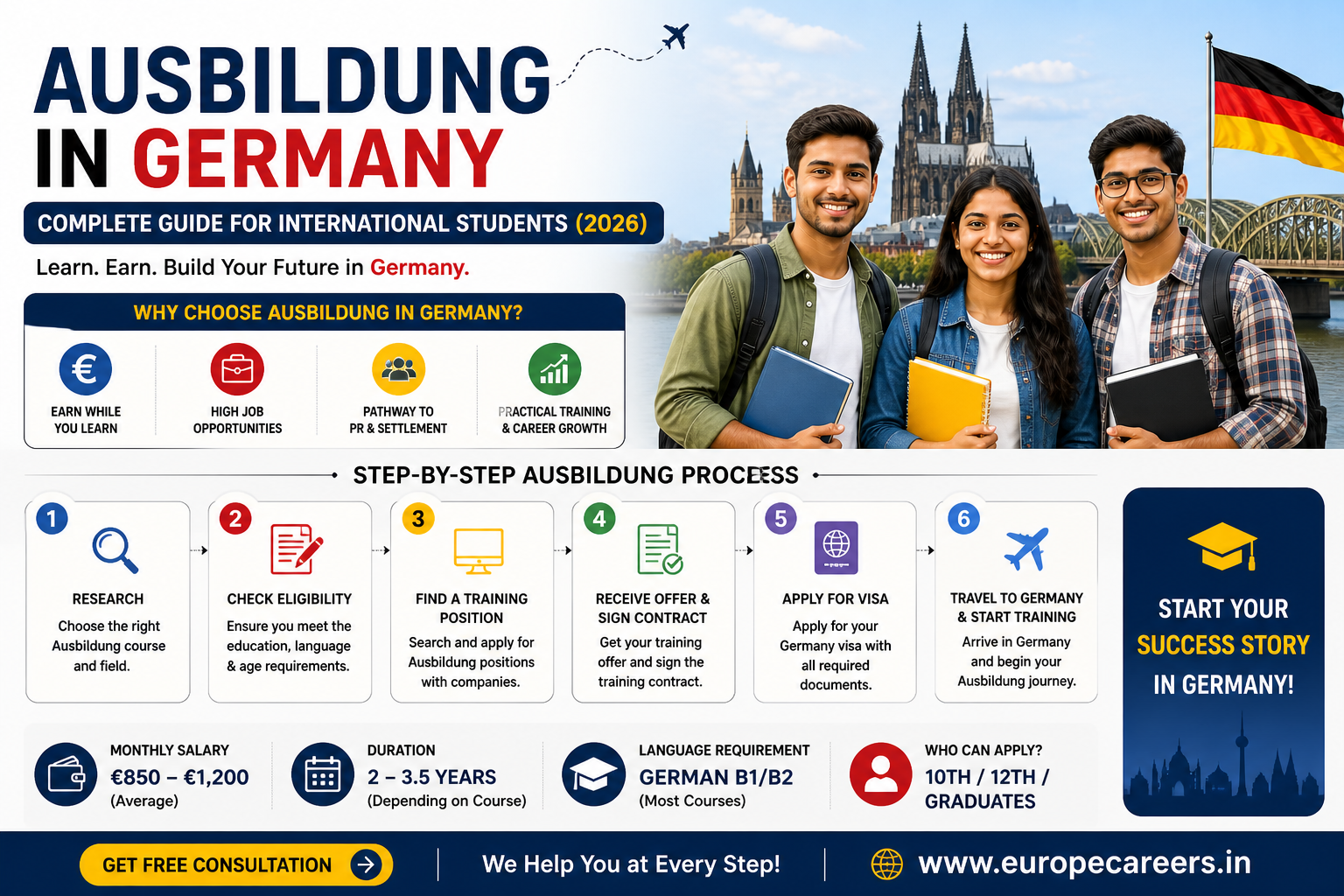
Step-by-Step Application Process for Ausbildung in Germany
Here’s a practical, honest breakdown of how the application process works:
Step 1: Choose Your Profession Research which Ausbildung field suits your interests, qualifications, and German language level. Use the Federal Employment Agency’s (Bundesagentur für Arbeit) BERUFENET database to explore recognized professions.
Step 2: Reach the Required German Level Enroll in a German language course and aim for B1 or B2 before applying. This is often the biggest bottleneck for international applicants, so start early.
Step 3: Get Your Documents Ready Typical documents include:
- School/university transcripts (translated and certified)
- Language certificate (Goethe-Institut, telc, or ÖSD)
- CV in German (Lebenslauf) in European format
- Motivation letter in German
- Passport copy
- Credential recognition documents (if required)
Step 4: Search and Apply for Training Positions Apply directly to companies via platforms like:
- Ausbildung.de
- Make it in Germany (www.make-it-in-germany.com)
- LinkedIn and company career portals
- Bundesagentur für Arbeit job portal
Apply to multiple companies simultaneously. Competition can be high in popular fields, so don’t put all your eggs in one basket.
Step 5: Interviews and Assessment Tests Most companies conduct a telephone or video interview in German, and some require a written aptitude test. Prepare for basic math, comprehension, and job-specific questions.
Step 6: Sign Your Ausbildungsvertrag (Training Contract) If selected, you’ll receive an official training contract. This is the document that enables you to apply for your Ausbildung visa.
Step 7: Apply for Your Visa Submit your visa application to the German embassy or consulate in your country (details in the visa section below).
Step 8: Move to Germany and Begin Training Once your visa is approved, you arrange your accommodation, register your address (Anmeldung), open a bank account, and begin your Ausbildung.
Ausbildung Salary and Cost Breakdown
Let’s talk money — because this is what most people want to know.
Ausbildung Salary in 2026
Germany introduced a statutory minimum training salary. In 2026, the minimum is approximately €649–€700 per month in the first year of training. This increases each subsequent year. However, many companies — particularly in IT, banking, and engineering — pay significantly more.
Here’s a rough breakdown by sector:
- IT (Fachinformatiker): €800 – €1,200/month
- Banking and Finance: €900 – €1,100/month
- Mechatronics/Engineering: €700 – €1,000/month
- Healthcare/Nursing: €1,000 – €1,200/month (after recent reforms)
- Hospitality/Chef: €600 – €900/month
- Retail/Business Administration: €600 – €850/month
These are training salaries — not full employment wages. Once you’re fully qualified and employed, your salary increases significantly.
Monthly Cost Breakdown
Here’s what you can realistically expect to spend per month in Germany as an Ausbildung student:
- Rent (shared apartment/WG): €300 – €600
- Food: €150 – €250
- Transport (monthly ticket): €50 – €100
- Health insurance (your share): €80 – €150
- Miscellaneous: €100 – €150
Total estimated monthly expenses: €700 – €1,200
Depending on your salary and location (smaller cities are cheaper), many Ausbildung trainees cover most or all of their living costs from their training salary alone. In higher-paying fields like IT or nursing, you’ll actually have money left over.
Top Ausbildung Courses in Germany for International Students
These are the most in-demand and recommended Ausbildung fields in 2026:
1. Fachinformatiker (IT Specialist) One of the most popular choices. Specializations include application development and system integration. High demand, great pay, and many companies conduct this training partly in English.
2. Pflegefachmann/frau (Nursing Specialist) Germany has a massive shortage of nursing professionals. Healthcare Ausbildung pays well (especially post-2020 reforms) and almost guarantees employment. B2 German is strongly recommended here.
3. Mechatroniker (Mechatronics Engineer) Combines mechanics, electronics, and computing. Perfect for students with a technical background. Strong salary and huge demand in Germany’s manufacturing sector.
4. Kaufmann/Kauffrau für Büromanagement (Office Management) A versatile business administration program. Good for those interested in office work, HR, or customer relations. Widely available across industries.
5. Elektroniker (Electrician / Electronics Technician) Essential trades with consistent demand. Good pay and strong job security, especially in construction and industrial sectors.
6. Koch (Chef / Culinary Specialist) Ideal for those passionate about food and hospitality. Germany’s hospitality sector actively recruits internationally.
7. Bankkaufmann/frau (Banking Specialist) Excellent for finance-minded students. Germany’s banking sector values thoroughness and reliability — skills that international candidates often bring.
(Related reading: Study and Work in Germany — Your Complete 2026 Guide)
Visa Process for Ausbildung in Germany
Non-EU nationals need a Vocational Training Visa (Ausbildungsvisum) to pursue Ausbildung in Germany. Here’s what the process looks like:
Required Documents
- Valid passport (at least 6 months validity beyond your intended stay)
- Signed Ausbildungsvertrag (training contract) from your German employer
- Proof of German language proficiency (B1/B2 certificate)
- Academic transcripts and certificates (translated and certified)
- Credential recognition letter (if applicable)
- Proof of accommodation in Germany
- Proof of health insurance
- Financial proof or sponsorship letter (if required)
- Biometric passport photos
- Completed visa application form
Process Timeline
- Booking the appointment: Embassy appointments can take 4–12 weeks to schedule, depending on your country. Book early.
- Visa processing time: Typically 6–12 weeks after submission, though it can vary.
- After arrival: Once in Germany, you’ll receive a residence permit for the duration of your training from the local immigration office (Ausländerbehörde).
Important: Apply for your visa well in advance of your training start date. Delays are common, and your employer will need to know your expected arrival date.
Career Opportunities After Ausbildung in Germany
Completing your Ausbildung in Germany opens up more than just a job — it opens up a life.
After graduation, most Ausbildung trainees receive a permanent job offer from the same company where they trained. That alone is a major advantage. German companies invest heavily in their trainees and often prefer to hire from within.
Beyond your first job, the career trajectory looks like this:
Immediate employment: Most qualified professionals find work within weeks or months of completing their Ausbildung, especially in high-demand fields.
Salary jump: Your salary after qualification is considerably higher than your training salary. IT professionals, for instance, can earn €35,000–€50,000+ per year as a starting salary after their Ausbildung.
Further education (Weiterbildung): After your Ausbildung, you can pursue advanced qualifications like a Meister (master craftsman), Techniker (technical specialist), or even a university degree through Germany’s Studium mit Ausbildung pathway. Some universities grant degree-eligible students direct entry if they have completed vocational training.
Permanent Residency (PR): Work for two years in your qualified profession after Ausbildung → apply for the Niederlassungserlaubnis (permanent settlement permit). It’s one of the clearest PR routes available in Germany.
EU Freedom of Movement: With German PR or citizenship, you gain access to work and live across the European Union.
Common Mistakes to Avoid When Applying for Ausbildung
From experience working with hundreds of students, here are the mistakes that hold people back:
Applying before reaching B1/B2 German. This is the single biggest reason applications get rejected. Don’t rush the language part.
Sending a generic CV and motivation letter. German companies expect a formal, structured Lebenslauf and a specifically tailored motivation letter. A template pulled from Google won’t cut it.
Applying to only one or two companies. The application process is competitive. Apply to 10–20 companies simultaneously.
Ignoring the credential recognition process. Some fields — especially healthcare and engineering — require official recognition of your foreign qualifications. Start this process early; it can take months.
Underestimating the cost of the pre-departure phase. Language courses, document translation, visa fees, and flights add up. Plan your finances carefully.
Missing visa appointment windows. Embassy slots fill up fast. As soon as you have a training contract signed, start the visa process.
Why Working with a Consultancy Makes the Difference
Here’s something students rarely hear: the biggest obstacle isn’t your qualifications or even your German level — it’s knowing where to look and how to present yourself correctly to German employers.
German application culture is different. The format of your CV, the tone of your motivation letter, the way you prepare for an interview — all of it is specific and unfamiliar to most international applicants. Getting these things wrong can cost you months of effort.
This is where a reliable, experienced consultancy like Europe Careers genuinely adds value. Rather than navigating this complex process alone — figuring out credential recognition, preparing German-format documents, finding legitimate training vacancies, and managing visa paperwork — you work with people who have done this for many students before you and know the process inside out.
Europe Careers supports international students at every stage: from German language preparation to employer matching, document preparation, visa guidance, and pre-departure support. If you’re serious about pursuing Ausbildung in Germany, having expert guidance at your side isn’t a luxury — it’s a practical investment in getting it right the first time.
(Explore: How Europe Careers Helps You Get Your Ausbildung Training Contract)
Frequently Asked Questions (FAQs)
Q1: Can I do Ausbildung in Germany without knowing German? Most Ausbildung programs require at least B1 level German, and many employers prefer B2. A few English-based programs exist in IT and hospitality, but they are limited. It is strongly recommended to reach B2 before applying.
Q2: What is the minimum salary during Ausbildung in Germany? Since 2024, Germany has set a statutory minimum Ausbildung salary. In 2026, this starts at approximately €649–€700/month in the first year, increasing each year. Many companies pay significantly more, especially in IT, banking, and engineering sectors.
Q3: Can Ausbildung lead to permanent residency in Germany? Yes. After completing your Ausbildung and working in Germany for two years in your trained profession, you can apply for a permanent settlement permit (Niederlassungserlaubnis). This is one of the most reliable PR pathways in Germany.
Q4: What is the age limit for Ausbildung in Germany? There is no official upper age limit for Ausbildung. However, most applicants are between 17 and 35. Companies generally welcome mature candidates, especially in sectors facing skilled worker shortages.
Q5: How long does Ausbildung take to complete? Ausbildung programs typically last between 2 and 3.5 years depending on the profession. Some programs can be shortened if you already have relevant qualifications or prior experience.
Q6: Do I need a visa to do Ausbildung in Germany as an international student? Yes, non-EU students need a specific Ausbildung visa (vocational training visa) to pursue vocational training in Germany. EU citizens do not require a visa. The visa process involves submitting your training contract, proof of language skills, and financial documentation.
Q7: What are the most in-demand Ausbildung fields in Germany? The most in-demand fields include IT (Fachinformatiker), nursing and healthcare, mechatronics, electrical engineering, hotel and hospitality management, and banking. IT and healthcare roles consistently see the highest demand and offer strong starting salaries.
Conclusion: Is Ausbildung in Germany Right for You?
If you’re looking for a way to build a real career in Germany — one that pays you while you train, leads to a recognized qualification, and puts you on the path to permanent residency — Ausbildung is genuinely one of the best options available right now. The demand for skilled workers is only growing, the salary is livable, and the long-term opportunities are real.
Yes, it requires effort. You’ll need to learn German seriously. You’ll need to prepare your documents properly and go through a structured application process. But for students who are willing to put in that work, the reward is a stable, fulfilling life in one of Europe’s strongest economies.
The best time to start planning was yesterday. The second best time is right now.
Ready to take the next step?
At Europe Careers, we help international students find legitimate Ausbildung training positions in Germany, prepare application documents, and navigate the entire visa process — from start to finish. Our team has helped students from India, Pakistan, Nepal, Nigeria, the Philippines, and beyond successfully begin their careers in Germany.
Contact Europe Careers today for a free consultation and find out which Ausbildung program is the right fit for you. Don’t navigate this alone — let experts who know the German system guide you every step of the way.